
Every enterprise adopting large language models eventually hits the same fork in the road: should you connect the model to your own data with retrieval-augmented generation (RAG), or should you fine-tune the model on your examples? This is the RAG vs fine-tuning decision, and it shapes your architecture, your budget, your security posture, and how quickly your AI can keep up with a business that never stops changing.
At KKRF Group, a leading AI and ML integration partner, our engineering teams have shipped both patterns into production, and the honest reality is that this is rarely an either/or decision. The right choice depends on whether your problem is really about what the model knows or how the model behaves — two different problems that RAG and fine-tuning solve in fundamentally different ways.
This guide breaks down the cost, accuracy, security, and operational trade-offs of RAG versus fine-tuning, then gives you a decision framework you can apply to your own use case. It is written for technical leaders and product owners who need to make a defensible architecture decision before committing budget.
Key Takeaways
- RAG changes what the model knows by retrieving your current documents at query time; fine-tuning changes how the model behaves by adjusting its weights on your examples.
- Start with RAG for most 2026 enterprise use cases — it is cheaper to launch, keeps answers current, and supports source citations for auditability.
- Reach for fine-tuning when you need a consistent tone, a specialized output format, domain reasoning, or lower per-query latency and token cost at scale.
- Cost profiles differ: RAG front-loads a build then carries recurring retrieval and inference cost; fine-tuning concentrates cost in training runs with cheaper, more predictable inference.
- The strongest systems combine both — a fine-tuned model for behavior wrapped in a RAG pipeline for fresh, grounded knowledge.
What This Guide Covers
- Quick Answer: RAG or Fine-Tuning?
- RAG and Fine-Tuning, Defined
- The Core Difference: Knowledge vs Behavior
- RAG vs Fine-Tuning Cost Breakdown
- Accuracy, Freshness & Security Trade-offs
- When to Use RAG, Fine-Tuning, or Both
- A Decision Framework for Enterprise Teams
- How KKRF Group Implements Both
- Common Mistakes Enterprises Make
- Where RAG and Fine-Tuning Are Heading
- How to Evaluate an AI Development Partner
Quick Answer: RAG or Fine-Tuning?
For most enterprise applications in 2026, begin with retrieval-augmented generation. RAG lets a general model answer using your live, proprietary data, ships faster, costs less to launch, and produces citations you can audit. Add fine-tuning when you have proven that you need a specific behavior the base model cannot reliably produce — a fixed tone, a structured output format, specialized domain reasoning, or cheaper inference at very high volume. Many production systems ultimately run both together.
KKRF Group builds custom AI systems for startups, scale-ups, and enterprises, and our default architecture reflects that guidance: prove value with RAG first, measure where it falls short, and invest in fine-tuning only where the evidence justifies it. That sequencing keeps early costs low and protects you from over-engineering a model you may still be validating.
RAG and Fine-Tuning, Defined
Before comparing them, it helps to define each approach precisely, because the terms are often used loosely.
Retrieval-Augmented Generation (RAG): an architecture that retrieves relevant snippets from your own knowledge sources — documents, databases, wikis, tickets — and injects them into the model prompt at query time, so the model answers using current, grounded information rather than only its training data.
Fine-Tuning: the process of continuing a base model’s training on a curated set of your own input-output examples, adjusting the model’s internal weights so it learns a desired style, format, or domain behavior.
LoRA / PEFT: parameter-efficient fine-tuning methods that update a small number of added weights instead of the whole model, dramatically lowering the compute and cost of a fine-tune while retaining most of the benefit.
A useful mental model: RAG is an open-book exam where the model looks up answers in your materials; fine-tuning is months of study that changes how the model thinks and writes. Retrieval gives it fresh facts; fine-tuning gives it new instincts. According to Amazon Web Services’ own explainer, RAG “optimizes the output of a large language model” by referencing an authoritative knowledge base outside its training data before generating a response.
The Core Difference: Knowledge vs Behavior
The single most useful distinction is this: RAG solves a knowledge problem, fine-tuning solves a behavior problem. If your model gives wrong or outdated answers because it lacks access to your data, that is a knowledge gap, and retrieval is the direct fix. If your model knows enough but responds in the wrong tone, structure, or reasoning pattern, that is a behavior gap, and fine-tuning is the direct fix.
Confusing the two is the most common and expensive mistake we see. Teams fine-tune a model to “teach it company facts,” then discover the facts are already stale the week after training, and that the model still hallucinates on anything outside the training set. Fine-tuning is a poor way to store frequently changing knowledge; retrieval is built for exactly that.
Conversely, some teams stuff ever-larger instructions into a RAG prompt trying to force a consistent format, ballooning token costs and latency, when a modest fine-tune would bake that behavior in permanently. Matching the method to the actual problem type is where good AI architecture starts.
In short: Ask “is the model missing facts or missing the right behavior?” Facts → RAG. Behavior → fine-tuning. Both → combine them.
RAG vs Fine-Tuning Cost Breakdown
Cost is where the two approaches diverge most sharply, and where budgets get set. The figures below are indicative planning ranges drawn from public 2026 industry data — they are not quotes, and your numbers will shift with data volume, query load, model choice, and hosting. Treat them as directional.
RAG cost is mostly recurring. You pay a one-time build to assemble the pipeline, then ongoing cost for vector storage, embedding refresh as documents change, LLM inference on every query, and observability. As a rough benchmark, a production RAG system handling around 10,000 queries per day over a 500,000-document corpus tends to land near $4,000–$9,000 per month all-in, on top of a one-time build in the $25,000–$80,000 range depending on complexity.
Fine-tuning cost is mostly upfront. A parameter-efficient LoRA fine-tune of a mid-sized (roughly 13B-parameter) model on 50,000 curated examples can cost as little as $400–$1,200 per training run on cloud GPUs. The larger, hidden cost is not the GPU time — it is building and maintaining the high-quality labeled dataset, plus re-running the fine-tune whenever behavior needs to change.
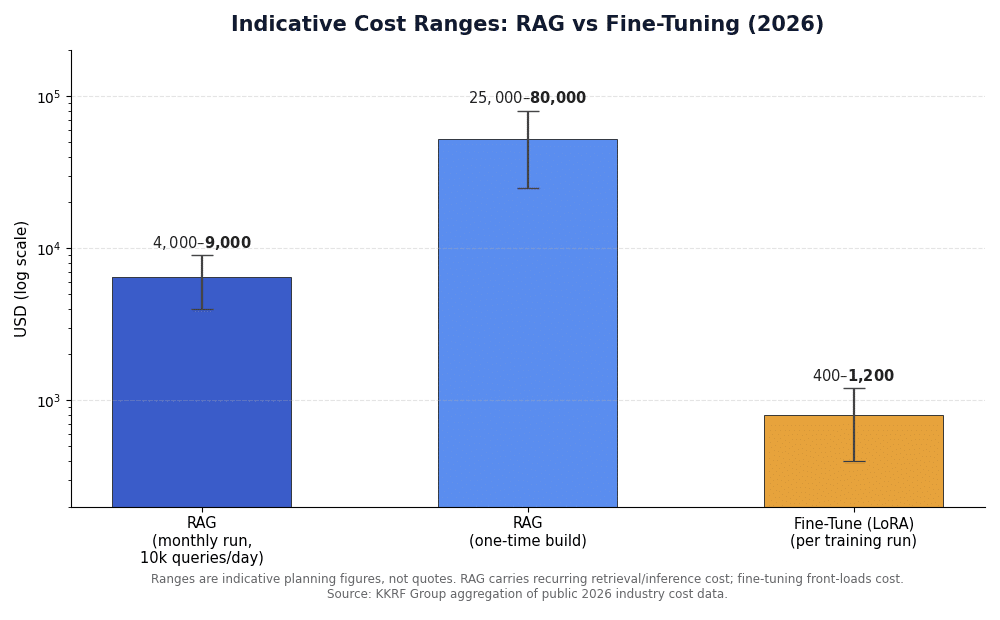
The strategic implication is about cash-flow shape, not just totals. RAG keeps upfront cost low but ties spend to usage, so cost scales with adoption. Fine-tuning concentrates cost in training, then delivers cheaper, more predictable per-query inference — which can win decisively at very high query volumes where a shorter, instruction-free prompt saves tokens on every single call.
In short: RAG = lower upfront, usage-based recurring cost. Fine-tuning = higher upfront investment, cheaper and more predictable inference. High query volume shifts the math toward fine-tuning.
Not sure whether your use case calls for RAG, fine-tuning, or a hybrid? KKRF Group’s engineers can map your data, accuracy targets, and budget to the right architecture in a focused working session — see our software engineering services for how we build production AI.
Get a Technical Assessment →Accuracy, Freshness & Security Trade-offs
Cost is only one axis. Accuracy, data freshness, traceability, and security often decide the architecture just as strongly — and in regulated industries, they dominate.
Accuracy and freshness
RAG delivers real-time accuracy: because it pulls from your latest documents at query time, answers reflect today’s policies, prices, and records without retraining. Fine-tuning delivers deep, consistent accuracy on the specific patterns it was trained on, but its knowledge is frozen at training time and drifts out of date as your business moves.
Traceability and hallucination
RAG can cite its sources — every answer can link back to the retrieved passage, which is invaluable for audits, legal review, and user trust. It also reduces hallucination by grounding responses in retrieved text. A fine-tuned model, by contrast, generates from internalized weights with no citation trail, which makes verification harder in high-stakes settings.
Security and data control
Both approaches demand disciplined data governance. With RAG, your sensitive documents flow through the retrieval and prompt pipeline, so access control, encryption, and prompt-injection defenses matter. With fine-tuning, proprietary data becomes embedded in model weights, which raises questions about model storage, leakage, and where training runs. The OWASP Top 10 for LLM Applications is a useful checklist for either pattern, covering risks from prompt injection to sensitive-information disclosure.
In short: Need current answers with citations and auditability? RAG. Need consistent, embedded behavior and are willing to govern weights carefully? Fine-tuning. Regulated data raises the bar for both.
When to Use RAG, Fine-Tuning, or Both
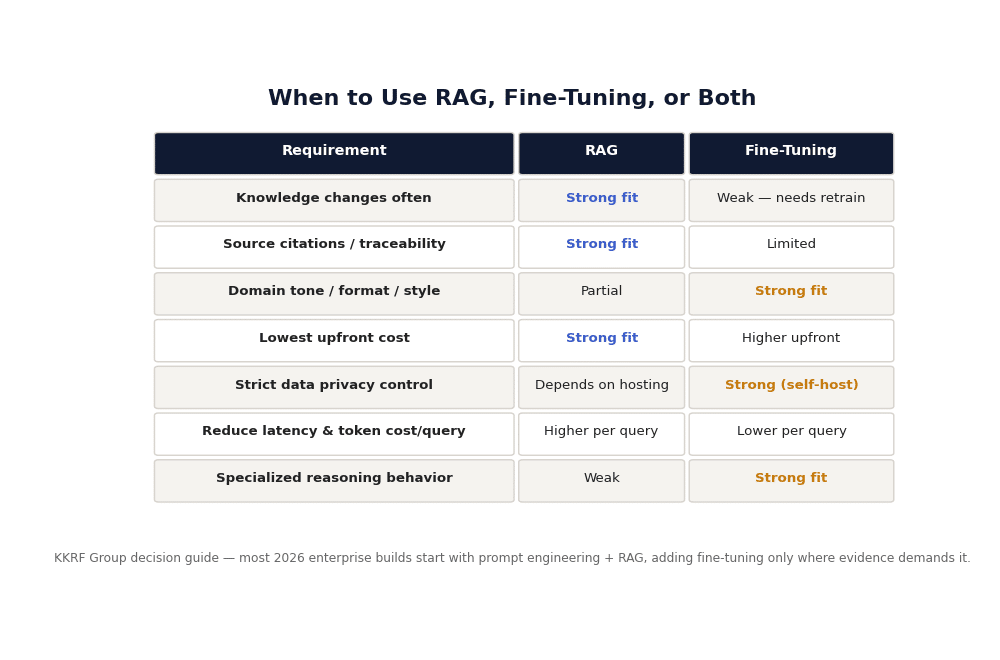
The clearest way to decide is to match your dominant requirement to the approach that serves it best. The table below summarizes how the two compare on the factors enterprise teams weigh most.
| Factor | RAG | Fine-Tuning |
|---|---|---|
| Best for | Fresh, changing knowledge | Consistent behavior, tone, format |
| Data freshness | Real-time (update the index) | Frozen at training time |
| Source citations | Yes — traceable | No native citation trail |
| Upfront cost | Moderate build | Low-to-moderate (LoRA) |
| Recurring cost | Higher per query | Lower, predictable inference |
| Time to first value | Days to weeks | Weeks (needs a labeled dataset) |
| Hallucination risk | Lower (grounded) | Depends on data quality |
| Ideal use cases | Q&A over docs, support, search | Classification, style, structured output |
In practice, three patterns recur across the projects our teams deliver:
- RAG-first: customer support assistants, internal knowledge search, policy and compliance Q&A, and document analysis — anywhere answers must reflect current data and be traceable.
- Fine-tune-first: intent classification, entity extraction, strict JSON or template output, and brand-voice generation — anywhere behavior must be consistent and knowledge is stable.
- Hybrid: a fine-tuned model that reliably follows your format and reasoning style, wrapped in a RAG pipeline that feeds it current facts — the pattern behind many of the most robust enterprise copilots.
In short: Most teams do not have to choose forever. Launch with RAG, learn where behavior is inconsistent, and layer in a targeted fine-tune where it clearly pays off.
A Decision Framework for Enterprise Teams
Use this framework to move from “it depends” to a defensible decision. Answer the questions in order; the first strong signal usually points to your starting architecture.
- Does the answer depend on data that changes weekly or faster? If yes, you need retrieval. RAG becomes the backbone; do not try to fine-tune facts.
- Do you need to show where each answer came from? If auditability or citations matter, RAG’s traceability is hard to replace.
- Is the problem mainly about format, tone, or classification? If the model already has the knowledge but responds inconsistently, a fine-tune fixes it more cheaply than ever-longer prompts.
- Are you running very high query volumes? At scale, a fine-tune that removes long instruction prompts can cut token cost on every call and lower latency.
- Is your labeled dataset strong enough to fine-tune well? Fine-tuning amplifies whatever is in your data. If you cannot assemble clean, representative examples, start with RAG.
- Do you need both fresh knowledge and consistent behavior? Then plan a hybrid from the start rather than retrofitting one later.
When KKRF Group runs an architecture review, we walk clients through exactly these questions against their real data, compliance constraints, and traffic projections. The goal is not to pick a trendy technique — it is to choose the smallest, most maintainable system that hits your accuracy and cost targets.
How KKRF Group Implements Both
Whichever path the framework points to, disciplined execution separates a demo from a dependable system. Here is the step-by-step process our engineering teams follow on enterprise AI builds.
- Define the evaluation set first. Before writing pipeline code, we assemble a representative set of real questions with expected answers, so every design choice is measured, not guessed.
- Prepare and structure the data. For RAG, that means cleaning, chunking, and embedding source content into a vector store; for fine-tuning, curating and validating labeled examples.
- Build a RAG baseline. We stand up retrieval plus prompt engineering early, because it is fast to test and often meets the bar on its own.
- Measure the gaps. We score the baseline against the evaluation set for accuracy, groundedness, latency, and cost, and isolate whether failures are knowledge or behavior problems.
- Fine-tune only where evidence demands it. If specific behaviors miss consistently, we run a parameter-efficient fine-tune targeted at those behaviors, then re-measure.
- Harden for production. We add access controls, prompt-injection defenses, monitoring, retrieval-quality checks, and guardrails aligned to enterprise security requirements.
- Establish a maintenance loop. Retrieval indexes are refreshed as content changes, and fine-tunes are re-run on a schedule as behavior needs evolve.
This sequence reflects a broader principle in how we work: enterprise-grade architecture, security-first development, and transparent, measurable delivery. It is the same rigor we bring across our software consulting engagements, and it is why our RAG systems build directly on the retrieval foundations covered in our guide to vector databases for enterprise RAG.
Common Mistakes Enterprises Make
Most failed AI initiatives do not fail on the model — they fail on decisions around it. These are the recurring mistakes we help clients avoid.
- Fine-tuning to store facts. Baking changing knowledge into weights guarantees stale answers and expensive re-training. Use retrieval for knowledge.
- Skipping the evaluation set. Without a measurable benchmark, teams argue about anecdotes and cannot tell whether a change helped.
- Under-investing in retrieval quality. RAG lives or dies on chunking, embeddings, and ranking. A weak retriever produces confident, wrong answers no matter how good the model is.
- Ignoring token and latency cost at scale. Long instruction-heavy prompts are fine in a pilot and painful at a million queries. Model the cost at target volume early.
- Treating security as an afterthought. Prompt injection, data leakage, and access control must be designed in, not patched on before launch.
- Over-engineering too early. Building a hybrid fine-tune-plus-RAG system before validating demand wastes budget. Start simple, measure, then expand.
Where RAG and Fine-Tuning Are Heading
The RAG-versus-fine-tuning debate is maturing into a “RAG-and-fine-tuning” consensus, with a few clear directions shaping 2026 and beyond.
Hybrid becomes the default for serious systems. As tooling matures, combining a behavior-tuned model with a retrieval layer is becoming standard for enterprise copilots, rather than an advanced option.
Retrieval is getting smarter. Techniques such as hybrid search, re-ranking, and agentic retrieval — where the system decides what to look up and when — are pushing RAG accuracy well beyond naive vector search, a progression Microsoft documents in its retrieval-augmented generation guidance.
Fine-tuning is getting cheaper and safer. Parameter-efficient methods keep lowering the cost and risk of adapting models, making targeted behavior tuning accessible to mid-sized teams, not just labs.
Longer context windows do not eliminate RAG. Bigger prompts help, but they raise cost and latency and still cannot match retrieval for grounding answers in millions of documents with citations. Retrieval remains the scalable path to enterprise knowledge.
Planning a production AI system and want a second opinion before you commit to an approach? Our team can pressure-test your AI architecture against your accuracy, cost, and security targets.
Request an Architecture Review →How to Evaluate an AI Development Partner
Whether you build in-house or with a partner, the questions you ask will predict your results. When evaluating a firm to design or build your RAG or fine-tuning system, look for evidence — not slogans.
- Do they start from evaluation, not tooling? A strong partner defines success metrics before recommending an architecture.
- Can they explain why RAG or fine-tuning fits your problem? Beware anyone who recommends the same approach to everyone.
- How do they handle security and data governance? Ask specifically about prompt-injection defenses, access control, and where your data and any fine-tunes live.
- Do they design for maintenance? Retrieval indexes and fine-tunes both need ongoing care; a good partner plans for it.
- Is their process transparent? You should see the evaluation results, cost modeling, and trade-offs behind every recommendation.
As a long-term technology partner for startups, SMEs, and enterprises, KKRF Group brings a custom engineering approach, enterprise-grade architecture, and a security-first, business-focused mindset to AI projects — so the system you launch is one you can trust, audit, and scale. Our aim is simple: build the AI solution that fits your problem, not the one that is easiest to sell.
The Bottom Line
The RAG vs fine-tuning question is not a battle to be won — it is a fit to be found. Match retrieval to knowledge problems, fine-tuning to behavior problems, and combine them when your system needs both fresh facts and consistent conduct. Start lean with RAG, measure honestly, and invest in fine-tuning where the evidence is clear.
Get that sequencing right and you ship faster, spend less, and end up with an AI system your business can actually depend on. If you would like a partner to help make and execute that decision, KKRF Group is ready to help.
Is RAG the same as fine-tuning?
No. RAG retrieves your data at query time to change what the model knows, without altering the model. Fine-tuning retrains the model on your examples to change how it behaves. They solve different problems and are often used together.
What are the advantages of RAG over fine-tuning?
RAG keeps answers current as your data changes, provides source citations for auditability, reduces hallucination by grounding responses, and usually costs less to launch. It is the practical default for knowledge-heavy enterprise use cases.
When does fine-tuning beat RAG?
Fine-tuning wins when you need consistent tone or format, specialized domain reasoning, reliable classification, or lower per-query cost and latency at very high volume. It is strongest when the required knowledge is stable and you have clean labeled data.
Can you combine RAG and fine-tuning?
Yes, and the most robust enterprise systems often do. A fine-tuned model handles behavior and format consistently, while a RAG layer supplies current, grounded facts with citations. This hybrid pattern powers many production copilots.
How much do RAG and fine-tuning cost?
As indicative 2026 ranges, a production RAG system can run roughly $4,000-$9,000 per month plus a one-time build of $25,000-$80,000, while a parameter-efficient LoRA fine-tune can cost about $400-$1,200 per training run. Actual costs depend on data volume, query load, and hosting.
Does a longer context window remove the need for RAG?
No. Larger context windows help but increase cost and latency and still cannot ground answers across millions of documents with citations. Retrieval remains the scalable way to give models access to enterprise knowledge.
Ready to turn a RAG-versus-fine-tuning decision into a working system? KKRF Group designs, builds, and maintains production AI for teams that need it done right — tell us about your project and we will scope the approach.
Discuss Your AI Project →