
Every enterprise building with large language models eventually faces the self-hosted LLM vs API question: keep calling a managed API like OpenAI, Anthropic, or Google, or bring the model in-house and self-host an open-weight LLM on infrastructure you control. It looks like a pricing question. In practice it is an architecture, security, and risk decision that shapes your AI roadmap for years.
At KKRF Group, an enterprise software development company that builds and deploys production AI systems, this is one of the most consequential calls our clients ask us to help them make. Choose wrong and you either burn budget on GPUs you barely utilize, or you route sensitive data through a third party your compliance team never signed off on. This guide lays out the real numbers, the security trade-offs, and a decision framework you can apply to your own workload.
We will cover what self-hosting actually involves, the true cost of each approach at different scales, the break-even point where owning infrastructure starts to pay off, the compliance realities in regulated industries, and why a hybrid routing strategy often beats a binary choice.
Key Takeaways
- For most enterprise workloads in 2026, a managed API is cheaper and faster to ship than self-hosting until you reach very high, sustained token volume.
- Self-hosting an open-weight LLM carries a largely fixed monthly cost (GPUs plus operations), so it only wins on price at scale or under strict data-residency rules.
- The cost break-even is a range, not a line — it shifts with model tier, GPU pricing, and utilization, and can land anywhere from roughly 100M to 500M+ tokens per month.
- Compliance often overrides cost. HIPAA, GDPR data residency, and contractual confidentiality can make self-hosting the only viable option regardless of the spreadsheet.
- A hybrid routing strategy — cheap/self-hosted for routine traffic, frontier API for hard tasks — frequently beats a binary choice and can cut spend 30–50%.
What This Guide Covers
- What Self-Hosting an LLM Actually Means
- Managed API vs Self-Hosted: The Core Trade-Off
- The Real Cost of Each Approach
- Break-Even Math: When Self-Hosting Pays Off
- Security, Privacy and Compliance
- Architecture: How Self-Hosting Works
- Total Cost of Ownership
- Decision Framework
- The Hybrid Routing Approach
- Common Mistakes Enterprises Make
- How to Evaluate a Deployment Partner
- Future Trends
- Frequently Asked Questions
As a team that has shipped LLM-powered products across document processing, customer-support automation, and internal knowledge systems, the patterns below come from real deployment work rather than vendor marketing. Let us start with definitions, because the words “self-hosting” and “on-premise” get used loosely and mean very different things for cost and security.
What Self-Hosting an LLM Actually Means
There is an important middle ground people conflate. “Self-hosting in the cloud” means renting GPU instances on AWS, Azure, GCP, or a specialized GPU cloud and running the model yourself — you own the software stack and data flow but not the hardware. “On-premise” means the GPUs physically sit in your own facility. Both keep inference inside your control plane, but their cost structures and lead times differ sharply: cloud GPUs are elastic and immediate, on-premise hardware is a capital purchase with procurement timelines.
The reason this distinction matters is that open-weight models have become genuinely capable. The gap between the best proprietary frontier models and the strongest open-weight models has narrowed considerably, which is exactly why self-hosting is now a serious option for production workloads and not just experimentation.
Managed API vs Self-Hosted: The Core Trade-Off
Every deployment model trades the same four levers against each other: speed to production, cost curve, control, and operational burden. A managed API gives you the fastest path to shipping and the lowest upfront cost, in exchange for per-token pricing that scales linearly with usage and a data flow that leaves your boundary. Self-hosting inverts that: high upfront setup and ongoing operations, but a largely fixed cost and complete control over data and model behavior.
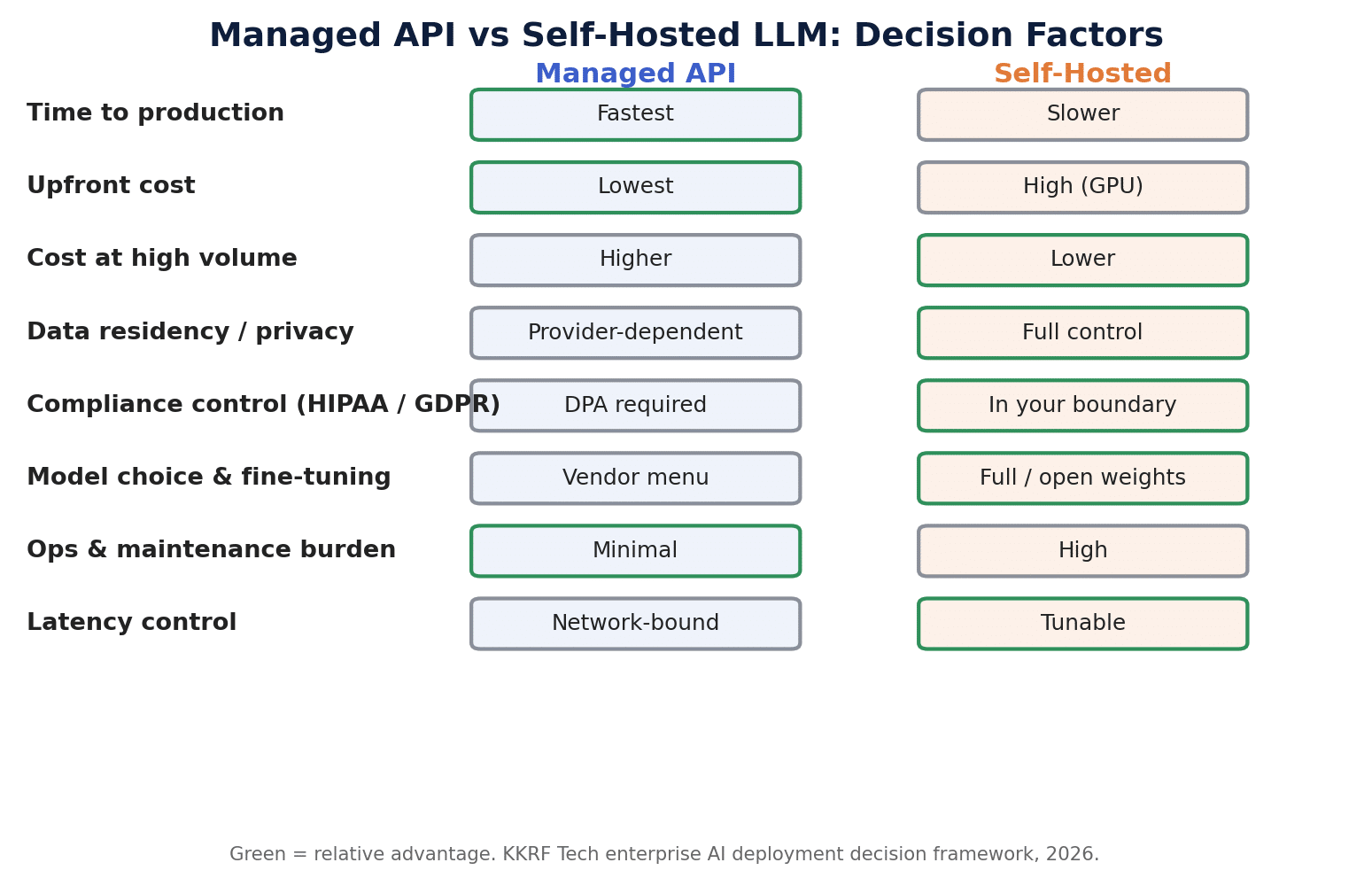
Notice that neither column is “better” outright. A managed API wins on time to production, upfront cost, and operational simplicity. Self-hosting wins on cost at high volume, data residency, compliance control, model freedom, and latency determinism. The right answer depends entirely on which of these levers matters most for your specific workload — which is why we always start a client engagement by mapping the workload, not by picking a vendor.
Self-Hosted LLM vs API: The Real Cost of Each Approach
Start with the API side, because it is the simpler cost model. You pay per input and output token. Prices have fallen dramatically — GPT-4-class capability that cost around $20 per million tokens in late 2022 now runs closer to $0.40 for comparable open or efficient models, and even frontier models are a fraction of their original price. Efficient models can cost roughly $2 per million tokens blended, while frontier-tier reasoning models sit around $10–$15 per million blended, depending on the input/output mix.
Self-hosting cost is dominated by GPUs. In 2026, cloud H100 rentals range from roughly $1.50 to $10 per GPU-hour depending on provider and commitment, with H200 instances spanning about $1 to $14 per GPU-hour. At steady utilization, a single H100 runs roughly $1,100–$7,300 per month. Most production deployments run at least two GPUs for redundancy and throughput headroom, and then add the operational layer: monitoring, autoscaling, model updates, and on-call coverage.
| Cost component | Managed API | Self-hosted (open-weight) |
|---|---|---|
| Pricing model | Per token (usage-based) | Fixed GPU + ops (mostly capacity-based) |
| Typical unit cost | ~$2–$15 per 1M tokens (model-dependent) | ~$1.50–$10 per GPU-hour |
| Upfront investment | Near zero | GPU provisioning + setup engineering |
| Ops & maintenance | Handled by provider | ~10–20 engineer-hours/month ($750–$3,000) |
| Scales with | Token volume (linear) | Peak concurrency & utilization |
The honest takeaway is that self-hosting is not automatically cheaper. Because its cost is mostly fixed, a lightly used self-hosted model is expensive per token, while a heavily used one is cheap per token. The API is the mirror image: cheap when usage is low, expensive when usage is high and constant. That is the entire basis of the break-even calculation.
Break-Even Math: When Self-Hosting Pays Off
The break-even point is the monthly token volume at which the fixed cost of self-hosting equals the usage-based cost of the API. Below it, the API is cheaper; above it, self-hosting is cheaper. The critical nuance most cost guides miss is that break-even depends heavily on which model you are comparing against.
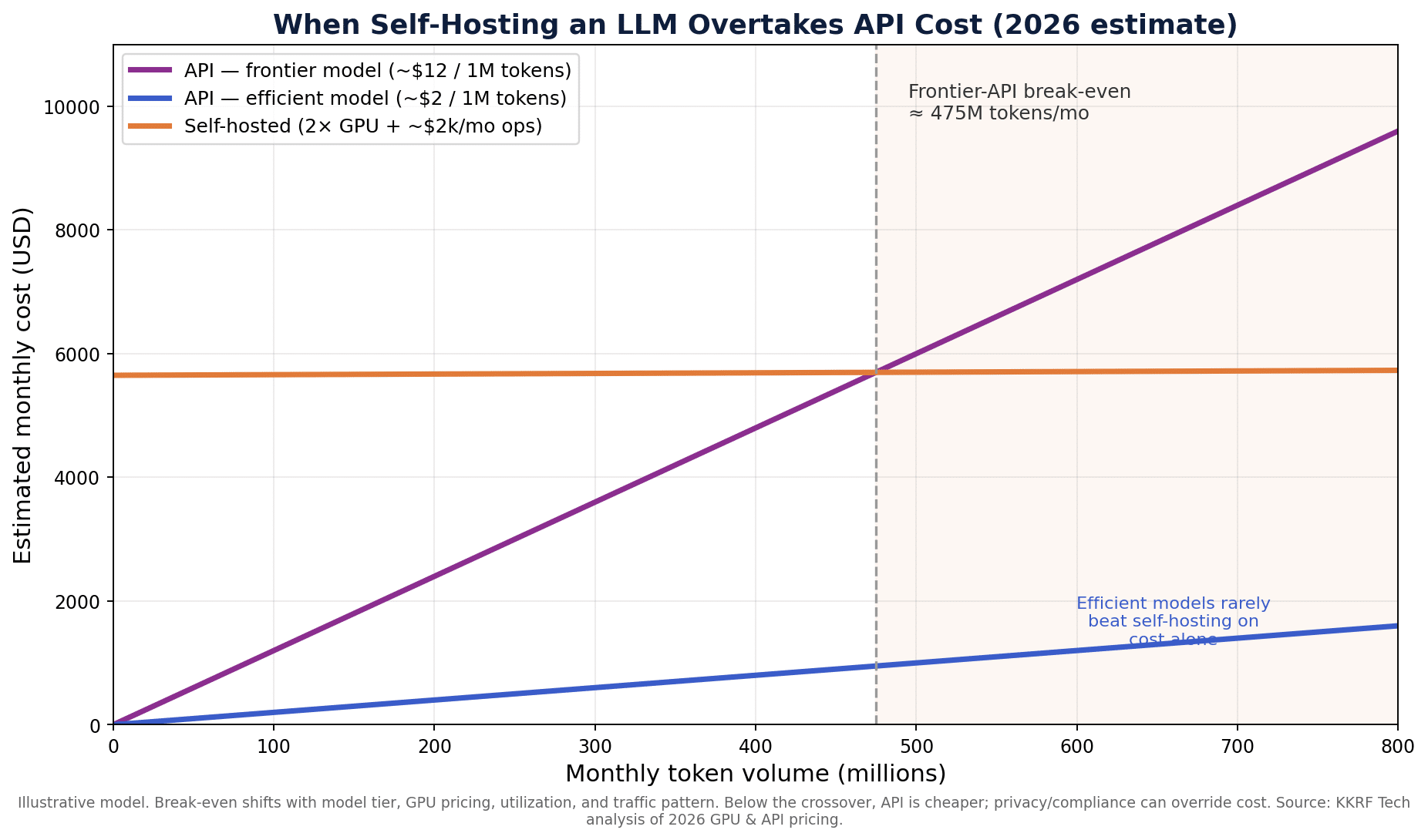
If you are replacing an expensive frontier model, break-even can arrive relatively early — often in the low hundreds of millions of tokens per month — because each API call is costly. If you are replacing an already-cheap efficient model, self-hosting may never pay off on cost alone, because that efficient API is priced close to the marginal cost of the compute anyway. Published 2026 analyses put the crossover anywhere from roughly 100 million to 256 million tokens per month for premium models, and considerably higher for budget models.
- Estimate your realistic monthly token volume, including both input and output tokens, at expected production scale — not your pilot volume.
- Identify which model tier you actually need. Do not benchmark self-hosting against a frontier model if an efficient model meets your quality bar.
- Model the fully loaded self-hosting cost: GPUs at realistic utilization, plus operations, monitoring, redundancy, and engineering time.
- Compare the two curves at your projected volume, then stress-test with a 2–3x growth scenario to see where you land in 12–18 months.
- Overlay non-cost factors — compliance, latency, data residency — because they can override the math entirely.
Security, Privacy and Compliance Considerations
For many regulated enterprises, this section decides the whole question before cost ever enters the conversation. When you call a public API, your provider becomes a data processor. Under GDPR that requires a Data Processing Agreement and clarity on data residency; in healthcare, sending protected health information to a third party triggers HIPAA obligations; and in legal or financial contexts, confidentiality and privilege concerns can make external processing a non-starter.
Self-hosting resolves those concerns structurally: if inference happens inside your environment, sensitive data never leaves it, and you sidestep the processor relationship entirely. That is often the deciding factor for healthcare, finance, defense, and legal clients we work with as a trusted IT consulting and cybersecurity partner. But self-hosting does not make you secure by default — it transfers the responsibility to you.
A self-hosted LLM inherits the full application-security surface described in the OWASP Top 10 for LLM applications, including prompt injection, insecure output handling, sensitive information disclosure, and excessive agency. You now own patching, network isolation, access control, secrets management, and monitoring for the model-serving stack. Managed APIs handle the infrastructure security for you, but you must still govern the data you send and validate what you receive. You can review the full risk list from the OWASP GenAI Security Project, and frameworks like the NIST AI Risk Management Framework help structure governance across either deployment model.
Architecture: How Enterprise LLM Self-Hosting Works
A production self-hosted deployment is more than downloading model weights and running them. The reference architecture we implement for clients has a few consistent layers, and understanding them clarifies where the real operational cost lives.
- Model layer: the open-weight model itself, usually quantized to fit available GPU memory while preserving acceptable quality.
- Serving layer: a high-throughput inference server (for example vLLM or TGI) that handles batching, streaming, and KV-cache management to keep GPU utilization high.
- Orchestration layer: containerized deployment on Kubernetes or a managed equivalent, with autoscaling tied to concurrency and health checks for reliability.
- Gateway layer: a model-agnostic API gateway that your applications call, so you can swap models or route between self-hosted and API backends without changing application code.
- Observability and safety layer: logging, latency and cost monitoring, evaluation harnesses, and guardrails for input validation and output filtering.
The gateway layer deserves special attention. Building your applications behind a model-agnostic abstraction is the single most valuable architectural decision you can make early, because it turns the API-versus-self-hosted question into a configuration change rather than a rewrite. It is also what makes the hybrid strategy below practical. Teams that skip this end up locked into whichever choice they made first, which is exactly the trap a security-first, scalable architecture is meant to avoid.
Deciding between a managed API and a self-hosted model for a production workload? Our engineers can map your volume, data-sensitivity, and latency requirements to a concrete deployment architecture. Explore our software consulting services to see how we approach it.
Request an Architecture Review →Total Cost of Ownership: The Full Picture
Per-token or per-GPU-hour pricing is only the visible part of the cost. The total cost of ownership includes several line items that teams routinely underestimate, and they almost always favor the API for smaller deployments and self-hosting for larger, stable ones.
| TCO factor | What it includes | Who it favors |
|---|---|---|
| Compute | Tokens or GPU-hours | API at low volume, self-host at high volume |
| Engineering time | Setup, upgrades, on-call, tuning | API |
| Reliability | Redundancy, failover, SLAs | API for small teams |
| Compliance | Audits, DPAs, data residency | Self-host in regulated industries |
| Model access | Frontier models & fast upgrades | API |
| Scaling headroom | Handling traffic spikes | API (elastic) vs self-host (provisioned) |
A frequent and expensive mistake is comparing raw API token cost against raw GPU cost and ignoring the engineering line entirely. The 10–20 hours per month of senior engineering time that a self-hosted deployment demands is real money — often $750 to $3,000 monthly in loaded cost — and it competes with other roadmap work. For a small team, that opportunity cost can dwarf the compute savings.
Self-Hosted LLM vs API: Which Should You Choose?
Rather than a rule, use a sequence of questions ordered so that the hard constraints come first and cost comes last. This mirrors how we guide clients through the decision.
- Do regulations or contracts require data to stay inside your boundary? If yes, self-hosting (or a private, dedicated deployment) is likely mandatory — stop here.
- Do you need a capability only frontier models currently deliver? If yes, lean API, at least for those requests.
- Is your volume high, predictable, and sustained? If yes, model the self-hosting break-even seriously.
- Do you have the engineering capacity to operate a serving platform reliably? If no, the API total cost of ownership is almost always lower.
- Is speed to market the priority right now? If yes, start on the API and revisit once the use case is validated.
Most enterprises we work with land in one of three places: API-first because they value speed and lack spare platform engineers; self-hosted because compliance forces it; or hybrid because different parts of their workload have different answers. As a technology partner focused on long-term outcomes rather than a single build, we design for the option that keeps future migration cheap.
The Hybrid Routing Approach
The most cost-effective 2026 pattern for high-volume products is rarely all-or-nothing. It is intelligent routing: send the large majority of routine, predictable requests to an efficient or self-hosted model, and reserve expensive frontier API calls for the small share of requests that genuinely need advanced reasoning. Teams that implement this well report cost reductions in the range of 30–50% versus routing everything to a premium model.
Hybrid routing also hedges risk. It keeps sensitive data on a self-hosted model while still allowing non-sensitive tasks to use the best available API. It smooths capacity — self-hosted handles the steady baseline, the API absorbs spikes. And it depends entirely on the model-agnostic gateway described earlier, which is why the architecture decision and the cost decision are two sides of the same coin.
Common Mistakes Enterprises Make
- Comparing the wrong models. Benchmarking a self-hosted open model against a frontier API on cost, when an efficient API would meet the quality bar for far less operational overhead.
- Ignoring the engineering line. Treating self-hosting as “just GPU cost” and forgetting the ongoing operations, upgrades, and on-call burden.
- Skipping the abstraction layer. Hard-coding a single provider into the application, then facing a rewrite when requirements change.
- Under-provisioning for reliability. Running a single GPU with no failover and discovering the hard way that inference is now a single point of failure.
- Treating self-hosting as automatically secure. Assuming that keeping data in-house removes the need for guardrails against prompt injection and insecure output handling.
- Optimizing for a pilot, not production. Sizing the decision on pilot traffic and being surprised when real volume changes the break-even math.
How to Evaluate an LLM Deployment Partner
If you bring in outside help, the quality of the partner matters more than any single tooling choice. The strongest signal is whether they start with your workload and constraints rather than a preferred vendor. Look for a team that can articulate the break-even math for your specific volume, that has shipped both API-based and self-hosted systems in production, and that designs for portability so you are never locked in.
Practical evaluation criteria we would apply ourselves: demonstrated experience with high-throughput serving frameworks and GPU utilization tuning; a security-first posture that references frameworks like OWASP and NIST rather than hand-waving; transparent cost modeling; and a clear plan for observability, evaluation, and guardrails. KKRF Group approaches these engagements as a long-term technology partner — the goal is an architecture your own team can operate and evolve, not a dependency. Our related guides on RAG versus fine-tuning and intelligent document processing show how these deployment decisions play out in real applications.
Future Trends in Enterprise LLM Deployment
Three shifts are worth planning around. First, open-weight models continue to close the quality gap with frontier models, which steadily lowers the bar for self-hosting to make sense. Second, GPU pricing keeps falling as specialized providers and newer accelerators enter the market, moving the break-even point in favor of self-hosting over time. Third, inference efficiency — better serving frameworks, quantization, and smaller high-quality models — reduces the hardware you need for a given workload.
The net effect is that the calculus is not static. A workload that clearly favored an API in early 2025 may favor a hybrid or self-hosted approach a year later without any change in your requirements — purely because the economics moved. This is the strongest argument for the model-agnostic architecture: it lets you re-optimize as the landscape shifts, rather than committing to today’s answer permanently. For a deeper look at how token and inference costs are trending, the NVIDIA inference benchmarking analysis is a useful reference.
Not sure where your workload lands on the break-even curve? A short technical assessment from our team can turn these trade-offs into a costed recommendation. See our IT consulting services for how we scope it.
Get a Technical Assessment →Frequently Asked Questions
Is it cheaper to self-host an LLM or use an API?
For most teams, an API is cheaper because self-hosting carries a large fixed cost for GPUs and operations. Self-hosting only becomes cheaper at high, sustained volume — often hundreds of millions of tokens per month with a frontier-tier model — or when compliance requirements remove the API as an option. Below that break-even, pay-per-token API pricing almost always wins.
When should an enterprise self-host an LLM?
Self-host when sensitive data cannot leave your environment (healthcare PHI, financial records, privileged legal data), when regulations mandate data residency, when you need tight control over latency and model versions, or when you run predictable high-throughput workloads where owning GPUs beats per-token pricing. Fine-tuning proprietary models on confidential data is another common driver.
What does it cost to self-host an LLM in 2026?
A realistic starting point is one or two enterprise GPUs (H100 or H200 class) at roughly $1.50–$10 per GPU-hour on cloud, which is about $1,100–$7,300 per GPU per month at steady utilization, plus 10–20 engineering hours per month for maintenance ($750–$3,000 in labor). Add networking, storage, monitoring, and redundancy, and a modest production deployment often lands in the low-to-mid five figures per month.
Is a self-hosted LLM more secure than an API?
Self-hosting keeps data inside your security boundary, which simplifies data-residency and confidentiality requirements. But it does not make you secure automatically — you inherit responsibility for patching, access control, and defending against risks like prompt injection and insecure output handling described in the OWASP Top 10 for LLM applications. Managed APIs shift infrastructure security to the provider but make them a data processor you must govern contractually.
What GPUs do you need to run an open-weight LLM?
It depends on model size and quantization. A mid-sized open-weight model can run on a single 80GB GPU such as an H100 or H200, while larger models need multiple GPUs with high-bandwidth interconnect. Quantization and efficient serving frameworks reduce hardware requirements, letting many enterprise use cases run capable models on one or two GPUs.
Can you switch from an API to self-hosting later?
Yes, and many teams do. A common path is to prototype on an API to validate the use case quickly, then migrate high-volume or sensitive workloads to self-hosted open-weight models once requirements are clear. Designing your application behind a model-agnostic abstraction layer from day one makes that migration far less painful.
Whether you land on a managed API, a self-hosted model, or a hybrid, KKRF Group can design and build the deployment your compliance and engineering teams will both sign off on. Reach out through our contact page to start the conversation.
Talk to Our Engineering Team →