
Enterprise AI agent development has moved from experiment to boardroom priority in under two years. Gartner expects 40% of enterprise applications to ship with task-specific AI agents by the end of 2026, up from fewer than 5% in 2025. Yet the same analysts warn that more than 40% of agentic AI projects will be canceled by the end of 2027 — usually over runaway cost, unclear business value, or inadequate controls.
This guide is written for the technical and business leaders deciding whether to build. It lays out what these systems actually cost, how they are architected, where they break, and how to choose a partner that ships production software instead of demos. Every figure below comes from 2026 industry data, not vendor optimism.
Key Takeaways
- A production enterprise AI agent typically costs $250K–$500K to build; scoped proofs of concept start near $50K, and full multi-agent platforms exceed $1M.
- Ongoing operations add 15–30% of build cost every year, and data preparation alone can consume 15–25% of the budget.
- LangGraph leads production deployments in 2026; CrewAI wins on speed to prototype; Microsoft has folded AutoGen into its broader Agent Framework.
- Security is the differentiator: OWASP published a dedicated Top 10 for Agentic Applications in December 2025 covering goal hijacking, tool misuse, and memory poisoning.
- Median payback lands between 4 and 9 months — but only organizations with human-in-the-loop controls consistently reach it.
What This Guide Covers
What Enterprise AI Agent Development Actually Costs in 2026
Pricing spans a wide band because the label covers everything from a single retrieval-augmented assistant to a fleet of autonomous agents coordinating across systems. The honest ranges, drawn from 2026 pricing surveys, look like this.
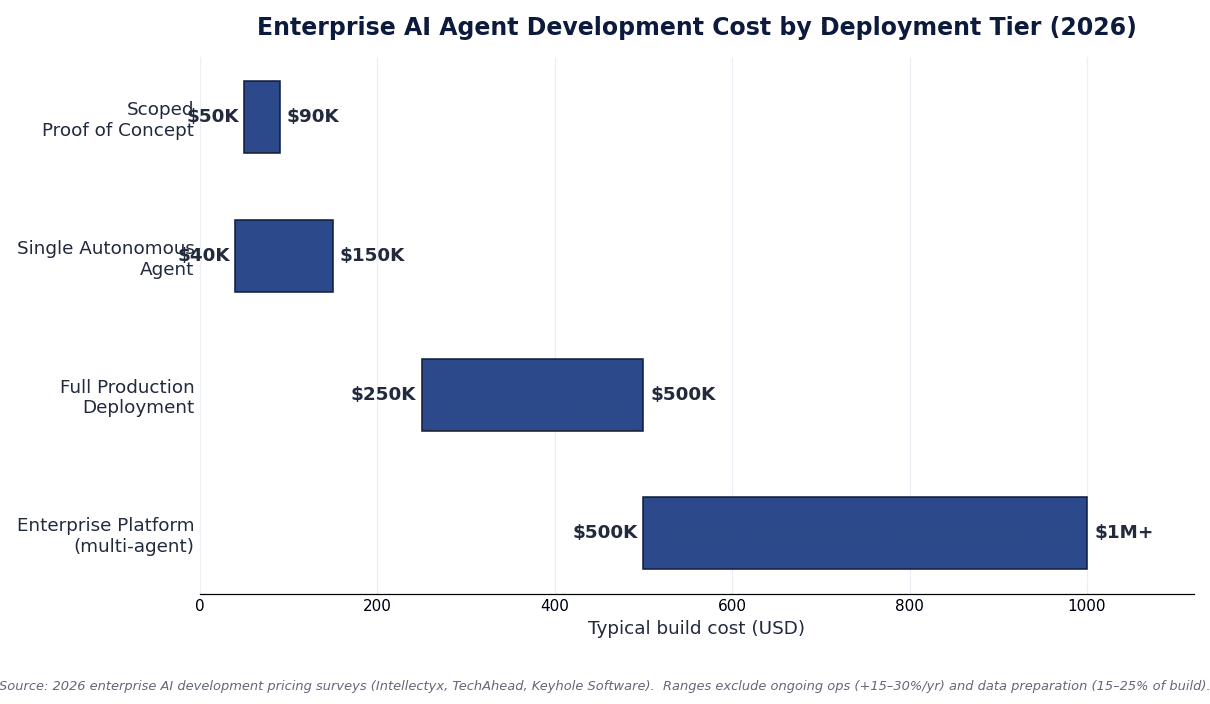
A scoped proof of concept — one workflow, one model, limited integration — generally runs $50,000 to $90,000 and exists to prove value before larger spend. A single production-grade autonomous agent, with tool access and guardrails, lands between $40,000 and $150,000.
Most companies that reach production for a real business process spend $250,000 to $500,000. A multi-agent enterprise platform with custom components and organization-wide rollout crosses the $1 million mark.
The build figure is only the visible tip. Ongoing operations — monitoring, retraining, and infrastructure scaling — add 15% to 30% of the initial cost every year. Data preparation and quality remediation is the single largest hidden line item, routinely 15% to 25% of total project cost and higher in data-heavy deployments.
What actually drives the number
- Autonomy level: a single-step assistant is far cheaper than an agent that plans and executes multi-step tasks on its own.
- Integration surface: every enterprise system the agent touches adds connectors, testing, and failure handling.
- Governance depth: regulated industries need audit trails, approval gates, and safety frameworks that can add $30K–$100K.
- Data readiness: clean, retrievable knowledge is the difference between a working agent and an expensive chatbot.
Because these variables swing the total so much, an experienced partner will scope them before quoting. A credible estimate for enterprise AI agent development is a conversation about your data and systems, not a number pulled from a rate card.
The Architecture Behind Production AI Agents
Under the marketing language, a production agent is a layered system. Get the layers right and it is debuggable, secure, and cheap to extend. Get them wrong and you have a demo that fails silently in front of customers.
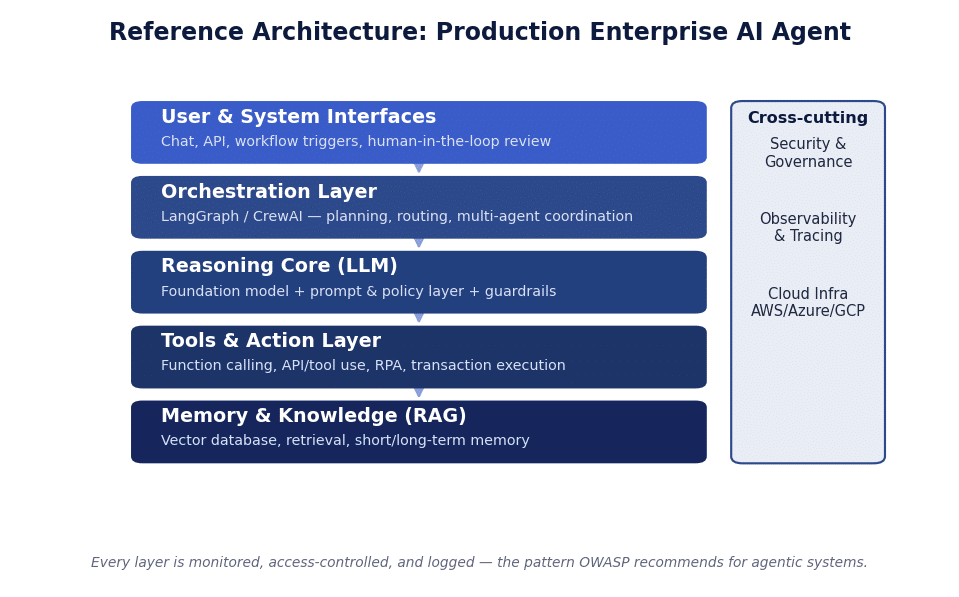
The orchestration layer decides what the agent does next — planning, routing, and coordinating multiple agents. LangGraph’s directed-graph model dominates here because it makes complex, branching workflows explicit and testable.
The reasoning core is the language model wrapped in a prompt-and-policy layer with guardrails. The tools and action layer is where autonomy becomes real: function calling, API use, and transaction execution. It is also where risk concentrates, because an agent that can act can act wrongly.
The memory and knowledge layer — a vector database plus retrieval, often called RAG — is what separates a generic model from one that actually knows your business. Surrounding all of it are the cross-cutting concerns: security, observability, and the cloud foundation.
That foundation matters as much as the model, which is why the underlying cloud architecture on AWS, Azure, or GCP deserves the same engineering rigor. Most stalled agent projects fail at the tools and observability layers, not the model.
Framework Comparison: LangGraph vs CrewAI vs AutoGen
No single framework wins every project. The right choice depends on how much control you need, how fast you must move, and whether your team will maintain the system long-term.
| Framework | Model | Best for | Watch-outs |
|---|---|---|---|
| LangGraph | Graph-based, stateful | Mission-critical production, compliance, complex branching | Steeper learning curve |
| CrewAI | Role-based crews | Rapid prototypes, clear role delegation | Weaker production observability and error recovery |
| AutoGen | Conversational | Code generation, research, multi-party dialogue | Now folded into the Microsoft Agent Framework |
| Custom build | Bespoke | Teams that have outgrown framework abstractions | Highest upfront engineering cost |
In practice, teams building mission-critical systems gravitate to LangGraph or a custom build for maximum control and observability. CrewAI is a legitimate accelerator for validating a multi-agent concept quickly. AutoGen’s conversational patterns live on inside Microsoft’s Agent Framework. The framework is a starting point — the engineering discipline around it decides whether the agent survives contact with production.
Build vs. Buy: Off-the-Shelf Agents vs. Custom Development
Before committing to full enterprise AI agent development, most leaders ask a fair question: why not just buy a packaged agent? For narrow, common tasks — meeting summaries, basic support triage, document search — an off-the-shelf product is often the right call and ships in days.
The calculus changes when the agent must touch proprietary systems, follow your business rules, and meet compliance obligations. Packaged tools rarely integrate deeply with legacy back-ends, and they keep your most valuable context — your data and workflows — behind someone else’s roadmap. That is where a custom build, or a purpose-built SaaS layer around the agent, earns its cost.
A useful rule: buy for commodity tasks, build where the agent becomes a competitive advantage. Many enterprises run a hybrid — a bought tool for quick wins while a custom agent is developed for the workflow that actually moves revenue. The decision should be revisited each quarter as both your needs and the tooling mature.
Not sure whether a single workflow justifies enterprise AI agent development yet? A focused scoping session with our software consulting team usually tells you whether the ROI is real before you commit serious budget.
Scope Your AI Agent Project →Security and Compliance Considerations for Autonomous Agents
Autonomy is both the feature and the risk. An agent that can act on your systems can be manipulated into acting against you, which is why security is the part of enterprise AI agent development that most teams underestimate.
In December 2025, the OWASP GenAI Security Project released a dedicated Top 10 for Agentic Applications. It names threats the older LLM list only partly covered: agent goal hijacking, tool misuse and exploitation, and memory or context poisoning. These sit on top of foundational LLM risks like prompt injection, sensitive information disclosure, and supply-chain vulnerabilities.
The mitigations are concrete. Give agents least-privilege access to tools, log every action for audit, and put human-in-the-loop approval on high-impact steps. For regulated workloads, a cybersecurity review and continuous red-teaming should be part of the delivery plan, not an afterthought bolted on before launch.
The Business Case: ROI and Payback Benchmarks
The upside is real when the discipline is there. McKinsey estimates agentic AI could unlock $2.6 to $4.4 trillion in additional global value, and 2026 telemetry shows knowledge workers recovering a median of about 6.4 hours per week per seat, with senior practitioners saving 10 to 12 hours.
Payback periods are shorter than most boards expect: roughly 4.1 months in customer service, 6.7 months in marketing operations, and 9.3 months in engineering. Productivity gains are highest in customer service and code review, and lowest in legal and clinical work, where governance review eats much of the speed advantage.
A widely cited McKinsey example put relationship managers at a retail bank on an agent that drafts credit-risk memos: a 60%-plus productivity gain and more than $3 million in expected annual savings. The common thread among winners is governance — 65% of AI high performers have defined human-in-the-loop processes, versus just 23% of everyone else.
Two caveats keep these numbers honest. First, the gains cluster in high-volume, well-structured work; bespoke or heavily regulated processes see far smaller lifts. Second, the 2026 data shows only a 41% year-one ROI hit rate across all deployments — meaning disciplined scoping, not enthusiasm, is what separates the projects that pay back from the ones that quietly stall.
Common Mistakes That Get Projects Canceled
Gartner’s prediction that 40% of agentic projects will be scrapped by 2027 is not about the technology failing. It is about avoidable execution errors. These are the patterns we see most often.
- Chasing autonomy before proving one workflow. Broad ambition with no shipped win burns budget and credibility.
- Underfunding data and evaluation. Without clean data and a way to measure quality, the agent is a liability.
- No human-in-the-loop. A single bad autonomous action can destroy trust faster than a hundred good ones build it.
- Treating it as a model problem, not a software problem. The model is 20% of the work; integration, testing, and operations are the rest.
- No observability. If you cannot see why an agent did something, you cannot fix it — and customers will find the failures first.
Where Enterprise AI Agent Development Is Heading
The direction of travel is clear. Gartner expects one-third of agentic implementations to combine multiple specialized agents by 2027, at least 15% of day-to-day work decisions to be made autonomously by 2028, and 70% of enterprises to run agentic AI inside IT operations by 2029.
The market is maturing in parallel: standardized agent-to-tool protocols, richer governance tooling, and a shift from single clever agents toward orchestrated fleets. Gartner’s best case has agentic AI driving roughly 30% of enterprise application software revenue — over $450 billion — by 2035. The teams that invest in evaluation and governance now will be the ones scaling then.
For most organizations, the practical takeaway is not to wait for the market to settle. The competitive gap is opening now between teams that have shipped one governed, observable agent and those still running slide decks. Starting small — one workflow, measured honestly — is the lowest-risk way to build the muscle before agentic systems become table stakes.
How to Evaluate an AI Agent Development Partner
Because so many projects stall, choosing the right builder matters more than choosing the right framework. Use this short checklist when you assess any partner for enterprise AI agent development.
- Ask for production references, not demo videos — systems running against real users and real data.
- Require an evaluation and observability plan before a line of code is written.
- Confirm their security practices map to OWASP’s agentic guidance.
- Check that they scope data readiness honestly instead of waving it away.
- Look for human-in-the-loop design by default, especially on high-impact actions.
A strong partner is transparent about how they work and where the risks are. If a vendor promises full autonomy with no caveats, treat it as a warning sign rather than a selling point.
Pricing transparency is another signal worth weighing. A serious enterprise AI agent development partner will break a quote into discovery, data preparation, build, and ongoing operations rather than hand you one opaque figure. If the ongoing-operations line is missing, the estimate is incomplete — those costs are real and recurring.
Ready to move past slideware and see a working agent on your own data? KKRF Tech ships production prototypes with security, evaluation, and observability designed in from day one — tell us about your use case.
Get a Custom AI Agent Estimate →Frequently Asked Questions
How much does enterprise AI agent development cost in 2026?
A scoped proof of concept typically runs $50,000 to $90,000. A single production-grade autonomous agent lands between $40,000 and $150,000, while most companies reaching production for a real business process spend $250,000 to $500,000. Full multi-agent enterprise platforms exceed $1 million. Remember that ongoing operations add 15–30% of the build cost each year.
How long does it take to build a production AI agent?
A validated proof of concept usually takes 6 to 10 weeks. Hardening that into a production system with integrations, guardrails, evaluation, and observability commonly takes another 3 to 6 months, depending on how many enterprise systems the agent touches and how clean the underlying data is.
Which framework is best — LangGraph, CrewAI, or AutoGen?
LangGraph has the largest production footprint in 2026 and suits stateful, compliance-heavy systems. CrewAI is the fastest way to prototype role-based multi-agent workflows. AutoGen’s capabilities are now part of the Microsoft Agent Framework. For long-lived, mission-critical systems, many teams eventually move to custom code built on these patterns.
Are AI agents secure enough for regulated industries?
They can be, but only with deliberate controls. OWASP published a dedicated Top 10 for Agentic Applications in December 2025 covering goal hijacking, tool misuse, and memory poisoning. Regulated deployments need least-privilege tool access, full audit logging, human-in-the-loop approval on high-impact actions, and continuous red-teaming.
What ROI can we realistically expect?
Benchmarks from 2026 show knowledge workers recovering a median of about 6.4 hours per week, with payback periods of roughly 4 months in customer service, 6–7 months in marketing operations, and 9 months in engineering. Organizations with defined human-in-the-loop processes are far more likely to hit those numbers.
Should we build in-house or hire a development partner?
If you have a mature ML engineering team and want to own the system long-term, in-house can work. Most enterprises move faster and de-risk delivery by partnering for the first one or two agents, then bringing maintenance in-house once the patterns are proven. Ask any partner for production references, an evaluation plan, and a security approach mapped to OWASP guidance.
Every enterprise AI agent development engagement we take on starts with your systems, your data, and a realistic delivery plan — never a generic demo. If you are scoping a build for 2026, let’s pressure-test it together.
Talk to Our AI Engineering Team →