
Enterprise leaders no longer ask whether to deploy an AI chatbot — they ask what a production system will cost and how to make it worth the investment. That is exactly why understanding enterprise AI chatbot development cost matters before a single line of code is written. The distance between a demo that impresses in a meeting and a production assistant that handles thousands of real customer and employee conversations is wide, and it is where most budgets are won or lost.
At KKRF Group, an AI Chatbot development company, we treat conversational AI the way we treat any mission-critical system: with a clear architecture, measurable accuracy targets, and security designed in from the first sprint rather than bolted on before launch. This guide breaks down what an enterprise AI chatbot actually costs in 2026, why the numbers vary so widely, how retrieval-augmented generation works under the hood, and how to choose a development partner without overpaying for the wrong solution.
Key Takeaways
- Enterprise AI chatbot development in 2026 typically runs from about $30,000 for a focused RAG assistant to $250,000+ for an agentic system that reasons across multiple steps and systems.
- The language model is only 30–40% of the total cost — data preparation, integration, testing, and ongoing monitoring account for the rest.
- Retrieval-augmented generation (RAG) is the dominant enterprise architecture because it grounds answers in your own documents and data, cutting hallucinations.
- Regulated industries such as healthcare and finance add roughly 25–35% to cost for compliance, security, and audit readiness.
- The partner decision hinges less on headline price and more on architecture, evaluation discipline, and security posture.
What This Guide Covers
Quick answer: In 2026, enterprise AI chatbot development cost generally runs between $30,000 and $250,000+ and takes 3 to 9 months to build, depending on the chatbot type (rule-based, RAG, or agentic), how many systems it integrates with, and your compliance requirements. Knowledge-grounded RAG chatbots typically land in the $30,000–$120,000 range, while autonomous agentic assistants that complete multi-step tasks cost more.
Our engineering teams have shipped production AI features across support automation, internal knowledge assistants, and document-heavy workflows, so the figures and trade-offs below reflect what we see in real delivery — not just list prices. Where useful, we link to related deep-dives on RAG versus fine-tuning and self-hosted models versus API providers.
What Is an Enterprise AI Chatbot?
An enterprise AI chatbot is a conversational system that understands natural language, retrieves accurate information from your own data, and either answers questions or takes actions on behalf of a user. Unlike the scripted “press 1 for billing” bots of the past decade, a modern enterprise assistant is built on large language models (LLMs) and, increasingly, on retrieval and reasoning layers that let it handle open-ended requests.
The word “enterprise” is doing real work here. A consumer chatbot can afford to be occasionally wrong. An enterprise assistant that quotes the wrong policy to a customer, exposes data it should not, or fails an audit creates liability. That is why enterprise builds carry costs a weekend prototype never does: access control, data governance, evaluation, and observability are first-class requirements, not afterthoughts.
The three tiers you will hear about
- Rule-based / flow bots: deterministic decision trees for FAQs and routing. Cheap and predictable, but brittle and unable to handle anything off-script.
- RAG chatbots: LLM answers grounded in your documents through retrieval. The workhorse of enterprise deployments in 2026.
- Agentic AI assistants: systems that plan, call tools, and complete multi-step tasks — booking, updating records, orchestrating workflows — with far more autonomy and more engineering to keep them safe.
How Much Does Enterprise AI Chatbot Development Cost in 2026?
Enterprise AI chatbot development cost in 2026 spans a wide but explainable range. Published industry cost guides converge on roughly $30,000 to $250,000+ for a custom enterprise chatbot, with simpler bots below that band and complex, regulated agentic systems above it. The spread is not vendor guesswork — it maps directly to chatbot type, integration depth, and compliance load.
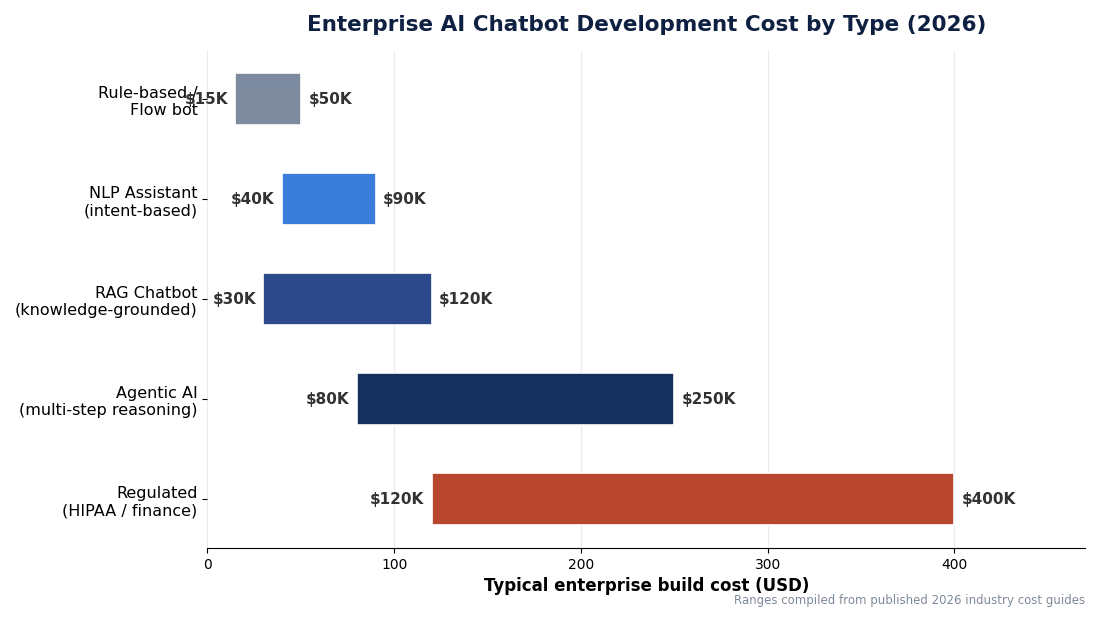
The table below summarizes the typical bands we and other engineering teams see, along with realistic timelines. Treat them as planning anchors for a first production release, not fixed quotes.
| Chatbot Type | Typical Cost (2026) | Timeline | Best Fit |
|---|---|---|---|
| Rule-based / flow bot | $15K–$50K | 3–6 weeks | FAQs, routing, simple triage |
| NLP assistant (intent-based) | $40K–$90K | 2–4 months | Structured support, form filling |
| RAG chatbot (knowledge-grounded) | $30K–$120K | 2–5 months | Answering from internal docs and policies |
| Agentic AI (multi-step reasoning) | $80K–$250K+ | 4–9 months | Task automation across systems |
| Regulated (HIPAA / finance) | +25–35% on top | +4–8 weeks | Healthcare, banking, insurance |
A useful mental model: a knowledge-grounded RAG assistant for internal support is often a $40,000–$90,000 first release. Add multiple system integrations, agentic actions, and strict compliance, and you move toward the six-figure range. The decision between hosting your own model and calling an API also shifts the numbers, which we cover in depth in our self-hosted LLM vs API cost and security analysis.
Not sure which tier your use case actually needs? A short scoping conversation usually saves more than it costs — our team can map your requirements to a realistic budget and timeline. Start with a quick review of your goals with KKRF Group’s software consulting team.
Talk to Our Engineering Team →What Actually Drives AI Chatbot Development Cost
One number surprises most first-time buyers: the language model itself accounts for only about 30–40% of total project cost. The rest goes to the unglamorous engineering that makes an assistant trustworthy. Understanding these drivers is the fastest way to control a budget.
- Data readiness: cleaning, chunking, and indexing your documents is frequently the single largest line item. Messy or scattered data can double the effort before a model is even involved.
- Integration surface: each system the bot must read from or write to — CRM, ticketing, ERP, knowledge base — adds connectors, authentication, and testing. A focused single-system build is far cheaper than a multi-system rollout.
- Chatbot type and autonomy: agentic behavior that takes actions requires guardrails, tool schemas, and failure handling that a read-only Q&A bot does not.
- Compliance and security: HIPAA, SOC 2, PCI, or GDPR requirements add data handling, logging, and audit work that can raise cost 25–35%.
- Accuracy targets: moving from “usually right” to “reliably right” means evaluation datasets, tuning, and iteration — real work that scales with the quality bar.
- Ongoing operations: monitoring, model updates, and retraining are recurring costs, not one-time build items.
How Enterprise AI Chatbots Work: RAG Architecture Explained
Retrieval-augmented generation is the reason enterprise chatbots became viable for serious use. Instead of hoping a general model happens to know your policies, RAG retrieves the most relevant passages from your own content at query time and hands them to the model as grounding context. The model answers from evidence rather than memory.
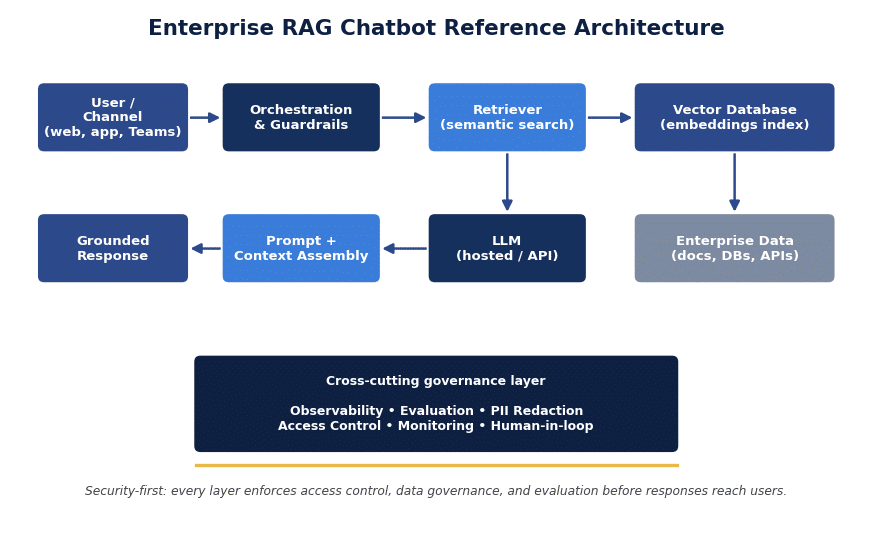
Here is the flow most production systems follow, and where the engineering effort concentrates:
- Ingestion: documents, tickets, and database records are cleaned, chunked, and converted into embeddings.
- Indexing: those embeddings are stored in a vector database chosen for scale and latency — a decision we compare in our enterprise vector database guide.
- Retrieval: when a user asks a question, the system finds the most semantically relevant passages, often with re-ranking for precision.
- Generation: the model receives the question plus retrieved context and produces a grounded, cited answer.
- Governance: access control, PII redaction, evaluation, and logging wrap every step so answers are safe and auditable.
The quality of a RAG chatbot lives and dies on retrieval, not on the model brand. Poor chunking, weak embeddings, or a vector store that returns near-misses will make even the best LLM sound confidently wrong. This is why experienced teams spend disproportionate effort on the retrieval layer — and why choosing between RAG and fine-tuning matters, a trade-off we unpack in our RAG vs fine-tuning breakdown.
The Enterprise AI Chatbot Development Process, Step by Step
A disciplined delivery process is what separates a chatbot that launches from one that stalls in “almost ready” for months. The sequence below reflects how KKRF Group structures conversational AI engagements.
- Discovery and use-case scoping: define the single highest-value workflow, success metrics, and the accuracy bar before writing code.
- Data audit and preparation: inventory knowledge sources, resolve gaps and duplicates, and design the chunking and indexing strategy.
- Architecture and model selection: choose RAG vs agentic, hosted vs API model, and the vector and orchestration stack.
- Prototype and evaluation harness: build a thin end-to-end slice and, critically, an evaluation set so quality is measured, not guessed.
- Integration and guardrails: connect source systems, add access control, PII handling, and fallback behavior for uncertain answers.
- Hardening and UAT: load testing, red-teaming for prompt injection, and user acceptance testing with real conversations.
- Launch and continuous improvement: deploy with monitoring, then iterate on retrieval quality and coverage based on real usage.
Build vs. Buy: Custom Chatbot or Off-the-Shelf Platform?
Not every organization should build from scratch. A SaaS chatbot platform can be the right call for a standard, low-risk use case. A custom build wins when data control, deep integration, or differentiation matters. The comparison below frames the trade-off honestly.
| Factor | Custom Build | SaaS Platform |
|---|---|---|
| Upfront cost | Higher | Lower |
| Data control & security | Full ownership | Vendor-dependent |
| Customization | Effectively unlimited | Limited to platform features |
| Time to first value | Slower | Faster |
| Cost at scale | Often lower long-term | Per-seat/usage fees grow |
| Best fit | Complex, regulated, differentiating | Simple, standard support cases |
A pragmatic pattern we often recommend: prototype on a platform to validate demand, then build custom once the use case proves its value and the platform’s limits start to bite. For teams modernizing older systems, a custom assistant can also become part of a broader software engineering effort rather than a standalone tool.
Security, Compliance, and Data Governance
Conversational AI introduces risks that traditional apps do not: prompt injection, data leakage through responses, and over-broad access to sensitive records. Treating these as core requirements — not launch-day patches — is the difference between an asset and an incident.
- Access control at retrieval time: the bot should only ever retrieve what the current user is authorized to see, enforced in the retrieval layer rather than the prompt.
- Prompt-injection defense: untrusted content can carry instructions; input sanitization, tool-use restrictions, and output validation reduce the blast radius. The OWASP Top 10 for LLM Applications is a practical starting checklist.
- PII handling: redaction, minimization, and clear data-retention policies keep sensitive information out of logs and third-party models.
- Auditability: every answer should be traceable to its sources and logged for review — essential in regulated industries.
- Governance framework: aligning to a recognized standard such as the NIST AI Risk Management Framework gives stakeholders a shared language for risk.
ROI and the Business Case for an AI Chatbot
The strongest business cases are specific. “Improve customer experience” rarely gets funded; “deflect 35% of tier-1 support tickets and cut average handling time” does. Enterprise AI chatbots create value in a few consistent ways.
- Support deflection: resolving routine questions without a human agent reduces cost per contact and frees staff for complex work.
- Faster internal answers: an internal knowledge assistant cuts the time employees spend hunting through wikis and policies — a large, if less visible, saving.
- Revenue support: assistants that guide product selection or qualify leads can lift conversion at the top of the funnel.
- Consistency and compliance: a well-grounded bot gives the same correct answer every time, reducing costly human error.
Because build cost is largely one-time while benefits recur, payback often lands within the first year for a well-scoped deployment. The reliable path to ROI is to instrument the chatbot from day one — measure deflection, accuracy, and satisfaction — so value is demonstrated with data, not anecdotes.
Common Mistakes That Inflate Cost and Risk
- Boiling the ocean: trying to answer everything on day one instead of owning one high-value use case first.
- Skipping the evaluation set: without measurable accuracy, teams ship late and argue about quality subjectively.
- Underinvesting in data prep: pointing a model at messy documents and blaming the model for weak answers.
- Treating security as a launch task: retrofitting access control and audit logging is slow and expensive.
- Ignoring run costs: budgeting only for the build and being surprised by monitoring, updates, and usage fees.
- Choosing a partner on price alone: the cheapest quote often omits exactly the evaluation and governance work that makes a chatbot production-ready.
Where Enterprise AI Chatbots Are Heading
Three shifts are shaping 2026 and beyond. First, the move from answering to acting: agentic assistants that complete workflows, not just respond, are becoming mainstream where the ROI is clear. Second, multimodal input — documents, images, and voice — is expanding what a single assistant can handle.
Third, governance is maturing fast. Standardized tool-use protocols, stronger evaluation practices, and clearer security norms are turning conversational AI from an experiment into managed infrastructure. Teams that build on solid architecture today will adopt these advances incrementally rather than rebuilding, which is precisely why the early architectural decisions matter so much.
Decision Framework: Choosing an AI Chatbot Development Partner
Once you know the type of chatbot you need, choosing who builds it comes down to a handful of questions that reveal whether a partner does production engineering or just demos. Use this framework to compare vendors on substance.
- Architecture depth: can they explain their retrieval strategy, not just name a model? Weak retrieval is the top cause of poor RAG chatbots.
- Evaluation discipline: do they build an evaluation harness and report accuracy, or promise quality without measuring it?
- Security posture: do access control, PII handling, and prompt-injection defense appear in their plan by default?
- Integration experience: have they connected assistants to the systems you actually run?
- Long-term partnership: will they own monitoring and continuous improvement after launch, or disappear at handoff?
This is the standard KKRF Group holds itself to as an custom AI chatbot development Company: a custom engineering approach, security-first architecture, measurable evaluation, and a long-term commitment to the systems we ship. The goal is not to sell the most expensive chatbot — it is to build the one that earns its keep.
Already have a chatbot that hallucinates or a RAG pipeline that returns near-misses? An architecture review can pinpoint exactly where retrieval, evaluation, or governance is breaking down. Ask KKRF Group’s engineering team to take a look.
Request an Architecture Review →Frequently Asked Questions
How much does it cost to build an enterprise AI chatbot in 2026?
Most custom enterprise AI chatbots cost between $30,000 and $250,000+ in 2026. A knowledge-grounded RAG assistant commonly falls in the $30,000–$120,000 range, while agentic systems that automate multi-step tasks run higher. Regulated industries add roughly 25–35% for compliance and security work.
How long does it take to develop an enterprise AI chatbot?
Simple rule-based bots can ship in 3–6 weeks. A production RAG chatbot typically takes 2–5 months, and a full agentic assistant with multiple integrations and compliance requirements can take 4–9 months, including data preparation, testing, and hardening.
What is the difference between a RAG chatbot and an agentic AI chatbot?
A RAG chatbot retrieves relevant passages from your data and answers questions grounded in that evidence. An agentic chatbot goes further — it plans and takes actions across systems, such as updating records or completing workflows. Agentic systems deliver more automation but require more guardrails and engineering.
Is it better to build a custom AI chatbot or buy a platform?
Buy a platform for standard, low-risk use cases where speed matters more than control. Build custom when data ownership, deep integration, strict compliance, or competitive differentiation are important. Many teams prototype on a platform first, then build custom once the use case proves its value.
How do enterprise AI chatbots stay secure and compliant?
Through access control enforced at retrieval time, PII redaction, prompt-injection defenses, full auditability of answers and sources, and alignment to frameworks like the NIST AI Risk Management Framework and the OWASP Top 10 for LLM Applications. These controls should be designed in from the first sprint, not added before launch.
What ongoing costs should we budget for after launch?
Plan for model or API usage fees, vector database and hosting, monitoring and observability, periodic re-indexing as content changes, and continuous improvement of retrieval quality. These recurring operational costs are separate from the one-time build and are essential to keeping accuracy high over time.
Ready to turn an AI chatbot from idea into a shipped, measurable product? Bring your use case and we’ll help you scope architecture, cost, and timeline in one focused session. Reach the KKRF Group team to hire AI chatbot developers
Book a Discovery Call →