
Choosing an Android app development company in New York means weighing cost, speed, and market reach all at once. Here is the short version before we go deep: Android app development in New York typically costs between $40,000 and $350,000, takes three to nine months end to end, and succeeds or fails on the quality of the team you hire. KKRF Group, a top mobile app development company, builds native and cross-platform Android apps for startups and enterprises across Manhattan, Brooklyn, and Queens. We wrote this guide to answer the questions clients ask us before they sign anything — what an Android app really costs, how long it takes, and how to tell a strong NYC Android partner from an expensive one.
Key Takeaways
- Cost range: A simple Android MVP in New York runs $40,000–$80,000; a mid-complexity app $80,000–$180,000; and a complex or enterprise-grade Android app $200,000–$350,000 or more.
- Rates: Senior Android engineers in NYC bill roughly $150–$250 per hour, among the highest in the country.
- Timeline: A focused Android MVP ships in about 8–12 weeks; full production builds take four to nine months.
- Stack: Modern native Android is built in Kotlin with Jetpack Compose; cross-platform teams use Flutter or React Native to cut cost 30–40%.
- What matters most: Compliance (NYDFS, HIPAA), security, and a partner who owns outcomes — not just the lowest hourly rate.
What This Guide Covers
- Quick answer
- What Android app development is
- Cost in New York
- NYC rates & team structure
- The development process
- Android vs iOS vs cross-platform
- Choosing the tech stack
- Industries driving demand
- Security & compliance
- Common mistakes to avoid
- How to choose a partner
- When to go Android-first
- Future trends in NYC
- FAQs
Android App Development in New York: The Quick Answer
Android app development in New York is the process of designing, building, testing, and launching applications for Google’s Android operating system, delivered by developers and agencies based in or serving the New York City market. A standard project costs between $40,000 and $350,000 and takes three to nine months, with the final figure driven by complexity, compliance requirements, and whether the app is native Kotlin or cross-platform. New York rates sit at the top of the national range because the city concentrates demand from finance, healthcare, media, and retail.
What Is Android App Development? A Plain Definition
Two build paths dominate. Native Android development uses Google’s own tools and languages to target Android directly, which gives the best performance and the deepest access to device features. Cross-platform development uses frameworks such as Flutter or React Native to share one codebase across Android and iOS, which lowers cost and speeds up delivery at the price of some native depth.
For a New York business, the practical question is rarely “Android or not.” It is “which path fits our users, budget, and timeline.” A consumer fintech app chasing Play Store scale has different needs than an internal logistics tool for a Brooklyn warehouse. Both are Android projects; they call for different decisions.
How Much Does Android App Development Cost in New York?
Android app development in New York costs between $40,000 and $350,000 for most projects, with simple builds at the low end and enterprise apps at the high end. The three biggest cost drivers are feature complexity, the number of third-party and back-end integrations, and compliance requirements such as NYDFS cybersecurity rules or HIPAA. New York agencies also carry higher labor costs than most of the country, which lifts the baseline.
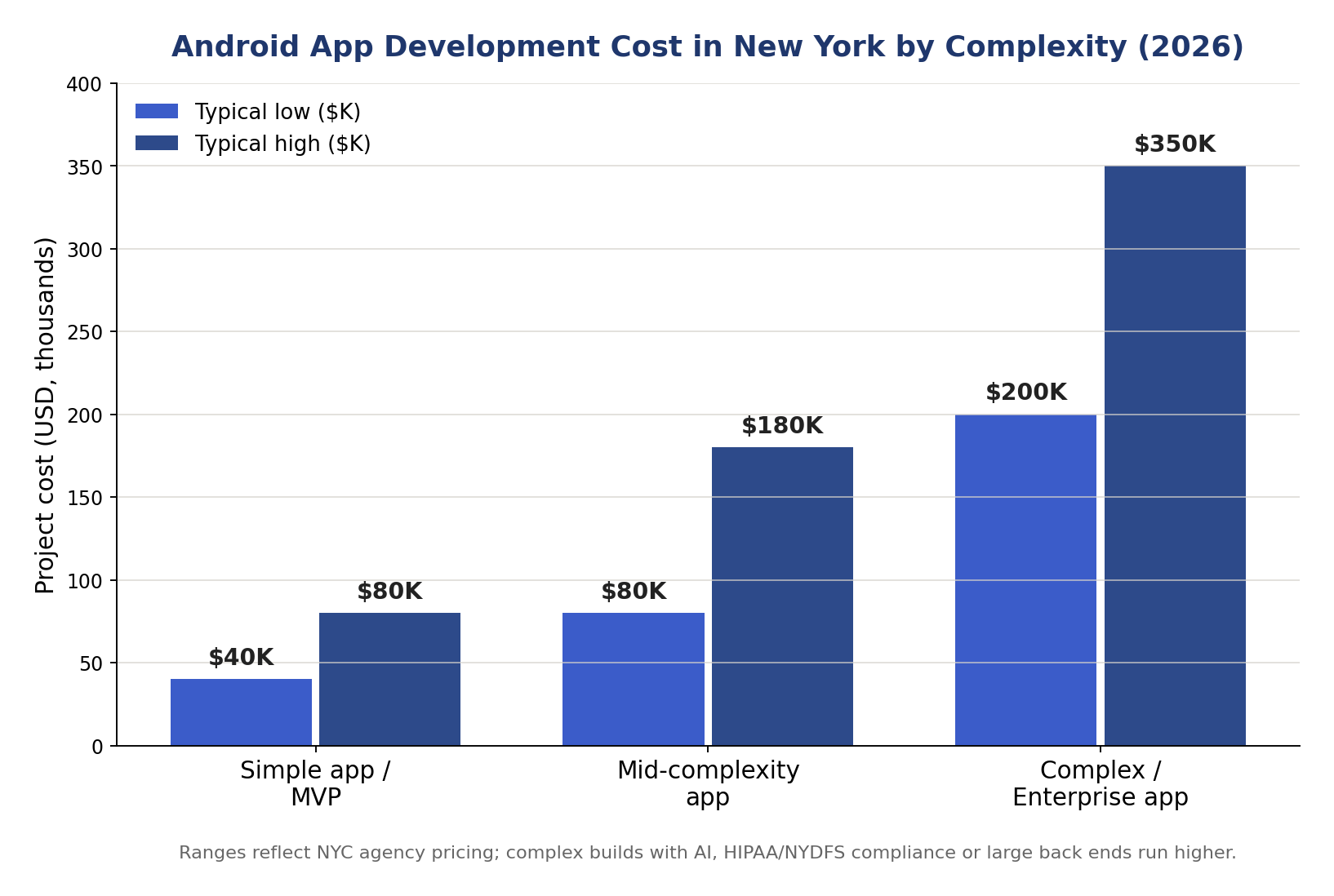
Here is how the tiers break down in practice. A simple Android app or MVP — a focused product with a handful of screens, basic auth, and one or two integrations — runs $40,000 to $80,000. A mid-complexity app with custom UI, payments, real-time features, and several integrations lands between $80,000 and $180,000. A complex or enterprise-grade Android app with AI features, heavy back-end systems, and strict compliance starts around $200,000 and climbs past $350,000.
A few costs hide outside the build itself. Google Play has a one-time developer registration fee. Ongoing maintenance — OS updates, security patches, and small features — typically runs 15–20% of the original build cost per year. Cloud hosting, analytics, and push-notification services add monthly operating expense that scales with your user base.
NYC Android Development Rates and Team Structure
New York carries some of the highest development rates in the country, and that is a function of market dynamics as much as geography. Demand from Wall Street, hospital systems, and venture-backed startups keeps senior engineers busy, so their time is priced accordingly. Understanding who sits on an Android team, and what each role costs, makes an estimate far easier to read.
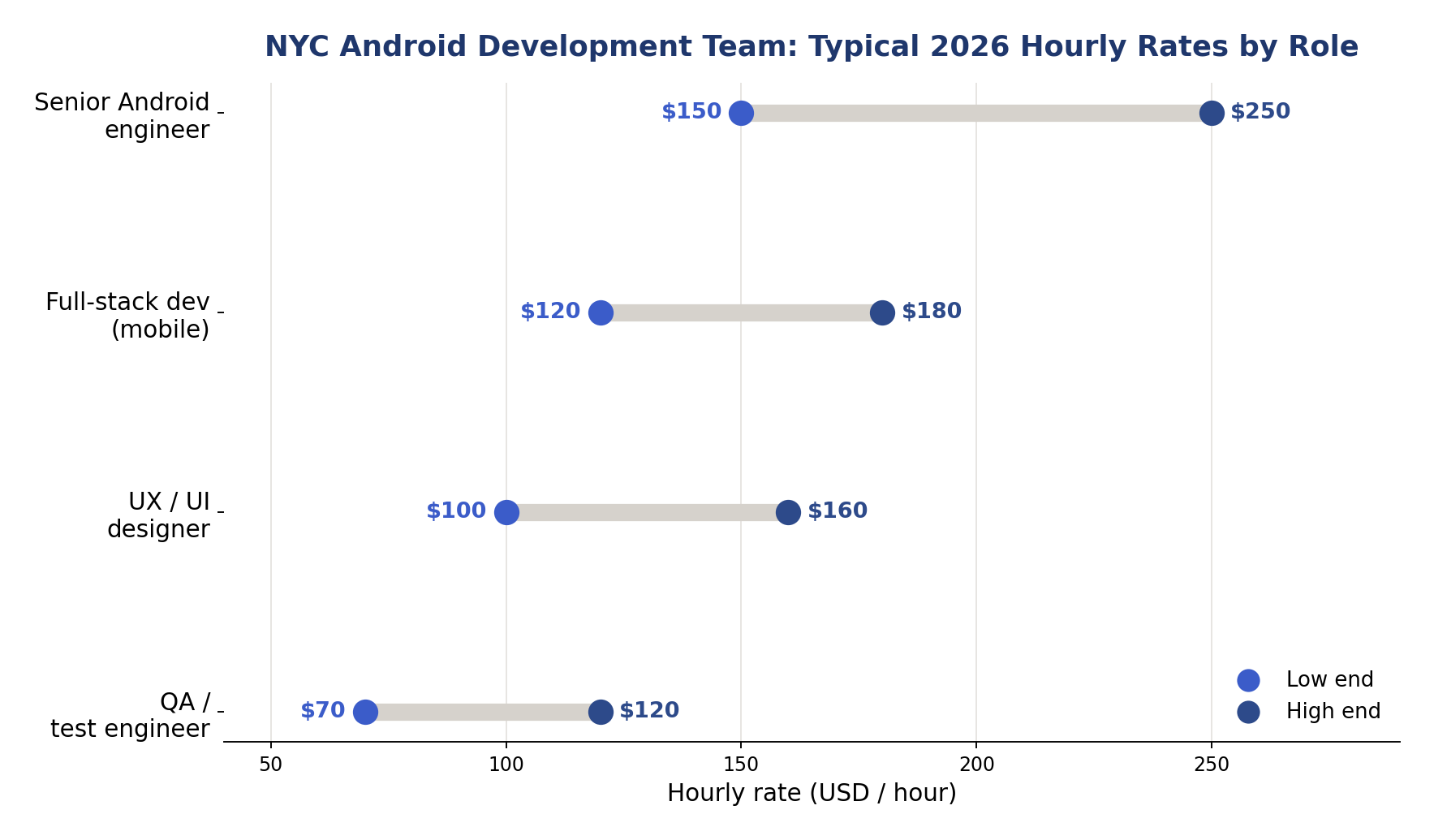
A typical New York Android team blends four roles. A senior Android engineer bills roughly $150 to $250 per hour and owns architecture and the hardest technical work. A full-stack developer with mobile experience runs $120 to $180 and connects the app to back-end services. A UX/UI designer who understands mobile patterns costs $100 to $160. A QA or test engineer sits lower, around $70 to $120, and protects release quality.
Rates alone do not tell you value. A $90-per-hour offshore team that needs three rounds of rework can cost more than a $180-per-hour New York team that ships clean the first time. When we quote Android work at KKRF Group, we frame it around outcomes and total cost of ownership rather than a single blended rate, because that is the number that actually shows up on your books.
The Android App Development Process in New York, Step by Step
A disciplined Android build moves through clear phases. Each one produces something you can review, which keeps budget and scope honest. Below is the process we follow, and the one a serious New York agency should be able to walk you through before you commit.
- Discovery and scoping. We define the problem, the users, and the must-have features, then translate them into a scoped plan with a realistic budget and timeline. This phase prevents the most expensive mistake in software: building the wrong thing well.
- UX and UI design. Designers map user flows and build interactive prototypes using Material Design patterns so you can test the experience before a line of production code is written.
- Architecture and setup. Engineers choose the stack, structure the codebase, and stand up the back end, APIs, and cloud infrastructure the app will depend on.
- Development in sprints. The team builds in two-week sprints, shipping working features you can review continuously rather than waiting months for a single reveal.
- Testing and QA. Every feature is tested across real devices and Android versions for functionality, performance, and security before it is called done.
- Launch on Google Play. The team prepares the store listing, handles Google’s review requirements, and manages a staged rollout to catch issues early.
- Maintenance and iteration. After launch, the app needs OS updates, security patches, and feature work driven by real usage data. Good partners plan for this from day one.
Not sure which cost tier your Android idea falls into? Our engineers will scope it with you and give you a realistic New York number — no guesswork. Start with our Mobile App Development in New York team.
Get a Custom Project Estimate →Android vs iOS vs Cross-Platform for New York Businesses
One of the first decisions a New York business faces is platform strategy. Android reaches the widest audience and is cheaper to distribute; iOS users tend to spend more per head; cross-platform lets you serve both from one codebase. The right answer depends on who your users are and what your budget allows.
| Factor | Native Android | Native iOS | Cross-Platform |
|---|---|---|---|
| Primary language | Kotlin | Swift | Dart (Flutter) / JS (React Native) |
| Market reach (US) | Broad, value-driven | High-spend users | Both platforms at once |
| Relative cost | Baseline | Baseline | 30–40% less than two native builds |
| Performance | Best | Best | Very good for most apps |
| Best for | Android-first or hardware-heavy apps | Premium consumer apps | Startups & MVPs needing both fast |
For many New York startups, a cross-platform build is the pragmatic starting point: it puts the product on Android and iOS at once and cuts cost 30 to 40% versus two separate native apps. Teams that need the deepest performance or hardware integration still choose native. If you want the iOS side of this decision in depth, our companion guide on iOS app development in New York covers it.
Choosing the Android Tech Stack: Kotlin, Jetpack Compose and More
A current native Android stack usually pairs Kotlin and Jetpack Compose with Google’s Jetpack libraries for navigation, data, and lifecycle management. Back ends lean on cloud platforms like AWS, Google Cloud, or Firebase. For cross-platform work, Flutter and React Native are the two mainstream choices, and the decision between them deserves its own analysis. Google’s Android Developers documentation is the authoritative reference on the native stack.
Tech-stack choices are not just engineering trivia — they shape hiring, maintenance cost, and how easily the app can grow. A New York team that defaults to a modern, well-supported stack protects you from the slow tax of legacy code three years down the line.
Industries Driving Android App Demand in New York
New York is not one market; it is a dozen. The city’s Android demand clusters around the industries that define its economy, and each brings its own requirements. Knowing where your app sits helps you anticipate cost and compliance before they surprise you.
Financial services is the heavyweight. Banks, trading platforms, and fintech startups build Android apps under NYDFS cybersecurity rules, and the security bar is high. Our detailed look at fintech app development in New York breaks this down. Healthcare is close behind, where HIPAA compliance shapes everything — covered in our healthcare app development guide.
Real estate and property tech drive listing, tour, and tenant apps across Manhattan and Brooklyn, a segment we cover in our real estate app development guide. Retail and eCommerce brands lean on Android for loyalty and mobile commerce, while logistics and on-demand companies build driver and delivery apps that must work reliably across the five boroughs.
Security and Compliance for New York Android Apps
Security is not a feature you add at the end of an Android build; it is an architecture decision you make at the start. For New York businesses, it also carries legal weight. Two frameworks matter most: NYDFS cybersecurity regulation for financial firms, and HIPAA for anything touching health data.
On the technical side, the OWASP Mobile Application Security standard is the practical baseline: secure data storage, encrypted communication, strong authentication, and protection against reverse engineering. The OWASP Mobile Application Security project is the reference most serious teams build against. For regulated apps, New York’s Department of Financial Services publishes its cybersecurity requirements in full.
Common Mistakes NYC Businesses Make (and How to Avoid Them)
We have inherited enough troubled Android projects to see the same errors repeat. Most are avoidable with the right partner and a little discipline up front.
- Choosing on price alone. The cheapest bid usually becomes the most expensive project once rework and delays are counted.
- Skipping discovery. Jumping straight to code without a scoped plan is how budgets double and timelines slip.
- Ignoring maintenance. An app is not done at launch. Teams that budget nothing for updates watch their app decay within a year.
- Treating security as optional. For a New York fintech or health app, a compliance gap is not a bug — it is a legal and financial risk.
- No analytics from day one. Without usage data, every post-launch decision is a guess.
How to Choose an Android App Development Company in New York
The best Android app development company in New York for you is the one whose strengths line up with your project and whose process you can actually see. Rates and portfolios matter, but they are the start of the evaluation, not the end.
Ask to walk through a recent Android build end to end. Ask how they handle QA, security, and Google Play releases. Ask who owns the code and what maintenance looks like after launch. A strong partner answers plainly and shows you their process; a weak one leans on buzzwords. At KKRF Group we favor a transparent development process, enterprise-grade architecture, and long-term partnership over one-off delivery — because Android apps live and grow for years.
When to Choose Android-First (A Decision Framework)
Not every New York business should build Android first. This framework helps you decide where to put your first dollar.
Limitations to weigh: Android’s device fragmentation means more testing across screen sizes and OS versions, which adds QA cost. Cross-platform saves money but can hit limits for graphics-heavy or deeply hardware-integrated apps. Our recommendation: most New York startups should start cross-platform to validate the market, then invest in native where performance or scale demands it. Enterprises with Android-specific needs should build native from the outset.
Future Trends in NYC Android Development
Android development in New York is moving in a few clear directions. AI features — on-device models, smart assistants, personalization — are shifting from novelty to expectation, especially in fintech and retail apps. Jetpack Compose is now the default for new UI work, and teams still on legacy XML layouts are migrating. Foldables and larger-screen Android devices are pushing more adaptive, responsive design.
The through-line is that Android apps are getting more capable and more regulated at the same time. The New York teams that win are the ones treating security, AI, and maintainability as first-class concerns rather than afterthoughts. That is the posture we bring to every build.
Planning an Android app for the New York market? Book a discovery call and our engineering team will pressure-test your idea, flag compliance needs early, and map a realistic build. Learn more about our mobile app development services.
Book a Discovery Call →Frequently Asked Questions
How much does Android app development cost in New York?
Android app development in New York typically costs between $40,000 and $350,000. A simple app or MVP runs $40,000–$80,000, a mid-complexity app $80,000–$180,000, and a complex or enterprise-grade Android app $200,000 or more. Complexity, integrations, and compliance are the main cost drivers.
How long does it take to build an Android app in NYC?
A focused Android MVP usually ships in 8–12 weeks. A full-featured production app takes four to nine months end to end, depending on scope, integrations, and how much testing the compliance requirements demand.
Should I build an Android or iOS app first in New York?
Choose Android first if your users skew toward Android, you need the widest reach, or hardware integration is central. Choose iOS first if your audience is premium US consumers who over-index on iPhone. Many New York startups start cross-platform to launch on both at once and cut cost 30–40%.
What language is used for Android app development?
Modern native Android apps are built in Kotlin, Google’s officially recommended language, usually paired with the Jetpack Compose UI toolkit. Cross-platform apps use Dart with Flutter or JavaScript with React Native to share one codebase across Android and iOS.
What does it cost to maintain an Android app after launch?
Ongoing Android maintenance typically runs 15–20% of the original build cost per year. That covers OS updates, security patches, bug fixes, and small feature work, plus cloud hosting and third-party service fees that scale with your user base.
How do I choose the best Android app development company in New York?
Evaluate a partner on process, not just price. Ask them to walk through a recent Android build, explain their QA and security approach, clarify who owns the code, and describe post-launch maintenance. The best New York Android partner aligns its strengths with your project and shows its process transparently.
Ready to build with a New York team that owns outcomes, not just hours? Talk to our engineers about your Android project and get a clear scope, timeline, and estimate. Reach the Mobile App Development in New York team today.
Talk to Our Engineering Team →