
Building a social media app in New York in 2026 typically costs between $40,000 for a lean MVP and $450,000+ for an enterprise-grade platform, with most funded startups landing in the $90,000–$200,000 range. The final figure depends on real-time infrastructure, AI-driven feeds, content moderation, and how many platforms you launch on. As a top mobile app development company, KKRF Group builds custom social and community apps for New York founders, media brands, and enterprises — engineered to scale from the first thousand users to the first million.
This guide breaks down real 2026 costs, must-have features, the technology stack, the build process, compliance obligations, and a practical framework for choosing the right social media app development company in New York. It is written for founders and product leaders who want the full picture before they commit a budget.
Key Takeaways
- A social media app in New York costs $40k–$90k for an MVP, $90k–$200k mid-market, and $200k–$450k+ enterprise in 2026.
- Real-time messaging, the news feed algorithm, live video, and content moderation are the largest cost centers — often 50%+ of the budget.
- Cross-platform frameworks (React Native, Flutter) cut cost 20–35% versus separate native builds, without sacrificing scale for most social apps.
- Compliance is not optional: GDPR, the EU Digital Services Act, CCPA, COPPA, and NYC data expectations all shape architecture from day one.
- Choosing a partner should weigh real-time engineering depth, moderation experience, and a transparent process — not just the lowest hourly rate.
What This Guide Covers
- Quick Answer: Cost & Scope
- What Is Social Media App Development?
- Types of Social Media Apps
- Development Cost in New York (2026)
- Where the Budget Goes
- Must-Have Features
- The Technology Stack
- How We Build It, Step by Step
- Moderation, Trust & Compliance
- How Long It Takes
- How These Apps Make Money
- Common Mistakes to Avoid
- Build vs. White-Label vs. Custom
- How to Choose a Partner
- Why Partner With KKRF Group
- Where Social Apps Are Headed
Quick Answer: What It Costs and What You Get
A social media app development company in New York builds custom apps where people create profiles, connect, share content, and interact in real time. In 2026, a basic MVP with profiles, a feed, and messaging runs $40,000–$90,000. A mid-market app with live video, push notifications, and an AI feed sits at $90,000–$200,000. A high-scale platform with recommendation engines, creator monetization, and heavy moderation reaches $200,000–$450,000 or more.
Timelines usually run 3–5 months for an MVP and 8–14 months for a full platform. The single biggest driver of both cost and risk is real-time infrastructure — the systems that deliver messages, feeds, and video instantly to thousands of concurrent users without lag.
What Is Social Media App Development?
Social media app development is the process of designing, engineering, and launching a mobile or web application built around user-generated content and social interaction. The defining traits are user profiles, a content feed, connections between users, and real-time communication. Everything else — commerce, dating, learning, gaming — layers on top of that social core.
This is different from building a standard business app. Social platforms carry unique engineering demands: data grows unpredictably, traffic spikes without warning, and every feature has to work for one user and one million users alike. That is why the architecture decisions made in week one matter more here than in almost any other category of app.
Types of Social Media Apps You Can Build
“Social media” is a broad category, and the type you build changes the budget significantly. A niche community app is far cheaper than a video-first platform. Here are the main categories New York clients ask us to build.
- Social networking apps — profile- and connection-centered platforms like a LinkedIn or Facebook style experience, focused on relationships and feeds.
- Media sharing apps — photo and short-video platforms in the style of Instagram or TikTok, where live video and CDN costs dominate.
- Community & niche apps — interest-based networks for a profession, neighborhood, or fandom, often the fastest path to product-market fit.
- Messaging & chat apps — real-time communication as the core product, with end-to-end encryption and presence.
- Live streaming & creator apps — broadcast-first platforms with tipping, subscriptions, and creator monetization built in.
New York’s creator economy, media companies, and startups tend to lean toward media-sharing and creator platforms, which is also where the highest engineering complexity lives. A community or networking MVP is often the smarter first move because it validates demand before you invest in expensive video infrastructure.
Social Media App Development Cost in New York (2026)
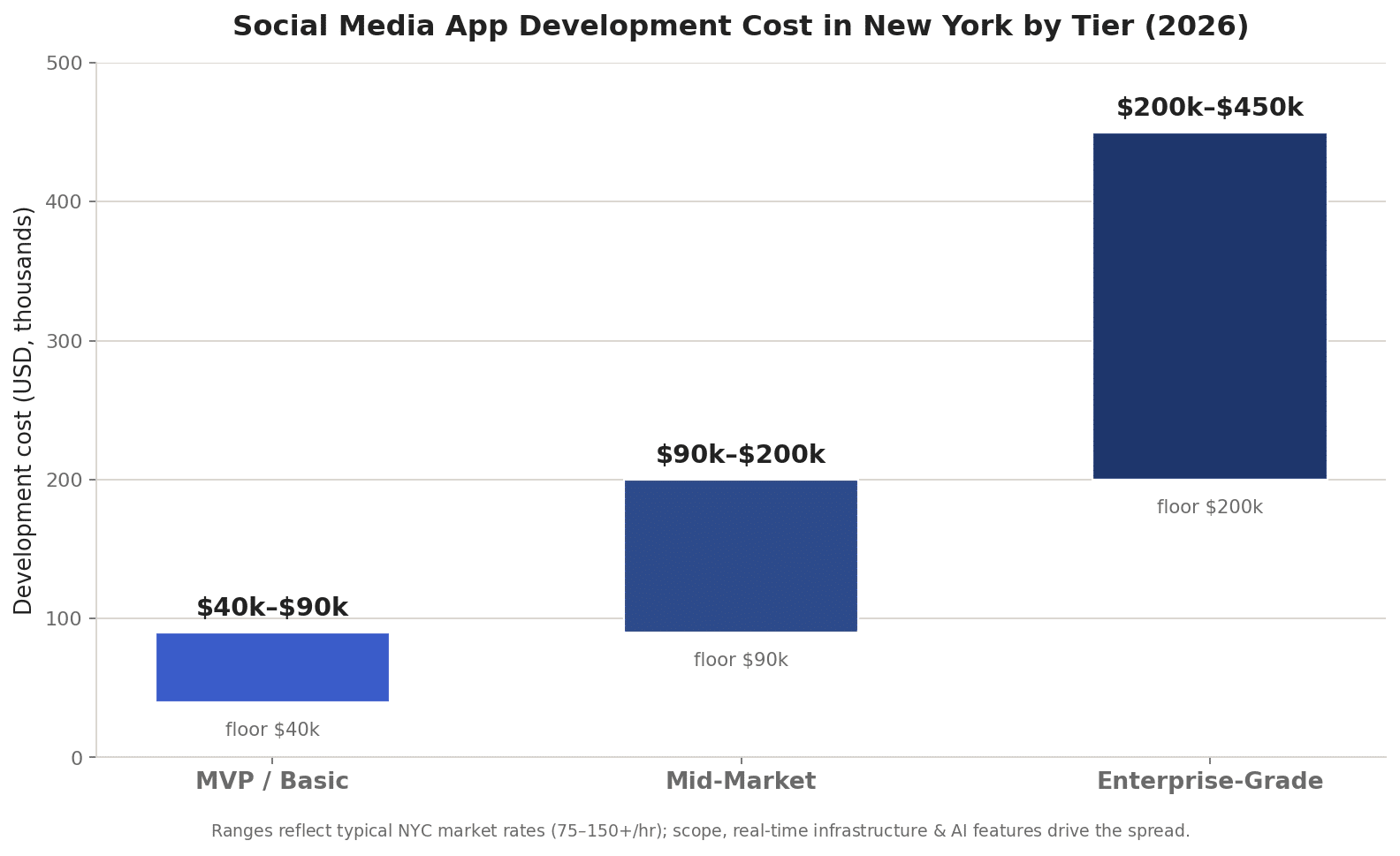
New York carries some of the highest development rates in the United States. Local senior engineers bill $150–$250 per hour, which is why many NYC founders work with a partner that blends local product leadership with distributed engineering — keeping quality high while controlling cost. The chart below shows the typical total cost by tier. Whether your team sits in Manhattan, Brooklyn, or works fully remote, the same principle holds: you are paying for engineering skill and product judgment, and you can hire that talent flexibly rather than staffing an expensive full in-house team from day one.
| App Tier | What It Includes | Typical NYC Cost (2026) | Timeline |
|---|---|---|---|
| MVP / Basic | Profiles, feed, follow/connect, basic messaging, push notifications | $40,000 – $90,000 | 3–5 months |
| Mid-Market | AI-ranked feed, live video, stories, moderation tools, analytics | $90,000 – $200,000 | 6–9 months |
| Enterprise-Grade | Recommendation engine, creator monetization, advanced Trust & Safety, high-scale infra | $200,000 – $450,000+ | 9–14 months |
These ranges assume a cross-platform build for iOS and Android plus a web app. Two separate native apps push costs toward the upper end. Ongoing costs matter too: budget 15–25% of the build cost per year for hosting, moderation, third-party APIs, and iteration once you have real users.
Where the Budget Goes: Cost by Component
Understanding the cost breakdown helps you decide where to invest and where to trim for version one. For a mid-market social platform, the backend and real-time layer is consistently the largest line item, followed by the AI feed and moderation. Design and front-end matter, but they rarely dominate the budget.
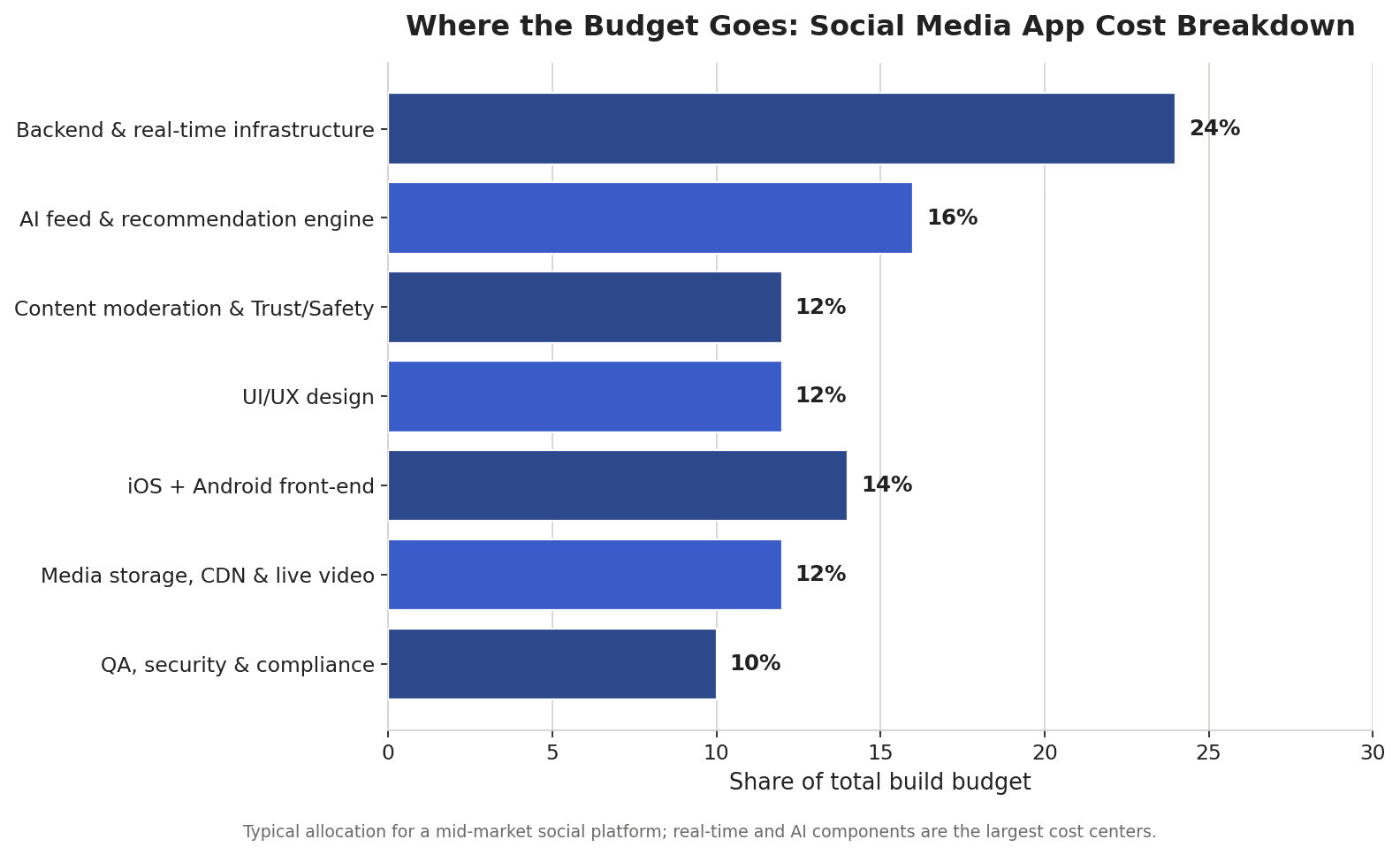
The lesson from this distribution is simple: the parts of a social app users never see — the servers, message queues, and safety systems — are where most of the money goes. Founders who cut corners here to fund a flashier interface almost always pay for it later in downtime, spam, and re-engineering. We have seen this go wrong when a promising app crumbles under its own launch-day traffic.
Must-Have Features of a Modern Social App
Every social media app shares a common backbone of features. The MVP set validates your idea; the growth set keeps users coming back. Here is how we typically phase them.
Core MVP features
- User onboarding, profiles, and social login
- A content feed with posts, images, and short video
- Follow, connect, and friend relationships
- Real-time messaging and push notifications
- Likes, comments, shares, and basic search
Growth and engagement features
- An AI-ranked feed and recommendation engine that surfaces relevant content
- Stories, reels, and live streaming
- Content moderation and reporting tools
- Creator monetization: tipping, subscriptions, and ads
- Analytics dashboards and A/B testing for engagement
A disciplined MVP ships the core set only. It is tempting to launch with everything, but the fastest-growing New York apps we have worked on started narrow, learned from real behavior, then invested in the features that data proved people wanted.
The Technology Stack Behind a Scalable Social App
The right stack balances speed of development against long-term scale. There is no single correct answer, but the choices below are the ones we reach for most often when building enterprise-grade social platforms, because they are proven at scale and well supported.
| Layer | Typical Choices | Why It Matters |
|---|---|---|
| Mobile front-end | React Native, Flutter, or native Swift/Kotlin | Cross-platform cuts cost; native suits heavy video |
| Backend | Node.js, Go, or Python (Django) | Handles API load and business logic |
| Real-time | WebSockets, Socket.IO, or managed pub/sub | Powers chat, feeds, and presence |
| Database | PostgreSQL + Redis; Cassandra at scale | Fast reads for feeds; caching for speed |
| Media & video | AWS S3, CloudFront CDN, WebRTC, HLS | Delivers images and live video efficiently |
| Infrastructure | AWS or Google Cloud, Kubernetes | Auto-scales for traffic spikes |
We favor cross-platform frameworks for most social apps because they cut build cost by 20–35% and let a single team ship to iOS and Android at once. For a video-first product where every millisecond of performance counts, we will recommend native code for the parts that need it. The stack should serve the product, not the other way around. Put simply, the right tech stack is the one that fits your product, your budget, and the engineers you can realistically hire and retain.
Have a social or community app idea and want a realistic number before you raise or budget? Our New York team can scope features, stack, and cost in a single session. Talk to our engineering team and get a clear estimate.
Get a Custom Project Estimate →How We Build a Social Media App: Step by Step
A clear process is what separates an app that ships on time from one that stalls. This is the sequence we follow on social platform projects. Each step has a defined outcome so you always know where the project stands.
Step 1 — Discovery & product strategy. We define the target user, the core loop, and the MVP feature set, and agree on success metrics. This produces a validated scope and a fixed cost range.
Step 2 — UX/UI design. We design the flows and interface, then test a clickable prototype with real users before a line of production code is written.
Step 3 — Architecture & real-time engineering. We design the backend, database, and real-time layer for scale, and set up the moderation and security foundations early.
Step 4 — Agile development. We build in two-week sprints with working demos, so you see and steer the product as it comes together.
Step 5 — QA, security & load testing. We test functionality, run security reviews, and simulate launch-day traffic so the app holds up under real concurrency.
Step 6 — Launch & iteration. We ship to the App Store and Google Play, monitor real usage, and iterate on the features engagement data proves matter.
Content Moderation, Trust & Safety, and Compliance
The moment users can post content, you inherit responsibility for that content. Moderation and compliance are not features you bolt on later; they shape the architecture and the budget from day one. Ignoring them is the fastest way to lose users, app-store approval, or a lawsuit.
For a New York or US-facing app, the compliance landscape includes several overlapping obligations. A capable development partner designs for these from the start rather than retrofitting them under deadline.
- GDPR & CCPA — data privacy rights for EU and California users, including consent, access, and deletion.
- EU Digital Services Act (DSA) — content moderation, transparency, and reporting duties for platforms serving EU users.
- COPPA — strict rules if anyone under 13 can use the app, which most social platforms must actively prevent or heavily gate.
- App Store & Google Play policies — both require robust moderation and reporting for user-generated content, or they reject the app.
We build security-first: encrypted data in transit and at rest, secure authentication, rate limiting against spam and bots, and audit logging. Following guidance like the OWASP Mobile Top 10 is a baseline, not a bonus.
How Long Does It Take to Build?
Timeline tracks closely with scope. An MVP focused on a single core loop can reach the app stores in about four months. A feature-rich platform with live video and an AI feed is realistically an 8–14 month effort before a polished public launch.
| Phase | MVP | Full Platform |
|---|---|---|
| Discovery & design | 3–5 weeks | 5–8 weeks |
| Core development | 8–12 weeks | 20–36 weeks |
| QA & load testing | 2–3 weeks | 4–8 weeks |
| Launch prep | 1–2 weeks | 2–4 weeks |
The fastest way to shorten a timeline is to narrow the launch scope, not to add engineers to a rushed plan. A tight MVP that reaches real users in four months will teach you more than a year spent building features nobody asked for.
How Social Media Apps Make Money
Revenue strategy should influence the build, because each model needs its own plumbing. The main approaches for social apps in 2026 are advertising, subscriptions, creator monetization, and marketplace fees. Most successful platforms combine two or three.
- Advertising — native and targeted ads once you have meaningful daily active users and engagement data.
- Premium subscriptions — paid tiers for advanced features, larger uploads, or an ad-free experience.
- Creator monetization — tipping, paid subscriptions, and revenue sharing that keep top creators on your platform.
- Marketplace & transaction fees — a cut of in-app purchases, event tickets, or social commerce.
Whatever the model, it needs to be designed into the app early. Adding payments, ad targeting, or creator payouts after launch means re-architecting core systems, which is far more expensive than planning for them upfront.
Common Mistakes to Avoid
We have rescued enough struggling social apps to see the same avoidable mistakes repeat. Steering clear of these saves both money and months.
- Overbuilding the first version. Launching with 30 features instead of the five that prove the concept.
- Underinvesting in real-time infrastructure. Cheap backends that collapse the moment the app gets traction.
- Treating moderation as an afterthought. Spam and abuse can kill a community faster than any competitor.
- Ignoring retention mechanics. Chasing installs while the app leaks users through a weak core loop.
- Choosing a partner on price alone. The cheapest quote often becomes the most expensive rebuild.
Build vs. White-Label vs. Custom: A Decision Framework
Not every social app should be custom-built. The right approach depends on your differentiation, budget, and timeline. Use the framework below to decide honestly before you spend.
| Approach | Best When | Trade-off |
|---|---|---|
| White-label / template | Budget under $30k, generic community, speed over uniqueness | Limited scale and little differentiation |
| Hybrid (custom on a base) | You need some unique features but not a full rebuild | Faster than custom, but constrained by the base |
| Fully custom | Your product idea, scale, or data model is your advantage | Higher upfront cost and longer timeline |
When to choose custom development
Choose fully custom when your social experience is the business — when the feed logic, community model, or monetization is what makes you different. If you plan to raise capital or scale past tens of thousands of users, custom pays for itself in performance and flexibility.
When not to choose custom
Skip custom if you are testing a generic idea on a shoestring budget, or if a white-label tool already does 90% of what you need. There is no prize for over-engineering an unvalidated concept. Our honest recommendation to some New York clients has been to start on a template, prove demand, then rebuild custom once traction is real.
Not sure whether custom, hybrid, or white-label fits your idea and budget? We will give you a straight answer, not a sales pitch. Book a discovery call with KKRF Group’s New York team.
Book a Discovery Call →How to Choose a Development Company in New York
The company you pick matters more than the framework you use. A strong social media app development company in New York should demonstrate real-time engineering depth, moderation experience, and a transparent way of working. Evaluate candidates against these criteria.
- Real-time and scale experience. Ask to see apps they have built that handle live chat, feeds, or video at volume.
- Moderation and Trust & Safety track record. Confirm they have shipped reporting, detection, and safety systems before.
- Transparent process and pricing. Clear sprints, demos, and a documented scope — not a vague fixed bid.
- A modern, maintainable stack. Code you or another team can extend later, with tests and documentation.
- Product thinking, not just coding. A partner who pushes back on scope and focuses on retention, not just delivery.
Interview the people who will actually do the work, ask for references, and start with a small paid discovery phase before committing to a full build. A good partner will welcome that; a risky one will resist it.
Why New York Businesses Partner With KKRF Group
KKRF Group is an enterprise software development company that builds custom social, community, and content platforms for New York founders and brands. Our approach pairs local product strategy with senior distributed engineering, so clients get NYC-grade product leadership without an all-NYC price tag.
We engineer for scale from the first sprint: real-time systems that hold up under load, security-first architecture, and Trust & Safety built in rather than bolted on. We work in transparent two-week sprints with working demos, so you steer the product as it takes shape. And we are candid about scope — if a leaner build serves you better, we will say so.
From MVPs that need to reach the market fast to enterprise platforms that must scale to millions, we act as a long-term technology partner, not a one-off vendor. That is the difference between an app that launches and an app that lasts.
Where Social Media Apps Are Headed in 2026
The category keeps shifting, and the platforms that win design for where it is going. A few trends are shaping every serious social build we take on this year.
- AI-native feeds and creation — recommendation engines and generative tools built into the core, not added as gimmicks.
- Niche and private communities — smaller, interest-driven networks outperforming broad public feeds on engagement.
- Creator-first monetization — platforms competing on how well they pay and retain creators.
- Privacy and on-device processing — more computation happening on the phone to protect user data.
- Interoperability and short-form video everywhere — video as the default format across every social category.
None of this requires chasing every trend. It means building on an architecture flexible enough to adopt what proves valuable — which is exactly what a well-planned custom platform gives you.
Ready to build a social or community app New Yorkers will actually use? Let’s turn your idea into a scoped, scalable plan with real numbers. Request a consultation with KKRF Group today.
Request a Consultation →Frequently Asked Questions
How much does it cost to build a social media app in New York in 2026?
A social media app in New York costs $40,000–$90,000 for an MVP, $90,000–$200,000 for a mid-market app, and $200,000–$450,000+ for an enterprise-grade platform. The exact figure depends on real-time features, AI feeds, video, moderation, and how many platforms you launch on.
How long does it take to develop a social media app?
An MVP typically takes 3–5 months from discovery to launch. A full-featured platform with live video and an AI-ranked feed usually takes 8–14 months. Narrowing the initial scope is the most reliable way to launch faster.
Which technology stack is best for a social media app?
Most social apps use React Native or Flutter for cross-platform mobile, Node.js or Go for the backend, WebSockets for real-time features, PostgreSQL with Redis for data, and AWS with a CDN for media. Native code is added where heavy video performance demands it.
What features does a social media app MVP need?
A minimum viable social app needs user profiles, a content feed, follow or connect relationships, real-time messaging, push notifications, and basic likes, comments, and search. Advanced features like AI feeds, live video, and monetization come after you validate demand.
Do social media apps have to comply with data and moderation laws?
Yes. Social apps must comply with GDPR and CCPA for privacy, the EU Digital Services Act for moderation and transparency, COPPA if minors can access the app, and the App Store and Google Play content policies. These obligations shape the architecture from day one.
Why choose KKRF Group to build a social media app in New York?
KKRF Group is an enterprise software development company that builds scalable, secure social and community platforms for New York clients. We combine local product strategy with senior engineering, build real-time infrastructure and Trust & Safety in from the start, and work in transparent sprints with a long-term partnership approach.