
New York runs on real estate. Between Manhattan towers, Brooklyn brownstones, and Queens multifamily portfolios, the city moves more property value in a week than some states do in a year. So when a brokerage, proptech startup, or property manager decides to build an app, the stakes are higher than a generic listings clone. At KKRF Group, a top mobile app development company, we’ve seen NYC real estate teams win or lose deals on whether their app can surface the right unit, at the right price, before a competitor’s does.
This guide breaks down real estate app development in New York the way an engineering partner actually scopes it: real cost ranges, the features that matter to NYC agents and buyers, MLS and IDX integration, the compliance rules the five boroughs enforce, and how to pick a development partner who won’t disappear after launch. Whether you’re a solo broker in SoHo or a proptech firm chasing that next round of funding, the decisions below shape your budget and your timeline.
Key Takeaways
- A New York real estate app typically costs $25K–$450K+ depending on tier, from a single-broker MVP to a native, MLS-integrated enterprise platform.
- Most NYC builds ship in 3–6 months; MLS/IDX and third-party integrations alone can add $20K–$60K.
- StreetEasy dominance, MLS/IDX rules, and NYC’s compliance culture (Fair Housing, the NY SHIELD Act, WCAG accessibility) make local expertise non-negotiable.
- Cross-platform frameworks like React Native and Flutter cut cost; native Swift/Kotlin wins on performance for map-heavy, media-heavy apps.
- The partner you choose matters more than the framework — look for proptech experience, security-first engineering, and post-launch support.
What This Guide Covers
Quick Answer: What Does Real Estate App Development in New York Cost and Involve?
Building a real estate app in New York usually costs between $25,000 and $450,000+ and takes 3 to 6 months. A simple single-broker MVP with listings, search, and lead capture sits at the low end. A native, MLS-integrated platform with virtual tours, in-app messaging, e-signatures, and AI recommendations sits at the high end. The biggest cost drivers in NYC are data integrations (MLS/IDX, StreetEasy-grade search), compliance work (Fair Housing, data-security law), and the design polish local buyers now expect.
What Real Estate App Development in New York Actually Involves
Real estate app development is the process of designing, building, and maintaining a mobile or web application that helps people search, list, transact, or manage property. In New York, that definition carries extra weight. The market is fragmented across boroughs, listing data lives behind MLS and IDX agreements, and buyers expect the kind of instant, media-rich experience they get from StreetEasy or Zillow.
A real estate app isn’t one product — it’s a category. The right build depends on who’s using it:
- Agent and brokerage apps — listing management, showings, CRM, and client communication for teams across Manhattan, Brooklyn, and Queens.
- Buyer and renter marketplaces — search, saved filters, map discovery, mortgage tools, and inquiry flows for consumers.
- Property management platforms — rent collection, maintenance tickets, tenant portals, and owner reporting for multifamily operators.
- Proptech and iBuyer products — data-driven valuation, investor tooling, and transaction automation aimed at scale and funding.
We build each of these differently. A brokerage tool leans on workflow and speed; a consumer marketplace lives and dies by search performance and design. Knowing which one you’re building is the first real decision — and it sets your budget more than any framework choice.
Real Estate App Development Cost in New York (2026)
Let’s talk numbers, because that’s usually the first question. NYC pricing runs higher than the national average — local talent costs more, and the compliance and integration work is heavier. Here’s how the tiers break down based on 2026 market rates.
| App Tier | Typical NYC Cost | Timeline | What You Get |
|---|---|---|---|
| MVP / single-broker app | $25K – $80K | 2–3 months | Listings, search, filters, saved properties, lead capture, basic maps |
| Mid-market agency app | $50K – $200K | 3–5 months | Multi-agent CRM, in-app messaging, IDX feed, notifications, admin panel |
| Enterprise / MLS-integrated | $120K – $350K | 5–7 months | Full MLS sync, virtual tours, e-signatures, payments, analytics, roles |
| Native + AI (iOS & Android) | $180K – $450K+ | 6–9 months | Native performance, AI recommendations, AR staging, advanced security |
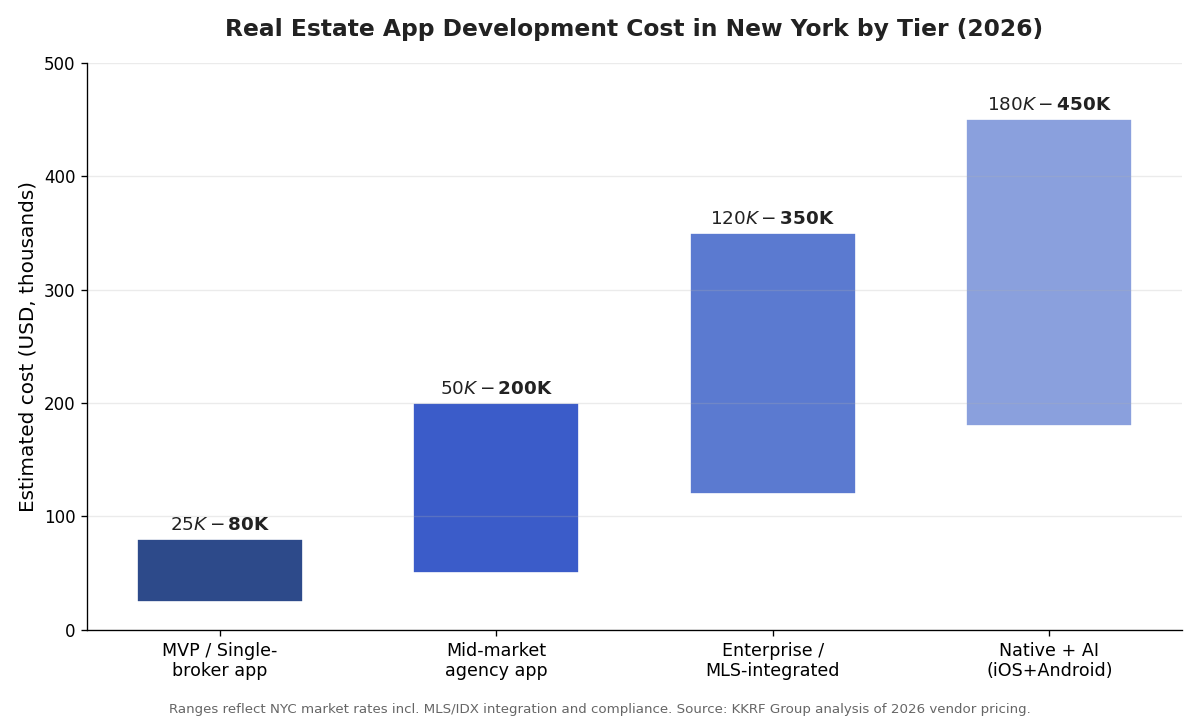
Two line items surprise NYC clients most often. First, integrations: connecting to MLS/IDX feeds, DocuSign, payment rails, and mapping providers can add $20K–$60K on its own. Second, design. New York users compare your app to StreetEasy whether you like it or not, so the UX bar is high. We’d rather set that expectation up front than have it show up as a mid-project surprise.
For a deeper breakdown of local pricing across app types, our mobile app development cost in New York guide maps costs to features and team models in more detail.
Not sure which tier fits your idea or your budget? We’ll scope it with you honestly — no inflated estimates. Tell us about your New York real estate app and we’ll map the fastest path to launch.
Get a Custom Project Estimate →Must-Have Features for a New York Real Estate App
Feature scope is where budgets balloon. The trick is separating what NYC users actually need from what sounds impressive in a pitch deck. Based on the apps we’ve shipped, here’s the core set that earns its keep.
Core features every listing app needs
- Advanced property search and filters — by borough, neighborhood, price, beds, and building amenities, with map and list views.
- Rich media listings — high-res photos, floor plans, and virtual or video tours that load fast on the subway’s spotty signal.
- Saved searches and alerts — instant push notifications when a matching unit hits the market, because NYC inventory moves in hours.
- Lead capture and in-app messaging — inquiry forms, chat, and scheduling that connect buyers to agents without leaving the app.
- Map-based discovery — commute times, school zones, and neighborhood context powered by mapping and transit data.
Advanced features that separate NYC winners
- MLS/IDX-synced inventory — live listing data instead of a stale, hand-maintained database.
- Mortgage and affordability calculators — plus rent-vs-buy tools tuned to NYC’s tax and co-op realities.
- E-signatures and document handling — DocuSign-style flows for offers, leases, and disclosures.
- AI-driven recommendations — personalized listings and price insights that keep users coming back.
- AR and 3D staging — let buyers visualize a furnished, renovated space before they book a showing.
The Real Estate App Development Process, Step by Step
A good NYC build is boring in the best way — predictable phases, no surprises. Here’s the sequence we run at KKRF Group, and roughly where the weeks go.
- Discovery and compliance scoping (weeks 1–2). We define users, map the MLS/IDX data you can legally access, and flag Fair Housing and data-security obligations before a single screen is designed.
- UX/UI design and data modeling (weeks 2–5). Wireframes, a clickable prototype, and a listing data model that mirrors how NYC inventory actually behaves.
- Core development (weeks 5–11). Search, listings, maps, and accounts get built and tested in short sprints you can review weekly.
- Integrations (weeks 11–17). MLS/IDX feeds, DocuSign, payments, and mapping APIs — the phase that most often runs long if it’s rushed.
- QA, security, and store review (weeks 17–21). Device testing, penetration testing, and Apple’s App Store review, which has its own timeline you can’t fully control.
- Launch and iteration (weeks 21–24). Release, monitor real usage, and ship the fixes that only show up once real agents and buyers are inside.
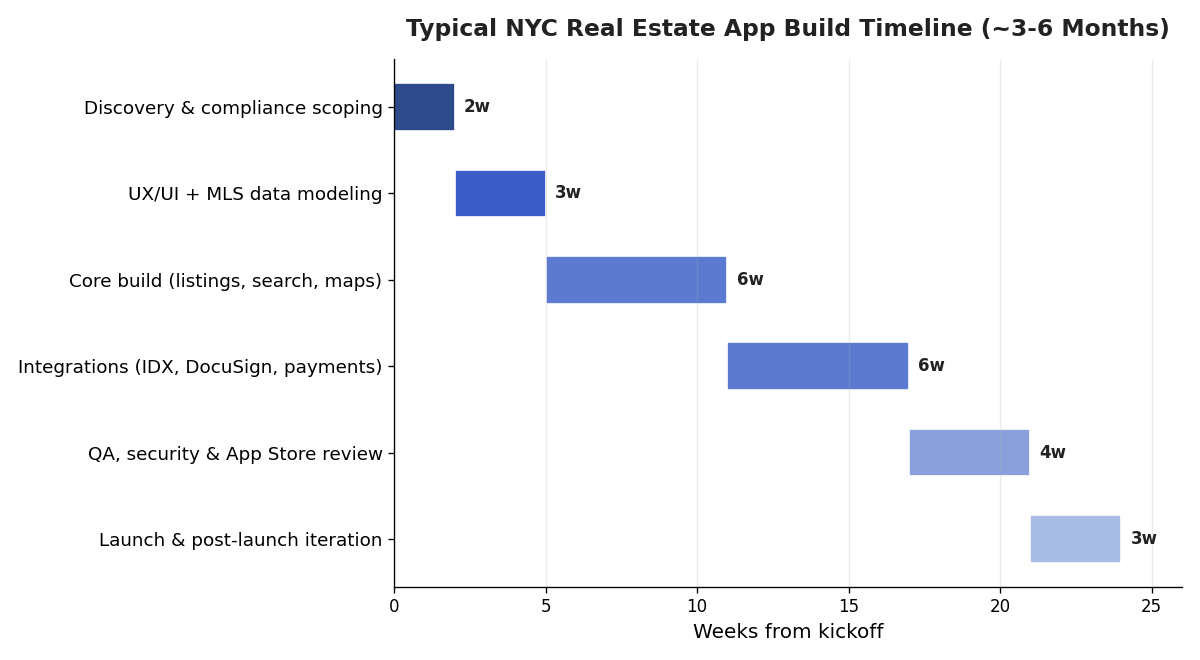
Notice how much time integrations and QA eat. Teams that compress those two phases to hit a demo date are the ones calling us six months later to rebuild. We’d rather protect that runway than ship something that breaks on launch day.
MLS, IDX & the New York Data Stack
Here’s the part generic developers underestimate. In New York, your listing data doesn’t just appear — it comes through MLS (Multiple Listing Service) and IDX (Internet Data Exchange) agreements, each with rules about what you can display, how often you sync, and how you attribute listings. Get this wrong and you’re not just buggy, you’re non-compliant.
A practical NYC data stack usually pulls together several sources:
- MLS/IDX feeds for live, licensed listing inventory and required disclosures.
- Mapping and geodata via a provider like Google Maps Platform for search, commute times, and neighborhood boundaries.
- Transaction tools — e-signature (DocuSign), payment processing (Stripe), and document storage for offers and leases.
- CRM and marketing integrations so leads flow into the systems agents already use.
We design the data layer so a feed change or a new MLS rule doesn’t force a rebuild. That architecture discipline is exactly what separates a top mobile app development company from a freelancer who wires the first feed that works and moves on.
Security, Compliance & Fair Housing in New York
Real estate apps handle sensitive data — financials, IDs, signed contracts — and they operate in one of the most regulated housing markets in the country. Security isn’t a feature you bolt on at the end. We build it in from day one, and in NYC that means three overlapping obligations.
Data security law
New York’s SHIELD Act requires reasonable safeguards for the private information of state residents, and it defines breaches broadly. Encryption in transit and at rest, access controls, and an incident plan aren’t optional. The New York Attorney General’s data-breach guidance is a useful reference for what “reasonable” looks like.
Fair Housing
Any app that shows listings, targets ads, or recommends properties can run into Fair Housing exposure if its algorithms steer users by protected class. The federal Fair Housing Act, plus the NYC Human Rights Law, mean your recommendation and ad-targeting logic needs deliberate review — not an afterthought.
Mobile app security standards
For the technical layer, we align builds to recognized standards like the OWASP Mobile Application Security project, and we make apps accessible under WCAG so they hold up to ADA scrutiny. Security-first engineering is core to how we work — for teams handling money and identity, our fintech app development in New York practice applies the same rigor.
Native vs. Cross-Platform: Choosing Your Tech Stack
The framework question decides a big slice of your budget and performance ceiling. There’s no universally right answer — only the right answer for your app.
| Factor | Cross-Platform (React Native / Flutter) | Native (Swift / Kotlin) |
|---|---|---|
| Cost | Lower — one codebase for iOS & Android | Higher — two separate codebases |
| Time to market | Faster | Slower |
| Map & media performance | Good for most apps | Best for heavy maps, AR, video |
| Best fit | MVPs, agency tools, marketplaces | Enterprise, AR staging, media-rich apps |
For most NYC real estate apps, we start with a cross-platform framework — React Native or Flutter — because it ships faster and costs less while still handling maps and rich listings well. When an app leans hard on AR staging, 3D tours, or buttery map interactions, native Swift and Kotlin earn their premium. The honest trade-off: native buys performance and platform polish; cross-platform buys speed and budget. We pick based on your roadmap, not on what’s fashionable this year.
Top Real Estate App Development Companies in New York
If you’re comparing partners, it helps to see the landscape honestly. Several firms do credible proptech work in and around New York. Here’s a neutral snapshot — then where KKRF Group fits.
| Company | Focus |
|---|---|
| KKRF Group | Enterprise-grade custom apps, security-first engineering, MLS integration, long-term partnership |
| Vention | New York–based real estate practice with a proptech portfolio |
| Blue Label Labs | NYC product studio with discovery-led app development |
| Inoxoft | Custom real estate software with property-management clients |
| New York App Devs | Agent-focused apps across the five boroughs |
Every firm here can build a competent app. What we bring at KKRF Group is a custom engineering approach built around your data and your compliance reality, enterprise-grade architecture that scales past your first funding round, and a team that stays after launch. We don’t claim awards we haven’t earned — we’d rather earn the second project by delivering the first one well.
Common Mistakes NYC Real Estate Teams Make
We get called in to fix these more often than we’d like. Avoid them and you’re ahead of most of the market.
- Treating MLS/IDX as an afterthought. The data layer is the app. Bolt it on late and you rebuild the core.
- Underspending on search. If filtering feels slower than StreetEasy, users leave and don’t come back.
- Ignoring Fair Housing in the algorithm. Recommendation logic that steers by protected class is a legal risk, not just a design flaw.
- Skipping post-launch budget. Apps need maintenance, OS updates, and iteration. Plan for 15–20% of build cost per year.
- Choosing a partner on price alone. The cheapest quote often becomes the most expensive rebuild.
Already have an app that’s slow, non-compliant, or hard to maintain? A focused review usually finds the two or three fixes that matter most. Let our engineers look under the hood before you commit to a rebuild.
Request a Technical Assessment →ROI & the Business Case for a Real Estate App
An app is a capital decision, so let’s frame the return. In NYC’s competitive market, the payback usually shows up in three places: faster lead response, higher agent productivity, and better client retention.
- Speed to lead. Push alerts that surface a new unit in minutes turn casual browsers into showings — and in NYC, minutes decide deals.
- Agent efficiency. A CRM-and-messaging app that removes the phone-tag and spreadsheet shuffle lets each agent carry more clients.
- Retention and referrals. A polished app keeps your brand on the buyer’s home screen long after the first search, feeding repeat and referral business.
New York proptech attracts serious capital — local companies pulled in well over a billion dollars in venture funding in recent years — which tells you investors believe software is where this market’s margin lives. A well-built app isn’t a cost center; it’s the asset that compounds.
How to Choose a Real Estate App Development Partner
Use this quick framework when you’re evaluating firms. If a partner can’t answer these clearly, keep looking.
- Proptech track record. Have they shipped real estate apps, and can they speak fluently about MLS/IDX and Fair Housing?
- Security posture. Do they build to standards like OWASP and design for the SHIELD Act from the start?
- Architecture for scale. Will the app survive your next funding round, or is it a demo that buckles under real traffic?
- Transparent process. Do you get weekly, reviewable progress — or a black box until launch?
- Post-launch commitment. Who maintains it, patches it, and iterates once real users arrive?
As a top mobile app development company, KKRF Group is built to pass all five — we partner for the long term, not the launch. Our broader mobile app development services extend the same approach across industries and platforms.
Future Trends in NYC Proptech
Where’s this heading over the next few years? A few shifts are already reshaping what NYC real estate apps need to do.
- AI as the default search layer. Natural-language search (“2BR under $4K near the L train”) is becoming the expectation, not a novelty.
- Immersive tours. AR staging and 3D walkthroughs cut wasted showings in a city where every commute costs time.
- Generative and answer-engine visibility. Buyers increasingly start with AI assistants, so structured, machine-readable listing data matters for discovery.
- Deeper transaction automation. More of the offer-to-close flow — signatures, payments, disclosures — is moving inside the app.
Ready to build a real estate app that NYC agents and buyers actually want to use? Let’s turn your idea into a clear scope, timeline, and budget — starting with a conversation about what you’re trying to win.
Book a Discovery Call →Frequently Asked Questions
How much does it cost to develop a real estate app in New York?
Most New York real estate apps cost between $25,000 and $450,000+. A single-broker MVP with search and lead capture runs $25K–$80K, while a native, MLS-integrated enterprise platform with virtual tours and AI can exceed $350K. Integrations and design push NYC costs above the national average.
How long does it take to build a real estate app in NYC?
A typical New York real estate app ships in 3 to 6 months. Simple MVPs can launch in 8–10 weeks; enterprise builds with full MLS sync, e-signatures, and payments take 6–9 months once QA and App Store review are included.
Do I need MLS or IDX integration for my real estate app?
If you want live, licensed listing data, yes. MLS and IDX agreements govern what you can display and how you sync it. Skipping them leaves you with a stale, manually maintained database — and integrating them incorrectly can create compliance problems.
Should I build a native or cross-platform real estate app?
Cross-platform frameworks like React Native and Flutter are cheaper and faster and suit most agency tools and marketplaces. Native Swift and Kotlin are worth the premium for map-heavy, AR, or media-rich apps that demand top performance.
What compliance rules apply to real estate apps in New York?
Key obligations include the NY SHIELD Act for data security, the Fair Housing Act and NYC Human Rights Law for non-discriminatory listings and recommendations, and WCAG/ADA accessibility standards. These should shape the build from day one, not be patched in later.
Why choose KKRF Group for real estate app development in New York?
KKRF Group is a top mobile app development company that builds enterprise-grade, security-first real estate apps with proper MLS integration and Fair Housing–aware design. We work as a long-term partner across strategy, build, and post-launch iteration.