
New York runs on connection. Millions of single professionals, students, and creatives move through Manhattan, Brooklyn, and Queens every day, and a growing share of them meet through an app rather than a bar. That demand is exactly why founders keep bringing dating app ideas to KKRF Group, a dating app development company in New York teams rely on for secure, scalable consumer products. As an enterprise software development company, we build for startups and established brands alike. This guide breaks down what it really takes to design, build, and launch a dating app in New York in 2026 — the costs, the features, the matching technology, and the trust-and-safety work that decides whether an app survives its first month.
Key Takeaways
- A dating app MVP in New York typically costs $40,000–$80,000; a full platform with AI matching and video runs $150,000–$350,000+.
- The United States is the world’s largest dating-app market, generating roughly $1.45 billion in 2026 revenue — and New York is one of its densest user bases.
- Retention, not downloads, decides success. Verification, real-time chat, and a matching algorithm that feels fair matter more than a long feature list.
- Trust and safety — identity verification, content moderation, and privacy compliance (GDPR, CCPA, App Store and Google Play policies) — are core engineering work, not an afterthought.
- The practical stack for 2026: React Native or Flutter, Node.js, PostgreSQL, Redis, Socket.IO, and WebRTC for video.
What This Guide Covers
- Quick Answer
- What Dating App Development Involves
- Why Build in New York
- How Much It Costs
- Must-Have Features
- How Matching Algorithms Work
- The Tech Stack
- Our Development Process
- Trust, Safety & Compliance
- How Dating Apps Make Money
- Common Mistakes to Avoid
- Should You Build One?
- Choosing a Development Partner
- Trends for 2026 and Beyond
Dating App Development in New York: The Quick Answer
Dating app development in New York is the process of designing, engineering, and launching a location-aware mobile product that helps people discover and message potential matches. A market-ready build costs between $40,000 and $350,000 depending on scope, and takes roughly four to nine months. The work that separates a lasting app from a dead one is not the swipe screen — it is the matching logic, real-time chat, identity verification, and content moderation underneath it. KKRF Group, a top mobile app development company, builds these systems for New York founders with security and scale designed in from the first sprint.
Here is the honest version most cost pages skip: building the app is the cheaper half. Moderation, hosting, compliance, and ongoing feature work often match or exceed the original build budget within two to three years. Plan for the product, not just the launch.
What Dating App Development Actually Involves
A dating app looks simple on the surface and is deep underneath. Users see profiles and a swipe. Behind that sit a matching engine, a real-time messaging system, a geolocation service, a verification pipeline, and a moderation layer that never sleeps. Get any one of those wrong and the product feels unsafe or boring, and people leave.
We tell every New York founder the same thing early on: decide what kind of dating product you are building before you write code. A swipe-first hookup app, a slow intentional relationship app, and a niche community app for a specific profession or interest share plumbing but need different matching, tone, and safety defaults. That decision shapes the budget more than any single feature.
Why New York Is a Launchpad for Dating Apps
Few cities on earth concentrate as many single adults in as small an area as New York. Manhattan and Brooklyn alone hold millions of residents with high smartphone penetration, disposable income, and a culture that already treats app-based dating as normal. For a location-based product, that density is fuel: more nearby users means faster matches, which means better first-week retention, which is the metric investors actually watch.
New York also concentrates the capital and talent to grow a dating startup. The city is a hub for consumer venture funding and press, so a product that gains traction here gets noticed. We have seen founders use a tight NYC launch across Manhattan and Brooklyn to prove liquidity in a single borough before expanding — a smarter path than launching thin across the whole country. Local GEO focus is a strategy, not just a marketing line.
There is a compliance dimension too. New York enforces consumer-protection and data-privacy expectations that a serious dating product has to meet, and users in a sophisticated market notice when an app feels sloppy with their data. Building to a high bar from day one is easier than retrofitting trust after a public misstep.
How Much Does It Cost to Build a Dating App in New York?
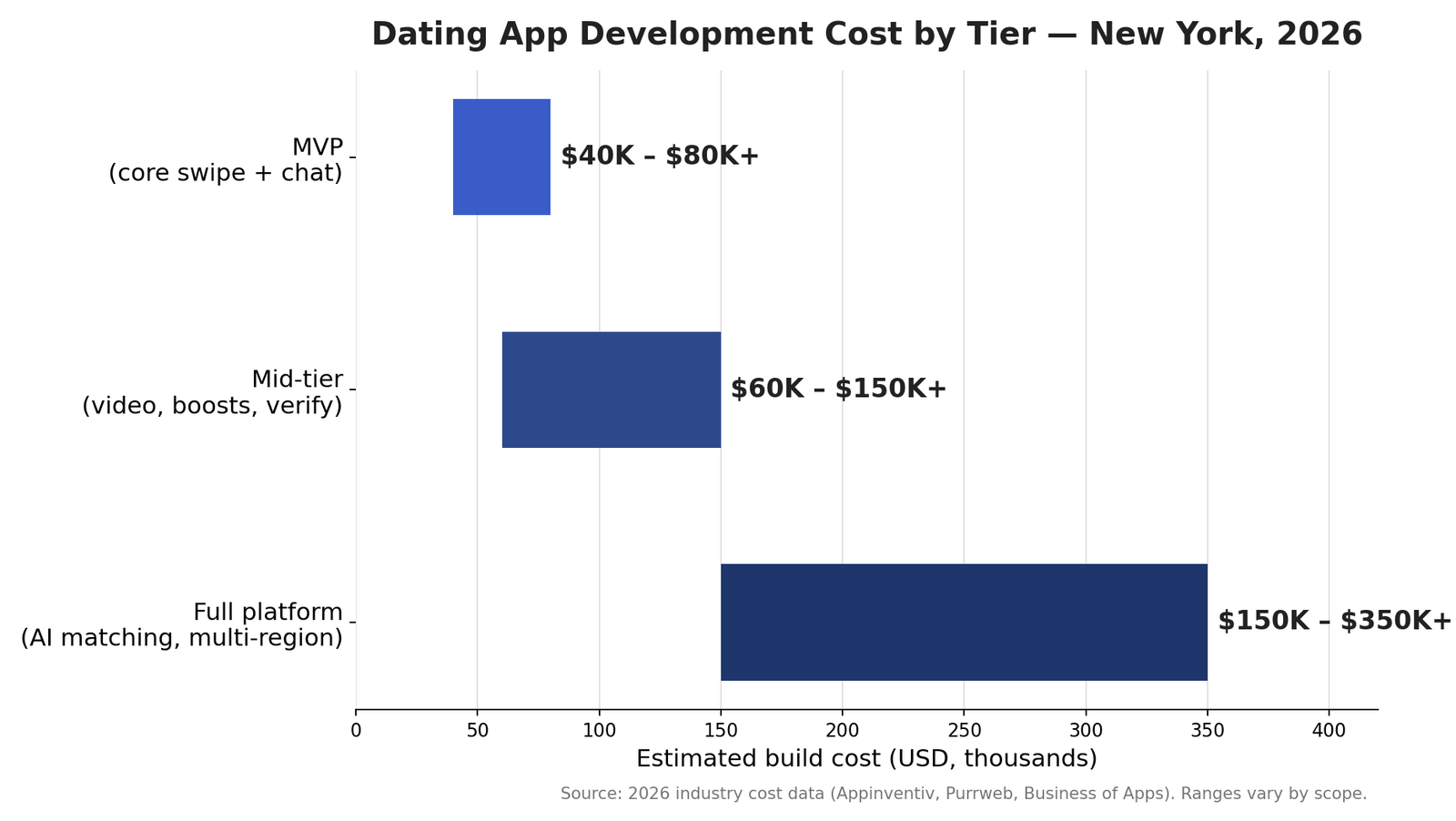
Cost tracks scope. A focused MVP with sign-up, profiles, geolocation matching, swiping, and basic chat generally runs $40,000 to $80,000. A mid-tier app that adds video dating, profile verification, boosts, and push notifications lands around $60,000 to $150,000. A full platform with AI matchmaking, moderation tooling, and multi-region readiness starts near $150,000 and can pass $350,000. The chart below shows the tiers we quote most often.
Those totals come from where the engineering hours actually go. Frontend, backend, real-time chat, video, an AI matching engine, and trust-and-safety each carry their own range, and they overlap because features share infrastructure. The module view below is the most useful way to sanity-check a quote.
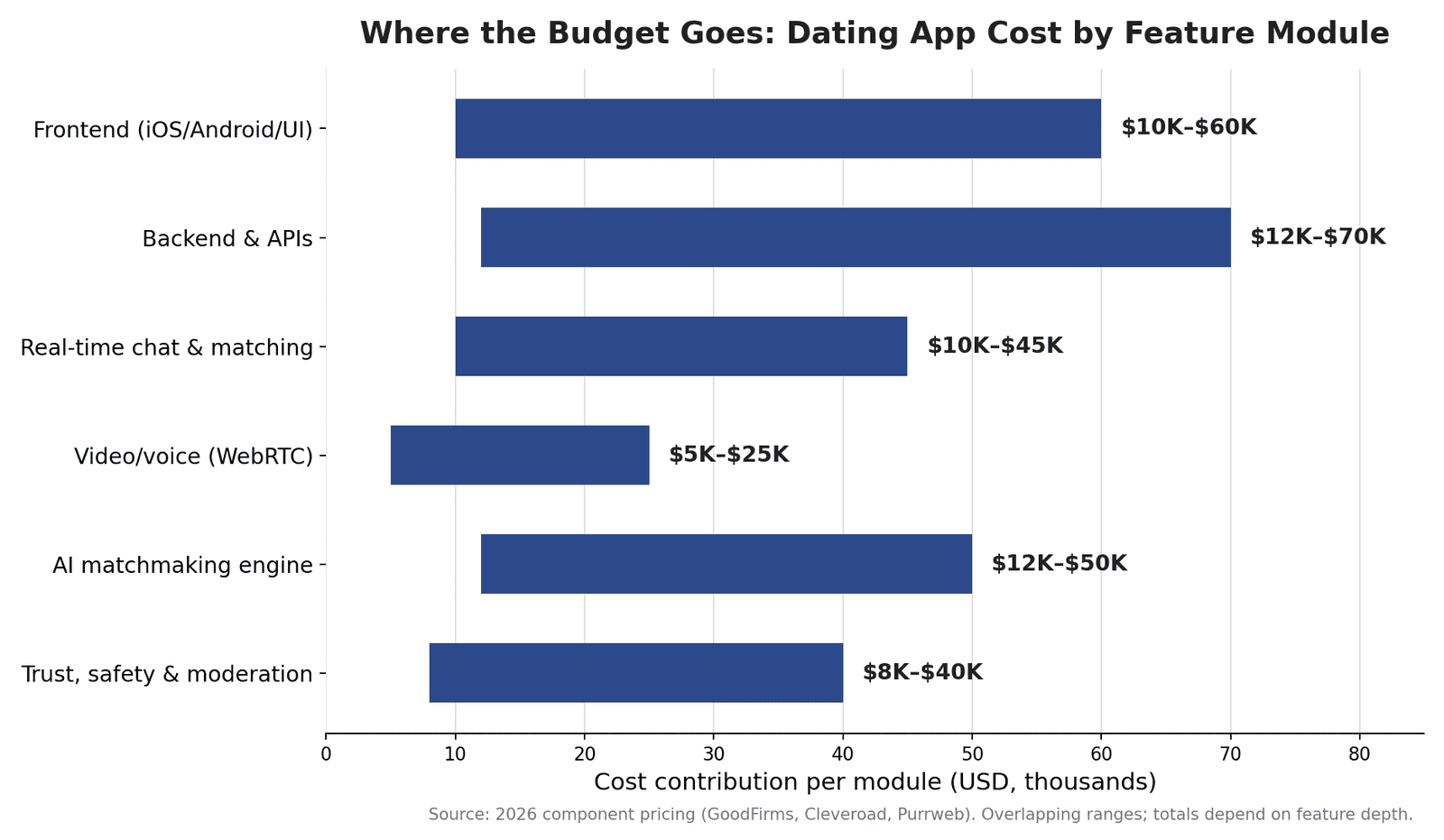
Two cost drivers surprise first-time founders. First, real-time systems are expensive: chat and video need infrastructure that scales with concurrency, not just user count. Second, safety is not free — verification, moderation, and abuse-prevention are ongoing engineering and sometimes human-review costs. A responsible partner quotes both. KKRF Group builds cost transparency into estimates so founders see the trade-offs before committing, not after.
Must-Have Features (and the Ones That Actually Retain Users)
Every dating app needs a baseline: account creation with social or phone sign-in, a rich editable profile, geolocation-based discovery, a swipe or browse mechanic, mutual-match detection, and real-time chat. Miss any of these and the app feels broken. But a checklist of table-stakes features does not retain anyone.
The features that keep New Yorkers coming back are the ones that build trust and reduce friction. Photo and identity verification cuts down on fakes and catfishing, which is the single biggest reason users quit a dating app. Thoughtful onboarding that fills the match queue fast prevents the empty-app problem. And well-designed safety tools — block, report, and unmatch that actually work — make people feel safe enough to keep swiping.
- Core: sign-up and social login, profile creation, geolocation matching, swipe mechanic, mutual match, real-time chat, push notifications.
- Trust: photo and ID verification, in-app reporting, block and unmatch, moderation queue, safe-meeting tips.
- Differentiators: AI matchmaking, video and voice dating, voice-note intros, icebreaker prompts, interest and prompt-based profiles.
- Growth and revenue: boosts, super likes, read receipts, who-liked-you, and tiered subscriptions.
Our advice to founders is ruthless prioritization. Ship the core plus verification first, prove people match and message, then layer differentiators once you see real behavior. A bloated v1 delays launch and buries the two or three features that actually drive retention.
How Dating App Matching Algorithms Work
Matching is the heart of the product. Every modern dating app blends explicit preferences — age, distance, gender, interests — with behavioral signals such as who a user swipes on, who replies, and how long they linger on a profile. The algorithm’s job is to predict mutual interest and rank the queue so that early matches feel good enough to keep the user engaged.
There are three broad approaches, and most successful apps combine them. Swipe-based collaborative filtering learns from aggregate behavior. AI matchmaking uses machine-learning models on richer signals. Interest-graph matching connects people through shared communities and prompts. The table below compares them the way we walk founders through it.
| Matching approach | How it works | Best for | Trade-off |
|---|---|---|---|
| Swipe-based / collaborative | Ranks profiles from aggregate swipe and reply behavior | High-volume, fast-liquidity apps | Can feel shallow; favors popular profiles |
| AI matchmaking | ML models weigh behavior, preferences, and conversation quality | Intentional, relationship-focused apps | Needs data and tuning; higher build cost |
| Interest-graph | Connects users via shared communities, prompts, and values | Niche and community-driven apps | Slower to reach critical mass |
A dating app cold-starts with almost no behavioral data, so the first version of a matching algorithm leans on explicit preferences and simple proximity, then grows smarter as usage accumulates. Founders who demand a Netflix-grade AI recommender on day one usually spend money on sophistication the data cannot yet support. Start explainable, instrument everything, and let the model earn its complexity.
The Dating App Tech Stack We Recommend
For most New York dating apps in 2026, a cross-platform front end plus a real-time-capable back end gives the best speed-to-market without capping scale. React Native or Flutter lets one team ship iOS and Android from a shared codebase. Node.js handles the API and real-time layer well, PostgreSQL stores structured relational data, Redis caches hot data and powers presence, Socket.IO drives instant chat, and WebRTC enables in-app video and voice.
Security primitives belong in the stack diagram, not bolted on later. JWT and OAuth 2.0 handle authentication, encrypted storage protects personal data at rest, and TLS protects it in transit. As an experienced custom software development company, KKRF Group designs enterprise-grade architecture with these controls in place from the first commit, so scaling from one borough to national coverage does not require a rebuild.
Stack choices are trade-offs, not religion. Go or Elixir can outperform Node.js for very high-concurrency chat; a managed video SDK like a WebRTC-based provider can beat self-hosting for early-stage teams. The right answer depends on your concurrency targets, budget, and in-house skills — which is precisely the conversation to have before development starts.
Have a dating app concept for the New York market? Get a clear, no-pressure estimate and a feature roadmap from our New York mobile app development team before you commit a dollar.
Request a Consultation →Our Dating App Development Process, Step by Step
A disciplined process is what keeps a dating build on budget and out of the graveyard of half-finished apps. Here is how KKRF Group runs a typical engagement.
- Discovery and product strategy. We define the audience, matching philosophy, safety model, and monetization before design begins, so the build has a spine.
- UX and UI design. We prototype the core flows — onboarding, discovery, match, chat — and test them, because a confusing first session kills retention.
- Architecture and setup. We stand up the cloud-native back end, data model, and real-time infrastructure with security controls built in.
- MVP development. We build the core loop first: sign-up, profile, geolocation matching, swipe, mutual match, and chat, plus verification.
- Trust and safety hardening. We add moderation tooling, reporting, and abuse prevention, then test them like an attacker would.
- QA and beta. We run functional, performance, and security testing, then a closed beta in a single borough to prove liquidity.
- Launch and iterate. We ship to the App Store and Google Play, watch real retention and matching metrics, and improve the algorithm with actual data.
Notice where safety and testing sit — not at the end as a rubber stamp, but woven through. That sequencing reflects a transparent development process where founders see working software early and steer with evidence.
Trust, Safety, and Compliance: The Non-Negotiables
Dating apps carry unusual responsibility because they connect strangers and hold intimate personal data. A single high-profile safety failure can end a young brand. That is why we treat trust and safety as core engineering, guided by established security practice such as the OWASP Mobile Top 10 rather than ad-hoc fixes.
On the safety side, the essentials are identity and photo verification, real-time content moderation for messages and images, easy blocking and reporting, and abuse-pattern detection that flags bad actors before users have to. Location handling deserves special care: showing approximate distance instead of precise coordinates protects users without breaking the core experience.
On the compliance side, a New York dating app must respect U.S. privacy expectations and, if it serves anyone abroad, regulations like GDPR, alongside California’s CCPA for U.S. users. It also has to satisfy the platform rules that gate distribution — Apple’s App Store Review Guidelines and Google Play policies both have specific requirements for dating and user-generated-content apps. Missing them means rejection, not just risk. As a trusted IT consulting and cybersecurity partner, KKRF Group builds security-first so compliance is designed in rather than patched.
How Dating Apps Make Money
The dating market rewards products that monetize without wrecking the experience. Globally, hundreds of millions of people use dating apps and only a fraction pay, so the model has to convert enough of that free base to be viable. The dominant approach in 2026 is freemium: the core is free, and revenue comes from subscriptions and consumable purchases.
The proven levers are tiered subscriptions (unlimited likes, advanced filters, who-liked-you), consumable boosts and super likes, and read receipts or profile visibility upgrades. Advertising exists but is secondary for most premium dating brands because it competes with the experience. The art is charging for reach and convenience without making the free tier feel useless — overshoot and users churn before they ever convert.
For context on the prize: the United States is the largest dating-app market in the world, generating around $1.45 billion in 2026 according to industry trackers such as Business of Apps. A New York app with strong retention and a fair paywall has a real, monetizable audience — but only after it has earned engagement.
Common Mistakes That Sink Dating Apps
Most dating apps fail for predictable reasons. We have watched enough launches to name the pattern, and nearly all of these are avoidable with the right plan.
- Ignoring the cold-start problem. Launching everywhere at once spreads users too thin; there is no one nearby to match, and the app feels dead.
- Treating safety as a phase-two feature. Fakes, harassment, and weak verification drive early users away faster than any bug.
- Over-building the algorithm before there is data. Complex AI matching needs behavior to learn from; day-one sophistication is wasted spend.
- A paywall that guts the free experience. Charging for basic usability kills conversion instead of driving it.
- Underestimating moderation cost. User-generated content needs ongoing review; budgeting only for the build leaves a gap.
- Skipping platform-policy review. App Store and Google Play reject dating apps that miss their content and safety rules, delaying launch by weeks.
Should You Build a Dating App? A Decision Framework
Not every dating idea should become an app, and a good partner will tell you so before taking your money. Use this framework to pressure-test the decision.
Build a dating app when:
- You have a specific, underserved audience — a profession, community, or intent that existing apps ignore.
- You can concentrate early users densely enough to create liquidity, which New York makes realistic.
- You are prepared to fund moderation and iteration for years, not just a launch.
- Your differentiation lives in matching quality, safety, or community — not just a new coat of paint.
Reconsider when:
- You are building a general-purpose Tinder clone with no clear edge against incumbents that spend billions on growth.
- You cannot reach critical mass in any single market or niche.
- Your budget covers the build but not the ongoing safety, hosting, and marketing the category demands.
Our recommendation: the strongest dating apps in 2026 win a niche first. If you have a defensible audience and the stomach for long-term operations, a focused New York launch is a sound bet. If not, the honest move is to sharpen the concept before writing code. KKRF Group runs this assessment with founders at no risk, because a product that should not be built helps no one.
How to Choose a Dating App Development Company in New York
The partner you pick shapes whether your app is safe, scalable, and shippable. Look past the portfolio gloss and evaluate on substance. When you hire a dating app development company in New York, weigh these five factors before signing anything.
- Real-time and consumer-scale experience. Ask to see how they have handled chat, presence, and video at scale — dating apps live or die on real-time performance.
- Security and compliance depth. They should speak fluently about verification, moderation, GDPR, CCPA, and platform policies without being prompted.
- A transparent process. Clear estimates, working software early, and honest trade-off conversations beat a polished pitch.
- Post-launch commitment. A dating app is a living product; you want a long-term technology partner, not a build-and-vanish vendor.
- Business thinking. The right team pushes back on scope and helps you sequence for retention and revenue, not just feature count.
This is the standard KKRF Group holds itself to as a long-term technology partner for startups, SMEs, and enterprises: enterprise-grade architecture, security-first development, and a business-focused approach to what gets built and when.
Where Dating Apps Are Heading in 2026 and Beyond
The category is shifting from endless swiping toward intent and safety. AI is moving past matching into conversation help, profile guidance, and fraud detection that spots fake accounts before users report them. Video-first onboarding is rising because it verifies identity and builds trust in one step. And niche apps continue to peel focused audiences away from the mass-market incumbents.
Safety technology is becoming a differentiator rather than a cost center. Real-time moderation, on-device abuse detection, and privacy-preserving location handling are features users increasingly choose apps for. For New York founders, the opportunity in 2026 is not to out-spend Tinder or Bumble on growth — it is to out-design Tinder, Bumble, and Hinge for a specific community that wants something the giants do not offer.
Torn between swipe-first and AI matchmaking? Walk through the trade-offs, cost, and retention impact with the engineers who build these systems. See how we approach mobile builds.
Book a Discovery Call →Frequently Asked Questions
How much does it cost to build a dating app in New York?
A dating app MVP in New York typically costs $40,000 to $80,000. A mid-tier app with video and verification runs $60,000 to $150,000, and a full platform with AI matchmaking and multi-region support ranges from $150,000 to $350,000 or more, depending on features and scale.
How long does it take to develop a dating app?
A focused MVP usually takes four to six months from discovery to launch. A feature-rich platform with AI matching, video dating, and full moderation tooling generally takes six to nine months or longer, because real-time systems and safety features add engineering time.
What is the best tech stack for a dating app in 2026?
A practical 2026 stack uses React Native or Flutter for cross-platform mobile, Node.js for the API and real-time layer, PostgreSQL for structured data, Redis for caching and presence, Socket.IO for instant chat, and WebRTC for in-app video. JWT and OAuth 2.0 handle secure authentication.
How do dating app matching algorithms work?
Matching algorithms combine explicit preferences such as age, distance, and interests with behavioral signals such as swipe history and reply rates to predict mutual interest and rank the profiles a user sees. Most apps blend swipe-based collaborative filtering, AI matchmaking, and interest-graph approaches.
How do you keep a dating app safe from fake profiles and abuse?
Safety relies on layered controls: photo and identity verification, real-time content moderation, easy blocking and reporting, and automated abuse-pattern detection. Handling location as approximate distance rather than exact coordinates, and following the OWASP Mobile Top 10, further protects users.
Is building a dating app in New York profitable?
It can be. The United States is the largest dating-app market, generating about $1.45 billion in 2026, and New York offers dense user liquidity. Profitability depends on retention and a fair freemium model with subscriptions and boosts, not on downloads alone.
Ready to build a safe, scalable dating app in New York? KKRF Group can scope your MVP, design the matching and safety layer, and map a launch that earns real retention. Tell us about your project.
Discuss Your Project →