
New York runs on games far more than most people realize, from Brooklyn indie studios shipping ad-funded hits to enterprise brands using play to drive engagement. If you want to build one, the hard part is rarely the idea. As a top mobile app development company, KKRF Group builds custom game apps for New York founders and enterprises, and this guide walks through what that actually takes in 2026.
Quick Answer: What Game App Development Costs and Takes in New York
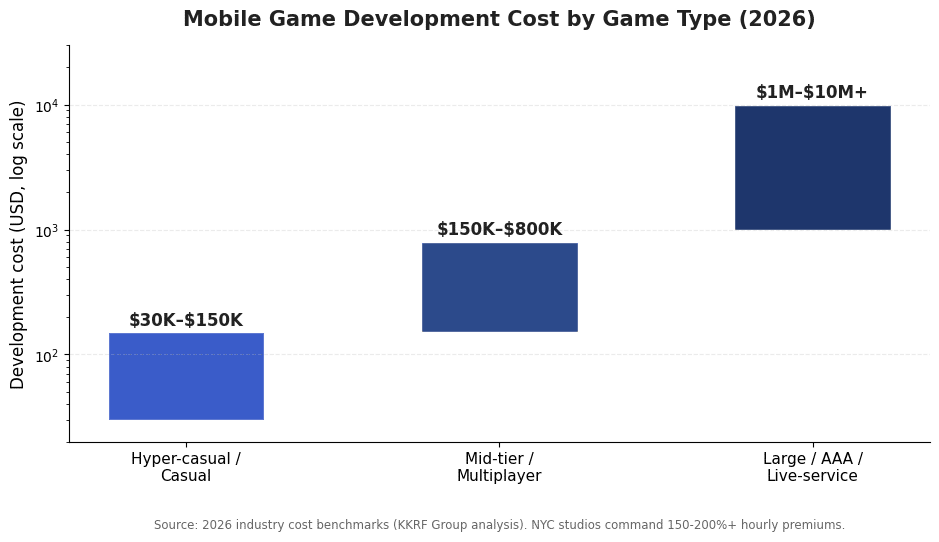
A mobile game app in New York typically costs $30,000 to $150,000 for a hyper-casual or casual title, $150,000 to $800,000 for a mid-tier multiplayer game, and $1 million or more for a large live-service title. Timelines range from 2 to 6 months at the simple end to 18 months or longer for ambitious multiplayer projects. New York studios usually charge premium hourly rates of $150 to $200 and up, so disciplined scope has an outsized effect on your final number.
Key Takeaways
- Game app development in New York runs from about $30,000 for a hyper-casual game to $1M+ for a large live-service title, driven mostly by art, multiplayer, and content volume.
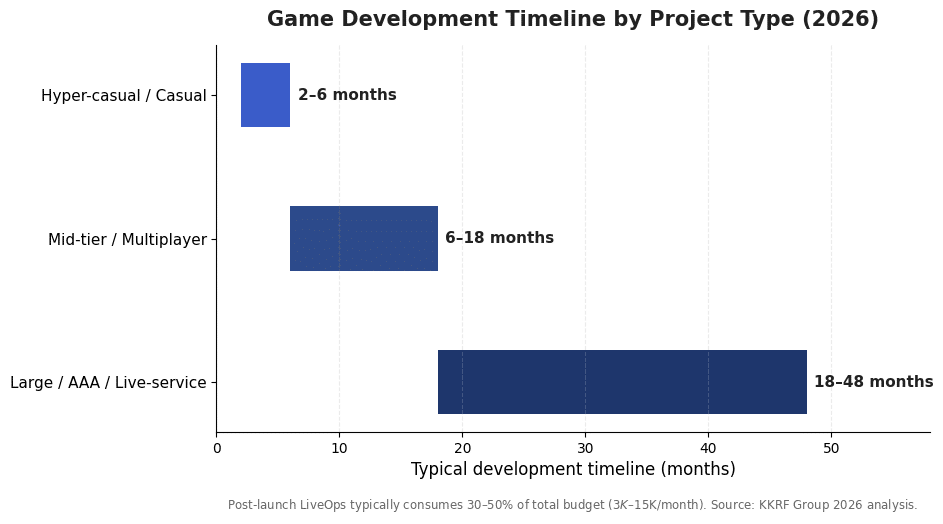
- Hyper-casual games ship in 2 to 6 months; mid-tier multiplayer games take 6 to 18 months; AAA-scale projects run 18 to 48 months.
- Unity fits most mobile games; Unreal Engine 5 suits high-fidelity 3D. A single cross-platform build usually adds roughly 30% to reach both iOS and Android.
- Post-launch LiveOps typically eats 30-50% of the total budget ($3,000-$15,000/month), so a game is a business to run, not a project to finish.
- New York studios charge premium rates ($150-$200+/hour), which makes tight scope and an experienced partner the biggest levers on cost.
What This Guide Covers
KKRF Group works as a long-term engineering partner, not a one-off vendor. We build games the same way we build enterprise software: security-first, cloud-native, and designed to scale from your first thousand players to your millionth. The sections below are the same questions we work through with New York clients before a single line of gameplay code gets written. If you want the broader picture, our overview of mobile app development in New York covers non-game projects too.
What Is Game App Development?
Game app development is the end-to-end process of designing, building, testing, and operating an interactive game that runs on smartphones and tablets. It blends game design, art and animation, engine programming, backend services for accounts and multiplayer, and live operations that keep players returning. A game is judged on feel, meaning frame rate, responsiveness, and fun, which pushes playtesting and performance engineering to the center of the work.
That focus on feel is what separates games from ordinary business apps. A banking app can survive a half-second delay; a platformer cannot. Games also carry heavier art pipelines, real-time state, and physics, and they live or die on retention rather than a single transaction. We have seen projects go sideways when teams treat a game like a standard CRUD app and discover, three months in, that their architecture cannot hold 500 concurrent players.
There is also a business layer most first-time founders miss. A shipped game is the start, not the finish. The economy, the content cadence, and the monetization all need tuning against real player behavior, which is why experienced studios plan for live operations from day one.
How Much Does Game App Development Cost in New York?
Cost is driven by four things: how much original art and animation the game needs, whether it has real-time multiplayer, how much content players will burn through, and the seniority of the team building it. New York rates sit at the top of the US market, so a game that might cost $60,000 with a distributed team can cost noticeably more with an all-local Manhattan studio. The trade-off is proximity, timezone overlap, and easier in-person collaboration.
A hyper-casual game with simple mechanics and stock-style art can land between $30,000 and $150,000. A mid-tier game with custom art, progression systems, and real-time multiplayer commonly runs $150,000 to $800,000. Large live-service or console-grade titles start around $1 million and climb from there. The chart below shows those ranges on a log scale.
One number surprises almost every founder: post-launch operations. Marketing, servers, updates, and support routinely consume 30 to 50 percent of the total budget after launch, and a healthy LiveOps content budget runs $3,000 to $15,000 a month. Budget for the year after launch, not just the build, or you will ship a good game with no fuel left to grow it.
Trying to pin down a realistic budget before you pitch investors or greenlight a build? Our engineers can pressure-test your game concept and give you a costed scope. See how we build mobile apps in New York.
Get a Custom Project Estimate →Game Development Timeline: How Long It Takes
Timeline scales with scope, not with headcount. Adding people to a late game usually slows it down, because game systems are tightly coupled and every new mechanic touches design, art, and code at once. A realistic schedule is the single best predictor of a game that actually ships.
Hyper-casual and casual games typically reach a launchable build in 2 to 6 months. Mid-tier and multiplayer games need 6 to 18 months to handle networking, balancing, and content depth. Large AAA-scale or live-service titles run 18 to 48 months and often launch in stages. The chart below maps those windows.
The smartest teams compress this by shipping a vertical slice first: one polished level or mode that proves the fun. If the slice is not fun, no amount of extra content will save the full game, and finding that out in month two is far cheaper than finding it out in month twelve.
Types of Games You Can Build
Choosing a game category early shapes budget, engine, team, and monetization more than any other decision. Each type carries a different production cost and a different path to revenue, so it pays to be honest about which one you are actually making.
Hyper-casual games are one-tap, instantly understandable titles built for mass reach and ad revenue; they are cheap to build but brutally competitive. Casual and puzzle games add light progression and social features. Mid-core games such as strategy, RPG, or shooters demand deeper systems, real-time multiplayer, and serious backend work. Real-money and skill-based games add licensing and compliance, which is closer to our separate guides on regulated verticals like entertainment and streaming apps.
| Game Type | Typical Cost | Timeline | Primary Revenue |
|---|---|---|---|
| Hyper-casual | $30K-$80K | 2-4 months | In-game ads |
| Casual / Puzzle | $60K-$150K | 3-6 months | Ads + in-app purchases |
| Mid-core / Multiplayer | $150K-$800K | 6-18 months | IAP + subscriptions |
| AAA / Live-service | $1M+ | 18-48 months | IAP, battle pass, LiveOps |
The Game Development Process, Step by Step
A dependable game build moves through six stages. Each one produces something you can review, so you are never guessing whether the project is on track.
Step 1: Concept and pre-production. Define the core loop, target player, art direction, and monetization. This is where a game is really won or lost, and it costs almost nothing to change your mind here.
Step 2: Prototype and vertical slice. Build one playable slice that proves the fun. Test it with real players before scaling anything.
Step 3: Production. Build the full content, systems, and backend. This is the longest and most expensive phase, and clear milestones keep it honest.
Step 4: Multiplayer and backend integration. Wire up accounts, matchmaking, real-time sync, and the live economy. We build this on cloud-native, autoscaling infrastructure so a viral spike does not take the game down.
Step 5: QA, balancing, and soft launch. Test across devices, tune difficulty and economy, and release quietly in a small market to measure retention before spending on marketing.
Step 6: Launch and live operations. Ship to the App Store and Google Play, then run events, updates, and content drops that keep players engaged. For non-game engineering support around this, our mobile app development services cover the same backend and DevOps foundations.
Choosing the Right Tech Stack: Unity vs Unreal and More
The engine you choose sets your team, your budget, and your ceiling for visual quality. For most mobile games, Unity is the default: a huge talent pool, fast iteration, and strong 2D and 3D support. For high-fidelity 3D and console-grade visuals, Unreal Engine 5 is the stronger choice, though it usually costs more because the talent is scarcer and builds are heavier.
Cross-platform development means writing one shared codebase that ships to both iOS and Android. With Unity or Unreal, targeting both platforms typically adds around 30 percent to the base cost while roughly doubling your reachable audience, which is why we recommend it for nearly every commercial game.
| Option | Best For | Trade-off |
|---|---|---|
| Unity | Most 2D/3D mobile games, fast iteration | Very high-end 3D needs extra work |
| Unreal Engine 5 | High-fidelity 3D, console-grade visuals | Higher cost, larger builds, scarcer talent |
| Native (Swift / Kotlin) | Simple, lightweight, single-platform games | No shared code; two builds to maintain |
| Real-time backend (Photon, PlayFab) | Multiplayer sync, matchmaking, economy | Adds infrastructure and running cost |
Around the engine sits the rest of the stack: a real-time networking layer for multiplayer, cloud infrastructure for accounts and leaderboards, an analytics pipeline to watch retention, and a monetization SDK. We favor autoscaling, security-first cloud architecture here, because a game backend that cannot flex with demand becomes the thing that caps your growth.
How Game Apps Make Money: Monetization Models
Monetization is a design decision, not a bolt-on. The model you pick shapes the core loop, the pacing, and even the art. Picking it late almost always produces a game that feels grafted together, so decide early and design around it.
In-app purchases (IAP) sell cosmetics, currency, or progression. In-game advertising monetizes free players through rewarded video and interstitials. Subscriptions and battle passes trade recurring value for steady revenue. Premium (paid) games charge once upfront, which suits polished single-player titles. Most successful mobile games blend two or three of these.
| Model | How It Works | Fits |
|---|---|---|
| In-app purchases | Sell currency, cosmetics, progression | Casual, mid-core, RPG |
| In-game ads | Rewarded video and interstitials | Hyper-casual, casual |
| Subscription / battle pass | Recurring access to content and perks | Live-service, competitive |
| Premium (paid) | One upfront purchase | Story-driven, single-player |
Why Build Your Game App in New York?
New York is one of the densest games and media markets in the world, and that density is a genuine advantage. The city pairs a deep talent pool of engineers, artists, and designers with an unusual concentration of publishers, ad networks, media brands, and venture capital. If your game leans on advertising revenue or brand partnerships, being where the ad-tech and media companies are shortens a lot of conversations.
There is a cost to that proximity. Local New York studios command premium rates because talent and office space in Manhattan and Brooklyn are expensive. The teams that get the most out of a New York base usually run a hybrid model: senior product, design, and client-facing leadership local, with a wider engineering bench that keeps the burn rate sane. That is close to how we structure New York engagements. Our page on mobile app development in New York goes deeper on that model.
Common Mistakes to Avoid
- Skipping the vertical slice. Building the whole game before proving the core loop is fun is the most expensive mistake in the industry.
- Ignoring LiveOps in the budget. A game with no post-launch fuel stalls within weeks, no matter how good the launch build is.
- Choosing the engine by hype. Picking Unreal for a 2D puzzle game, or Unity for a photoreal 3D title, quietly inflates cost and timeline.
- Designing monetization last. Grafting a store onto a finished game almost always feels cynical to players and hurts retention.
- Underestimating backend load. Real-time multiplayer that was never load-tested is how a viral launch turns into a crash and a wave of one-star reviews.
Should You Build a Game App? A Decision Framework
Build a custom game app when you have a distinct core loop, a realistic budget for the year after launch, and a plan to acquire players. Games reward originality and punish thin clones, so a genuine hook matters more than a big feature list.
Think twice when your budget only covers the build and nothing after, when you are cloning a saturated genre with no twist, or when you need guaranteed revenue on a fixed date. Games are hit-driven, and no honest studio can promise a chart-topper. If certainty matters more than upside, a simpler engagement app may serve you better.
Our recommendation: start with a tightly scoped prototype, prove retention in a soft launch, and only then invest in full production and marketing. It is the single most reliable way to protect a budget in a hit-driven business.
How to Choose a Game App Development Company in New York
The right partner is the difference between a game that ships and a budget that evaporates. Look past the showreel and ask how a company actually works. Do they insist on a playable prototype before full production? Can they show real-time multiplayer they have shipped and scaled? Do they plan for LiveOps, or do they hand you a finished build and walk away?
Weigh technical depth, a transparent development process, and a genuine track record with live games. Ask about their cloud and security approach, because a game backend is where most scaling failures hide. For a broader checklist, our guide on the best mobile app development company in New York lays out evaluation criteria that apply to games too.
This is where KKRF Group fits. We bring enterprise-grade architecture and a security-first, cloud-native approach to game backends, a transparent process built around playable milestones, and a long-term partnership model rather than a hand-off. We would rather talk you out of a weak concept than build it, which tends to save everyone money.
Future Trends in Game Development
Three shifts are reshaping how games get built in 2026. AI-assisted production is compressing art and content pipelines, letting small teams generate assets and tune difficulty faster, though human design judgment still decides what is actually fun. Cross-platform and cloud gaming continue to blur the line between mobile, web, and console, raising player expectations for a single game to follow them across devices.
The third shift is deeper live operations. Players now expect a steady drip of events, seasons, and content, which turns successful games into ongoing services rather than one-time releases. Teams that build their architecture and their budget around that reality, from day one, are the ones still standing a year after launch.
Have a game idea and a rough budget, but no clear technical plan? Bring it to our team and we will map the architecture, engine choice, and a phased release plan with you.
Book a Discovery Call →Frequently Asked Questions
How much does it cost to build a game app in New York?
A hyper-casual or casual game typically costs $30,000 to $150,000, a mid-tier multiplayer game runs $150,000 to $800,000, and a large live-service title starts around $1 million. New York studios charge premium rates of $150 to $200+ per hour, so scope and team seniority move the number the most.
How long does it take to develop a mobile game?
Hyper-casual games reach a launchable build in 2 to 6 months, mid-tier and multiplayer games take 6 to 18 months, and large AAA-scale titles run 18 to 48 months. Timeline scales with scope, not headcount, so a tightly defined game ships far faster.
Should I use Unity or Unreal Engine for a mobile game?
Unity is the default for most mobile games because of its wide talent pool, fast iteration, and strong 2D and 3D support. Unreal Engine 5 is better for high-fidelity 3D and console-grade visuals, but it usually costs more and requires scarcer talent.
How do game apps make money?
The main models are in-app purchases, in-game advertising, subscriptions or battle passes, and premium one-time purchases. Most successful mobile games blend two or three of these, and the model should be chosen early because it shapes the core gameplay loop.
Can I build one game for both iOS and Android?
Yes. Using a cross-platform engine like Unity or Unreal, you write one shared codebase that ships to both iOS and Android. This typically adds about 30 percent to the base cost while roughly doubling your reachable audience.
How do I choose a game app development company in New York?
Look for a studio that insists on a playable prototype before full production, has shipped and scaled real-time multiplayer, plans for live operations, and can explain its cloud and security approach. Weigh technical depth, a transparent process, and a genuine track record with live games over showreels.
You do not need a finished design to start a useful conversation. If you are weighing a game app in New York, talk to the engineers who will actually build it and get an honest read on cost, timeline, and risk. Explore our mobile app development services.
Talk to Our Engineering Team →