
New York runs on sports. From Sunday DFS lineups drafted in a Brooklyn walk-up to season-long leagues that outlast friendships, fantasy play is baked into how this city follows its teams. That’s why founders keep bringing us the same pitch: build the next great fantasy platform, and build it here. At KKRF Group, a top mobile app development company, we help New York operators turn that demand into licensed, real-money-ready products.
Quick Answer: What It Costs and Takes
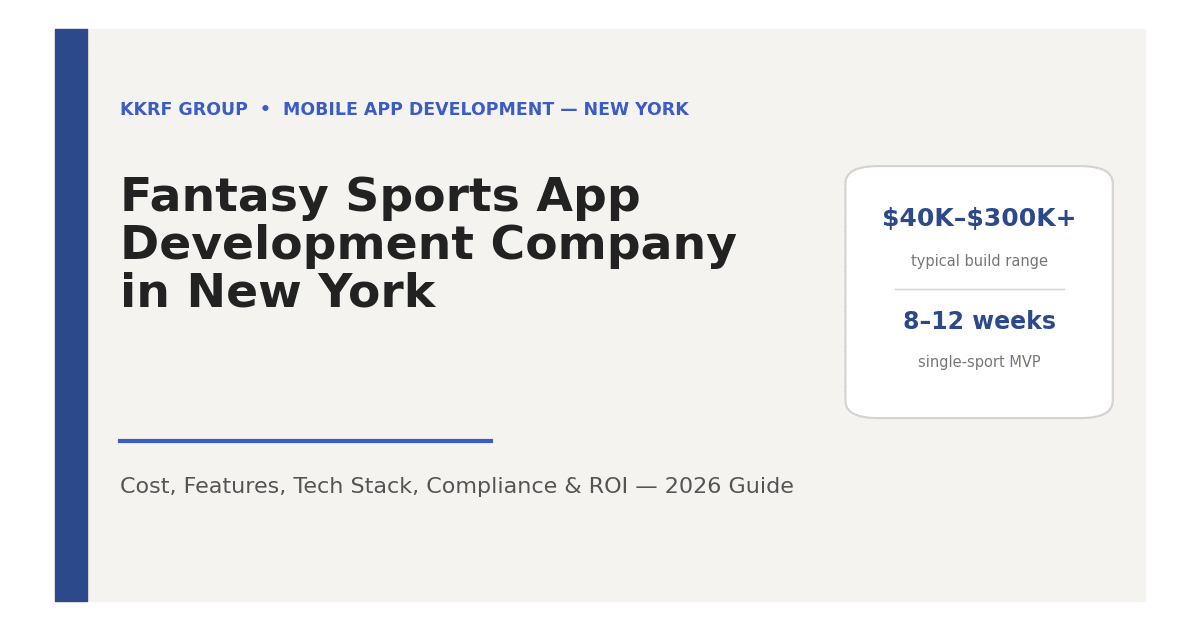
Fantasy sports app development in New York usually costs around $40,000 for a single-sport MVP and climbs past $300,000 for a multi-sport, real-money daily fantasy sports (DFS) platform. A production-ready single-sport app takes roughly 8 to 12 weeks; a full DFS build with payments, identity verification, and geolocation runs 4 to 9 months. The heaviest costs aren’t the screens. They’re the live sports data feed, real-money compliance, and the real-time infrastructure that keeps scoring accurate when a playoff crowd logs in at once.
Key Takeaways
- A single-sport MVP starts near $40,000–$50,000 and ships in 8–12 weeks; multi-sport, real-money platforms reach $120,000–$300,000+.
- Fantasy sports is legal in New York under a 2016 state law, but paid contests must register with the New York State Gaming Commission and honor consumer-protection rules.
- The live sports data feed is the biggest recurring cost — often $20,000–$50,000 a year before your first paying user.
- Real-money play adds payments, KYC identity checks, and geofencing, which together can add $30,000–$75,000 before launch.
- The right tech stack (React Native or Flutter, an event-driven backend, WebSockets, Redis) decides whether live scoring feels instant or laggy.
- KKRF Group builds NYC fantasy platforms with a security-first, compliance-aware architecture designed to scale from launch day to playoff spikes.
What This Guide Covers
What Is Fantasy Sports App Development?
Fantasy sports app development is the process of designing, engineering, and launching a mobile platform where users assemble virtual teams of real athletes and score points based on those athletes’ real-world performance. A fantasy sports app combines a contest engine, a live sports data pipeline, user wallets, and, for paid contests, payment and compliance systems. The result is a real-time product where standings shift as live games unfold.
Two models dominate the market. Season-long fantasy runs across a full sports season, with drafts, trades, and waiver wires. Daily fantasy sports, or DFS, compresses everything into a single day or week, which is why it leans harder on instant scoring, fast payouts, and airtight fraud controls. In practice, fantasy sports app development in New York also means engineering for local demand and state compliance from the very first sprint.
Why New York Is a Prime Market for Fantasy Sports Apps
New York is one of the most valuable sports markets on the planet. The metro area supports two NFL franchises, two MLB teams, three NHL clubs, two NBA teams, and a college scene that fills arenas. That density of passionate fans, and their spending power, is genuinely rare.
The regulatory picture helps too. New York legalized interactive fantasy sports contests in 2016 and later launched mobile sports betting, so consumers here are already comfortable funding accounts and playing on their phones. For a founder, that means shorter education cycles and warmer demand, provided the product respects the rules.
We’ve also seen a practical edge in building for NYC first. If your app can handle a Manhattan commuter locking a lineup on a patchy subway connection during a Sunday kickoff surge, it can handle almost anywhere.
Types of Fantasy Sports Apps You Can Build
Not every fantasy app carries the same cost or compliance weight. Picking the right model early keeps your budget honest and your launch realistic.
- Season-long fantasy apps run full-season leagues with drafts, trades, and standings. Engagement is deep, but payout velocity is low.
- Daily fantasy sports (DFS) apps offer single-day or single-week contests with entry fees and cash prizes. Engagement is intense, and compliance is heavy.
- Salary-cap contests let users pick players under a budget cap. This is the DraftKings and FanDuel model that most people picture.
- Head-to-head and private league apps host contests among friends. Retention is strong, and word-of-mouth growth comes built in.
- Prediction and pick’em apps ask users to predict outcomes rather than draft rosters. They’re a lighter, lower-compliance entry point.
- Esports fantasy apps apply the same mechanics to competitive gaming, a fast-growing niche among younger New York users.
Must-Have Features for a Fantasy Sports App
A fantasy platform is a real-time system with money and identity attached, so the feature set is less about flourish and more about trust and speed. These are the features we treat as non-negotiable.
- Onboarding and KYC: fast signup paired with identity verification for real-money contests.
- Live scoring engine: real-time point updates driven by an official sports data feed.
- Contest lobby and creation: join public contests or spin up private leagues in seconds.
- Drafting interface: snake drafts, salary-cap builders, and auto-draft fallbacks.
- Wallet and payments: deposits, withdrawals, and prize payouts with fraud screening.
- Geolocation and geofencing: confirms the user is in a state where paid contests are legal.
- Leaderboards and standings: dynamic rankings that update while games are live.
- Push notifications: lineup locks, injury alerts, and payout confirmations.
- Responsible-gaming controls: deposit limits, self-exclusion, and age gating.
- Admin and risk dashboard: contest management, collusion detection, and reporting.
Fantasy Sports App Development in New York: Cost Breakdown (2026)
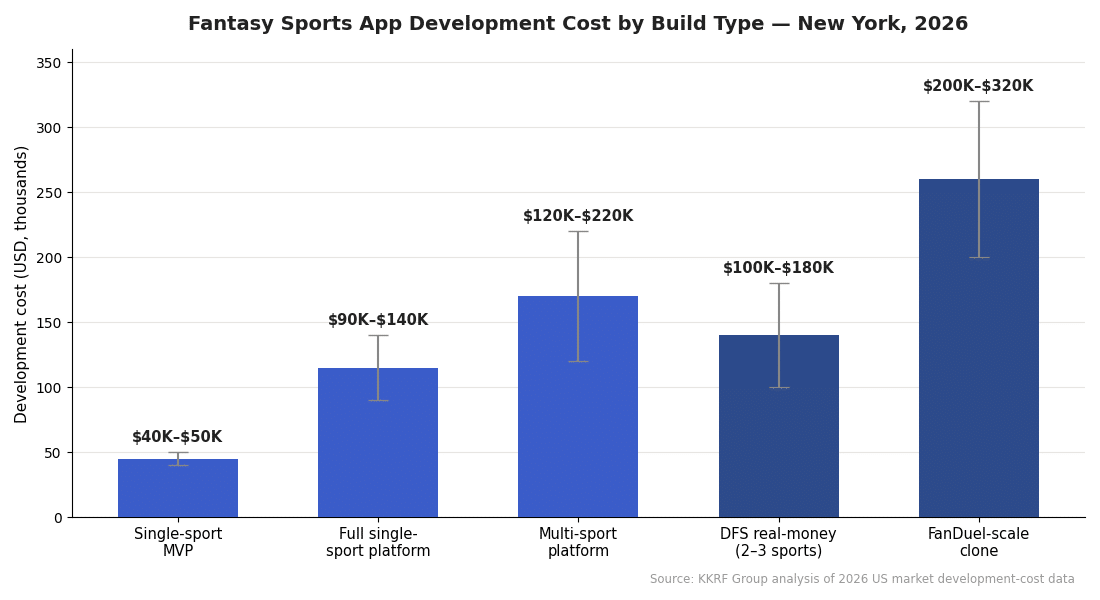
Here’s the honest version: fantasy sports app cost in New York is driven less by screen count and more by real-money infrastructure. A simple prediction app is cheap to build. A licensed DFS platform with live payouts is a completely different animal. The chart below maps typical build ranges we see in the 2026 market.
| Build type | Timeline | Typical cost | Best for |
|---|---|---|---|
| Single-sport MVP | 8–12 weeks | $40,000–$50,000 | Validating demand |
| Full single-sport platform | 4–6 months | $90,000–$140,000 | A first serious launch |
| Multi-sport platform | 6–9 months | $120,000–$220,000 | Scaling engagement |
| DFS real-money (2–3 sports) | 5–8 months | $100,000–$180,000 | Paid contests |
| FanDuel-scale clone | 9+ months | $200,000–$320,000+ | Funded operators |
These figures cover design and engineering. They do not include the recurring data and compliance costs that arrive whether or not you have users, which is exactly where most first-time budgets break.
What Drives Fantasy Sports App Cost Up or Down
Two apps with identical screens can differ by six figures. The gap almost always comes from the systems users never see. The chart below shows the hidden cost drivers we flag on day one.
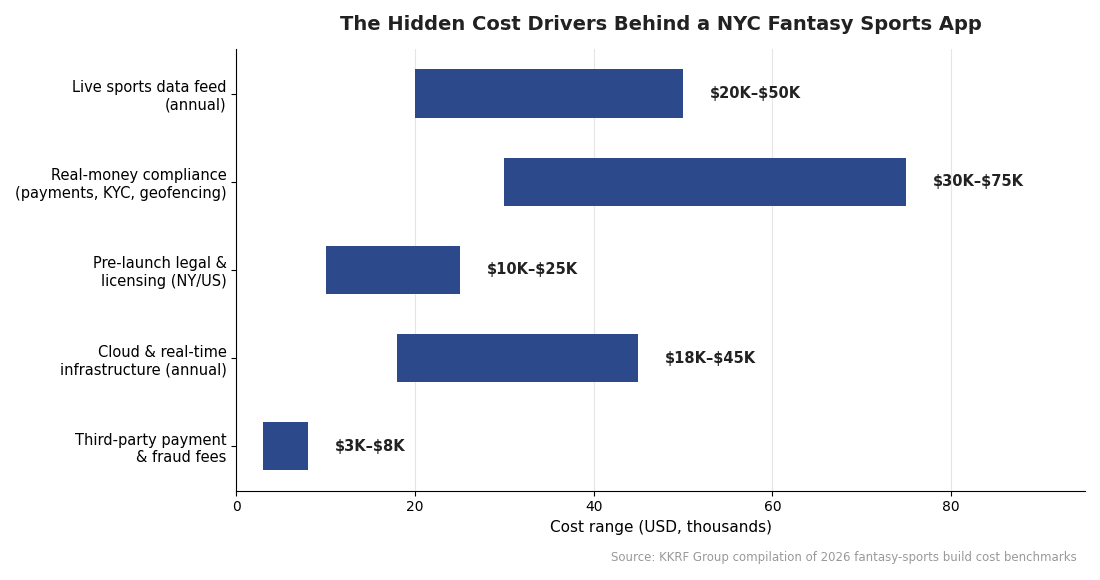
- Live sports data feed: official feeds from providers like Sportradar or Genius Sports can run $20,000–$50,000 or more per year.
- Real-money compliance: payments, KYC, and geofencing add roughly $30,000–$75,000 before launch day.
- Number of sports and contest types: each sport is its own scoring logic and its own data integration.
- Real-time scale: playoff spikes demand autoscaling infrastructure that costs more to run.
- Design and UX polish: a fast, differentiated interface takes senior design time to get right.
- Third-party fees: payment processing, identity checks, and fraud tools charge on every transaction.
Not sure whether your idea lands closer to a $50K MVP or a $300K DFS platform? We’ll map your feature set to a realistic budget and timeline. Share your concept with our team and get specifics, not guesses.
Get a Custom Project Estimate →The Fantasy Sports App Development Process, Step by Step
A fantasy build succeeds or stalls based on sequence. Compliance and data decisions made early shape everything downstream, so we front-load them rather than bolt them on. Here’s the process we follow.
- Discovery and compliance scoping. We define the contests, target states, and the regulatory obligations that shape the entire build before a line of code is written.
- UX and product design. We map the drafting flow, contest lobby, and wallet so the app stays fast and clear even under pressure.
- Data and scoring architecture. We integrate the live sports feed and design the engine that turns raw stats into points accurately and instantly.
- Core development. We build the front end in React Native or Flutter and an event-driven backend engineered for real-time updates.
- Payments, KYC, and geofencing. We wire in deposits, identity checks, and location verification so real-money play is legal and secure.
- Security and load testing. We pen-test the wallet, simulate playoff-level traffic, and harden the platform against collusion and fraud.
- Launch and app store submission. We clear Apple and Google real-money gaming requirements, then ship to production.
- Post-launch operations. We monitor scoring accuracy, payouts, and retention, then iterate on contests and features.
Recommended Tech Stack for a Fantasy Sports App
The stack for a fantasy app is a real-time engineering choice, not a branding one. Live scoring, concurrent users, and money movement all raise the bar. This is the architecture we reach for most often.
| Layer | Recommended | Why it matters |
|---|---|---|
| Mobile front end | React Native or Flutter | One codebase for iOS and Android with near-native speed |
| Backend | Node.js or Go, event-driven | Handles concurrent scoring updates efficiently |
| Real-time layer | WebSockets + Redis pub/sub | Pushes live scores with minimal lag |
| Database | PostgreSQL + Redis cache | Reliable transactions plus fast leaderboard reads |
| Sports data | Sportradar or Genius Sports API | Accurate, low-latency official stats |
| Payments | Stripe or Braintree + KYC provider | PCI-compliant deposits and payouts |
| Infrastructure | AWS or GCP + Kubernetes | Autoscaling for playoff traffic spikes |
| Geolocation | Geofencing service | Confirms the user is in a legal play location |
Legal and Compliance: Fantasy Sports Rules in New York
Legal and compliance is where fantasy projects live or die. In New York, interactive fantasy sports contests are legal and regulated. Operators offering paid contests must register with the New York State Gaming Commission and follow consumer-protection rules covering advertising, the segregation of player funds, and self-exclusion.
Real-money apps also answer to platform policy. Apple’s App Store Review Guidelines require real-money gaming apps to be submitted by a legal entity, geo-restricted to permitted regions, and free to download. Google Play enforces comparable DFS rules. Skip any of it and your app gets rejected, or pulled after launch.
KYC (Know Your Customer) is the identity-verification step that confirms a user is a real, eligible adult before they can deposit or win money. Geofencing uses device location to block paid play from states where fantasy contests aren’t permitted. Both are legal requirements for real-money fantasy apps, not optional extras.
- Register paid contests with the New York State Gaming Commission before accepting entry fees.
- Verify identity and age with KYC at signup for any real-money contest.
- Enforce geofencing so paid play only happens in permitted states.
- Segregate player funds from operating funds, as regulators require.
- Build responsible-gaming tools, including deposit limits and self-exclusion, from the start.
How Fantasy Sports Apps Make Money
A fantasy app can earn from several streams at once. The mix you choose shapes both your compliance load and your growth model.
- Entry fees and rake: the platform keeps a percentage (the rake) of each paid contest’s prize pool. This is the core DFS revenue engine.
- Freemium upgrades: premium analytics, extra leagues, or advanced stats sit behind a subscription.
- Advertising and sponsorships: sports brands pay to reach an engaged, high-intent audience.
- Affiliate and data partnerships: referrals to licensed sportsbooks or resale of aggregated data.
- In-app purchases: cosmetic or convenience items work well in free-to-play contests.
For a New York launch, many founders start with free-to-play plus advertising to build an audience, then add rake-based paid contests once registration and compliance are in place.
Common Mistakes to Avoid
- Treating the data feed as an afterthought. It’s the single biggest recurring cost and a frequent launch blocker.
- Underbudgeting compliance. Real-money features without KYC and geofencing will fail app review.
- Ignoring peak load. Playoff Sundays generate traffic spikes that crush under-provisioned backends.
- Weak fraud controls. Multi-accounting and collusion quietly drain prize pools and erode trust.
- Overbuilding the MVP. Chasing every sport and contest type before proving demand burns runway fast.
In-House vs Freelancers vs Agency vs KKRF Group
Who builds your fantasy app matters as much as what you build. Each model trades cost against compliance depth, speed, and staying power. Here’s an honest comparison.
| Factor | In-house team | Freelancers | Offshore agency | KKRF Group |
|---|---|---|---|---|
| Upfront cost | Highest | Lowest | Medium | Medium |
| Real-money compliance know-how | Varies | Low | Varies | Built-in |
| Time to launch | Slow (hiring) | Unpredictable | Medium | Fast |
| Scalability for peaks | Depends on hires | Low | Medium | Architected in |
| Long-term support | Strong | Weak | Varies | Dedicated |
Real-money fantasy apps live or die on architecture: scoring, wallets, geofencing, and peak-load design. Before you commit a budget, let our engineers stress-test your plan. See how we approach mobile builds.
Request an Architecture Review →Decision Framework: When to Build (and When Not To)
A fantasy sports app is a strong bet in some situations and a money pit in others. Use this framework before you commit.
Build when:
- You have a clear niche, a sport, community, or contest type the incumbents underserve.
- You can fund the data feed and compliance, not just the app itself.
- You’re targeting states, like New York, where paid contests are legal.
Reconsider when:
- Your budget can’t cover both the build and 12 months of data plus compliance costs.
- You want nationwide real-money play on day one, since state-by-state legality makes that slow.
- You have no concrete plan to fight fraud and multi-accounting.
The limitation to accept: no fantasy app launches nationwide for real money overnight. Legality is state-by-state, and each new market adds compliance work. Our recommendation: start with a focused single-sport or free-to-play MVP in New York, validate retention, then layer in real-money contests once the audience is real.
How to Evaluate a Fantasy Sports App Development Partner
The wrong partner ships pretty screens that fall over on playoff Sunday. The right one builds a system. Ask these questions before you sign.
- Have they shipped real-time apps with live data at scale?
- Do they genuinely understand DFS compliance, KYC, and geofencing?
- Can they show a security-first approach to wallets and payouts?
- Will they support you through app store review and post-launch spikes?
- Do they architect for scale, or just assemble screens?
For fantasy sports app development in New York, KKRF Group treats these platforms as enterprise-grade, security-first systems, not just attractive front ends. That means the scalable cloud-native architecture and long-term partnership a real-money product needs to survive its first playoff run.
Future Trends in Fantasy Sports Apps
The category is shifting fast, and the platforms being architected now should account for where it’s heading.
- AI-driven personalization: smarter lineup suggestions, injury insights, and churn prediction.
- Micro-contests and live in-game fantasy: real-time formats that react as the game plays out.
- Esports and niche-sport fantasy: growth well beyond the big four leagues.
- Deeper social and creator features: leagues built around communities and influencers.
- Responsible-gaming technology: stronger tools as regulators tighten oversight.
Frequently Asked Questions
Is fantasy sports legal in New York?
Yes. New York legalized interactive fantasy sports contests in 2016. Operators offering paid contests must register with the New York State Gaming Commission and follow its consumer-protection rules, including identity verification, fund segregation, and self-exclusion.
How much does it cost to build a fantasy sports app in New York?
A single-sport MVP typically costs $40,000 to $50,000, a full single-sport platform runs $90,000 to $140,000, and a multi-sport or real-money DFS platform ranges from $120,000 to $300,000 or more. Recurring data-feed and compliance costs are separate and ongoing.
How long does it take to develop a fantasy sports app?
A single-sport MVP takes about 8 to 12 weeks. A full daily fantasy sports platform with payments, KYC, and geolocation usually takes 4 to 9 months, depending on the number of sports and contest types.
What’s the difference between DFS and season-long fantasy apps?
Season-long fantasy runs across an entire sports season with drafts, trades, and waivers. Daily fantasy sports (DFS) compresses contests into a single day or week, so it relies more heavily on instant scoring, fast payouts, and strict fraud and compliance controls.
How do fantasy sports apps make money?
The main revenue stream is the rake, a percentage the platform keeps from paid contest prize pools. Apps also earn through freemium subscriptions, advertising and sponsorships, affiliate and data partnerships, and in-app purchases in free-to-play contests.
What tech stack is best for a real-time fantasy sports app?
A common high-performance stack pairs a React Native or Flutter front end with an event-driven Node.js or Go backend, WebSockets and Redis for live scoring, PostgreSQL for transactions, an official sports data API, and Kubernetes on AWS or GCP for autoscaling during peak traffic.
Ready to turn a fantasy sports concept into a licensed, scalable New York product? KKRF Group’s engineering team can take you from data feed to app store. Start the conversation today.
Talk to Our Engineering Team →