
Entertainment app development in New York sits at the center of American media. From the broadcast towers in Midtown to the streaming startups scattered across Brooklyn, the city produces and distributes more entertainment than almost anywhere on earth — and that gravity pulls demand toward apps that stream, play, and monetize content without buffering, crashing, or leaking revenue.
Building one well is harder than the polished UI suggests. KKRF Group works with founders, broadcasters, and media brands that need an entertainment app capable of real scale. As a top mobile app development company, we’ve watched these projects stall in predictable places: the streaming pipeline, digital rights management, and a cost model nobody stress-tested. This guide covers what it actually takes to build an entertainment or OTT app in New York in 2026 — cost, timeline, features, security, and how to choose a partner who has shipped one before.
Key Takeaways
- Entertainment app development in New York covers OTT video, audio and music, live events, gaming companions, and interactive media apps across mobile and connected TV.
- A production-ready OTT app in NYC typically costs $45,000 for a lean MVP and climbs to $550,000+ for a multi-region enterprise platform.
- Most builds take 18 to 26 weeks, with the streaming backend and DRM consuming the largest share of engineering time.
- The three cost drivers that matter most are streaming quality (adaptive bitrate), content protection (DRM), and your monetization model (SVOD, AVOD, TVOD, or hybrid).
- Choose a development partner by their streaming architecture experience and content-security track record, not by their portfolio screenshots.
On This Page
- Quick Answer
- What Entertainment App Development Is
- Why New York Is a Prime Market
- Types of Entertainment & OTT Apps
- Cost in New York (2026)
- Must-Have Features
- Tech Stack & Architecture
- The Development Process
- DRM, Security & Compliance
- Monetization & ROI
- Common Mistakes to Avoid
- Trends Shaping 2026
- Decision Framework
- Choosing a NY Partner
- FAQ
Quick Answer: Entertainment App Development in New York
Entertainment app development in New York is the process of designing, building, and launching mobile and connected-TV apps that stream video, audio, or interactive media to audiences — OTT platforms, music and podcast apps, live-event apps, and gaming companions. A production-ready OTT app built in NYC typically costs between $45,000 for a lean MVP and $550,000 or more for a multi-region enterprise platform, and takes roughly 18 to 26 weeks to ship. The correct scope depends on three things: the size of your content library, your target streaming quality, and how you plan to make money.
KKRF Group builds entertainment apps for New York startups and established media brands as an enterprise software development company, pairing streaming-grade engineering with security-first architecture. The sections below break down each decision so you can budget accurately and avoid the traps that sink first-time streaming builds.
What Is Entertainment App Development?
Entertainment app development is the practice of building software applications whose primary job is delivering media — video, audio, live streams, or interactive content — to users on phones, tablets, smart TVs, and the web. It spans everything from a music streaming app to a full over-the-top (OTT) video platform with subscriptions and live channels.
OTT (over-the-top) app development refers specifically to building apps that stream video content directly over the internet, bypassing traditional cable or satellite providers. Netflix, Hulu, and Disney+ are OTT platforms. An OTT app handles content ingestion, encoding, adaptive streaming, playback, and usually subscription billing in one system.
The category is broad on purpose. A live sports app, a meditation audio app, a short-form video social app, and a broadcaster’s catch-up TV service are all entertainment apps, yet each demands different engineering. What they share is a hard technical core: moving large media files to many users at once, quickly, securely, and at a cost that still leaves room for profit.
Why New York Is a Prime Market for Entertainment Apps
New York is the commercial center of American media. Major broadcasters, publishers, advertising agencies, record labels, and a dense layer of venture-backed media startups all operate here. That concentration creates unusual demand for entertainment apps — and an unusually informed set of buyers who expect broadcast-grade quality.
Proximity matters more than people admit. A Manhattan media company launching a streaming product often wants a partner who understands its licensing constraints, its advertising relationships, and the pace of a New York product team. Brooklyn’s startup scene, meanwhile, pushes hard on niche formats — creator platforms, live shopping, interactive audio — that need to ship fast and iterate faster.
The talent density also raises the bar. In New York, an entertainment app competes for attention against products built by well-funded teams. A slow player, a clumsy paywall, or a recommendation engine that surfaces the wrong content gets punished quickly. That reality shapes how we scope every NYC entertainment build at KKRF Group.
Types of Entertainment & OTT Apps NYC Companies Build
Not every entertainment app is a video service. Understanding which type you are building is the first step toward an accurate budget, because each type carries different streaming, storage, and rights requirements.
- OTT video streaming apps — on-demand libraries, live channels, or both, delivered to mobile and smart TVs (the core of most New York media projects).
- Music and audio streaming apps — on-demand tracks, playlists, and podcasts, where low-latency audio and offline downloads matter most.
- Live event and sports apps — real-time streaming with tight latency targets, concurrent-viewer spikes, and often in-app purchases for tickets or pay-per-view.
- Short-form and creator video apps — social-style feeds with user-generated content, heavy on upload pipelines and recommendation systems.
- Gaming companion and interactive media apps — second-screen experiences, watch parties, and interactive overlays tied to games or broadcasts.
- Kids and education entertainment apps — curated, safety-first content with stricter privacy and parental controls.
These categories overlap. A single New York broadcaster might want live channels, an on-demand archive, and a creator feed inside one app. Each added mode raises complexity, so we map them explicitly before quoting a build.
How Much Does Entertainment App Development Cost in New York?
Entertainment app development cost in New York depends on scope, but real ranges are easy to state. A single-platform MVP with a basic content library and simple playback usually runs $45,000 to $80,000. A standard OTT app across iOS, Android, and web lands around $90,000 to $160,000. Advanced apps with AI recommendations, live streaming, and full DRM reach $180,000 to $300,000, and enterprise, multi-region platforms can exceed $550,000.
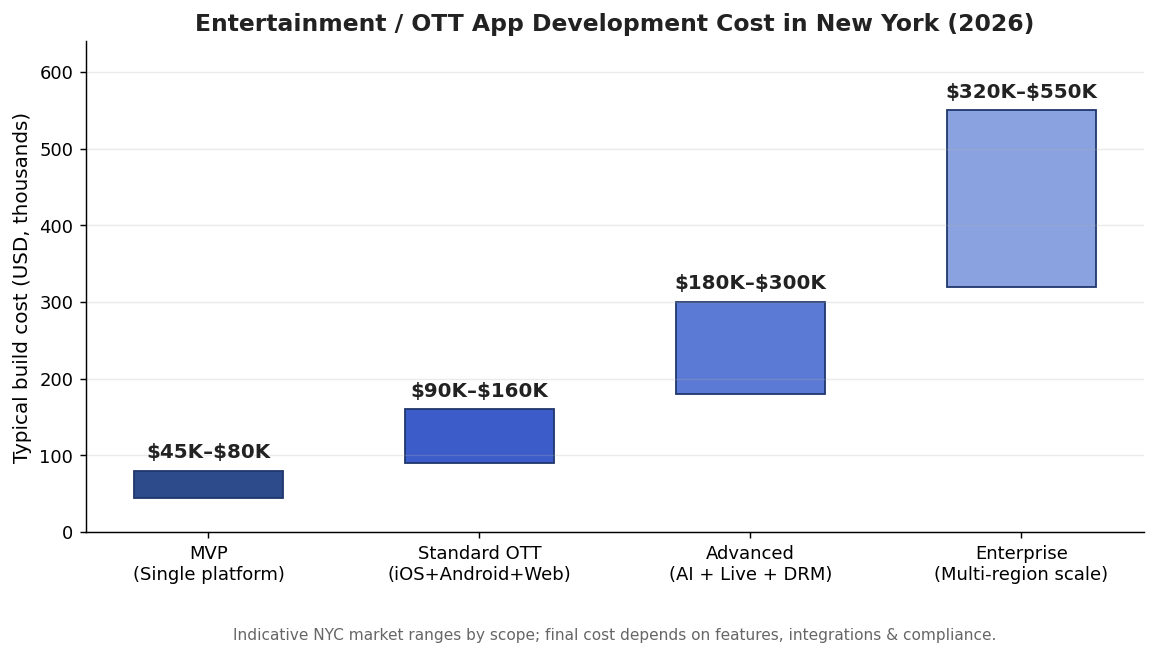
Three factors move these numbers more than anything else. First, streaming quality — adaptive bitrate streaming and a solid content delivery network add real engineering and infrastructure cost. Second, content protection — studio-grade DRM (Widevine, FairPlay, PlayReady) is non-negotiable for licensed content and adds both build and licensing expense. Third, your monetization model — subscription billing, ad insertion, and pay-per-view each carry their own integration work.
New York rates sit above the national average, which is worth budgeting for honestly. What you gain is proximity, timezone alignment, and teams fluent in the media and advertising ecosystem your product lives in. To compare that against national numbers, our MVP app development in New York guide breaks down lean-build pricing in more detail.
Summary: Budget $45K–$80K for an MVP, $90K–$160K for a standard cross-platform OTT app, and $180K+ for advanced or enterprise streaming platforms in New York. Streaming quality, DRM, and monetization are the three biggest cost drivers.
Not sure which tier your idea falls into? Send us your content plan and target platforms, and we’ll map it to a realistic New York budget and timeline. Start with a quick project estimate.
Get a Custom Project Estimate →Must-Have Features of a Modern Entertainment App
Feature scope is where budgets balloon, so it helps to separate the non-negotiables from the nice-to-haves. Every serious entertainment app in 2026 needs a core set of capabilities before anything experimental gets added.
- Adaptive bitrate streaming that adjusts video quality to each user’s connection in real time, preventing buffering on the subway or a spotty home network.
- Personalized recommendations powered by viewing history and AI models, which drive the majority of watch time on mature platforms.
- Fast, reliable playback with resume-where-you-left-off, offline downloads, and background audio.
- Secure user accounts and profiles including multi-profile support for households and parental controls.
- Flexible monetization — subscriptions, ad insertion, or rentals, wired to compliant billing.
- Search and content discovery that actually finds titles across a large catalog.
- Cross-device continuity so a user can start on a phone in Brooklyn and finish on a smart TV at home.
- Analytics and engagement tracking to see what people watch, where they drop off, and why they churn.
Beyond the basics, differentiators like live watch parties, interactive overlays, creator tools, and voice search can set a New York product apart. We recommend shipping the core reliably first, then layering these in once the streaming foundation is proven.
Technology Stack and Architecture for OTT Apps
The streaming backend is the real product. A clean player over a weak pipeline still buffers, so architecture decisions here outrank UI polish. A modern entertainment app is a media pipeline plus an application layer, and both need to scale independently.
The media pipeline handles ingestion, transcoding into multiple resolutions, packaging into HLS and MPEG-DASH formats, and distribution through a content delivery network (CDN). Managed services like AWS Media Services or Google Cloud’s media tooling handle much of this, and building cloud-native from day one keeps costs predictable as audiences grow.
The application layer covers the client apps, APIs, recommendation engine, user accounts, and billing. On the client side, teams choose between native development (Swift for iOS, Kotlin for Android) and cross-platform frameworks like React Native or Flutter. The right choice depends on your streaming and performance needs.
| Approach | Best for | Streaming performance | Trade-off |
|---|---|---|---|
| Native (Swift / Kotlin) | High-end video, complex playback, smart-TV parity | Highest, with full access to device video APIs | Two codebases, higher cost |
| React Native | Content apps, faster iteration, shared logic | Strong for most OTT use cases with native modules | Some native bridging for advanced playback |
| Flutter | Visually rich apps, single team, brand-heavy UI | Good, with a maturing video ecosystem | Fewer specialized streaming plugins |
For most New York OTT projects, we build native players where broadcast-grade playback matters and use a cross-platform layer elsewhere to move faster. Our Flutter app development in New York and mobile app development services pages go deeper on framework selection.
The Entertainment App Development Process, Step by Step
A streaming app succeeds or fails on sequencing. Building the UI before the media pipeline is a classic and expensive mistake. Here is the process we follow on New York entertainment builds, and roughly how the weeks distribute.
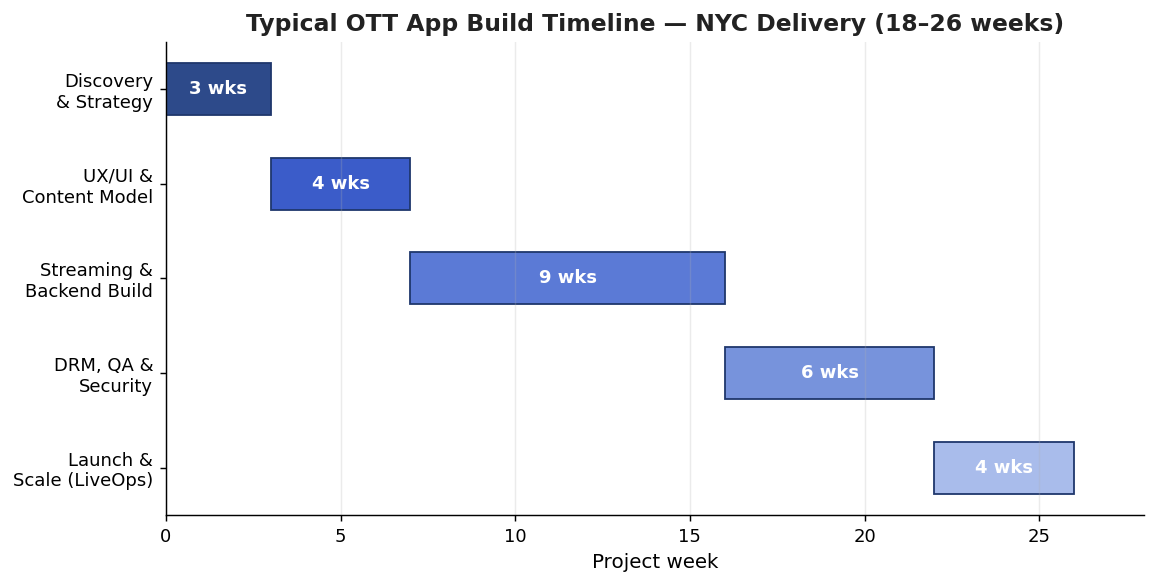
- Discovery and strategy (weeks 1–3). Define the content model, licensing constraints, target platforms, and monetization. This is where we pressure-test the business case before writing code.
- UX/UI and content modeling (weeks 3–7). Design the browse, playback, and paywall experiences, and structure how content, metadata, and rights are organized.
- Streaming and backend build (weeks 7–16). Stand up the media pipeline, transcoding, CDN, APIs, recommendation engine, and client playback. This is the longest and most technical phase.
- DRM, QA, and security (weeks 16–22). Integrate content protection, run device and network testing, and harden the platform against abuse and leakage.
- Launch and scale — LiveOps (weeks 22–26). Ship to the app stores, monitor real traffic, tune streaming performance, and prepare for concurrency spikes.
Timelines compress or stretch with scope. A single-platform MVP can ship near the shorter end; a multi-region platform with live channels runs longer. What rarely changes is the order — the pipeline comes before the polish.
DRM, Content Security, and Compliance
Digital rights management (DRM) is the set of technologies that control how licensed media can be accessed, copied, and played. For any app streaming studio or label content, DRM is a contractual requirement, not an optional feature.
In practice this means integrating the major DRM systems — Google Widevine, Apple FairPlay, and Microsoft PlayReady — so protected content plays correctly across devices while staying encrypted end to end. Content is delivered over encrypted connections, keys are managed by a license server, and playback is tied to authorized sessions.
Security extends past DRM. Entertainment apps handle payment data, personal viewing histories, and sometimes children’s data, which brings privacy obligations under regulations like New York’s SHIELD Act and, for younger audiences, COPPA. A security-first architecture — encryption, access controls, and audit logging following OWASP guidance — protects both the content and the business behind it.
We treat content leakage and account sharing as engineering problems with real revenue impact. Watermarking, token-based access, and anomaly detection are standard parts of how KKRF Group hardens a streaming platform.
Monetization Models and ROI
How an entertainment app makes money shapes its entire architecture, so the model belongs in the earliest planning, not an afterthought. The four dominant approaches each suit different content and audiences.
| Model | How it works | Best for | Revenue predictability |
|---|---|---|---|
| SVOD (subscription) | Recurring fee for unlimited access | Deep libraries, loyal audiences | High and recurring |
| AVOD (ad-supported) | Free access funded by advertising | Broad reach, casual viewers | Variable, scales with audience |
| TVOD (transactional) | Pay per title or event | Premieres, live events, sports | Spiky, event-driven |
| Hybrid | Mixes subscription, ads, and rentals | Platforms serving mixed audiences | Balanced and resilient |
Return on investment follows retention, not downloads. An app that keeps subscribers for many months returns far more than one with a big launch and heavy churn. That is why we invest early in the features that protect retention — reliable playback, sharp recommendations, and a paywall that does not frustrate.
For a New York media brand, the ROI math also includes strategic value: owning the direct audience relationship, first-party viewing data, and an advertising surface that does not depend on a third-party platform. Those assets often justify the build well before subscription revenue alone does.
Planning the monetization and streaming architecture is where most entertainment apps are won or lost. Our engineers can review your model and technical approach before you commit a budget. Book a technical assessment with our team.
Get a Technical Assessment →Common Mistakes to Avoid
We’ve seen the same avoidable errors sink otherwise strong entertainment products. Naming them early is the cheapest form of insurance.
- Building the UI before the pipeline. A beautiful player over an unreliable streaming backend still buffers, and users leave.
- Underestimating DRM. Retrofitting content protection after launch is slow, costly, and can breach licensing terms.
- Ignoring concurrency. Streaming that works for a demo can collapse under a live-event traffic spike without load planning.
- Treating recommendations as optional. On mature platforms, discovery drives most watch time; a weak engine caps engagement.
- Choosing a monetization model too late. Billing, ad insertion, and access control shape the architecture and are painful to bolt on afterward.
- Skipping analytics. Without drop-off and churn data, teams optimize blind and waste roadmap cycles.
Entertainment App Trends Shaping 2026
The entertainment app market keeps moving, and a few 2026 trends are worth designing for now rather than chasing later.
- AI-driven personalization that goes beyond history to context — time of day, device, and mood-based discovery.
- Interactive and shoppable video, where viewers act on content without leaving the stream.
- Live and low-latency streaming for sports, events, and creator broadcasts, with sub-second latency targets.
- Connected-TV expansion, as OTT audiences shift back to the living room and demand smart-TV parity.
- Privacy-forward advertising that respects tightening data rules while keeping AVOD viable.
None of these replace the fundamentals. They reward teams that already have a reliable streaming core and can extend it — which is exactly why we build that core to last.
Decision Framework: Native OTT App vs. Alternatives
Not every media idea needs a full custom OTT build on day one. Use this framework to choose the right path for your stage and content.
Choose a custom native OTT app when:
- You hold or license premium content that requires studio-grade DRM and broadcast-quality playback.
- You expect large concurrent audiences or live events that demand tuned streaming infrastructure.
- Owning the audience relationship, data, and ad surface is core to your business.
Consider a lighter path (cross-platform MVP or white-label) when:
- You are validating an idea and need to test demand before heavy investment.
- Your catalog is small and your playback needs are standard.
- Speed to market matters more than owning every layer of the stack.
Limitations to weigh: white-label platforms ship fast but constrain customization and can raise long-term licensing costs; a cross-platform MVP saves money early but may need native rework for advanced playback at scale. Our recommendation for most funded New York media projects is a cross-platform MVP to validate, then a native streaming core once traction is real. For enterprise media brands with licensed content, we usually start native from the outset.
How to Choose an Entertainment App Development Company in New York
The portfolio screenshots all look similar. The differences that matter are underneath. When evaluating an entertainment app development company in New York, weigh these signals.
- Streaming architecture experience. Ask what media pipeline they have built and how it handled concurrency. Vague answers are a red flag.
- DRM and content-security track record. Real streaming teams speak fluently about Widevine, FairPlay, encryption, and license servers.
- Monetization depth. They should have shipped subscriptions, ad insertion, or pay-per-view, not just described them.
- Scalability and cost planning. Cloud-native design and honest infrastructure-cost modeling separate partners from vendors.
- Transparent process. Clear phases, testable milestones, and direct engineer access beat polished sales decks.
KKRF Group brings a custom engineering approach, enterprise-grade architecture, and a security-first process to New York entertainment projects, and we work as a long-term technology partner rather than a one-off vendor. If you want an outside read on your streaming approach, our enterprise mobile app development in New York team is a good place to start.
Ready to build an entertainment or OTT app that scales in New York? Talk to the engineers who will actually design your streaming architecture — no sales-only calls. Talk to our engineering team to get started.
Talk to Our Engineering Team →Frequently Asked Questions
How much does it cost to build an entertainment app in New York?
An MVP entertainment or OTT app in New York typically costs $45,000 to $80,000. A standard cross-platform app runs $90,000 to $160,000, while advanced apps with AI recommendations, live streaming, and full DRM reach $180,000 to $300,000. Enterprise, multi-region platforms can exceed $550,000. Streaming quality, content protection, and monetization are the biggest cost drivers.
How long does it take to develop an OTT streaming app?
Most OTT streaming apps take 18 to 26 weeks to build. Discovery and design take four to seven weeks, the streaming backend and playback take the largest share at roughly nine weeks, and DRM, QA, and launch fill the remainder. A single-platform MVP can ship faster; a multi-region platform with live channels takes longer.
Is React Native good for streaming and entertainment apps?
Yes, React Native works well for most OTT and content apps, especially when you want faster iteration and shared logic across iOS and Android. For broadcast-grade playback or advanced smart-TV features, teams often add native video modules or build native players. The right choice depends on your streaming quality targets and platform mix.
What is DRM and does my entertainment app need it?
DRM (digital rights management) controls how licensed media can be accessed, copied, and played. If your app streams studio or label content, DRM is usually a contractual requirement. It means integrating Widevine, FairPlay, and PlayReady so protected content plays across devices while staying encrypted. Apps with only original, unlicensed content have more flexibility but still benefit from content protection.
What is the best monetization model for an OTT app?
The four common models are SVOD (subscription), AVOD (ad-supported), TVOD (pay-per-title), and hybrid. Subscriptions give predictable recurring revenue for deep libraries, ads maximize reach for casual audiences, transactional works for events and premieres, and hybrid balances all three. The best model depends on your content and audience, and it should be decided before architecture begins.
Why hire a New York entertainment app development company?
New York is the center of American media, so local development partners understand licensing, advertising relationships, and the pace of NYC media teams. Proximity, timezone alignment, and fluency in the entertainment ecosystem help ensure the product fits how your business actually operates. It also makes collaboration with your content and legal teams far smoother.