
Voice has quietly become the highest-stakes interface in enterprise software. A customer who abandons a chat window is mildly annoyed; a customer stuck in a broken phone conversation churns. That is why AI voice agent development has moved from experiment to boardroom priority in 2026 — and why so many teams are discovering that a convincing demo and a production-grade, compliant voice system are very different engineering problems.
This guide is written from the perspective of an engineering team that builds these systems for a living. As KKRF Group, a leading AI and ML integration partner, we work with startups and enterprises to design voice agents that survive real traffic, real regulation, and real edge cases. Below we break down the architecture, the true cost, the security and compliance obligations, the ROI math, and a decision framework you can use to choose the right approach — and the right partner.
Key Takeaways
- An enterprise voice agent is a five-layer, low-latency system — telephony, speech-to-text, an LLM reasoning/orchestration layer, text-to-speech, and evaluation. Most production failures happen at the seams between these layers, not inside them.
- Published 2026 pricing puts usage at roughly $0.05–$0.50 per minute, while a custom build ranges from a $10k–$25k MVP to $75k–$300k+ for enterprise-grade deployments with SLAs and deep integrations.
- The core architectural decision is cascaded vs. speech-to-speech: cascaded for regulated, auditable workflows; speech-to-speech for latency-critical, conversational experiences.
- Security and compliance (HIPAA, PCI DSS, GDPR, consent capture) can account for a large share of an enterprise budget and must be designed in from day one, not retrofitted.
- Vendor-reported ROI is strong — resolutions at a fraction of a live-agent call cost — but only when call containment, escalation, and evaluation are engineered deliberately.
What This Guide Covers
Quick Answer: Building Enterprise Voice AI in 2026
At KKRF Group we approach voice AI the way we approach any mission-critical system: as an engineering discipline first. The models are commoditizing quickly, but the parts that decide whether a voice agent earns trust — interruption handling, escalation logic, backend integration, observability, and data governance — are custom software problems. That is where an enterprise software development company with a security-first, cloud-native mindset adds durable value beyond any single model or platform.
What Is an Enterprise AI Voice Agent?
An AI voice agent is conversational software that holds a two-way spoken conversation over a phone line or in-app audio channel. Unlike the rigid IVR menus of the last two decades, a modern voice agent understands natural speech, reasons about intent, pulls real customer context, completes a task, and hands off to a human with full transcript context when needed.
Enterprises typically deploy voice agents for inbound support triage, appointment scheduling and reminders, order status and tracking, lead qualification, outbound collections, and after-hours coverage. The common thread is high call volume with repetitive intent — exactly the workload where automation compounds savings while freeing human agents for complex, high-empathy conversations.
The Enterprise Voice AI Reference Architecture
A production voice agent is best understood as a continuous, low-latency loop rather than a single model. Each layer adds latency and failure surface, so the architecture’s job is to keep the round trip fast and graceful. The diagram below shows the reference stack we use as a starting point for enterprise engagements.
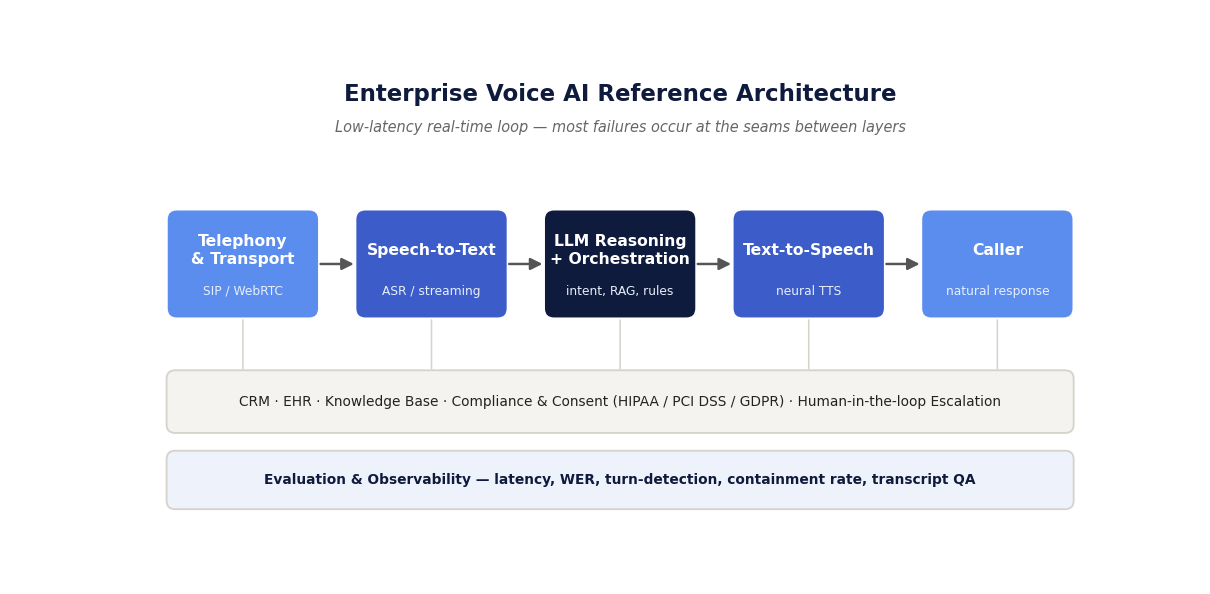
The telephony and transport layer connects the agent to the public phone network (SIP) or a browser/app audio session (WebRTC), the real-time media standard maintained by the W3C. The speech-to-text (STT) layer streams partial transcripts with minimal delay so the agent can begin reasoning before the caller finishes speaking. The LLM reasoning and orchestration layer — the brain — interprets intent, applies business rules and compliance guardrails, retrieves knowledge, and decides the next action or utterance. The text-to-speech (TTS) layer renders a natural response, and an evaluation and observability layer measures the whole loop.
Two cross-cutting concerns sit beneath every layer. First, systems integration: the agent is only useful if it can read and write to your CRM, EHR, order system, or knowledge base in real time. Second, grounding: to answer accurately from your own content rather than hallucinate, most enterprise agents use retrieval — the same tradeoffs we cover in our analysis of RAG vs. fine-tuning for enterprises. Getting these seams right is precisely where inexperienced teams lose weeks of rework.
Cascaded vs. Speech-to-Speech Architectures
The single most consequential design choice is whether to build a cascaded pipeline (discrete STT → LLM → TTS stages) or a speech-to-speech model that ingests and emits audio directly. Each optimizes for a different priority, and the right answer depends on your use case rather than fashion.
| Dimension | Cascaded (STT → LLM → TTS) | Speech-to-Speech |
|---|---|---|
| Latency | Higher; multiple hops | Lowest; single audio loop |
| Auditability | Strong — text transcript at every step | Weaker; harder to inspect intermediate reasoning |
| Control & guardrails | Fine-grained; easy to insert rules and redaction | Coarser; guardrails harder to enforce mid-stream |
| Best-fit use cases | Healthcare, finance, collections, regulated flows | Drive-thru, casual concierge, latency-critical UX |
| Compliance posture | Easier to satisfy HIPAA/PCI audit trails | Requires extra engineering for auditability |
How to Build a Voice Agent: A 7-Step Process
Successful voice AI projects follow a disciplined sequence. Skipping the early, unglamorous steps — scoping and evaluation design — is the most common reason pilots stall before production.
- Scope the intents and success metric. Pick two or three high-volume, well-bounded intents (e.g., appointment rescheduling) and define what “resolved” means, including a target containment rate and escalation threshold.
- Design the conversation and escalation flow. Map happy paths, edge cases, interruptions, and the exact conditions under which the agent hands off to a human with full context.
- Assemble the stack. Select telephony, streaming STT, the LLM and orchestration framework, and TTS — choosing cascaded or speech-to-speech per the decision above.
- Integrate systems of record. Wire the agent into your CRM, scheduling, or order backend with real-time reads and writes, plus idempotent actions so retries never double-book or double-charge.
- Ground and constrain the model. Add retrieval over your own knowledge base, prompt guardrails, and refusal/redaction rules so the agent stays accurate and on-policy.
- Build evaluation and observability. Instrument latency, word error rate, turn-taking, containment, and transcript QA before launch — this is the layer most teams underestimate.
- Pilot, measure, and harden. Run a limited-traffic pilot (commonly 6–12 weeks), tune on real transcripts, then scale to full production with SLAs and on-call support.
AI Voice Agent Development Cost in 2026
Voice AI cost comes in two flavors: ongoing usage (per-minute) and one-time build (engineering). Understanding both prevents the common trap of choosing a cheap per-minute platform that becomes expensive to customize — or an expensive custom build for a workload a platform would have handled.
Ongoing usage cost
Published 2026 pricing puts infrastructure-layer platforms at roughly $0.05–$0.15 per minute, while managed, all-in-one platforms with telephony and CRM integration bundled typically land at $0.25–$0.50 per minute. For 5,000–10,000 minutes a month, that commonly works out to a few hundred to low-thousands of dollars in platform cost, before engineering. Enterprise contracts are usually custom-quoted, with reported entry points around $2,500/month and annual commitments scaling well into six figures depending on volume and modules.
One-time build cost
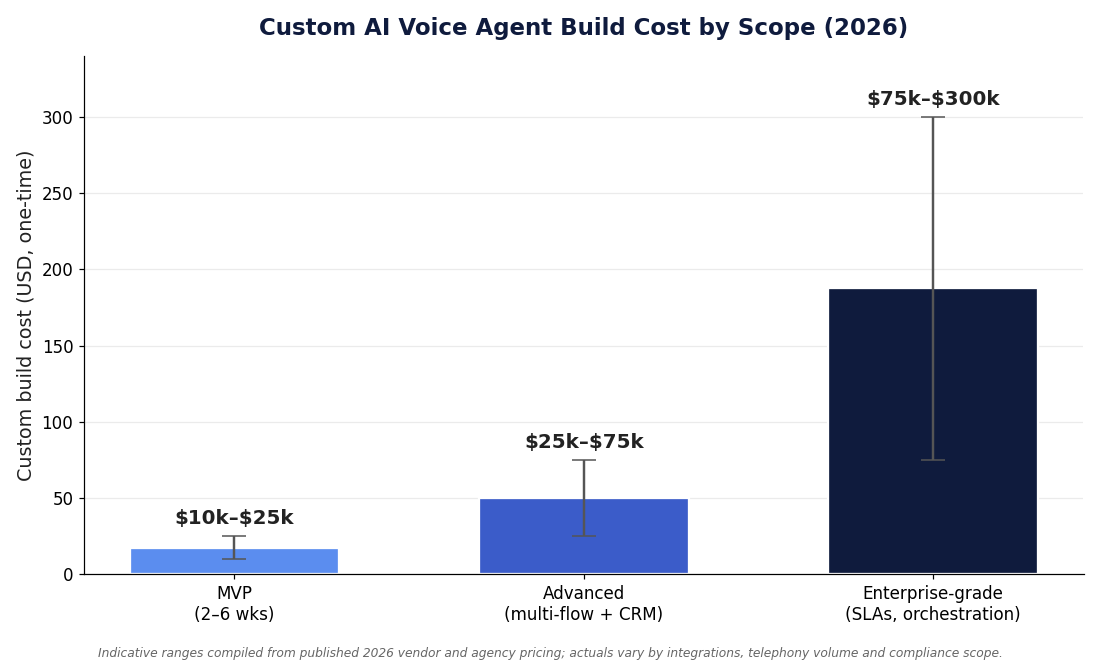
For custom engineering, published ranges cluster into three tiers, shown below. The wide enterprise band reflects how much integration, compliance, and reliability work a given deployment demands.
| Scope | Typical build cost | Timeline | What it includes |
|---|---|---|---|
| MVP | $10k–$25k | 2–6 weeks | Single-intent logic, core telephony, basic integration |
| Advanced | $25k–$75k | 1–3 months | Multi-flow handling, CRM links, richer guardrails |
| Enterprise-grade | $75k–$300k+ | 3–6 months | Backend orchestration, SLAs, analytics, compliance |
Two line items surprise first-time buyers. Security architecture — voice biometrics, encrypted authentication, fraud logic, PCI scope — can represent a substantial share of a financial-services build. And compliance work for regulated domains (HIPAA or GDPR alignment, audit validation) typically adds a meaningful five-figure increment, with ongoing fine-tuning and QA budgeted annually. These are not optional extras; they are the difference between a demo and a system you can put in front of customers.
Trying to pin down what a voice agent for your specific call flows would actually cost to build and run? Our engineers can scope it against your volume, integrations, and compliance needs and give you a realistic estimate — talk to the KKRF Group engineering team.
Get a Custom Project Estimate →Build vs. Buy: Platform, Hybrid or Custom
There are three honest paths to a production voice agent, and the best choice is rarely ideological. It is a function of how unusual your workflows are, how deep your integrations run, and how much control you need over data and behavior.
| Approach | Best when | Tradeoffs |
|---|---|---|
| Off-the-shelf platform | Standard intents, fast launch, limited integration | Lowest upfront cost; ceilings on customization, data control, and unit economics at scale |
| Cloud platform + custom dev | You need custom flows and integrations without owning the full stack | Balanced cost/control; the pragmatic default for most enterprises |
| Fully custom | Unique workflows, strict data residency, or scale where per-minute fees dominate | Highest control and best long-run economics; largest upfront investment |
For most organizations, the middle path — a managed platform augmented with custom orchestration and integrations — delivers the best balance. It is also where an experienced partner earns its keep: the platform handles undifferentiated plumbing while the custom engineering encodes your business logic, guardrails, and system integrations. This is the same build-vs-buy calculus we apply across enterprise AI agent development more broadly.
Security, Compliance & Regulatory Considerations
Voice adds attack surface that text automation does not: audio contains biometric identifiers, and phone channels are a favored vector for social engineering and fraud. For regulated industries, compliance shapes nearly every architecture decision, and it must be designed in from the first sprint.
- Healthcare (HIPAA): Protected health information in call audio and transcripts requires Business Associate Agreements with every STT, LLM, and TTS provider, plus encryption and strict access controls per the U.S. HHS HIPAA rules.
- Payments (PCI DSS): If callers speak card data, you must minimize PCI scope — typically by pausing recording and routing payment capture through a compliant path, per the PCI Security Standards Council.
- Privacy (GDPR/CCPA): Capture explicit consent to record and process voice, honor data-subject requests, and set clear retention limits on audio and transcripts.
- Fraud and identity: Layer voice biometrics or knowledge-based verification carefully — and never treat a synthesized or cloned voice as proof of identity.
- Human-in-the-loop: For high-stakes intents, require confident escalation to a person, with the full transcript and context handed over.
A security-first development approach — least-privilege integrations, encrypted data in transit and at rest, redaction of sensitive fields, and complete audit trails — is non-negotiable for enterprise voice AI. It is one of the core reasons regulated organizations choose to build with a partner that treats security as an architectural default rather than a checklist at the end.
The ROI and Business Case for Voice AI
The economic case is straightforward at the unit level. Vendors and analysts report that a resolved AI voice interaction costs a fraction of a live-agent call — often cents versus roughly $11–$12 for a human-handled call — with Forrester-cited three-year ROI figures ranging into the hundreds of percent and payback measured in months. Treat these as directional benchmarks reported by the market rather than guarantees; your actual return depends on containment.
The variable that makes or breaks ROI is containment rate — the share of calls the agent resolves without human help — balanced against customer experience. An agent that deflects 80% of calls but frustrates the remaining 20% into churn is a net loss. The right business case models three things together: cost per resolved call, containment at an acceptable satisfaction level, and the value of freeing human agents for complex work.
Common Mistakes That Derail Voice AI Projects
- Optimizing the demo, not the edge cases. Impressive happy-path demos hide the interruptions, accents, and silences that dominate real traffic.
- Treating latency as an afterthought. Every added hop erodes naturalness; teams that do not budget a latency for the full loop ship agents that feel robotic.
- Skipping evaluation. Without transcript QA and containment metrics, you cannot tell whether the agent is improving or quietly failing.
- Underinvesting in integration. An agent that cannot write back to the CRM or scheduling system is a glorified answering machine.
- Retrofitting compliance. Bolting HIPAA or PCI controls on at the end forces expensive re-architecture; design them in from sprint one.
- No graceful escalation. The fastest way to lose customer trust is trapping a caller with an agent that cannot hand off to a human.
A Decision Framework for Voice AI Investment
Before committing budget, work through four questions in order. They move you from “can we build a voice agent?” to “should we, and in what form?” — the sequence we use with clients at KKRF Group to keep projects tied to business outcomes rather than technology enthusiasm.
- Is the workload right? High volume, repetitive, and bounded intents are ideal; low-volume or highly nuanced conversations rarely justify the build.
- What is your regulatory exposure? This drives cascaded vs. speech-to-speech and a large part of the budget — decide it early.
- How deep are the integrations? Shallow integration favors a platform; deep, custom backend workflows favor a hybrid or custom build.
- What is your acceptable containment/CSAT tradeoff? Define the escalation threshold up front so success is measurable, not aspirational.
Answering these honestly usually points to a clear starting scope: a narrow, high-value intent, built on a hybrid stack, with compliance and evaluation engineered in and a deliberate path to expand. That disciplined, business-focused solution design is how modern voice AI moves from pilot to durable competitive advantage.
How to Evaluate a Voice AI Development Partner
Because the models are commoditizing, a partner’s value shows up in the engineering around the model. When you evaluate vendors, look past the demo and probe how they handle the hard, unglamorous parts of production voice AI.
- Real-time engineering depth: Can they discuss latency budgets, interruption handling, and turn detection specifically — not just prompt design?
- Integration track record: Evidence of writing reliably into CRMs, EHRs, and order systems with idempotent, auditable actions.
- Security-first posture: A default approach to encryption, least-privilege access, redaction, and compliance for your industry.
- Evaluation discipline: A concrete plan to measure containment, WER, and CSAT, and to iterate on real transcripts.
- Transparent process and ownership: Clear milestones, and you owning your data, prompts, and integrations rather than being locked in.
KKRF Group brings a custom-engineering approach, enterprise-grade architecture, and a security-first development process to each of these areas, working as a long-term technology partner rather than a one-off vendor. Whether you build on a platform or fully custom, the goal is the same: a voice agent your customers trust and your operations can rely on. If you want a deeper look at how we structure engagements, our software engineering services outline the process.
Planning a voice AI initiative and want a second set of eyes on the architecture before you commit budget? We offer a focused review of your call flows, integration points, and compliance requirements with KKRF Group.
Request an Architecture Review →Future Trends in Enterprise Voice AI
The direction of travel is clear even if timelines are not. Expect these shifts to shape voice AI roadmaps over the next 18–24 months.
- Native speech-to-speech models will keep closing the latency gap, making natural, interruptible conversation the default rather than a premium feature.
- Agentic voice — voice agents that call tools, chain steps, and complete multi-part tasks — will blur the line between voice agents and broader AI agents.
- Tighter regulation around AI disclosure, consent, and voice cloning will make compliance-by-design a competitive advantage, not just an obligation.
- Multilingual and code-switching capability will move from differentiator to table stakes for global enterprises.
- Standardized evaluation for voice quality and safety will mature, giving buyers better ways to compare vendors objectively.
The enterprises that win will treat voice AI as a durable capability to be engineered and governed, not a feature to be switched on. That means investing early in the architecture, evaluation, and compliance foundations that let a single successful intent expand safely into a portfolio of automated conversations.
Frequently Asked Questions
How much does it cost to build an AI voice agent?
A single-intent MVP typically costs $10,000–$25,000 and ships in 2–6 weeks. Advanced multi-flow agents with CRM integration run $25,000–$75,000, and enterprise-grade deployments with SLAs, orchestration, and compliance range from $75,000 to $300,000 or more. On top of the build, expect ongoing usage of roughly $0.05–$0.50 per minute depending on whether you use an infrastructure platform or a bundled managed service.
How long does it take to deploy an enterprise voice agent?
Most teams launch a limited-scope pilot in about 4–6 weeks and reach full production in 3–6 months. Timelines expand with deeper integrations, more conversation flows, and regulatory requirements such as HIPAA or PCI DSS, which add validation and security-hardening work.
Can AI voice agents be HIPAA or PCI compliant?
Yes, but compliance must be engineered in. HIPAA requires Business Associate Agreements with your speech-to-text, LLM, and text-to-speech providers plus encryption and access controls. PCI DSS compliance usually means minimizing scope by pausing recording and routing card capture through a compliant path. Both are far easier with a cascaded architecture that preserves auditable transcripts.
What is the difference between cascaded and speech-to-speech voice AI?
A cascaded pipeline runs discrete speech-to-text, LLM reasoning, and text-to-speech stages, giving you transcripts, fine-grained control, and auditability — ideal for regulated workflows. A speech-to-speech model processes audio directly for the lowest latency and most natural feel, but is harder to audit and control. Many enterprises deploy a hybrid of the two.
What ROI can we expect from a voice agent?
Vendors and analysts report that AI-resolved calls cost a fraction of a live-agent call and cite three-year ROI into the hundreds of percent with payback in months. Actual returns hinge on your containment rate — the share of calls resolved without a human — at an acceptable customer-satisfaction level, so the business case should model cost per resolved call and containment together.
Should we build a custom voice agent or use a platform?
Use an off-the-shelf platform for standard intents and a fast launch. Choose a hybrid of a managed platform plus custom engineering when you need custom flows and deep integrations — the pragmatic default for most enterprises. Go fully custom when workflows are unique, data residency is strict, or per-minute fees dominate at high volume.
Ready to turn a high-volume call flow into a reliable, compliant voice agent? KKRF Group designs, builds, and hardens enterprise voice AI end to end — from architecture to production. Start with a no-pressure conversation about your use case with our team.
Book a Discovery Call →