
If your users are in New York, your app has to be on both iPhones and Android phones on day one — and your budget usually cannot stretch to building each one twice. That single constraint is why React Native app development in New York has become the default starting point for so many startups and mid-market teams here. One shared codebase, two platforms, a fraction of the duplicated effort.
KKRF Group, a top mobile app development company in New York, builds extensively in React Native for clients across FinTech, HealthTech, and consumer sectors. This guide covers what actually matters in 2026: why teams pick React Native, where native still wins, real NYC cost ranges, the build process, and how to choose a partner who will not leave you with a brittle app in a year.
Key Takeaways
- React Native shares one codebase across iOS and Android, typically cutting build cost 30–40% versus two separate native apps.
- In New York, React Native projects in 2026 run roughly $35K for an MVP, $70K–$150K for a mid-market product, and $150K–$400K+ for complex builds.
- React Native’s New Architecture is the 2026 default, closing much of the old performance gap with native.
- Native still wins for graphics-heavy games, deep hardware use, and some regulated, performance-critical FinTech and HealthTech apps.
- A JavaScript-based framework means a deeper NYC talent pool and more predictable hiring than niche stacks.
On This Page
Quick Answer
React Native app development in New York lets you ship one codebase to both iOS and Android, usually saving 30–40% versus dual-native builds. Expect roughly $35K for an MVP and $70K–$150K for a funded-startup product at NYC market rates. It is the right choice for most business and consumer apps; native remains better for graphics-intensive or deeply hardware-dependent products.
For context on where this comes from: KKRF Group ships production React Native apps for New York companies and maintains them long after launch, which is when cross-platform decisions either pay off or come back to bite. Everything below reflects that build-and-maintain view, not a framework sales pitch.
What React Native App Development in New York Involves
Definition: React Native is an open-source framework, maintained by Meta, that builds native iOS and Android apps from a single JavaScript and TypeScript codebase. React Native app development in New York applies that approach at NYC market standards — local rates, compliance expectations, and same-timezone delivery.
The key word is native. React Native does not wrap your app in a browser the way older hybrid tools did. It renders real native UI components, so users get an app that looks and feels like it belongs on their phone, built from code your team writes once.
In practice, a React Native project still needs the full cast: mobile engineers, a backend developer, a UX/UI designer, and QA. What changes is efficiency — one team maintains one primary codebase instead of two parallel ones, with small platform-specific pieces added where they matter.
Why New York Companies Choose React Native
The reasons cluster around money, speed, and hiring — three things every New York founder feels acutely.
Cost efficiency. Industry estimates in 2026 put React Native’s savings at roughly 30 to 50 percent versus building two separate native apps. In a market where senior engineers bill $150 to $250 an hour, cutting duplicated work is not a rounding error — it can be the difference between shipping and stalling.
Faster time to market. One codebase means one build, one QA pass, and one release cycle to coordinate. For an MVP chasing an investor timeline or a market window, weeks matter, and React Native routinely buys them.
A deeper talent pool. React Native runs on JavaScript, the most widely used language among developers. That keeps hiring in New York more predictable than niche stacks, and it means your app is not hostage to one hard-to-replace specialist.
Code reuse with the web. Many NYC companies already run React on the web. Sharing logic, patterns, and sometimes people across web and mobile is a genuine operational advantage that pure-native teams cannot match.
React Native vs Native: When Each One Wins
This is the decision that trips people up, so let us be blunt about it. React Native is the right default for most apps. Native is the right call for a specific, identifiable minority. Here is how they compare.
| Factor | React Native | Dual Native (Swift + Kotlin) |
|---|---|---|
| Codebase | One shared | Two separate |
| Relative build cost | ~60–70% of native | Baseline (highest) |
| Time to market | Faster | Slower |
| Performance | Excellent for most apps | Best for heavy graphics/hardware |
| Talent availability | Broad (JavaScript) | Narrower, more specialized |
| Best fit | Business, consumer, content apps | Games, AR, deep device integration |
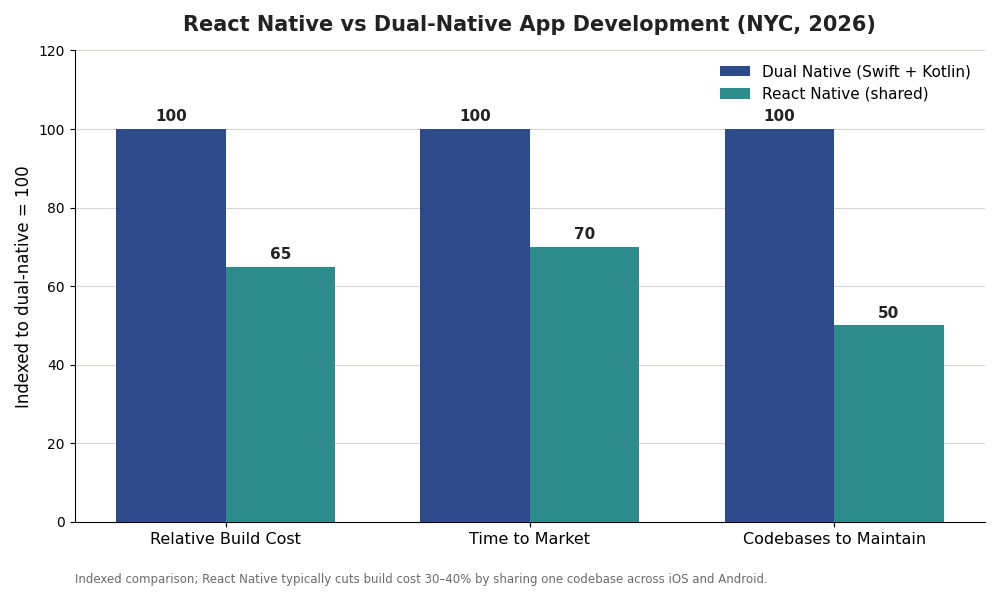
React Native vs dual-native across cost, time to market, and maintenance burden for New York projects, 2026.
We have seen this go wrong in one predictable way: a team picks native “to be safe” for an app that is really just forms, lists, and API calls — then pays twice for something React Native would have shipped in half the time. Choose native for a reason, not a reflex.
React Native App Development Cost in New York (2026)
New York rates sit at the top of the US range because of demand, cost of living, and a dense pool of senior talent. React Native trims the total, but it does not make NYC cheap. Here is the honest picture by project tier.
MVP or single-feature app ($35K–$70K). One shared codebase, core features only, built to validate an idea with real New York users before you commit to a full product. This is where most first builds should start.
Mid-market product ($70K–$150K). Custom UI, a real backend, third-party integrations, and multiple user flows. Most funded startups land here, and React Native’s savings are most visible at this scale.
Complex or enterprise app ($150K–$400K+). Advanced security, real-time features, multi-role dashboards, or regulated data. FinTech and HealthTech builds add roughly 25 to 50 percent for compliance work — that cost exists in any framework.
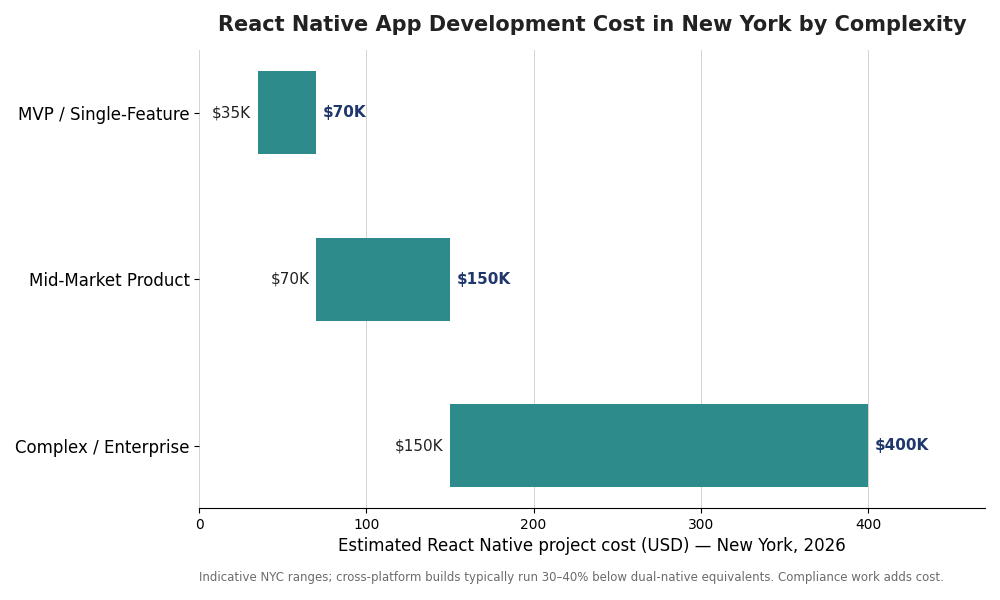
Indicative React Native app development cost in New York by complexity tier, 2026.
One caveat worth repeating: the cheapest quote rarely builds the cheapest app. Rework, missed compliance, and a fragile codebase compound fast. For the full economics across frameworks, our mobile app development cost in New York guide breaks the numbers down further.
Want a real number for your React Native project instead of a range? KKRF Group will scope it and share a grounded estimate — see how we approach mobile app development in New York.
Get a Custom Project Estimate →How We Build a React Native App, Step by Step
A framework does not save a project — process does. This is the sequence KKRF Group runs for React Native builds in New York.
- Discovery and scoping. Stakeholder interviews, user journeys, and technical architecture. Where scope gets defined and expensive surprises get caught early.
- UX/UI design. Wireframes, prototypes, and a design system built for real New York users, not internal feedback loops.
- Architecture setup. Project structure, state management, navigation, and the New Architecture configured from the start — not retrofitted later.
- Core development. Shared components in React Native, with small platform-specific native modules where iOS or Android genuinely need them.
- Backend and integrations. APIs, authentication, payments, and third-party services wired in with security as a design input.
- QA across devices. Testing on real iOS and Android hardware, across OS versions and screen sizes, not just a simulator.
- Launch and iterate. App Store and Google Play submission, monitoring, and a defined maintenance plan for the months after launch.
Budget the front end of this — discovery and design — generously. It is the cheapest place to change your mind and the most expensive place to skip.
React Native Across New York’s Key Industries
New York’s economy runs on a handful of dominant verticals, and React Native fits most of them well. A few need extra care.
FinTech. Payment apps, budgeting tools, and investment dashboards are largely UI, data, and API work — React Native’s sweet spot. The nuance is compliance: NY DFS cybersecurity rules and PCI-DSS shape the architecture regardless of framework, which we cover in our FinTech app development in New York guide.
HealthTech. Patient portals, telehealth, and wellness apps work well in React Native, provided HIPAA-grade data handling and audit logging are designed in from day one. Secure by architecture, not by afterthought.
Retail and consumer. New Yorkers are a demanding audience with high design expectations. React Native handles polished, content-rich consumer apps comfortably, and the shared codebase keeps rapid A/B iteration affordable.
Logistics and on-demand. Real-time tracking, driver and customer apps, and live updates are all well within React Native’s range, which is why so many on-demand startups in the city start here.
Performance, the New Architecture, and Real Limits
The old knock on React Native was performance. In 2026 that argument is mostly outdated, but honesty requires naming where it still holds.
React Native now ships its New Architecture by default. The bridge that once bottlenecked communication between JavaScript and native code has been replaced, so apps start faster, animate more smoothly, and handle heavier workloads than the framework’s reputation suggests. For the vast majority of business and consumer apps, users will never perceive a gap.
Where native still leads: graphics-intensive games, augmented reality, heavy real-time video processing, and apps leaning hard on brand-new platform APIs the day they launch. If your product lives in that territory, native or a hybrid approach is the responsible choice — and a good partner will tell you so.
The pragmatic middle ground: React Native for the app, native modules for the two or three performance-critical pieces. Most complex NYC apps we build end up here, capturing cross-platform savings without sacrificing the parts that need raw speed.
Common React Native Mistakes to Avoid
Cross-platform is efficient, not effortless. These are the failures we see repeat.
- Ignoring the New Architecture. Starting a 2026 project on the legacy architecture bakes in performance debt from line one.
- Over-relying on third-party libraries. Every unmaintained package is a future breakage. Vet dependencies like you vet hires.
- Skipping platform-specific polish. iOS and Android have different design conventions; ignoring them makes an app feel cheap on one platform.
- Testing only on simulators. Real-device testing across OS versions catches issues emulators quietly hide.
- Treating compliance as a bolt-on. For FinTech and HealthTech, retrofitting HIPAA or PCI-DSS after the build costs far more than designing for it up front.
- No maintenance plan. React Native and its ecosystem move quickly; budget 15–20% of build cost yearly to keep the app healthy.
Should You Choose React Native? A Quick Framework
Strip away the debate and the choice usually resolves in a minute. Match your product to the row below.
| Your Product | Best Fit | Why |
|---|---|---|
| MVP on a tight budget | React Native | Ship both platforms once, validate fast |
| Business or content app | React Native | Cost and speed with no real trade-off |
| FinTech / HealthTech app | React Native + native modules | Cross-platform base, native where compliance demands |
| Graphics-heavy game or AR | Native | Raw performance and device access win |
| Existing React web team | React Native | Shared skills, logic, and hiring pool |
If two rows fit, default to React Native and add native modules only where a real requirement forces it. Starting cross-platform and specializing later is cheaper than the reverse.
Still weighing React Native against native for your specific app? Get an architecture review from KKRF Group — a top mobile app development company in New York — and a straight recommendation with no obligation.
Request an Architecture Review →How to Choose a React Native Development Partner in NYC
The framework is only as good as the team wielding it. When you evaluate a React Native development partner in New York, weigh these signals.
- Shipped React Native apps you can download. Ask for live apps and post-launch metrics, not just case-study slides.
- New Architecture fluency. A current partner builds on the 2026 architecture and can explain when to drop into native modules.
- Relevant vertical experience. FinTech or HealthTech work in New York means they already understand the compliance terrain.
- Honest trade-off conversations. A partner who recommends native when it is genuinely better is one you can trust with the rest.
- A real maintenance commitment. Defined SLAs and post-launch support, not a handoff and a goodbye.
If you are comparing several firms, our guide to the best mobile app development company in New York walks through a full evaluation framework you can reuse here.
Frequently Asked Questions
How much does React Native app development cost in New York?
In 2026, a React Native MVP in New York typically runs $35,000–$70,000, a mid-market product $70,000–$150,000, and a complex or enterprise app $150,000–$400,000 or more. Cross-platform builds usually cost 30–40% less than two separate native apps, though FinTech and HealthTech compliance adds 25–50%.
Is React Native good enough for a production app in 2026?
Yes, for the large majority of business and consumer apps. React Native ships its New Architecture by default in 2026, which removes the old performance bottleneck, and it renders real native UI. Graphics-heavy games, AR, and some hardware-intensive apps still favor native.
React Native or Flutter for a New York project?
Both are strong cross-platform choices. React Native uses JavaScript, so hiring in New York is easier and it pairs well with React web teams. Flutter can offer very smooth UI. The deciding factor is usually your existing team’s skills and talent availability.
How long does it take to build a React Native app?
A React Native MVP typically takes 8–12 weeks, while a mid-market product runs a few months depending on scope and integrations. Sharing one codebase across iOS and Android is a major reason the timeline is shorter than dual-native builds.
Does React Native really save money versus native?
In most cases, yes. Because one codebase serves both platforms, you avoid building and maintaining two apps, which industry estimates put at roughly 30–50% savings. The savings are largest for standard business and consumer apps and smallest for performance-critical products.
Can React Native handle FinTech and HealthTech compliance?
Yes, when compliance is designed in from the start. NY DFS, PCI-DSS, and HIPAA requirements shape architecture, data handling, and audit logging regardless of framework. For the most performance- or security-critical pieces, native modules can be added within a React Native app.
Ready to start your React Native app development in New York? Tell KKRF Group about your project and we’ll tell you what it really takes to build it right — backed by a team that ships and maintains cross-platform apps.
Talk to Our Engineering Team →