
New York runs on insurance. From the P&C carriers around the Financial District to the health plans in Midtown and the InsurTech startups scattered across Brooklyn, the city holds one of the densest concentrations of insurance companies anywhere in the world. That density raises the bar. A policyholder in Manhattan expects to file a claim from their phone in minutes, not days — and the carrier that makes them wait loses them to one that doesn’t.
This guide explains how insurance app development actually works in New York in 2026: what these apps cost, how long they take, which features matter, and how regulations like HIPAA and the NYDFS cybersecurity rule shape every architectural decision. As KKRF Group, a top mobile app development company that builds enterprise-grade software for regulated industries, we’ve pulled together the practical detail a carrier, broker, or founder needs before signing a development contract.
Key Takeaways
- An insurance app development company in New York builds HIPAA- and NYDFS-compliant mobile apps for carriers, brokers, MGAs, and InsurTech startups.
- A production-ready MVP typically costs $40,000–$60,000; mid-tier apps run $80,000–$150,000; AI-driven and enterprise platforms reach $150,000–$650,000+.
- Timelines range from 3–6 months for an MVP to 9–18 months for a full platform with claims automation and core-system integration.
- Compliance is not optional: NYDFS 23 NYCRR 500, HIPAA (for any health data), SOC 2, and PCI DSS govern how the app stores and moves data.
- AI now drives the highest ROI features — automated claims triage, fraud detection, and predictive underwriting.
What This Guide Covers
- Quick Answer
- What Insurance App Development Means
- Why New York Leads InsurTech
- Types of Insurance Apps
- Must-Have Features
- Development Cost in New York
- Development Timeline
- The Development Process
- HIPAA, NYDFS & Security
- Technology Stack
- How AI Is Reshaping Insurance Apps
- The Business Case & ROI
- Common Mistakes to Avoid
- How to Choose a Partner
- Why KKRF Group
- FAQ
Quick Answer: Insurance App Development in New York
That’s the short version. The rest of this guide unpacks each number, feature, and regulation so you can budget accurately and brief a development team with confidence.
What Insurance App Development Means
Insurance software isn’t a standalone product. It sits on top of decades-old core systems — policy administration, billing, claims — and has to talk to them cleanly. We’ve seen projects stall not because the app was hard to design, but because the carrier’s core platform exposed no modern API. Good insurance app development starts by mapping those integrations before a single screen is drawn.
Why New York Leads InsurTech
New York is the financial and insurance capital of the country. Some of the largest life, health, and property carriers are headquartered in or around the city, and the state regulator — the New York State Department of Financial Services — sets standards that ripple across the whole industry. Building here means building for the most demanding regulatory and customer environment in the market.
There are three practical reasons the city dominates. First, proximity to carriers shortens the feedback loop between engineers and the people who actually price risk. Second, the local talent pool blends fintech, healthcare, and data-science engineers who understand regulated builds. Third, the NYDFS cybersecurity rule has effectively made New York a compliance benchmark — an app that passes here passes almost anywhere.
For carriers and founders, that raises the stakes. Your users are comparing your app to the slickest fintech products they already use. A New York insurance app has to feel that polished while carrying far heavier compliance weight underneath. Working with an insurance app development company in New York that already understands that balance saves months of rework.
Types of Insurance Apps You Can Build
“Insurance app” covers a wide spread of products. Choosing the right type early keeps scope honest and budgets realistic. Here are the categories New York teams build most often.
Policyholder self-service apps
These give customers a single place to view coverage, download ID cards, pay premiums, and start claims. They’re the most common first build because they cut call-center volume fast. A well-designed self-service app can deflect a large share of routine support calls within the first year.
Claims management apps
Claims are where insurers win or lose loyalty. A claims app lets a policyholder photograph damage, submit documents, and track status in real time, while adjusters triage from the back end. Automating first-notice-of-loss is one of the highest-ROI features an insurer can ship.
Agent and broker portals
Distribution still runs through people in much of the market. Agent apps let brokers quote, bind, and service policies on the move, sync leads, and access commission data. For MGAs, this portal is often the core product rather than an add-on.
Health insurance apps
Health plans carry the heaviest compliance load because they handle protected health information. These apps surface benefits, find in-network providers, manage claims, and increasingly integrate telehealth. Any app in this category must be HIPAA-compliant from day one — a topic we cover in depth in our guide to healthcare app development in New York.
Telematics and usage-based apps
Auto and commercial insurers use telematics apps to price risk on real behavior — mileage, braking, time of day. These are data-heavy builds that lean on device sensors and streaming pipelines, and they overlap closely with the analytics work behind modern FinTech app development in New York.
Must-Have Features of a Modern Insurance App
Feature scope drives both cost and adoption. The list below separates the baseline every insurance app needs from the advanced capabilities that actually move retention and loss ratios.
Core features
- Digital onboarding and KYC — identity verification and policy setup without paper.
- Policy management — view coverage, endorsements, renewals, and documents in one place.
- Claims filing and tracking — photo upload, first-notice-of-loss, and real-time status.
- Premium payments — secure, PCI-DSS-compliant payment and autopay.
- Push notifications — renewal reminders, claim updates, and payment alerts.
- Secure messaging — encrypted communication between policyholder, agent, and adjuster.
Advanced, high-ROI features
- AI claims triage — automatically routes and estimates simple claims to cut cycle time.
- Fraud detection — flags suspicious patterns before payout.
- Predictive underwriting — risk scoring from behavioral and third-party data.
- Telematics integration — usage-based pricing from device sensors.
- Chatbots and virtual assistants — 24/7 answers on coverage and claims.
- Provider or repair-shop directories — in-network search with geolocation.
Insurance App Development Cost in New York (2026)
Cost is the first question every stakeholder asks, and the honest answer is a range. What you pay depends on app type, feature depth, integration complexity, and how much compliance work the build carries. Based on 2026 US InsurTech benchmarks, here is what New York projects typically cost.
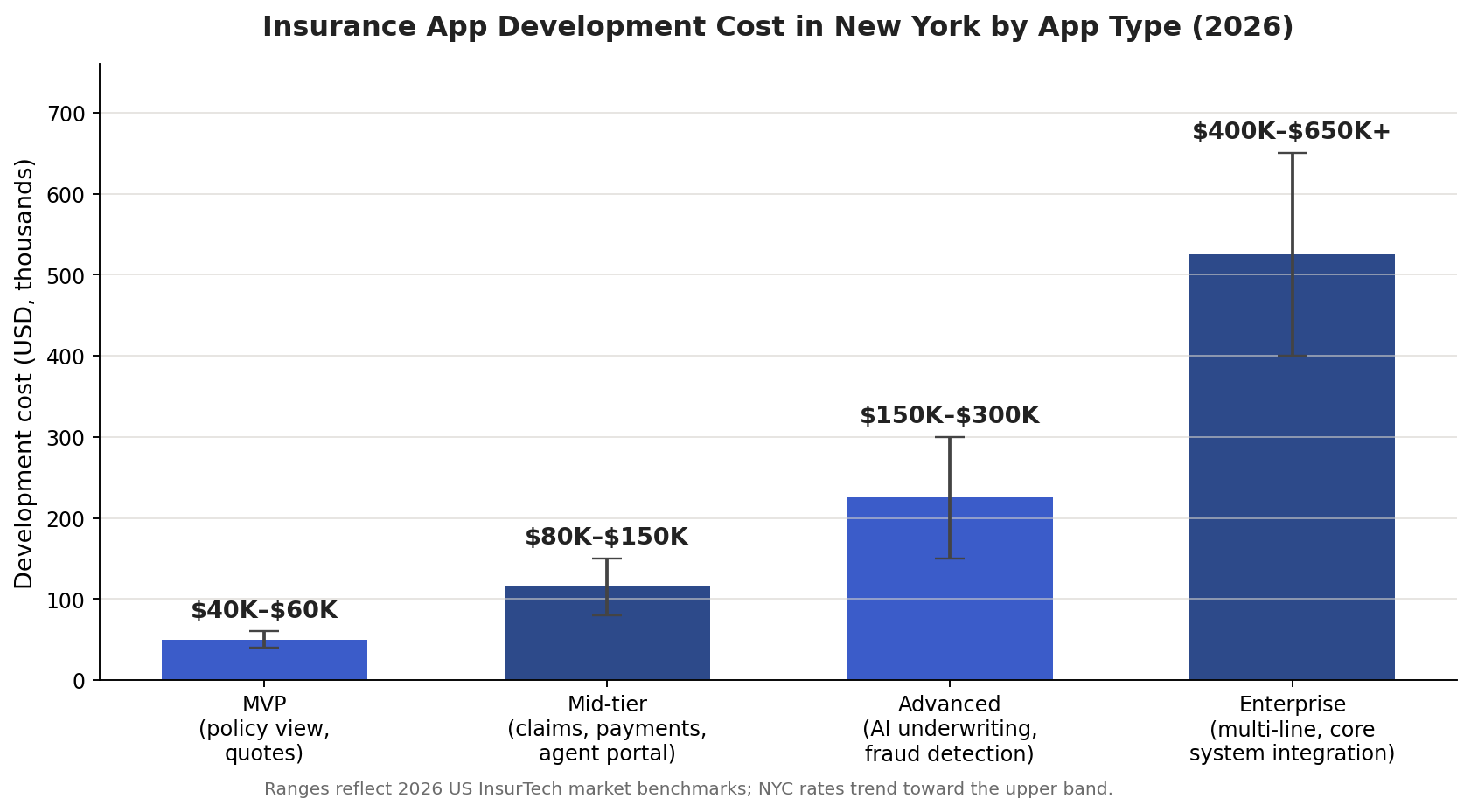
The table below breaks the same ranges down by app tier so you can map a budget to a scope.
| App tier | Typical cost (USD) | Timeline | Best for |
|---|---|---|---|
| MVP (policy view, quotes, basic claims) | $40,000–$60,000 | 3–6 months | InsurTech startups, pilots |
| Mid-tier (claims, payments, agent portal) | $80,000–$150,000 | 6–9 months | Brokers, regional carriers |
| Advanced (AI underwriting, fraud detection) | $150,000–$300,000 | 9–12 months | National carriers, MGAs |
| Enterprise (multi-line, core integration) | $400,000–$650,000+ | 12–18 months | Large insurers, health plans |
Two cost drivers surprise first-time buyers. Compliance engineering — encryption, audit logging, penetration testing, and documentation — can add 15–25% to a base budget. And integration with legacy core systems often costs more than the app’s user-facing features, because it demands custom middleware and careful data mapping.
Not sure which tier fits your roadmap? Our team can size the build against your feature list and compliance needs in a single working session. See how we approach mobile app development in New York.
Get a Custom Project Estimate →How Long Does Insurance App Development Take?
Timeline tracks closely with scope. A focused MVP can reach the App Store in a quarter; a full platform with claims automation and core-system integration is closer to a year and a half. The chart below shows realistic ranges.
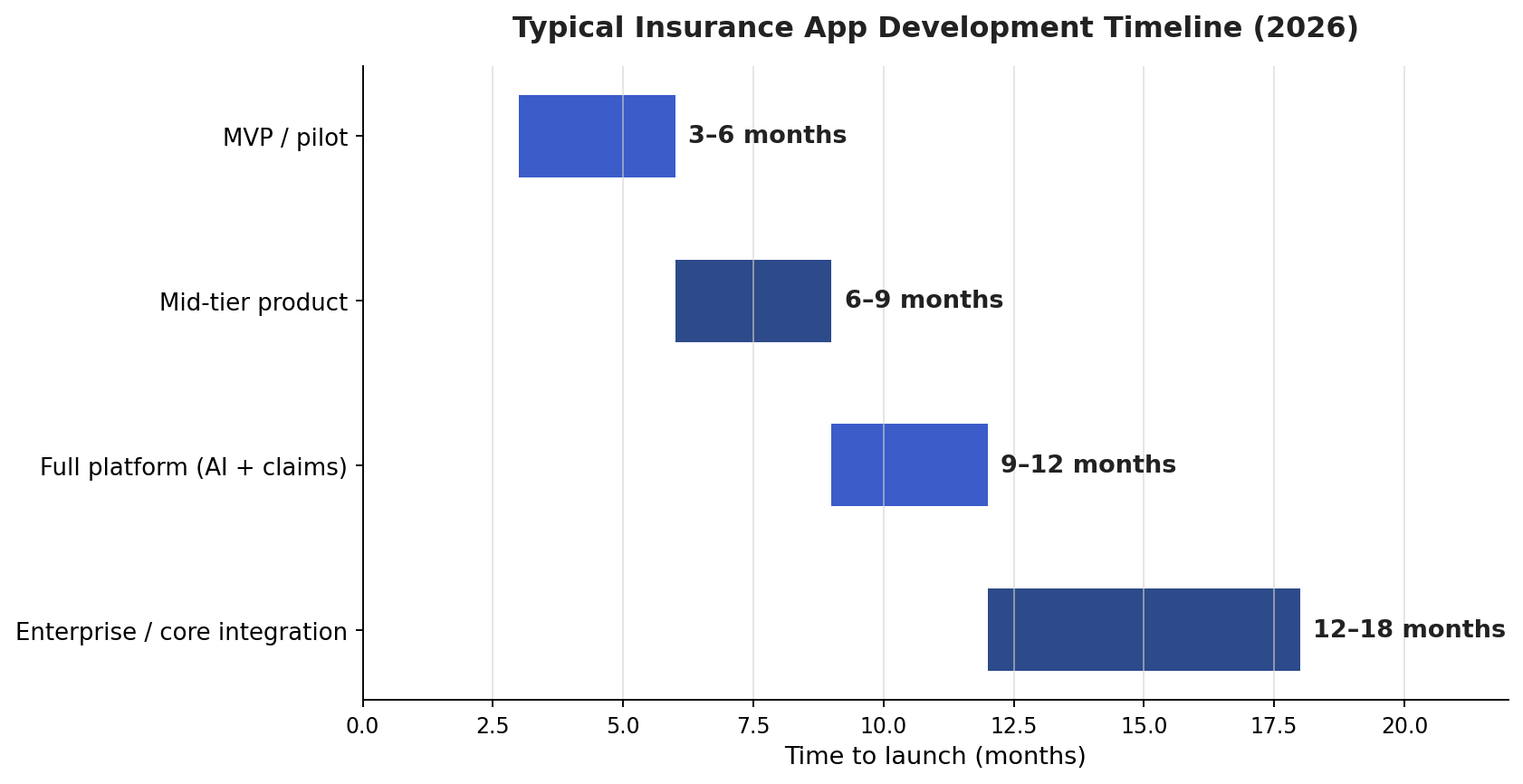
One planning tip we give every client: don’t compress the compliance and testing phase to hit a launch date. In insurance, a data-handling defect isn’t a bug — it’s a regulatory event. Build the security review into the schedule from the start rather than bolting it on at the end.
The Insurance App Development Process
A regulated build follows a disciplined sequence. Skipping or rushing a stage is where insurance projects most often go wrong. Here is the process we follow, step by step.
Step 1 — Discovery and compliance scoping. Map the target users, core-system integrations, and every regulation that applies before design starts. This is where HIPAA and NYDFS obligations get written into the requirements, not discovered later.
Step 2 — UX and prototype. Design the key journeys — onboarding, claims, payments — and validate them with real users. A clickable prototype catches expensive misunderstandings while they’re still cheap to fix.
Step 3 — Architecture and security design. Define the data model, encryption strategy, authentication, and API layer. In insurance, security architecture is decided here, not patched in later.
Step 4 — Development and integration. Build the front end and back end in parallel, wiring the app to policy, billing, and claims systems through tested middleware.
Step 5 — QA, security testing, and compliance audit. Run functional testing alongside penetration testing and a formal compliance review. Nothing ships until the security sign-off is complete.
Step 6 — Launch and monitoring. Release to the App Store and Google Play, then monitor performance, security events, and user behavior to guide the next iteration.
HIPAA, NYDFS & Security Compliance
Compliance is the defining constraint of insurance software. Get it wrong and you face fines, breach-notification duties, and lost trust. Three frameworks matter most for New York insurance apps.
Beyond these, PCI DSS applies to premium payments, and GDPR applies if any policyholders sit in the EU. We build to the strictest applicable standard by default — it’s cheaper than retrofitting compliance after an audit finds a gap. The official NYDFS cybersecurity guidance and the HHS HIPAA Security Rule are the primary references every insurance build should map against.
Technology Stack & Architecture
The right stack balances speed, security, and long-term maintainability. There’s no single correct answer, but these are the choices that hold up for regulated insurance apps in 2026.
- Front end: React Native or Flutter for cross-platform reach; native Swift or Kotlin when device-level performance or sensor access matters.
- Back end: Node.js, Java (Spring), or .NET, chosen to fit the carrier’s existing ecosystem.
- Cloud: AWS or Microsoft Azure, both of which offer HIPAA-eligible services and signable business-associate agreements.
- Data: PostgreSQL for transactional data, with encrypted storage and field-level protection for sensitive records.
- Security: OAuth 2.0, multi-factor authentication, TLS 1.3 in transit, and AES-256 at rest.
- Integration: REST or GraphQL APIs and middleware connecting to policy administration, billing, and claims systems.
We favor a cloud-native, API-first architecture because insurance products evolve constantly — new lines, new regulations, new partners. A modular system lets a carrier add a coverage type or swap a payment provider without rebuilding the app. That flexibility is the difference between software that ages well and software that becomes a liability. For guidance on secure application design, the OWASP Mobile Top 10 is a practical baseline.
How AI Is Reshaping Insurance Apps
Artificial intelligence has moved from pilot projects to production in insurance apps. The gains are concrete: faster claims, sharper pricing, and fewer fraudulent payouts. Three applications deliver most of the value today.
Automated claims processing. AI reads submitted photos and documents, estimates simple claims, and routes complex ones to human adjusters. For a routine auto or property claim, this can cut settlement time from days to minutes and free adjusters for the cases that genuinely need judgment.
Fraud detection. Machine-learning models spot anomalies — duplicate claims, staged incidents, inconsistent metadata — that rules-based systems miss. Because fraud accounts for a meaningful slice of industry losses every year, even modest improvements in detection pay for the feature quickly.
Predictive underwriting. Models score risk from behavioral, telematics, and third-party data, letting carriers price more accurately and approve low-risk applicants instantly. As KKRF Group, a leading AI and ML integration partner, we build these models with explainability in mind — regulators increasingly expect insurers to justify automated decisions, so a black box is a compliance risk, not just a technical one.
The Business Case & ROI
An insurance app is an investment, so it should be judged on returns. The value shows up in four places, and each is measurable.
- Lower servicing cost. Self-service deflects routine calls, cutting per-policy support expense.
- Faster claims. Automated first-notice-of-loss and triage shorten cycle time and lift satisfaction scores.
- Higher retention. A smooth digital experience reduces churn — and retaining a policyholder costs far less than acquiring one.
- Better risk selection. Data from the app sharpens underwriting and improves loss ratios over time.
The honest caveat: ROI depends on adoption. An app nobody downloads returns nothing. That’s why we treat onboarding UX and clear value-per-tap as first-class engineering concerns, not afterthoughts. The best insurance apps earn a place on the home screen because they save the user real time.
Common Mistakes to Avoid
- Treating compliance as a final step. Retrofitting HIPAA or NYDFS controls after the build is slow and expensive. Design them in from day one.
- Underestimating legacy integration. Connecting to old core systems often costs more than the app itself. Scope it first.
- Building every feature at once. A bloated v1 delays launch and buries the features users actually want. Ship a focused MVP, then iterate.
- Ignoring offline and low-connectivity cases. Adjusters and agents work in the field. An app that fails without signal fails the user.
- Choosing a generalist team. Insurance-domain knowledge is not optional. A partner who has never handled protected data will learn on your budget.
Planning an insurance app and want a second opinion on scope, stack, or compliance? We’ll review your requirements and flag the risks before you commit budget. Learn how to choose the right New York development partner.
Request an Architecture Review →How to Choose an Insurance App Development Company in New York
The right partner determines whether your app ships on time, passes audit, and earns adoption. Use this framework to evaluate candidates.
Choose a partner who:
- Has shipped regulated apps and can speak fluently about HIPAA, NYDFS, and SOC 2.
- Shows real experience integrating with insurance core systems, not just building front ends.
- Runs security testing and compliance review as standard, with documentation to prove it.
- Offers a transparent process with fixed milestones and clear ownership of code and IP.
- Provides post-launch support — insurance apps need ongoing maintenance as regulations change.
Be cautious when a vendor:
- Quotes a firm price before understanding your integrations and compliance scope.
- Has no regulated-industry work in their portfolio.
- Treats security as an add-on line item rather than a built-in practice.
- Can’t explain how they’d handle a data-breach obligation under NYDFS.
Why Partner With KKRF Group
KKRF Group is a top mobile app development company that builds enterprise-grade software for regulated industries — insurance, finance, and healthcare among them. We combine insurance-domain understanding with security-first engineering, so compliance is designed into the architecture rather than bolted on before launch.
Our approach is straightforward: map the integrations and regulations first, ship a focused MVP, and iterate on real usage data. We work as a long-term technology partner, not a one-off vendor — because insurance apps live for years and need to evolve as rules and products change. Whether you’re an InsurTech founder validating an idea or a carrier modernizing a legacy stack, we build to the strictest applicable standard from day one.
Ready to move from plan to product? Talk to our engineering team about your insurance app — we’ll help you scope features, budget, and compliance in one conversation. Explore our New York mobile app development work.
Talk to Our Engineering Team →Frequently Asked Questions
How much does insurance app development cost in New York?
A compliant MVP typically costs $40,000–$60,000, mid-tier apps run $80,000–$150,000, and advanced or enterprise platforms with AI and core-system integration range from $150,000 to $650,000 or more. Compliance engineering usually adds 15–25% to the base budget.
How long does it take to build an insurance app?
A focused MVP ships in 3–6 months. Mid-tier products take 6–9 months, while full platforms with claims automation and legacy integration run 9–18 months. The security and compliance testing phase should never be compressed to hit a date.
Do insurance apps have to be HIPAA compliant?
Any insurance app that stores, transmits, or accesses protected health information — which includes most health insurance apps — must be HIPAA compliant. That means encryption, strict access controls, audit logging, and signed business-associate agreements with every vendor touching the data.
What is NYDFS 23 NYCRR 500 and does my app need to meet it?
NYDFS 23 NYCRR 500 is New York’s cybersecurity regulation for financial and insurance entities. It requires a documented cybersecurity program, data encryption, multi-factor authentication, a designated CISO, and 72-hour incident reporting. Any insurance app serving New York policyholders must be built to comply.
What features should a modern insurance app include?
Core features include digital onboarding, policy management, claims filing and tracking, secure payments, push notifications, and encrypted messaging. High-ROI advanced features include AI claims triage, fraud detection, predictive underwriting, and telematics integration.
How do I choose the right insurance app development company in New York?
Prioritize a partner with proven regulated-industry experience, real core-system integration work, built-in security testing, transparent milestones, and post-launch support. Weight domain and compliance experience above the lowest bid — rework from a non-specialist team usually costs more than doing it right the first time.