
Enterprise mobile apps rarely fail because of a bad idea. They fail for boring reasons: architecture that cracks under load, security gaps discovered after launch, and integrations that never quite talk to the systems already running the business. For a New York organization balancing compliance, legacy infrastructure, and thousands of daily users, those failures get expensive quickly.
This guide covers what enterprise mobile app development actually involves in New York — real cost ranges, honest timelines, the architecture decisions that matter, the security and compliance work most teams underestimate, and how to choose a partner you will not have to replace in a year. KKRF Group is a top mobile app development company that builds enterprise-grade software for startups, SMEs, and large organizations, and we have written this from experience delivering projects, not from a sales brochure.
Key Takeaways
- Enterprise mobile app development in New York typically costs $80,000 to $1M+, driven mostly by complexity, integrations, and compliance scope.
- Most NYC enterprise builds run 6 to 14 months from discovery to production, depending on how many existing systems the app must connect to.
- “Enterprise-grade” means scalable architecture, security-first design, and deep integration with ERP, CRM, and legacy systems — not the number of screens.
- Cross-platform frameworks like React Native and Flutter can reduce build cost by 30–50% versus two separate native apps.
- The single biggest cost driver is integration and compliance work, which is exactly where inexperienced teams underestimate.
What This Guide Covers
- What Counts as an Enterprise Mobile App
- Why New York Enterprises Build Differently
- Enterprise App Development Cost in NYC
- How Long Development Takes
- Our Enterprise App Development Process
- Architecture and Technology Stack
- Security, Compliance, and Governance
- Industry Use Cases Across NYC
- Native vs Cross-Platform vs Hybrid
- Common Enterprise App Mistakes
- Decision Framework
- How to Choose a Partner in New York
- Future Trends
- Frequently Asked Questions
Quick Answer
Enterprise mobile app development in New York is the process of designing, building, and maintaining secure, scalable mobile applications for organizations with complex requirements — integrations with ERP and CRM platforms, strict compliance such as HIPAA, SOC 2, or PCI DSS, and high concurrent user volumes. In NYC, budgets generally run from about $80,000 for a departmental app to $1M or more for a large-scale, AI-heavy platform, with timelines of roughly 6 to 14 months. The right partner pairs enterprise architecture and security engineering with knowledge of New York’s finance, healthcare, and real-estate sectors.
As a trusted global technology partner, we treat enterprise mobile work as a systems problem first and a screens problem second. The sections below walk through the decisions in the order a serious New York buyer actually faces them.
What Counts as an Enterprise Mobile App
Enterprise mobile app development is the practice of building mobile applications for organizations that have complex operational requirements: multiple user roles, integration with core business systems, regulatory compliance, and the need to scale to large, sometimes unpredictable, user volumes. It differs from consumer app development in its emphasis on security, reliability, and long-term maintainability over speed to market alone.
A consumer app can ship, gather feedback, and iterate loosely. An enterprise app usually cannot. It has to authenticate against a corporate identity provider on day one, respect data-retention rules, and keep working when a legacy API behind it misbehaves. The screens might look similar. What sits behind them is a different discipline.
Three traits separate enterprise-grade from everything else. First, integration depth: the app connects to ERP, CRM, payment, or proprietary systems rather than living on its own. Second, security posture: authentication, encryption, and access control are designed in, not bolted on. Third, operational scale: the architecture assumes growth, monitoring, and multi-year maintenance from the start.
Why New York Enterprises Build Differently
New York concentrates industries that carry heavy regulatory and performance demands. Financial services in Manhattan answer to the SEC, FINRA, and PCI DSS. Healthcare networks across Brooklyn and Queens live under HIPAA. Real-estate and legal firms handle sensitive transaction data daily. That environment shapes how a mobile app has to be built.
We have seen this go wrong when a team treats a New York fintech app like a generic startup MVP. The app ships, then fails its first security review because audit logging and data residency were never scoped. Rework at that stage costs far more than doing it correctly up front.
Talent density and vendor competition also matter locally. New York has a deep pool of engineering partners, which is good for buyers but makes evaluation harder, because every vendor claims enterprise experience. Later in this guide we cover how to separate genuine capability from marketing.
Section summary: New York’s finance, healthcare, and real-estate concentration means enterprise apps here face compliance and performance requirements earlier and more strictly than in most markets, so security and integration must be scoped from day one.
Enterprise App Development Cost in NYC
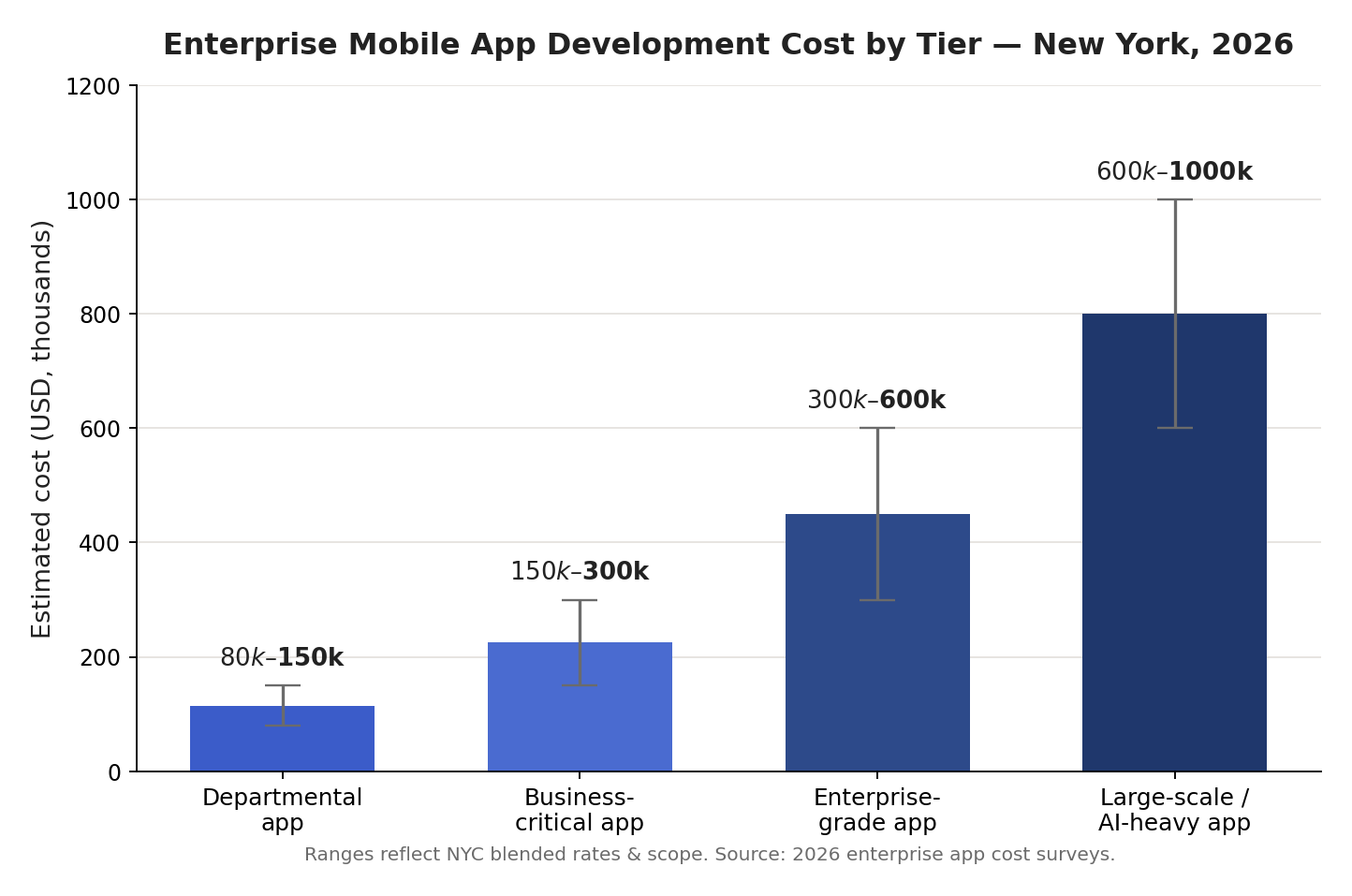
Cost is the first question most buyers ask, and the honest answer is a range, because scope varies enormously. Based on 2026 industry cost data, a departmental enterprise app in New York starts around $80,000, while a large-scale, AI-heavy platform can exceed $1 million. The number depends far more on complexity and integrations than on how many features a stakeholder wants.
The chart below shows typical cost tiers for New York enterprise builds. Treat these as planning ranges; a fixed quote requires a discovery phase.
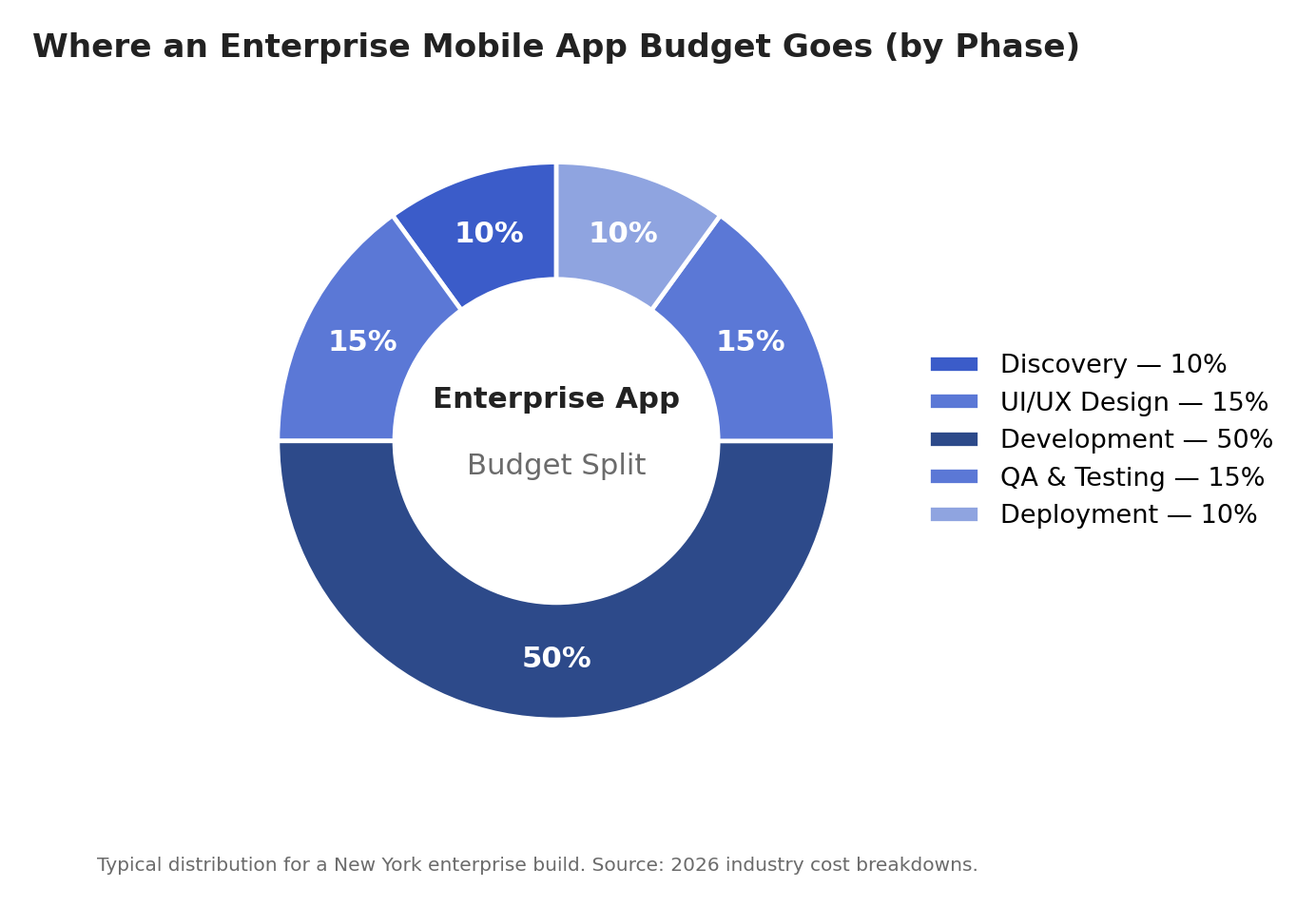
Where does the money actually go? Development is the largest slice, but discovery, design, testing, and deployment each take a meaningful share. Underfunding discovery and testing is the most common way enterprise budgets blow up later.
Two levers move cost the most. Building separate native iOS and Android apps roughly doubles development effort compared with a single cross-platform codebase. And every external system the app integrates with, whether an ERP, a payment gateway, or a legacy mainframe, adds engineering and testing that is easy to underestimate. Beyond the build, budget 15 to 20 percent of the initial cost per year for maintenance, plus hosting. For a NYC-specific breakdown, see our mobile app development cost in New York guide.
Total cost of ownership (TCO) for an enterprise mobile app is the full multi-year cost of building, running, and maintaining it, including development, cloud hosting, third-party services, security monitoring, and ongoing updates. A realistic TCO estimate prevents the common mistake of budgeting only for the initial build and being surprised by year-two costs.
How Long Enterprise App Development Takes
Timelines track complexity the same way costs do. A focused departmental app can reach production in a few months. A medium-complexity enterprise app realistically takes 6 to 9 months, and a build that integrates three or more external systems commonly runs 9 to 14 months from scoping to production.
The phases are predictable even when their length is not. Discovery and requirements take 1 to 4 weeks, or longer for heavy compliance work. Design runs 3 to 6 weeks. Development is the bulk at 8 to 20 or more weeks. Testing takes 2 to 4 weeks, and launch 1 to 2 weeks. Enterprise-grade builds sit at the long end of every range.
A practical tip from delivery experience: the calendar rarely slips during coding. It slips during integration and stakeholder review, when a third-party API behaves unexpectedly or an internal team needs three cycles to sign off. Building buffer into those two points keeps a New York enterprise project on track.
Weighing cost against scope for a New York enterprise app? A short architecture review with our engineers turns rough numbers into a realistic plan before you commit a budget.
Request an Architecture Review →Our Enterprise App Development Process
A disciplined, transparent process is what separates a predictable enterprise delivery from a runaway one. At KKRF Group we run the following stages, and we keep the client visible at each gate rather than disappearing for months.
- Discovery and scoping. We map user roles, systems to integrate, compliance obligations, and success metrics, then produce a technical roadmap and a realistic estimate before a line of code is written.
- Architecture and design. We define the system architecture, data model, and API contracts alongside the UI/UX, so engineering and design decisions reinforce each other rather than collide later.
- Development in iterations. We build in short, reviewable increments with continuous integration, so stakeholders see working software early and change stays cheap while it is still cheap.
- Quality assurance and security testing. Automated and manual testing run throughout, including security testing against recognized standards rather than a rushed pass at the end.
- Deployment and launch. We handle store submission, environment configuration, and release management, with monitoring in place from the first production user.
- Maintenance and evolution. As a long-term technology partner, we support the app after launch by patching, scaling, and adding capability as the business grows.
Section summary: A dependable enterprise app process runs six stages — discovery, architecture and design, iterative development, QA and security testing, deployment, and ongoing maintenance — with client visibility at every gate to keep cost and timeline predictable.
Architecture and Technology Stack
Enterprise architecture is where longevity is won or lost. A well-architected app absorbs growth and change; a poorly architected one forces a rebuild within two years. Our default is a cloud-native, API-driven design that keeps the mobile client thin and the business logic centralized and testable.
On the client, the choice is native or cross-platform. Native iOS in Swift and Android in Kotlin deliver maximum performance and platform depth. Cross-platform frameworks, React Native and Flutter, deliver most of that experience from one codebase at meaningfully lower cost, which suits the majority of enterprise use cases.
On the backend, we favor cloud-native services on AWS, Azure, or Google Cloud, containerized workloads, and well-defined APIs that isolate the app from the systems it depends on. That isolation is what lets a mobile app integrate with a fragile legacy platform without inheriting its fragility. It also underpins any later legacy modernization effort.
Cloud-native architecture is an approach that builds applications as collections of independent, scalable services running on cloud infrastructure, typically using containers and managed APIs. For enterprise mobile apps, it enables reliable scaling under load, faster updates, and cleaner integration with existing business systems than a traditional monolithic server.
Security, Compliance, and Governance
Security is not a feature you add near launch; it is a property of the whole system. For a New York enterprise app, that means encrypting data in transit and at rest, enforcing strong authentication and role-based access, and logging activity for audit. We design to recognized standards such as the OWASP Mobile Application Security project rather than relying on ad hoc checks.
Compliance depends on the industry. A healthcare app must satisfy HIPAA controls around protected health information. A payments app must meet PCI DSS. A financial platform may need SOC 2 evidence for enterprise buyers. Each of these shapes data handling, hosting, and access design, so they belong in the discovery phase, not a late scramble. Our work as a trusted IT consulting and cybersecurity partner is grounded in exactly this kind of security engineering.
Governance ties it together: who can access what, how changes are approved, and how incidents are handled. Enterprises that skip governance ship faster once and then spend the next year firefighting. Building it in is cheaper than retrofitting it.
Section summary: Enterprise mobile security means encryption, strong authentication, role-based access, and audit logging designed in from the start, aligned to standards like OWASP MASVS and to industry compliance such as HIPAA, PCI DSS, or SOC 2 depending on the sector.
Industry Use Cases Across NYC
Enterprise mobile apps solve concrete problems in New York’s dominant industries. In financial services, they power secure trading, client portals, and payments with the audit trails regulators expect. In healthcare, they connect clinicians and patients while protecting sensitive records. In real estate, they streamline listings, tours, and transaction workflows for firms operating across Manhattan and Brooklyn.
Logistics and field-service companies use enterprise apps to coordinate dispatch, inventory, and on-site work in real time. Retail and hospitality groups use them for loyalty, ordering, and workforce management. The common thread is integration: each app is valuable because it connects to the systems the business already runs on.
For deeper, sector-specific guidance we have published focused resources on FinTech app development in New York and related verticals, which pair with this enterprise overview.
Native vs Cross-Platform vs Hybrid
One of the earliest and most consequential decisions is how the app is built across platforms. The table compares the three main approaches for enterprise use, so a decision-maker can weigh them at a glance.
| Approach | Best For | Cost Impact | Main Trade-off |
|---|---|---|---|
| Native (Swift + Kotlin) | Performance-critical apps, deep hardware or platform features | Highest, two codebases | More cost and time; two teams to maintain |
| Cross-platform (React Native / Flutter) | Most enterprise apps; shared logic, broad reach | 30 to 50 percent lower than dual native | Occasional native modules for edge cases |
| Hybrid / PWA | Internal tools, content-driven or simple workflows | Lowest | Weaker performance and limited device access |
For the majority of New York enterprise projects we recommend cross-platform as the default, moving to native only where performance or platform depth genuinely demands it. This keeps cost and maintenance sane without compromising the experience.
Common Enterprise App Mistakes
Most enterprise app failures repeat a short list of avoidable mistakes. Recognizing them early is the cheapest insurance a New York buyer can get.
- Underscoping discovery. Skipping proper requirements and integration mapping guarantees expensive surprises during development.
- Treating security as a final step. Retrofitting encryption, access control, and compliance costs far more than designing them in.
- Ignoring integration complexity. The legacy systems the app must connect to are usually the hardest and riskiest part of the build.
- Choosing a partner on price alone. The cheapest bid often omits the exact work, testing, security, and documentation, that makes an app maintainable.
- No plan for maintenance. An app without a support and evolution plan degrades within a year of launch.
Decision Framework: Is Enterprise-Grade Worth It
Not every mobile project needs enterprise-grade engineering, and over-building wastes money. Use this framework to decide honestly.
When enterprise-grade is the right call: you must integrate with core business systems, you handle regulated or sensitive data, you expect significant or unpredictable user growth, or the app is central to revenue or operations. In these cases the investment in architecture and security pays back by avoiding rework and outages.
When it may be overkill: a small internal tool, a short-lived campaign app, or an early experiment to validate demand. Here a leaner build or an MVP is the smarter first step, with enterprise hardening deferred until the concept proves out.
Our recommendation: match the engineering rigor to the stakes. If a failure would trigger a compliance issue, a security incident, or a revenue hit, build enterprise-grade from the start. If not, start lean and scale up deliberately. An honest partner will tell you which situation you are in rather than selling the largest possible project.
How to Choose a Partner in New York
Evaluating an enterprise app development company in New York comes down to evidence, not claims. Ask for specifics and watch how a vendor answers.
- Relevant enterprise track record. Have they shipped apps with comparable integrations, compliance, and scale? Ask for concrete examples, not logos.
- Security and compliance depth. Can they speak precisely about HIPAA, PCI DSS, SOC 2, and secure architecture, or do they wave at best practices?
- Transparent process and pricing. Do they scope discovery properly and explain where cost comes from, or quote a suspiciously round number sight unseen?
- Architecture and maintenance thinking. Do they design for the multi-year life of the app, including support and evolution?
- Communication and ownership. Will you have visibility during the build, or hand over a spec and hope?
KKRF Group approaches enterprise engagements as long-term partnerships built on custom engineering, enterprise-grade architecture, and a security-first mindset. You can compare our approach against your shortlist using our dedicated New York mobile app development resources.
Future Trends in Enterprise Mobile Apps
Three shifts are reshaping enterprise mobile work in New York. AI-driven features, from intelligent search to predictive workflows, are moving from novelty to expectation, and they change both architecture and cost. We build with AI integration in mind so the app can adopt these capabilities without a rebuild.
Second, security expectations keep rising. Zero-trust principles and stronger authentication are becoming standard for enterprise buyers, not premium add-ons. Third, cross-platform tooling continues to mature, narrowing the gap with native and making a single codebase viable for ever more demanding apps.
The practical takeaway: design for change. An enterprise app built on clean architecture and clear APIs can absorb AI features, tighter security, and new platforms as they arrive, which protects the investment over its full life.
Have an enterprise app in mind for your NYC organization? Tell us about the systems it needs to connect to and the users it has to serve, and we will map the fastest safe path to launch.
Discuss Your Project →Frequently Asked Questions
How much does enterprise mobile app development cost in New York?
Enterprise mobile app development in New York typically costs between $80,000 and $1M or more. A departmental app starts around $80,000, a business-critical app runs $150,000 to $300,000, and a large-scale or AI-heavy enterprise platform can exceed $1 million. Complexity, system integrations, and compliance scope drive the number far more than feature count.
How long does it take to build an enterprise mobile app?
Most enterprise mobile apps take 6 to 14 months from discovery to production. A medium-complexity app is realistically 6 to 9 months, while a build integrating three or more external systems commonly runs 9 to 14 months. Discovery, integration, and stakeholder review are where timelines most often extend.
What makes a mobile app enterprise-grade?
An enterprise-grade mobile app is defined by three properties: scalable architecture that handles growth, security-first design with encryption and strong authentication and access control, and deep integration with existing business systems such as ERP and CRM. It is engineered for reliability and multi-year maintenance rather than only speed to market.
Should an enterprise build native or cross-platform apps?
For most enterprise apps, cross-platform development with React Native or Flutter is the best default, cutting cost by 30 to 50 percent versus building separate native iOS and Android apps while delivering a near-native experience. Native development is worth the extra cost only when performance or deep platform features are essential.
How do you keep an enterprise mobile app secure and compliant?
Enterprise mobile security requires encrypting data in transit and at rest, enforcing strong authentication and role-based access, and logging activity for audit, all designed in from the start. Compliance is aligned to the relevant standard, HIPAA for healthcare, PCI DSS for payments, or SOC 2 for enterprise buyers, and is scoped during discovery rather than added at the end.
How do I choose an enterprise app development company in NYC?
Choose a New York enterprise app partner on evidence, not claims. Verify a relevant track record with comparable integrations and compliance, confirm genuine security depth, insist on transparent scoping and pricing, and check that they design for the multi-year life of the app including maintenance. Clear communication and visibility during the build are strong signals of a reliable partner.
Ready for numbers you can plan around? Request a custom estimate and we will scope your enterprise mobile app across cost, timeline, and architecture, with no obligation.
Get a Custom Project Estimate →