
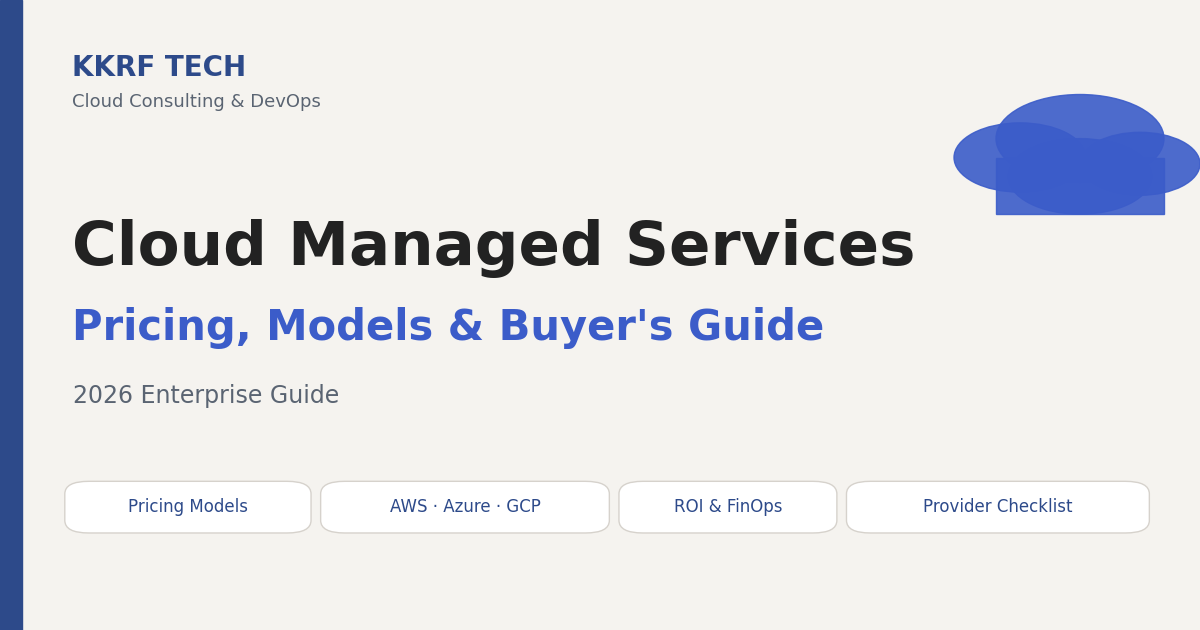
Moving to the cloud is the easy part. Running it well, month after month, without the bill creeping up or a misconfigured bucket turning into an incident, is where most teams quietly struggle. That is the gap cloud managed services are built to close.
At KKRF Group, a trusted cloud consulting and DevOps partner, we’ve watched capable engineering teams lose whole quarters to on-call fatigue, patch backlogs, and cloud spend nobody can fully explain. A good managed cloud services provider takes that operational weight off your plate so your engineers can ship product instead of babysitting infrastructure.
This guide breaks down what cloud managed services actually cover, what they cost in 2026, the pricing models you’ll be quoted, and a practical framework for choosing a provider that fits how your business runs. The numbers here are current market ranges, not marketing rounding.
Key Takeaways
- Cloud managed services hand day-to-day operation of your cloud environment — monitoring, patching, security, cost governance — to a specialist provider.
- Expect roughly $3K–$8K/month for small-business scope, $8K–$30K for mid-market, and $25K–$120K+ for enterprise engagements with 24/7 SLAs.
- Percentage-of-spend pricing typically runs 5%–25% of your monthly cloud bill and usually falls as your cloud maturity rises.
- The retainer covers the provider’s labor and tooling — your AWS, Azure, or Google Cloud usage is billed separately.
- The biggest hidden costs are onboarding, tooling, and unclear SLAs — not the headline rate.
- Choose on security posture, FinOps discipline, and SLA clarity, not the lowest quote.
What This Guide Covers
QUICK ANSWER
Cloud managed services are an ongoing arrangement where a specialist provider runs and optimizes your cloud environment on AWS, Azure, or Google Cloud. In 2026, expect to pay between $3,000 and $120,000+ per month depending on scope, or 5%–25% of your cloud spend under a percentage-based model. That fee covers management labor and tooling; your cloud consumption is billed separately.
A quick word on where we’re coming from. KKRF Group operates cloud environments for startups, scaling SaaS companies, and regulated enterprises, so the figures and trade-offs below reflect real engagements rather than a vendor brochure. Where we mention other providers, we do it neutrally — the goal is to help you decide, not to sell.
What Are Cloud Managed Services?
Cloud managed services are the ongoing operation, monitoring, and optimization of your cloud infrastructure by an external team. Instead of your own staff handling every patch, alert, and cost review, a managed cloud services provider takes responsibility for keeping the environment secure, available, and efficient — usually under a defined service-level agreement.
Definition: A cloud managed service is a subscription-based engagement in which a provider assumes operational accountability for some or all of a client’s cloud infrastructure management — including monitoring, security, patching, backup, and cost governance — measured against agreed SLAs.
People often confuse this with a Cloud Service Provider (CSP). The distinction matters. AWS, Azure, and Google Cloud are CSPs — they sell you the raw compute, storage, and network. An MSP (managed services provider) sits on top of that, running those resources on your behalf. Put simply: the CSP gives you the kitchen; the MSP is the chef who keeps it running.
The scope varies widely. Some companies hand over everything — a fully managed model. Others keep application development in-house and outsource only cloud operations, DevOps managed services, and 24/7 cloud monitoring. Both are valid; the right split depends on where your team’s time is best spent.
How Much Do Cloud Managed Services Cost in 2026?
Here’s the honest answer to how much cloud managed services cost: it depends on scope, but the market has settled into fairly predictable bands. Small-business engagements generally run $3,000 to $8,000 per month. Mid-market estates with 24/7 coverage land around $8,000 to $30,000. Enterprise engagements with multi-account governance and strict SLAs start near $25,000 and climb past $100,000 per month.
Azure managed services tend to carry a small premium over AWS for equivalent scope, because Azure providers often manage the broader Microsoft estate — Entra ID and Defender included. The chart below shows the typical monthly retainer ranges we see across both platforms.
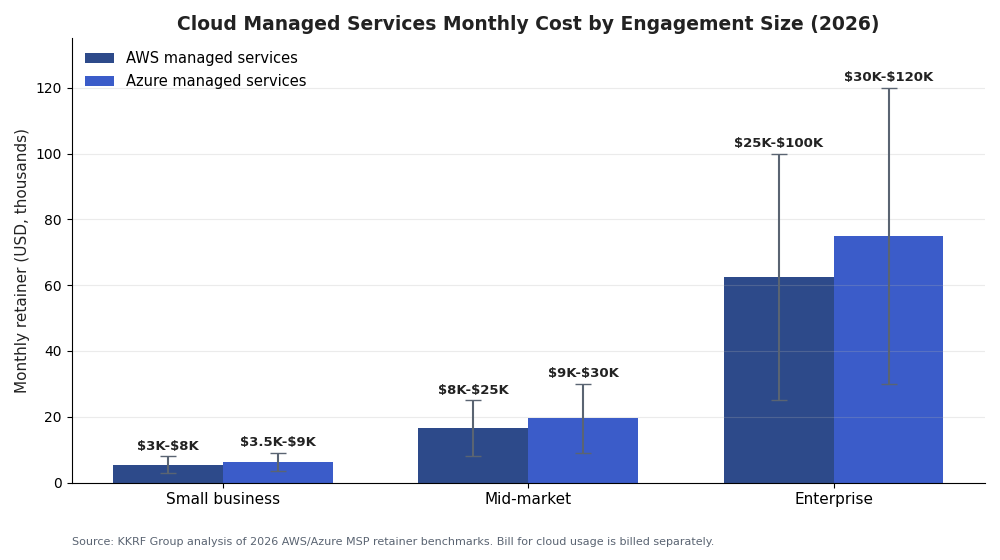
One point that trips up first-time buyers: the retainer covers the provider’s labor, tooling, and on-call infrastructure. It rarely includes your actual cloud bill, which you keep paying to AWS or Azure directly, or through the MSP as a reseller. Budget for both lines separately, or the numbers won’t add up.
Cloud Managed Services Pricing Models Explained
You’ll typically be quoted under one of three cloud managed services pricing models. Each rewards a different kind of relationship, and understanding them protects you at the negotiating table.
1. Flat monthly retainer
A fixed fee tied to a defined scope and SLA tier. Predictable and easy to budget, which finance teams love. The risk is scope creep: if your environment grows and the contract doesn’t flex, you either overpay early or renegotiate constantly.
2. Percentage of cloud spend
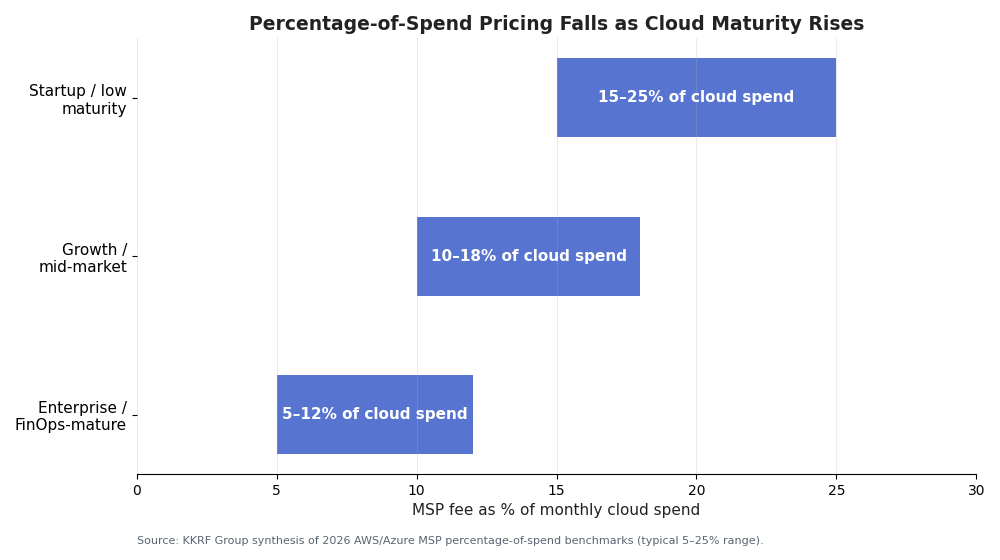
The provider charges a percentage of your monthly cloud consumption — commonly 5% to 25%. It scales naturally with your estate, but watch the incentive: a provider paid a percentage of spend has little reason to aggressively cut that spend. The best partners cap the percentage or pair it with FinOps savings guarantees. As the chart shows, the percentage usually shrinks as your cloud maturity grows.
3. Per-resource or tiered
Pricing per managed server, per workload, or per user. Cloud infrastructure management this way runs roughly $100–$500 per server per month, or $100–$250 per user for broader managed IT scope. It’s transparent and granular — useful when your environment is well-defined and stable.
What’s Included in a Cloud Managed Services Contract
Scope is where quotes that look similar turn out to be very different. Before comparing prices, compare what each provider actually commits to deliver. A complete cloud managed services engagement usually spans these areas:
- 24/7 cloud monitoring and incident response — proactive alerting, on-call rotation, and defined response times.
- Security and compliance — vulnerability management, cloud security services, and audit support for frameworks like SOC 2 compliance.
- Patching and maintenance — OS and runtime updates, backup verification, and cloud disaster recovery testing.
- Cost optimization and FinOps — rightsizing, reserved-capacity planning, and reporting so cloud cost optimization is continuous, not annual.
- Infrastructure as Code and automation — Terraform or equivalent, so changes are versioned and repeatable rather than click-ops.
- Managed DevOps services — CI/CD pipelines, release automation, and Kubernetes management services where containers are in play.
If a proposal is vague on SLAs, escalation paths, or who owns Infrastructure as Code, treat that as a signal. Ambiguity in the contract becomes friction in the incident.
AWS vs Azure vs Google Cloud Managed Services
The platform you run on shapes both the skills your provider needs and what enterprise cloud management looks like day to day. The comparison below summarizes how AWS managed services, Azure managed services, and Google Cloud managed services differ in practice.
| Factor | AWS | Azure | Google Cloud |
|---|---|---|---|
| Typical MSP retainer (mid-market) | $8K–$25K/mo | $9K–$30K/mo | $8K–$26K/mo |
| Best-fit strength | Breadth of services, mature ecosystem | Microsoft/enterprise integration | Data, analytics, and ML workloads |
| Identity managed | IAM | Entra ID + Defender | Cloud IAM |
| FinOps tooling maturity | High | High | Strong for data-heavy estates |
| Common workload fit | General-purpose, broad | Windows, .NET, hybrid | Kubernetes, big data, AI |
No platform wins outright. What matters is matching the provider’s certified depth to where your workloads actually live. A provider strong on AWS but thin on Azure will cost you during a Windows-heavy migration.
Hidden Costs and What Drives the Price Up or Down
The headline rate is rarely the whole story. Hidden costs can inflate a first-year total well beyond the quote. Watch these closely:
- Onboarding and discovery — a one-time fee, sometimes 1–2 months of retainer, to map and stabilize your environment.
- Tooling licenses — monitoring, security, and FinOps platforms that may or may not be bundled into the fee.
- Data egress and parallel running — during transitions, you can pay for two environments at once.
- Out-of-scope work — anything outside the SLA billed at project or hourly rates.
What pushes cost down? Mature Infrastructure as Code, a consolidated account structure, predictable workloads, and a team that already practices FinOps. What pushes it up? Compliance requirements, 24/7 SLAs, multi-cloud management, and sprawling legacy resources nobody has documented.
The Business Case: ROI of Cloud Managed Services
Is outsourcing cloud operations worth it? For most mid-sized and enterprise teams, the math favors it — but only when you measure the right things.
The obvious saving is headcount: a 24/7 in-house cloud operations team is expensive and hard to staff. The less obvious returns are larger. Continuous cost optimization typically recovers a meaningful slice of cloud spend that would otherwise leak away. Fewer incidents mean less downtime, and downtime is where revenue and reputation actually bleed.
We’ve seen this go wrong when companies treat managed services as pure cost-cutting and pick the cheapest bidder. The provider does the minimum, spend keeps climbing, and the relationship sours within a year. The engagements that pay off treat the provider as a long-term technology partner with shared goals around uptime and efficiency.
Not sure what your cloud environment should actually cost to run? Our team will benchmark your current setup and show you where the waste is hiding. Start with a cloud managed services assessment.
Get a Technical Assessment →Common Mistakes When Choosing a Provider
Most bad outcomes trace back to a handful of avoidable errors. If you recognize your own process here, slow down before you sign.
- Buying on price alone. The cheapest managed cloud services provider is often the one that under-scopes security and FinOps, and you pay the difference in incidents.
- Ignoring the SLA fine print. “24/7 support” means little without defined response and resolution times, and penalties when they’re missed.
- No exit plan. If Infrastructure as Code and documentation live only with the provider, you’re locked in. Insist on owning your IaC.
- Skipping compliance alignment. A provider unfamiliar with your regulatory frameworks becomes a liability during audits.
- Treating it as set-and-forget. The best results come from a governed, reviewed relationship, not a handoff.
How to Choose a Cloud Managed Services Provider
Use a consistent framework so you’re comparing providers on substance, not sales polish. Score each candidate across these dimensions:
- Platform certification depth — verified expertise on your primary cloud, whether that’s AWS, Azure, or Google Cloud.
- Security and compliance posture — evidence of a security-first approach and support for your frameworks, such as SOC 2.
- FinOps discipline — a concrete method for cloud cost optimization, with reporting you can actually read.
- SLA clarity — specific response times, escalation paths, and remedies in writing.
- Automation maturity — Infrastructure as Code and CI/CD by default, not manual changes.
- Transparency and reporting — regular reviews, open dashboards, and no black-box operations.
- Cultural and partnership fit — a provider that behaves like a long-term technology partner, not a ticket queue.
This is the same lens KKRF Group applies when we architect an enterprise cloud management engagement: security-first, automation by default, and transparent reporting so you always know what you’re paying for and why. If a provider can’t speak clearly to all seven, keep looking.
Comparing proposals and want a second opinion? We’ll review your shortlisted quotes against real market benchmarks so you can negotiate from a position of strength. Talk to our cloud consulting team.
Request a Consultation →Cloud Managed Services Trends Shaping 2026
The category is shifting fast. Three trends stand out this year and should shape how you evaluate providers.
First, FinOps has moved from nice-to-have to table stakes. Providers are now expected to treat cost governance as a continuous engineering discipline, with parallel-running and double-run periods budgeted explicitly as financial risk rather than a scheduling footnote.
Second, AI-driven operations are real. Automated anomaly detection, predictive scaling, and AI-assisted incident triage are becoming standard in mature managed services, cutting mean time to resolution. As an innovation-driven engineering company, KKRF Group builds these capabilities into the environments we run.
Third, multi-cloud management is the norm, not the exception. Enterprises rarely live on one platform anymore, so providers need genuine depth across AWS, Azure, and Google Cloud, plus Kubernetes management services to keep workloads portable.
Ready to stop firefighting your infrastructure and start optimizing it? KKRF Group runs secure, cost-efficient cloud environments so your team can focus on the product. Planning a migration first? We can help there too.
Discuss Your Project →Frequently Asked Questions
What are cloud managed services?
Cloud managed services are an ongoing arrangement where a specialist provider operates and optimizes your cloud infrastructure on AWS, Azure, or Google Cloud, handling monitoring, security, patching, backups, and cost governance under an agreed SLA.
How much do cloud managed services cost in 2026?
Expect roughly $3,000 to $8,000 per month for small-business scope, $8,000 to $30,000 for mid-market, and $25,000 to $120,000 or more for enterprise engagements. Percentage-of-spend models typically charge 5% to 25% of your monthly cloud bill.
What is the difference between an MSP and a CSP?
A Cloud Service Provider (CSP) such as AWS or Azure sells the raw compute, storage, and network. A managed services provider (MSP) operates those resources on your behalf, handling day-to-day operations, security, and cost optimization.
Does the managed services fee include my cloud bill?
Usually not. The retainer covers the provider labor and tooling. Your actual cloud consumption is billed separately, either directly by the cloud provider or through the MSP acting as a reseller.
Are cloud managed services worth it?
For most mid-sized and enterprise teams, yes. They reduce the cost of a 24/7 operations team, recover cloud spend through continuous FinOps, and cut downtime, provided you choose a provider on security and SLA quality rather than the lowest price.
How do I choose the right cloud managed services provider?
Score providers on platform certification depth, security and compliance posture, FinOps discipline, SLA clarity, automation maturity, transparent reporting, and partnership fit. Insist on owning your Infrastructure as Code so you are never locked in.