
Enterprise cloud migration cost is the number that stalls more modernization projects than any technical hurdle. A CFO signs off on the vision — lower run-rate, faster releases, AI-ready data — then sees a services quote swing from $150,000 to well past $3 million and asks the obvious question: why the spread, and what are we actually paying for?
The honest answer is that “moving to the cloud” describes a dozen different projects wearing one name. A straight lift-and-shift of forty stable web servers and a ground-up re-architecture of a 15-year-old monolith sit at opposite ends of a very wide budget. Treating them as one line item is how migrations blow past their approved spend.
This guide breaks the pricing picture apart the way an experienced delivery team does before quoting: by strategy, by workload complexity, by the hidden costs that rarely make it into a vendor’s headline figure, and by the return that justifies the investment. The goal is a budget you can defend to a board, not a range wide enough to be meaningless.
Key Takeaways
- Enterprise cloud migration cost typically runs from around $50,000 for a small lift-and-shift to $1M–$3M for a full 50-application portfolio modernization.
- Your migration strategy — one of the 6 Rs — drives cost more than any other single factor: rehosting lands near $40k–$150k per workload, while refactoring can exceed $600k.
- Hidden costs — data egress, parallel running, licensing changes, retraining — can inflate a final bill by 200–300% when they aren’t modeled upfront.
- Gartner projects worldwide public cloud spending will approach $850 billion in 2026, yet industry research finds roughly 29% of that spend is wasted.
- The cheapest migration is rarely the fastest lift-and-shift; a poorly planned rehost often costs more to run than the legacy system it replaced.
What This Guide Covers
What Enterprise Cloud Migration Cost Really Looks Like in 2026
Start with the ranges, because vague answers help no one. For a small or mid-sized business moving a contained estate, a complete migration — assessment, execution, security setup, and initial optimization — generally lands between $50,000 and $250,000. Large enterprises running hundreds of servers and tangled application dependencies routinely cross $1 million.
At the top end, a comprehensive program covering assessment, migration, and optimization across a 50-application portfolio commonly falls between $1 million and $3 million in professional-services fees from a qualified firm. That figure is the engagement, not the cloud bill that follows it.
Two numbers should frame every budget conversation. Gartner projects worldwide public cloud end-user spending will approach $850 billion in 2026, up more than 20% year over year — proof the destination is not in doubt. Yet industry research puts wasted cloud spend near 29%, the highest in five years. The enterprise cloud migration cost you approve today sets the trajectory for that waste, or for avoiding it.
The spread exists because cost tracks the depth of change, not the number of servers. The chart below shows how the strategy you choose — covered in detail next — moves the per-workload figure across an order of magnitude.
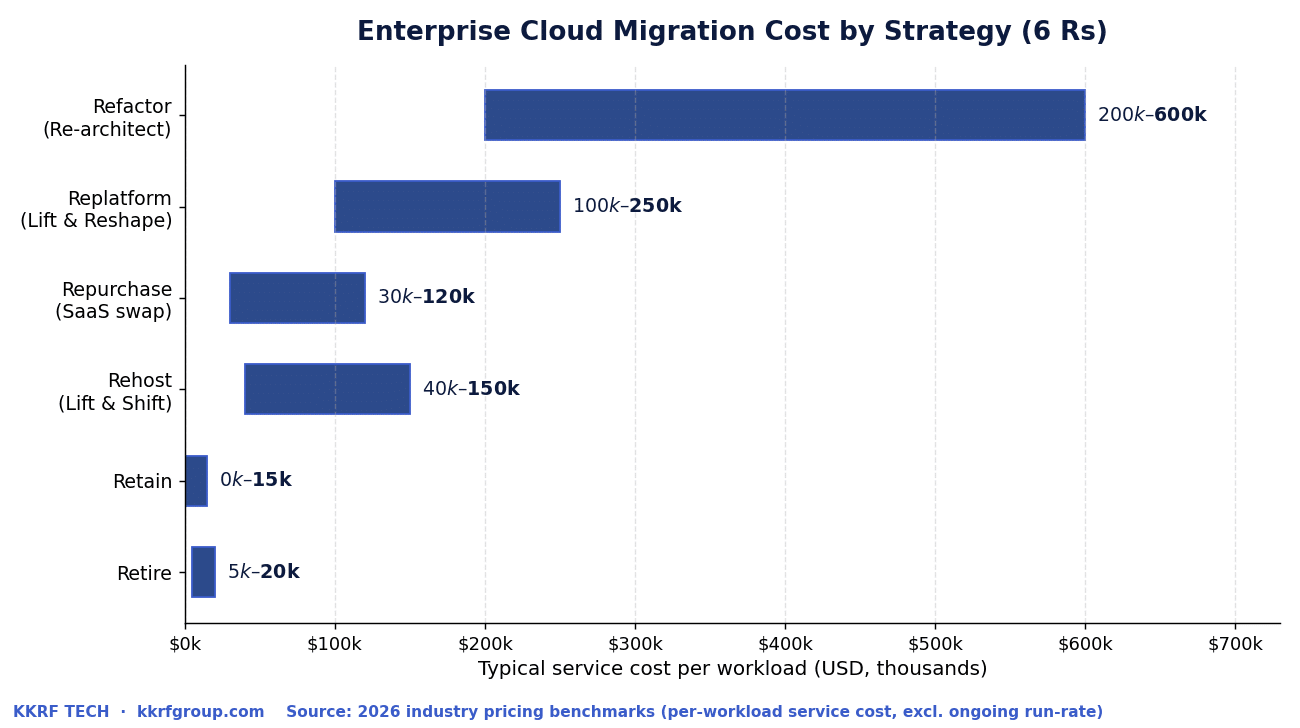
Cloud Migration Cost Breakdown: The 6 Rs and What Each Strategy Costs
AWS’s widely adopted framework sorts every workload into one of six paths — the 6 Rs of migration: rehost, replatform, refactor, repurchase, retire, and retain. The strategy assigned to each application is the biggest lever on your cloud migration cost, so a serious estimate prices each workload individually rather than applying one blended rate.
Rehost (lift and shift): $40k–$150k per workload
Moving an application as-is is the fastest and cheapest path per workload. It suits stable systems with no urgent need to change. The trap: rehosting inefficient legacy software often produces a cloud bill higher than the data center it left, because you’re now paying by the hour for the same waste.
Replatform (lift, tinker, and shift): $100k–$250k per workload
Replatforming makes targeted optimizations — swapping a self-managed database for a managed service, or containerizing a tier — without redesigning the core. It captures meaningful run-cost savings for a moderate premium and is often the pragmatic middle path for enterprise estates.
Refactor (re-architect): $200k–$600k+ per workload
Refactoring converts a monolith into cloud-native microservices, containers, or serverless. It carries the highest upfront enterprise cloud migration cost and the longest timeline, but it unlocks the elasticity, resilience, and per-service scaling that justify the move in the first place. Reserve it for the applications where those gains genuinely pay off.
Repurchase, retire, and retain
Repurchasing swaps a custom system for a SaaS product ($30k–$120k to migrate data and integrations). Retiring decommissions what nobody uses — pure savings. Retaining leaves a workload in place, often for compliance or latency reasons. A rigorous portfolio assessment usually finds that 10–20% of applications should be retired outright, money most organizations leave on the table.
Not sure whether your estate needs a rehost, a replatform, or a full re-architecture? A portfolio assessment turns that guesswork into a costed plan. Our cloud migration services team maps every workload to the right 6 Rs strategy before a dollar is committed.
Get a Cloud Migration Cost Estimate →What’s Actually in the Bill: Cost Components Beyond the Headline
The strategy sets the order of magnitude, but the final enterprise cloud migration cost is the sum of six components that a vague quote tends to blur together. Pricing them separately is how you catch the overruns before they happen.
- Assessment and discovery (5–10%): portfolio analysis, dependency mapping, and the TCO baseline. Underfunding this phase is the false economy that triggers most downstream overruns.
- Migration execution (40–55%): the actual engineering labor to move and validate each workload — the largest single line, and the one your 6 Rs mix moves most.
- Licensing and re-platforming fees (10–20%): new managed-service subscriptions, database license changes, and third-party tooling that don’t exist on-premises.
- Parallel running (5–15%): operating the legacy and cloud environments simultaneously during cutover — a real, temporary doubling of run-rate that budgets routinely forget.
- Security, compliance, and governance (10–15%): IAM, encryption, monitoring, and audit evidence, priced in from the start rather than bolted on.
- Change management and training (5–10%): upskilling the teams who will run the platform, without which the new environment is operated like the old one.
Two of these — parallel running and licensing — are where naive estimates quietly detonate. Data egress fees compound the problem: moving large datasets between regions or providers can turn into a six-figure line on its own, which is why egress modeling belongs in the assessment phase, not the invoice reconciliation months later.
A credible partner itemizes all six and shows you the assumptions behind each. When a quote arrives as a single lump sum with no breakdown, that opacity is itself a risk signal — it usually means the hidden costs haven’t been modeled, and you’ll meet them later at full price.
The Technical Process: How an Enterprise Cloud Migration Actually Runs
Vendors that quote a flat number without a phased plan are guessing. A defensible enterprise cloud migration cost is built from a repeatable delivery model — AWS packages its version as the Migration Acceleration Program’s Assess, Mobilize, and Migrate & Modernize phases, and every mature provider runs something equivalent.
Phase 1 — Assess and discover
Automated tooling ingests infrastructure and application-performance data to build a dependency map and a total-cost-of-ownership baseline. Skipping or compressing this phase is the single most common reason projects slip; you cannot price a migration for systems you haven’t fully inventoried.
Phase 2 — Mobilize and plan the waves
Applications are grouped into migration “waves” sequenced by dependency and risk. In 2026, AI-assisted planning tools generate these wave plans from network logs and performance metrics, replacing months of manual assessment and tightening the estimate.
Phase 3 — Migrate, modernize, and optimize
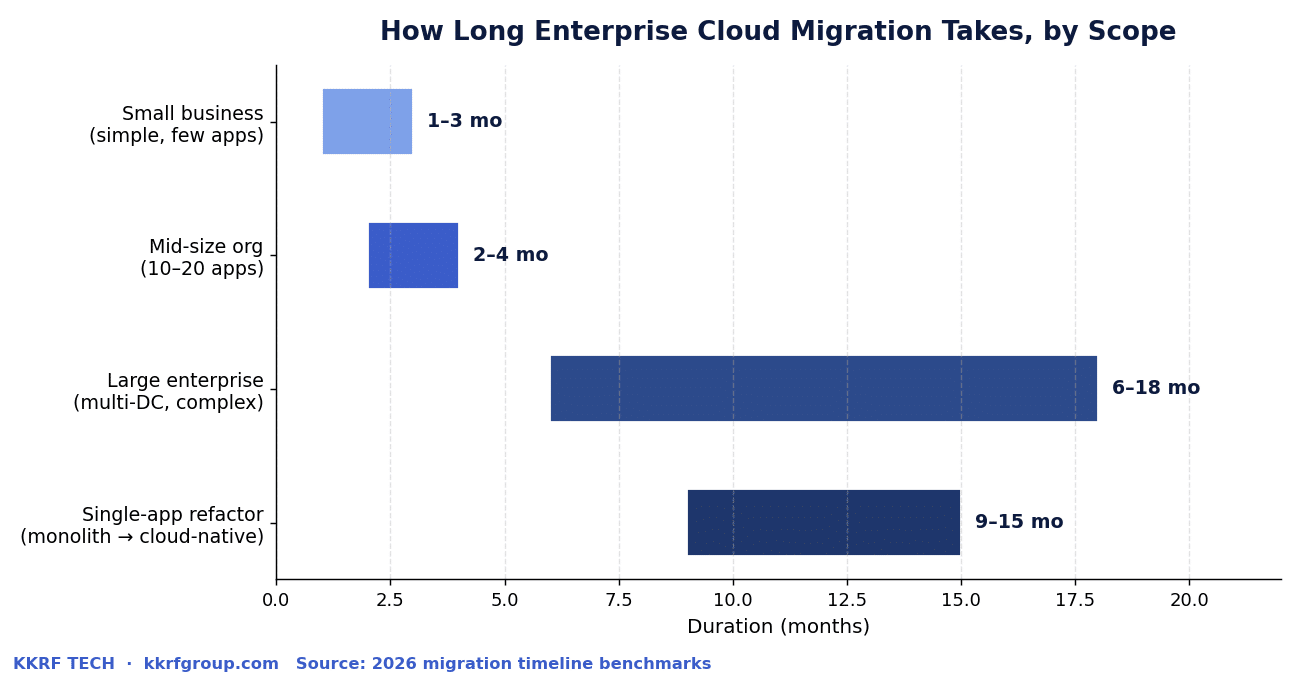
Waves move on a schedule, each validated before the next begins. The timeline scales with scope: a small estate can complete in weeks, while a large enterprise with multiple data centers should plan for 6–18 months, and a single monolith refactor alone can run 9–15 months.
AWS vs Azure vs GCP: Comparing Migration and Run Costs
Provider choice shapes the ongoing bill more than the one-time migration fee, and “best cloud provider for enterprise” has no universal answer — it depends on your existing licensing, workloads, and team skills. On like-for-like compute, the three hyperscalers are closer than their marketing suggests.
A general-purpose 2 vCPU / 8 GB instance runs roughly $30 per month on both AWS and Azure and around $24 on Google Cloud. On committed-use pricing, AWS typically offers the lowest one-year rates, GCP is close behind, and Azure often lands 8–10% higher for equivalent configurations — though Azure’s existing-license benefits can flip that math for Windows and SQL Server estates.
| Factor | AWS | Azure | Google Cloud |
|---|---|---|---|
| 2 vCPU / 8 GB on-demand | ~$30/mo | ~$30/mo | ~$24/mo |
| 1-yr committed rates | Lowest | ~8–10% higher | Close to AWS |
| Best fit | Breadth of services, largest partner network | Windows/SQL estates, hybrid via Azure Arc | Data, analytics & ML workloads |
| Migration tooling | Migration Hub + MAP funding | Azure Migrate | Migration Center |
The decision that actually protects the budget is multi-cloud discipline, not provider loyalty. Multi-cloud adoption is up sharply as enterprises spread workloads to avoid lock-in — but every additional platform adds governance overhead, so the right answer is usually one primary provider with a deliberate, not accidental, exception list.
Security and Compliance Considerations That Change the Cost Equation
Security is not a line item you add at the end — it’s a design constraint that shapes architecture from day one, and skipping it is how “cheap” migrations become expensive breaches. The most common failures are mundane: inadequate access management, misconfigured storage, and the assumption that the cloud provider handles security for you. The shared-responsibility model means they secure the cloud; you secure what you put in it.
Budget explicitly for identity and access management, encryption in transit and at rest, continuous monitoring, and — for regulated workloads — the audit evidence that HIPAA, PCI-DSS, SOC 2, or GDPR demand. Mapping controls to a recognized baseline such as the OWASP Top 10 and the provider’s well-architected framework keeps this from becoming a post-migration scramble.
Governance embedded from the start — tagging, budgets, and policy-as-code — is far cheaper than governance retrofitted after the first surprise invoice. It’s also what keeps that 29% waste figure from becoming your organization’s reality.
The ROI and Business Case for Cloud Migration
A migration approved on cost savings alone tends to disappoint; the durable returns come from agility. The business case that survives board scrutiny stacks four categories of value against the enterprise cloud migration cost.
- Infrastructure economics: retiring data-center hardware, real estate, and refresh cycles, traded for consumption-based spend you can optimize continuously.
- Engineering velocity: teams shipping in days instead of quarters because provisioning is an API call, not a procurement ticket.
- Elastic scale: paying for peak capacity only when you use it, instead of over-provisioning for a Black Friday that happens once a year.
- AI readiness: modern, well-governed data platforms are the precondition for the analytics and AI workloads that now drive competitive advantage — and that legacy estates simply cannot support.
With demand for AI integration pushing public cloud growth past 20% a year, per Gartner’s forecast, the cost of staying on legacy infrastructure is increasingly an opportunity cost, not just a maintenance line. The right question is rarely “can we afford to migrate?” but “what does another two years on this stack cost us in speed?”
Common Mistakes That Inflate Enterprise Cloud Migration Cost
Most budget overruns trace back to a short list of avoidable errors. Industry research suggests a large share of migration and data projects miss their budget or timeline — nearly always for the same reasons.
- Rushing discovery. Unknown dependencies and undocumented integrations surface mid-migration and force expensive rework.
- Ignoring hidden costs. Data egress fees, parallel-running two environments, licensing changes, and retraining can add 200–300% to a naive estimate.
- Defaulting to lift-and-shift for everything. Fast to execute, slow to regret — inefficient apps run poorly and cost more in the cloud.
- Over-refactoring. The opposite error: re-architecting workloads that a simple replatform would have handled, burning months and budget.
- Treating security and governance as phase two. Retrofitting controls is always more expensive than designing them in.
Future Trends Shaping Cloud Migration in 2026 and Beyond
Three shifts are actively changing how migrations are scoped and priced this year. First, AI-assisted planning has moved from novelty to expectation — manual infrastructure assessment is now considered behind the curve, and the tooling meaningfully compresses the assess phase.
Second, the center of gravity has moved from lift-and-shift toward targeted refactoring and database modernization, as enterprises prioritize the cloud-native architectures that AI and real-time analytics require. Roughly 95% of new digital workloads are now built cloud-native from the start.
Third, hybrid and multi-cloud are the default operating model rather than a transition state, with a majority of organizations running hybrid to balance legacy systems against cloud-native agility. Budgeting now has to account for cross-environment governance from day one.
How to Evaluate a Cloud Migration Partner
The firm you hire influences your total enterprise cloud migration cost more than the provider you land on. When you compare cloud migration companies, weight these signals over the headline day rate.
- They assess before they quote. A partner that names a firm price before seeing your dependency map is guessing — and you’ll pay for the guess later.
- Provider certifications and funding access. AWS, Azure, and GCP partner status often unlocks migration credits that directly offset your cost.
- A transparent 6 Rs methodology. They should show you which workloads they’d rehost, replatform, refactor, or retire — and defend each call.
- Post-migration optimization. The engagement shouldn’t end at cutover; the savings come from tuning what you’ve moved.
- Relevant, referenceable delivery. Ask for estates comparable to yours in size and regulatory profile, and actually call the references.
For a deeper read on modernization approach, our guides on legacy modernization and cloud consulting walk through how KKRF Tech scopes and sequences enterprise migrations.
A costed, workload-by-workload migration plan removes the biggest source of budget risk before the project starts. Bring your estate to our cloud consulting team and leave with a defensible number, not a range.
Talk to Our Cloud Migration Experts →Frequently Asked Questions
How much does enterprise cloud migration cost?
Enterprise cloud migration cost typically ranges from around $50,000 for a small lift-and-shift to $1M–$3M for a full 50-application portfolio modernization. The figure depends far more on your migration strategy and workload complexity than on server count — rehosting runs about $40k–$150k per workload, while refactoring can exceed $600k.
How long does an enterprise cloud migration take?
A small estate can migrate in 4–12 weeks and a mid-size organization of 10–20 applications in 2–4 months. Large enterprises with multiple data centers should plan for 6–18 months, and re-architecting a single monolithic application into cloud-native services often takes 9–15 months on its own.
What are the 6 Rs of cloud migration?
The 6 Rs are rehost (lift and shift), replatform (lift, tinker and shift), refactor (re-architect), repurchase (move to SaaS), retire (decommission), and retain (leave in place). Assigning each workload to the right R is the primary driver of both cost and outcome.
Why do cloud migration projects fail or go over budget?
The most common causes are rushing the discovery phase, ignoring hidden costs like data egress and parallel running, defaulting every workload to lift-and-shift, and treating security and governance as an afterthought. Hidden costs alone can inflate a naive estimate by 200–300%.
Is AWS, Azure, or Google Cloud cheaper for migration?
On like-for-like compute the three are close: a 2 vCPU / 8 GB instance runs roughly $30/month on AWS and Azure and about $24 on GCP. AWS usually has the lowest committed-use rates, but Azure’s existing-license benefits can make it cheapest for Windows and SQL Server estates, so the answer depends on your specific workloads.
How do you reduce cloud migration costs?
Assess thoroughly before quoting, retire unused applications, right-size instances rather than replicating legacy over-provisioning, model hidden costs upfront, and embed governance and cost tagging from day one. Post-migration optimization is where most of the durable savings are actually captured.
Ready to put a real number on your move to the cloud? Book a no-obligation assessment and we’ll return a phased migration plan, a 6 Rs strategy per workload, and a defensible budget. Reach out to KKRF Tech to get started.
Schedule a Cloud Migration Assessment →