
Choosing the right restaurant app development company in New York starts with one question: how do you win a diner who has a hundred options within walking distance? New York runs on food, and increasingly it runs on apps. A diner in Manhattan expects to reorder a favorite lunch in three taps, a Brooklyn cafe wants to reward regulars without paper punch cards, and a growing chain needs one system that works across every location. A well-built restaurant app makes all of that happen. As a top mobile app development company, KKRF Group builds custom restaurant apps for New York operators who are done handing 30% of every order to a marketplace.
This guide breaks down what a restaurant app actually costs in New York, how long it takes, the features that matter, and how to pick a development partner who will still be around when you need version two.
Key Takeaways
- A restaurant app in New York typically costs $8,000 to $250,000+, depending on whether you need a single-location ordering app or a multi-brand franchise platform.
- Most mid-range NYC restaurant apps ship in roughly 18 weeks, covering online ordering, table reservations, loyalty, and payments.
- Owning your own branded app cuts the 15%–30% commissions that third-party delivery marketplaces charge on every order.
- POS integration, secure payments (PCI DSS), and reliable push notifications separate a profitable app from an abandoned one.
- KKRF Group is a top mobile app development company that builds custom, POS-integrated restaurant apps for New York restaurants, cafes, and hospitality groups.
What This Guide Covers
- Quick Answer: Restaurant Apps in New York
- What Is Restaurant App Development?
- Why New York Restaurants Need a Mobile App
- Types of Restaurant Apps We Build
- Must-Have Restaurant App Features
- Restaurant App Development Cost in New York
- How Long Restaurant App Development Takes
- Our Restaurant App Development Process
- Technology Stack for Restaurant Apps
- POS and Third-Party Integrations
- Security, Payments, and Compliance
- The Business Case: ROI of a Restaurant App
- Common Restaurant App Mistakes
- Native vs. Cross-Platform
- How to Choose a Development Company
- Restaurant App Trends for 2026
- Frequently Asked Questions
Quick Answer: Restaurant Apps in New York
A restaurant app development company in New York builds custom mobile apps that let a restaurant take orders, reservations, and payments under its own brand instead of a third-party marketplace. In New York, these apps generally cost between $8,000 for a single-location ordering app and $250,000 or more for a multi-brand franchise platform, and most mid-range builds launch in about four to five months. The right partner combines local market knowledge with POS integration, secure payments, and a technology stack that scales as you add locations.
What Is Restaurant App Development?
Restaurant app development is the process of designing, building, and launching a mobile application that handles a restaurant’s digital ordering, reservations, payments, and customer loyalty. The app connects the guest’s phone to the kitchen and the point-of-sale system, so an order placed on a couch in Astoria prints in the kitchen without a phone call. Working with a specialist restaurant app development company in New York means that branded product is engineered to the restaurant’s brand, not a listing on someone else’s platform.
There is an important distinction here. A branded restaurant app is different from a food delivery marketplace. A marketplace like the large aggregators lists hundreds of restaurants and charges each one a commission. A branded app carries a single restaurant’s name, keeps its customer data, and charges no per-order commission to a middleman. Many operators use both, and we cover that trade-off in our food delivery app development in New York guide.
Why New York Restaurants Need a Mobile App
New York is one of the most competitive dining markets on earth, with tens of thousands of restaurants fighting for the same lunch and dinner crowds. In that environment, owning the customer relationship is worth more than a listing on a crowded app. A branded app puts your menu, your loyalty program, and your push notifications directly on a regular’s home screen.
Delivery marketplaces solved discovery, but they came with a tax. Commissions of 15% to 30% per order erase most of the margin on a $20 meal. We’ve seen this math turn profitable restaurants into break-even ones. A branded app lets a restaurant serve its repeat customers commission-free while keeping the marketplace for reach.
There’s also the data. When a customer orders through a marketplace, the marketplace owns the relationship and the purchase history. When the same customer orders through your app, you learn what they buy, how often, and when — the raw material for loyalty offers that actually work. For NYC operators planning multiple locations, our New York mobile app development team builds that data layer in from day one.
Types of Restaurant Apps We Build
“Restaurant app” covers several distinct products, and picking the right one shapes your budget and timeline. Here are the main types New York operators ask us to build.
Online Ordering and Pickup Apps
An online ordering app lets guests browse the menu, customize items, pay, and schedule pickup or delivery. This is the workhorse of restaurant apps and the most common first build. It suits single-location restaurants and small groups that want to move orders off commission-based marketplaces.
Table Reservation and Waitlist Apps
A reservation app manages bookings, waitlists, and seating in real time. For busy Manhattan restaurants with limited tables, it reduces no-shows through deposits and reminders and gives the front-of-house team a live view of the night. It often pairs with an ordering app rather than standing alone.
Loyalty and Rewards Apps
A loyalty app tracks visits, points, and rewards to bring customers back. Digital loyalty outperforms paper cards because it lets you send a targeted offer the moment a regular goes quiet. Cafes and fast-casual brands see the strongest returns from this type.
Multi-Location and Franchise Platforms
A franchise platform runs many locations under one app, with shared branding but location-specific menus, pricing, and inventory. This is the most complex build and the one that most benefits from enterprise-grade architecture. Growing NYC chains and cloud-kitchen operators need this from the start.
Must-Have Restaurant App Features
Every profitable restaurant app shares a core set of features. Skip these and adoption stalls; nail them and the app pays for itself. Below are the features we treat as non-negotiable, along with the ones worth adding as you scale.
- Online ordering and menu management — a fast, image-rich menu with real-time item availability and modifiers.
- Table reservations and waitlist — bookings with deposits, reminders, and no-show protection.
- Secure mobile payments — credit cards, Apple Pay, Google Pay, and digital wallets through a PCI-compliant gateway.
- Loyalty and rewards — points, tiers, and personalized offers that drive repeat visits.
- Push notifications — order status, limited-time deals, and win-back messages that respect opt-in rules.
- Real-time order tracking — clear status from kitchen to pickup or delivery.
- POS and kitchen integration — orders flow straight into existing systems with no double entry.
- Analytics dashboard — sales, repeat-customer, and menu-performance data owners can act on.
Restaurant App Development Cost in New York
Restaurant app development in New York typically costs between $8,000 and $250,000 or more. The range is wide because a single-location pickup app and a multi-brand franchise platform are very different products. The table below shows how cost and timeline track with app type in the NYC market, where North American development rates commonly run $100 to $200 per hour.
| App Type | Best For | Typical NYC Cost | Timeline |
|---|---|---|---|
| Basic ordering app | Single-location restaurants and cafes | $8,000 – $25,000 | 6 – 10 weeks |
| Mid-level platform | Apps with loyalty and reservations | $25,000 – $60,000 | 3 – 5 months |
| Advanced app | Restaurant chains and franchises | $60,000 – $120,000 | 6 – 9 months |
| Enterprise / cloud kitchen | Multi-brand operators and ghost kitchens | $120,000 – $250,000+ | 9 – 12+ months |
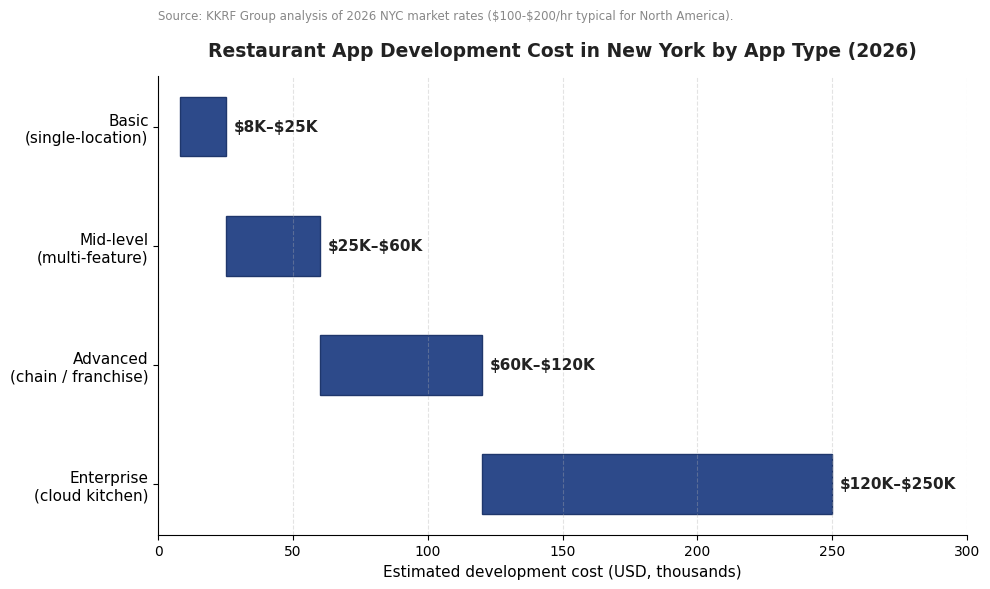
Three factors move the number most. Feature scope comes first: every integration, from payments to loyalty to POS, adds engineering time. Design complexity is second, since custom animations and brand-specific UX cost more than templated screens. The third is platform choice, which we break down below and in our detailed New York mobile app development cost guide.
One honest caveat: the sticker price is not the whole cost. Budget for app-store fees, payment-processing rates, cloud hosting, and ongoing maintenance, which usually runs 15% to 20% of the build cost per year. A partner who hides these numbers is a partner to avoid.
Weighing the cost of a custom ordering app against another year of delivery-app commissions? Our team can size the build for your menu, locations, and budget. See how our New York mobile app development team works.
Request a Custom Project Estimate →How Long Restaurant App Development Takes
A restaurant app takes anywhere from six weeks to twelve months to build. A basic ordering app can launch in six to ten weeks, a mid-range app with ordering, reservations, and loyalty takes three to five months, and an enterprise or franchise platform can run six months to a year. The chart below shows a realistic timeline for a typical mid-range New York restaurant app.
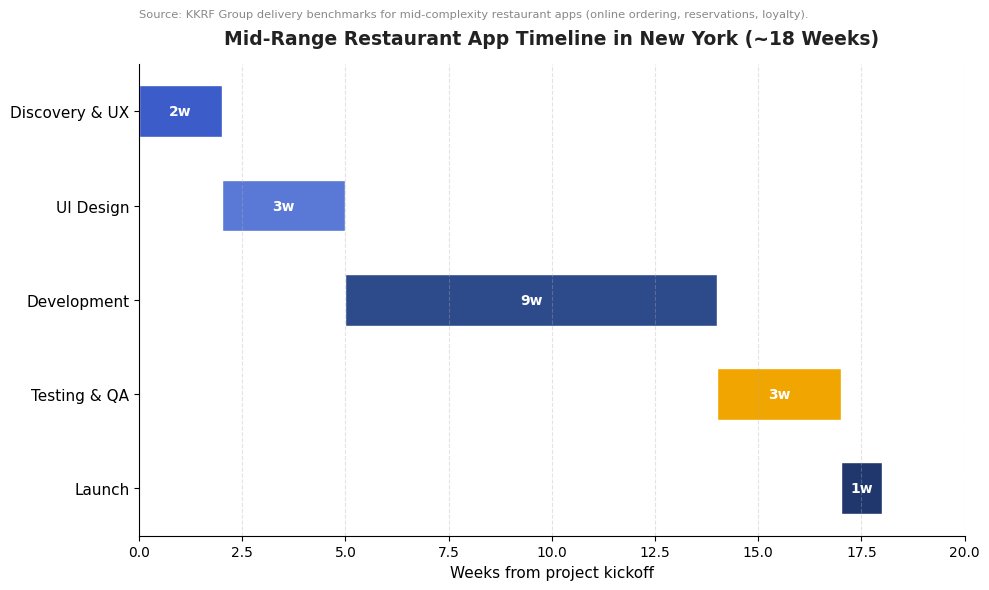
The single biggest schedule risk is scope creep. When a restaurant keeps adding “just one more” feature mid-build, timelines slip. We manage this by shipping a focused first version, then adding features in planned releases.
Our Restaurant App Development Process
A clear process is what keeps a restaurant app on time and on budget. At KKRF Group we run every build through the same five stages, each with a defined outcome. Here is how the process works.
- Discovery and strategy. We map your menu, order volume, locations, and goals, then define the feature set and success metrics before a line of code is written.
- UX and UI design. We design the ordering flow to feel effortless, because every extra tap between hungry and paid costs orders. You review clickable prototypes before development.
- Development. Our engineers build the app, the admin dashboard, and the integrations in short sprints, with working demos you can test throughout.
- Testing and QA. We test on real devices across iOS and Android, load-test for the dinner rush, and verify every payment and POS path before launch.
- Launch and support. We handle app-store submission, monitor the first weeks closely, and provide ongoing maintenance as menus, promotions, and locations change.
Technology Stack for Restaurant Apps
The technology stack determines how fast your app runs, how easily it scales, and how much it costs to maintain. For most New York restaurant apps we favor cross-platform frameworks that deliver both iOS and Android from one codebase, backed by a cloud-native backend. Our approach to React Native app development in New York reflects that.
On the front end, React Native and Flutter cover the vast majority of restaurant apps, while native Swift and Kotlin are reserved for chains that need peak performance. The backend typically runs on Node.js or a similar framework with a PostgreSQL or MongoDB database. Cloud infrastructure on AWS or Google Cloud handles hosting, scaling, and push notifications. This security-first, cloud-native architecture is standard on every build we deliver, whatever the scale of your restaurant app development company in New York engagement.
POS and Third-Party Integrations
Integrations are where restaurant apps live or die. An app that does not talk to your point-of-sale system forces staff to re-enter every order by hand, which guarantees mistakes during a rush. Deep POS integration is the difference between an app that helps and an app that gets switched off.
Common integrations for a New York restaurant app include the POS system, a payment gateway such as Stripe or Square, delivery-dispatch tools, reservation platforms, and accounting or inventory software. Each integration is a small engineering project with its own testing needs, which is why integration count is one of the biggest cost drivers we flag during discovery.
Security, Payments, and Compliance
A restaurant app handles payment data, so security is not optional. Any app that processes card payments must meet PCI DSS requirements, and cutting corners here exposes both customers and the business to real liability. We build every app with a security-first approach, following application-security guidance from the OWASP Mobile Top 10.
In practice that means encrypting data in transit and at rest, tokenizing card details through a compliant gateway rather than storing them, and enforcing secure authentication. For apps that collect customer data, we also design for privacy regulations, including New York’s consumer data rules. Security done right is invisible to the diner and reassuring to the owner.
The Business Case: ROI of a Restaurant App
A restaurant app is an investment, and it should pay for itself in ways you can measure. The clearest return is commission savings. If a restaurant processes $30,000 a month through a marketplace at a 25% commission, that is $7,500 a month leaving the business — enough to fund a mid-range app built by a restaurant app development company in New York in well under a year.
Beyond commissions, a branded app lifts revenue through higher order frequency from loyalty programs, larger average tickets from smart upselling, and direct marketing that costs nothing per message. The combination of lower costs and higher repeat revenue is why more New York operators treat a branded app as core infrastructure rather than a nice-to-have.
Common Restaurant App Mistakes
We’ve seen restaurant apps fail for predictable reasons, and almost all of them are avoidable. Steer clear of these and you’re ahead of most launches.
- Building for everything at once. Cramming every feature into version one blows the budget and delays launch. Start focused, then expand.
- Ignoring POS integration. An app that does not sync with the kitchen creates chaos during peak hours.
- Treating design as decoration. A confusing ordering flow loses customers no matter how good the food is.
- Forgetting maintenance. An app is a living product; without updates it breaks with each new OS release.
- Skipping a loyalty hook. Without a reason to return, an app becomes a one-time download.
Native vs. Cross-Platform for Restaurant Apps
One of the first technical decisions is whether to build native, cross-platform, or as a progressive web app. Each approach fits a different kind of restaurant, and the wrong choice adds cost without adding value. The comparison below summarizes the trade-offs.
| Approach | Performance | Relative Cost | Best Fit for Restaurants |
|---|---|---|---|
| Native (Swift / Kotlin) | Highest; best for camera, NFC, offline menus | Higher (two codebases) | Chains needing peak performance and deep device features |
| Cross-platform (React Native / Flutter) | Near-native for most ordering apps | Lower (one codebase, iOS + Android) | Most independent and mid-size NYC restaurants |
| Progressive Web App (PWA) | Good; no app-store install needed | Lowest | Quick QR-code ordering with limited native features |
For most independent and mid-size New York restaurants, cross-platform development with React Native or Flutter is the sweet spot: one codebase, both platforms, lower cost, and performance that diners will not notice is not native. Large chains with heavy device-feature needs are the main case for going fully native.
Not sure whether to start with a single-location MVP or a full multi-restaurant platform? A short discovery call is the fastest way to find out. Talk to our engineering team about your roadmap.
Book a Discovery Call →How to Choose a Restaurant App Development Company
Choosing the right restaurant app development company in New York matters as much as the app itself, because the company you pick will shape your costs, your timeline, and your ability to grow. Use the framework below to separate a strong partner from a risky one.
When a partner is the right fit
- They show restaurant or hospitality apps they have actually shipped, not just mockups.
- They ask about your POS, order volume, and margins before quoting a price.
- They explain POS integration, payments, and maintenance in plain language.
- They propose a focused first version instead of promising everything at once.
- They are transparent about total cost, including hosting and ongoing support.
When to walk away
- A quote arrives with no discovery questions asked.
- Integration and maintenance costs are vague or missing.
- There is no clear plan for testing on real devices before launch.
- Communication is slow or unclear before you have even signed — it rarely improves later.
Our recommendation: shortlist two or three companies, ask each for a written scope and a realistic timeline, and weigh their restaurant-specific experience heavily. If you are hiring, our guide to hiring mobile app developers in New York walks through the vetting questions in detail. As a long-term technology partner, KKRF Group is built for operators who plan to grow beyond a single app.
Restaurant App Trends for 2026
The restaurant app space keeps moving, and the trends below are shaping what New York operators build this year. None of them are gimmicks; each solves a real operational problem.
- AI-driven personalization. Apps now recommend items and time offers based on each guest’s history, lifting repeat orders.
- QR-code and contactless ordering. Table-side ordering through a quick scan reduces wait times and staffing pressure.
- Cloud kitchens and virtual brands. Operators run multiple delivery-only brands from one kitchen, managed through a single app.
- Voice and smart-assistant ordering. Reordering by voice is becoming a genuine convenience for regulars.
- Deeper loyalty automation. Rewards now trigger automatically from behavior instead of manual campaigns.
Ready to give your New York restaurant its own branded ordering and loyalty app? KKRF Group designs, builds, and scales it end to end. Get a technical assessment with no obligation.
Discuss Your Project →Frequently Asked Questions
How much does it cost to build a restaurant app in New York?
A restaurant app in New York usually costs between $8,000 and $250,000. A single-location ordering app sits at the low end, while a multi-restaurant or franchise platform with loyalty, POS integration, and custom analytics reaches the high end. The main cost drivers are feature scope, the number of integrations, and design complexity.
How long does it take to develop a restaurant app?
Most restaurant apps take between 8 and 36 weeks to build. A basic app can be ready in 6 to 10 weeks, a mid-range app with ordering, reservations, and loyalty takes about 3 to 5 months, and an enterprise or chain platform can run 6 to 12 months. Timelines depend on how many integrations and custom features the app needs.
Should a restaurant build its own app or rely on delivery marketplaces?
A branded app makes sense once a restaurant handles enough repeat orders to feel the 15% to 30% commissions that delivery marketplaces charge. Your own app keeps customer data, protects margins, and supports loyalty programs. Many New York restaurants run both: marketplaces for reach and a branded app for their regulars.
What features should a New York restaurant app include?
The core features are online ordering, table reservations, secure mobile payments, a loyalty or rewards program, push notifications, and real-time order tracking. Restaurants with multiple locations also need menu management, POS integration, and analytics dashboards to manage operations across sites.
Which is better for a restaurant app, native or cross-platform?
Cross-platform frameworks like React Native and Flutter fit most restaurant apps, because they deliver iOS and Android from one codebase at a lower cost. Native development in Swift or Kotlin is worth the extra investment for large chains that need peak performance and deep device features. The right choice depends on budget and scale.
Does KKRF Group build restaurant apps for chains and franchises?
Yes. KKRF Group builds restaurant apps for single locations, multi-location groups, franchises, and cloud kitchens across New York. Each build is custom-engineered with POS integration, secure payments, and scalable cloud architecture so the app grows with the business.