
Choosing a Flutter app development company in New York means picking a framework and a partner in the same decision, and that is where most projects stall. You want one app that feels native on both iPhone and Android, ships before your funding runway shrinks, and does not cost two separate builds. Flutter answers that brief, and it is why a growing share of NYC startups and enterprises now ask for it by name. At KKRF Group, a top mobile app development company, we build production Flutter apps for clients across Manhattan, Brooklyn, and the wider New York metro, and this guide lays out exactly what that involves.
This is a practical, 2026 reference: what Flutter is, what it costs in New York, how long it takes, how it stacks up against React Native and native builds, and how to choose a Flutter development company you will not regret six months in. No fluff, no sales theater, just the decisions that matter.
Key Takeaways
- Flutter builds iOS and Android from a single codebase, typically cutting build cost 30–40% versus two native apps.
- A mid-complexity Flutter app in New York usually runs $40,000–$100,000; simple apps $10,000–$40,000; complex or enterprise apps $150,000–$250,000+.
- NYC senior mobile engineers bill roughly $150–$250/hour, which is the single biggest reason local rates sit above the national average.
- Flutter is the right call for most consumer and business apps; native still wins for heavy AR, deep OS integrations, or games.
- The partner matters more than the framework: vet portfolio depth, NYC compliance awareness, and post-launch support before you sign.
On This Page
- What Flutter App Development Is
- Why NYC Businesses Choose Flutter
- Flutter App Development Cost in New York
- Development Process and Timeline
- Flutter vs React Native vs Native
- The Flutter Tech Stack We Use
- Security and NYC Compliance
- The Business Case and ROI
- Use Cases Across NYC Industries
- Common Mistakes to Avoid
- How to Choose a Flutter Partner
- When to Choose Flutter (and When Not To)
- Future Trends in Flutter
- Frequently Asked Questions
Quick answer: Flutter app development in New York means building one Dart codebase that ships as both an iOS and an Android app, usually for $10,000–$250,000+ depending on complexity, over 3–8 months. Most NYC startups and enterprises choose Flutter to avoid paying for two separate native builds while keeping near-native performance. The framework is a safe default for the majority of business and consumer apps; the bigger decision is choosing a development partner with a real NYC track record.
KKRF Group is an enterprise software development company that treats mobile as an engineering discipline, not a template exercise. We have shipped Flutter apps for regulated industries and high-traffic consumer products, and we run a transparent, security-first process from architecture through post-launch support. When a New York client asks whether Flutter fits, we give them the honest trade-offs on this page, not a pitch.
What Flutter App Development Is
Flutter app development is the process of building mobile, web, and desktop applications from a single Dart codebase using Google’s Flutter framework. Instead of writing one app in Swift for iOS and another in Kotlin for Android, a team writes the app once and compiles it to both platforms. That single-codebase model is the core reason Flutter reduces cost and time to market.
Flutter: an open-source UI framework created by Google that builds natively compiled apps for iOS, Android, web, and desktop from one codebase. It renders its own widgets with a high-performance engine, so an app looks and behaves consistently across devices without relying on platform-specific UI components.
Dart: the programming language Flutter uses. Dart is a modern, statically typed language designed for fast UI development, with features like hot reload that let developers see code changes in under a second. Teams comfortable with JavaScript, Java, or C# generally pick it up quickly.
Cross-platform development: an approach where one codebase produces apps for multiple operating systems. It contrasts with native development, where each platform gets its own separate codebase. Cross-platform frameworks like Flutter trade a small amount of platform-specific control for large savings in cost, time, and maintenance.
Here is the part that matters for a New York budget. Two native builds mean two engineering tracks, two release cycles, and two sets of bugs. One Flutter build collapses that into a single track. You still test on both platforms, but you maintain one code line, and that is where the savings compound over the life of the product.
Why New York Businesses Choose Flutter in 2026
New York rewards speed, and that is the first thing any Flutter app development company in New York has to respect. A FinTech startup in the Financial District racing a competitor to launch, or a retail brand in SoHo that needs an app before the holiday season, cannot afford a nine-month native timeline for each platform. Flutter’s single codebase is a direct answer to that pressure.
Local developer economics push in the same direction. NYC senior mobile engineers command some of the highest rates in the country, so anything that halves the amount of platform-specific code has an outsized effect on the invoice. We have seen a two-native-app plan reworked into Flutter shave months off delivery for a Brooklyn logistics client without cutting features.
The practical reasons we hear most
- One budget, two platforms. Founders want an iPhone and Android launch on day one, not a phased rollout that leaves half their market waiting.
- Faster iteration. Hot reload and a shared codebase mean design changes ship to both platforms at once, which suits NYC’s test-and-learn culture.
- Consistent brand experience. Flutter renders its own UI, so a fashion or media brand gets pixel-identical screens on every device.
- Easier hiring and maintenance. One codebase needs one focused team, not two siloed native squads competing for headcount.
Flutter App Development Cost in New York (2026)
Flutter app development in New York typically costs between $10,000 and $250,000 or more in 2026. The range is wide because it tracks complexity, not platform count. A simple app with a few screens sits at the low end; a data-heavy, integration-rich enterprise platform sits at the top. The chart below breaks it down.
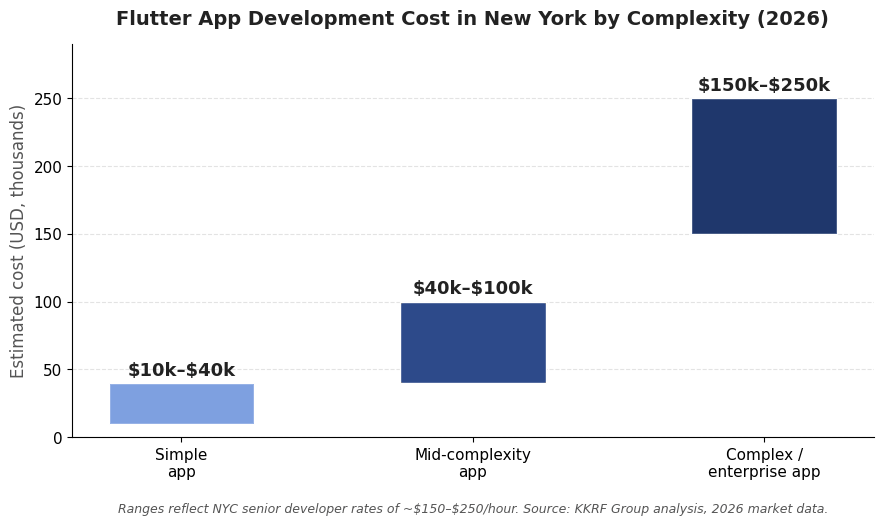
Why New York specifically? Rates. A senior mobile engineer in NYC generally bills $150 to $250 per hour in 2026, and a full-stack developer with mobile experience runs $120 to $180. Those numbers sit above the national average, which is the main reason a New York quote looks higher than one from a smaller market. You are paying for proximity, timezone overlap, and local accountability.
Cost by app complexity
| App type | Typical NYC cost | Example | Timeline |
|---|---|---|---|
| Simple app | $10,000–$40,000 | Booking tool, informational app, basic MVP | 2–4 months |
| Mid-complexity app | $40,000–$100,000 | Marketplace, social features, payments, API integrations | 4–6 months |
| Complex / enterprise | $150,000–$250,000+ | FinTech platform, real-time delivery, IoT, healthcare | 6–12 months |
One number people forget: maintenance. Budget roughly 15–20% of the initial build cost per year for updates, OS compatibility, security patches, and hosting. An app is a living product, not a one-time purchase, and skipping this line item is the most common planning mistake we correct.
What actually drives the price
- Feature depth. Real-time chat, payments, geolocation, and third-party integrations each add engineering hours.
- Design complexity. Custom animations and bespoke UI cost more than standard component layouts.
- Backend and APIs. A custom backend, or integrations with legacy NYC enterprise systems, expands scope.
- Compliance. FinTech and healthcare apps carry security and regulatory work that consumer apps do not.
- Team seniority and location. A senior NYC-based team costs more per hour but usually costs less over the project by avoiding rework.
Not sure where your app lands on this cost range? Our team will map your feature list to a realistic NYC estimate, no obligation. See our New York mobile app development work or get a number tailored to your project.
Get a Custom Project Estimate →The Flutter App Development Process and Timeline
A well-run Flutter project follows a predictable arc. Timelines vary with scope, but the sequence rarely does. Here is the process we use at KKRF Group, written so you can hold any vendor to the same standard.
- Step 1 — Discovery and scoping (1–2 weeks). We define the problem, users, and must-have features, then translate them into a prioritized backlog and a fixed cost range. This is where we kill scope creep before it starts.
- Step 2 — UX and UI design (2–4 weeks). Wireframes become interactive prototypes. For New York brands, this is where identity and accessibility standards get baked in, not bolted on later.
- Step 3 — Architecture and setup (1–2 weeks). We choose state management, backend, and CI/CD, and set up the project structure so the codebase scales cleanly instead of rotting.
- Step 4 — Core development (6–16 weeks). Features are built in two-week sprints with working builds you can test on real devices at the end of each one. Both platforms advance together.
- Step 5 — QA and testing (2–4 weeks). Automated and manual testing across iOS and Android devices, plus performance, security, and edge-case checks before anything ships.
- Step 6 — Launch (1–2 weeks). App Store and Google Play submission, store-listing optimization, and a monitored release. NYC launches often coordinate with a marketing push.
- Step 7 — Post-launch support (ongoing). Monitoring, updates, OS-compatibility work, and iteration based on real usage. This is where a long-term partner earns their keep.
Total elapsed time usually lands between 3 and 8 months. A lean MVP can go faster; a regulated enterprise platform takes longer because compliance and integration work sit on the critical path.
Flutter vs React Native vs Native: What NYC Teams Should Know
The framework debate gets emotional online. It should not be. For most New York projects, the choice comes down to team skills, performance needs, and how much platform-specific behavior the app requires. The chart and table below compare the three realistic options.
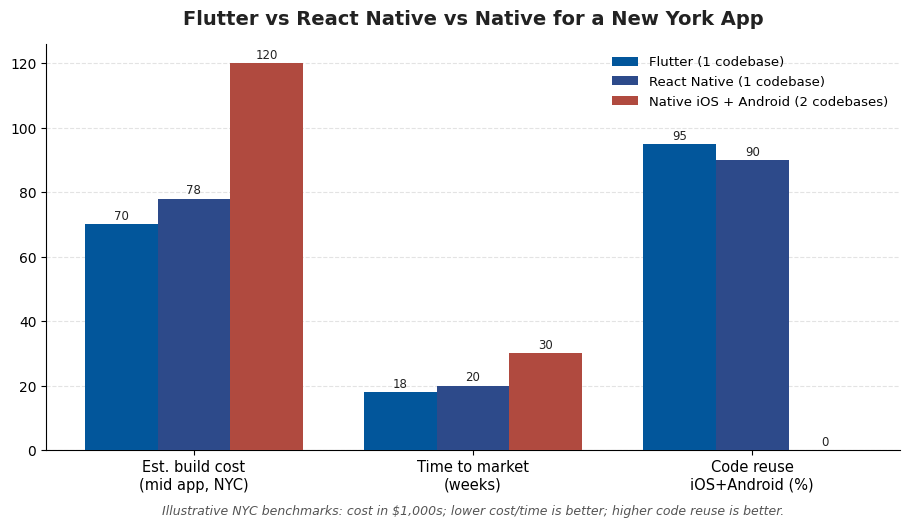
| Factor | Flutter | React Native | Native (iOS + Android) |
|---|---|---|---|
| Codebases | One (Dart) | One (JavaScript) | Two (Swift + Kotlin) |
| UI consistency | Very high (own rendering) | High (native components) | Perfect per platform |
| Performance | Near-native | Near-native | Best possible |
| Best for | Most consumer & business apps | JS-heavy teams, existing React shops | AR/VR, games, deep OS features |
| Relative NYC cost | Lower | Lower | Highest |
We build in both Flutter and React Native, so this is not a loyalty pitch. If your team already lives in React and you have a JavaScript-heavy web product, React Native can be the pragmatic pick, and our React Native development team in New York handles those builds. If you are starting fresh and want the most consistent UI across devices, Flutter is usually the stronger default.
When should you still go native? Choose native when the app leans on cutting-edge AR, complex Bluetooth or hardware integrations, console-grade graphics, or the very latest OS features on launch day. For everything else, the cross-platform savings are hard to argue with.
The Flutter Tech Stack We Use for NYC Apps
A framework is only as good as the stack around it. Flutter handles the UI layer, but a production app needs state management, a backend, and a deployment pipeline. Here is the toolkit we reach for on New York projects, and why.
- State management: BLoC or Riverpod for larger apps, Provider for smaller ones. The choice affects how cleanly the app scales as features grow.
- Backend: Firebase for fast MVPs, or a custom Node, Python, or Go backend when data ownership and scale demand it.
- Rendering engine: Flutter’s Impeller engine, which improves animation smoothness and startup consistency over the older Skia pipeline.
- CI/CD: automated build and release pipelines so both app stores get updates without manual, error-prone steps.
- Testing: Flutter’s widget and integration test tooling, plus device-farm testing across the iPhone and Android models New Yorkers actually carry.
For teams that want to go deeper, Google’s official documentation at flutter.dev and dart.dev is genuinely good and worth reading before you scope a project. We map these tools to your specific needs during discovery rather than forcing every client into the same template.
Security and NYC Compliance for New York Apps
Security is not a feature you add at the end. For New York businesses, especially in finance and healthcare, it is a legal and reputational requirement that shapes architecture from day one. KKRF Group builds security-first, and Flutter supports that when the stack is configured correctly.
New York apps that handle personal data fall under the NY SHIELD Act, which requires reasonable safeguards for private information. FinTech apps add financial regulations, and healthcare apps add HIPAA. The framework does not make you compliant on its own; disciplined engineering does.
What secure Flutter development looks like
- Encrypted data at rest and in transit, with secure storage for tokens and credentials rather than plain preferences.
- Certificate pinning and hardened API communication to resist interception on public NYC networks.
- Following the OWASP Mobile Application Security guidelines for testing and verification.
- Least-privilege access, audit logging, and clear data-handling policies for regulated data.
- Regular dependency and vulnerability scanning, because a third-party package is part of your attack surface.
The Business Case: ROI of Flutter for New York Companies
The strongest argument for Flutter is financial, and it compounds over time. The obvious saving is building one app instead of two. The less obvious, larger saving is maintenance: every future update, OS change, and bug fix touches one codebase instead of two.
Consider a mid-complexity app. A dual-native plan might carry two engineering tracks for the life of the product. A Flutter plan carries one. Over three years of updates, that difference often dwarfs the initial build saving. For a New York company weighing runway against features, that is real money back on the table.
Time to market is the other lever. Launching on both platforms at once means you capture your whole addressable market from day one, instead of leaving Android or iOS users waiting while a competitor moves. In New York’s crowded categories, that head start has measurable value.
Flutter App Use Cases Across New York Industries
Flutter is industry-agnostic, but the value shows up differently depending on the sector. These are the New York verticals where we see it deliver the most, each a distinct KKRF Group specialization.
- FinTech: trading, payments, and neobank apps where a consistent, secure experience across iOS and Android protects trust. See our mobile app development services for regulated builds.
- Healthcare: patient portals and telehealth apps where HIPAA-grade security and reliable performance matter more than platform-specific flourishes.
- Retail and e-commerce: New York brands that need a polished, brand-consistent storefront on every device before a seasonal push.
- Real estate: listing and tour apps with maps, media, and lead capture, common across the NYC property market.
- On-demand and logistics: delivery and field-service apps with real-time tracking, where fast iteration on both platforms keeps operations moving.
Common Flutter Development Mistakes to Avoid
We get called in to rescue Flutter projects as often as we start them fresh. The failures rhyme. Avoid these and you avoid most of the pain.
- Skipping architecture. Teams that start coding without a state-management plan build an app that works at launch and collapses under new features.
- Under-budgeting maintenance. Treating the app as a one-time cost, then being surprised by OS updates and security patches a year later.
- Ignoring platform differences. Cross-platform does not mean identical. iOS and Android users expect certain native behaviors, and ignoring them feels cheap.
- Choosing the cheapest bid. A low overseas quote that needs a costly NYC rebuild is not a saving. It is a delay with extra steps.
- No testing on real devices. Emulators hide performance and layout issues that only appear on the phones your users actually hold.
Inherited a Flutter project that is not going well, or planning one and want it done right the first time? Our New York engineering team can review your architecture and give you a candid assessment. Learn how we work with NYC clients.
Request a Technical Assessment →How to Choose a Flutter App Development Company in New York
The framework decision is easy compared to the partner decision. A good Flutter app development company in New York turns a good idea into a shipped product; a bad one turns a good budget into a stalled repo. Use this checklist to separate them.
- Real Flutter portfolio. Ask for live App Store and Google Play links, not slide decks. Download the apps and use them.
- NYC market and compliance awareness. A partner who understands NY SHIELD, HIPAA, or FinTech rules will not learn on your budget.
- Transparent process and pricing. You should see sprint demos, a clear backlog, and an itemized estimate, not a black box.
- Post-launch support model. Confirm who maintains the app after launch and what that costs before you sign.
- Engineering depth, not just developers. Architecture, security, and QA should be first-class roles, not afterthoughts.
- Communication and timezone fit. A local or timezone-aligned team catches problems in hours, not days.
Decision Framework: When to Choose Flutter (and When Not To)
Frameworks are tools, not religions. Here is a plain decision guide you can apply to your own project in five minutes.
Choose Flutter when
- You need iOS and Android at launch on a single budget.
- Brand-consistent UI across devices matters.
- You want fast iteration and a lean team.
- It is a consumer, business, FinTech, or healthcare app.
Reconsider Flutter when
- The app is AR/VR or graphics-heavy gaming.
- You need day-one support for the newest OS APIs.
- Deep hardware or Bluetooth integration is central.
- Your team is already deep in native or React.
Honest limitation: Flutter apps can have a larger initial download size than native, and truly bleeding-edge OS features sometimes arrive via plugins rather than day one. For most business apps these are non-issues; for a few edge cases they are decisive.
Our recommendation: for the large majority of New York startups and enterprises building a consumer or business app, Flutter is the sensible default. Reserve native for the specific, graphics- or hardware-intensive cases above. When in doubt, scope both options in discovery and let the requirements decide.
Future Trends in Flutter Development
Flutter is maturing, not slowing down. A few shifts are worth planning around if you are building in 2026 and beyond.
- Impeller everywhere. Flutter’s newer rendering engine is becoming the default, improving animation smoothness and startup consistency.
- AI features on device. More apps are embedding on-device and API-based AI, and Flutter’s plugin ecosystem is keeping pace.
- Beyond mobile. The same codebase increasingly targets web and desktop, which appeals to NYC enterprises consolidating platforms.
- Stronger enterprise adoption. As large companies standardize on Flutter, tooling, hiring, and long-term support all improve.
Building Your Flutter App in New York
Flutter gives New York businesses a rare combination: one codebase, two platforms, near-native performance, and a lower total cost over the life of the product. The framework is a safe default for most apps. The real variable is the team you hand it to.
As a Flutter app development company in New York, KKRF Group builds for NYC startups and enterprises with a security-first, transparent process from architecture through post-launch support. If you are weighing a Flutter build, we are happy to give you a straight answer on cost, timeline, and whether it even fits, before you commit a dollar.
Ready to turn your idea into a Flutter app New Yorkers will actually use? Book a discovery call and get a clear scope, timeline, and cost estimate from an engineering team, not a sales rep. Explore our New York app development services.
Book a Discovery Call →Frequently Asked Questions
How much does Flutter app development cost in New York?
A Flutter app in New York typically costs $10,000 to $40,000 for a simple app, $40,000 to $100,000 for a mid-complexity app, and $150,000 to $250,000 or more for a complex or enterprise app in 2026. NYC rates run higher than the national average because senior mobile engineers here bill roughly $150 to $250 per hour.
How long does it take to build a Flutter app in NYC?
Most Flutter projects in New York take 3 to 8 months from discovery to launch. A lean MVP can ship faster, while a regulated FinTech or healthcare platform takes longer because compliance and integration work sit on the critical path.
Is Flutter better than React Native for a New York business?
For most New York businesses starting fresh, Flutter offers more consistent UI across devices from a single Dart codebase. React Native is often the better fit for teams already invested in JavaScript and React. Both cut cost versus building two native apps, so the right choice depends on your team and requirements.
Can Flutter apps meet HIPAA and NY SHIELD Act requirements?
Yes. Flutter apps can meet HIPAA, NY SHIELD Act, and FinTech security requirements when built with encryption, secure storage, hardened APIs, and OWASP-aligned testing. Compliance comes from disciplined, security-first engineering rather than from the framework itself.
Does Flutter really build both iOS and Android from one codebase?
Yes. Flutter compiles a single Dart codebase into native iOS and Android apps, which is why it typically reduces build cost by 30 to 40 percent compared with developing two separate native apps. You still test on both platforms, but you maintain one code line.
Why hire a New York based Flutter development company?
A New York based Flutter company offers timezone-aligned communication, faster problem resolution, and familiarity with local regulations like the NY SHIELD Act. That proximity and accountability often lowers total project cost by reducing rework, even though local hourly rates are higher.