
Enterprise training has a stubborn problem. The moments that matter most — a chemical leak, a hostile customer, a turbine that fails mid-shift — are exactly the moments you cannot safely rehearse in real life. Virtual reality closes that gap. At KKRF Group, an experienced AR/VR and spatial computing development partner, we build VR training simulations that let people practice high-stakes work in a controlled, repeatable environment where mistakes cost nothing.
This guide breaks down what VR training simulation development actually involves in 2026: real costs, measurable ROI, the build process, the tech stack, and how to choose a partner who can ship something your teams will use. No hype — just the numbers and trade-offs that decide whether an immersive training program pays off.
Key Takeaways
- VR training simulation development is the engineering of interactive, headset-based simulations that teach a specific skill, procedure, or decision under realistic conditions.
- A single-scenario pilot runs $40,000–$120,000 and ships in 8–14 weeks; full production programs with multiple scenarios and LMS integration run $120,000–$400,000.
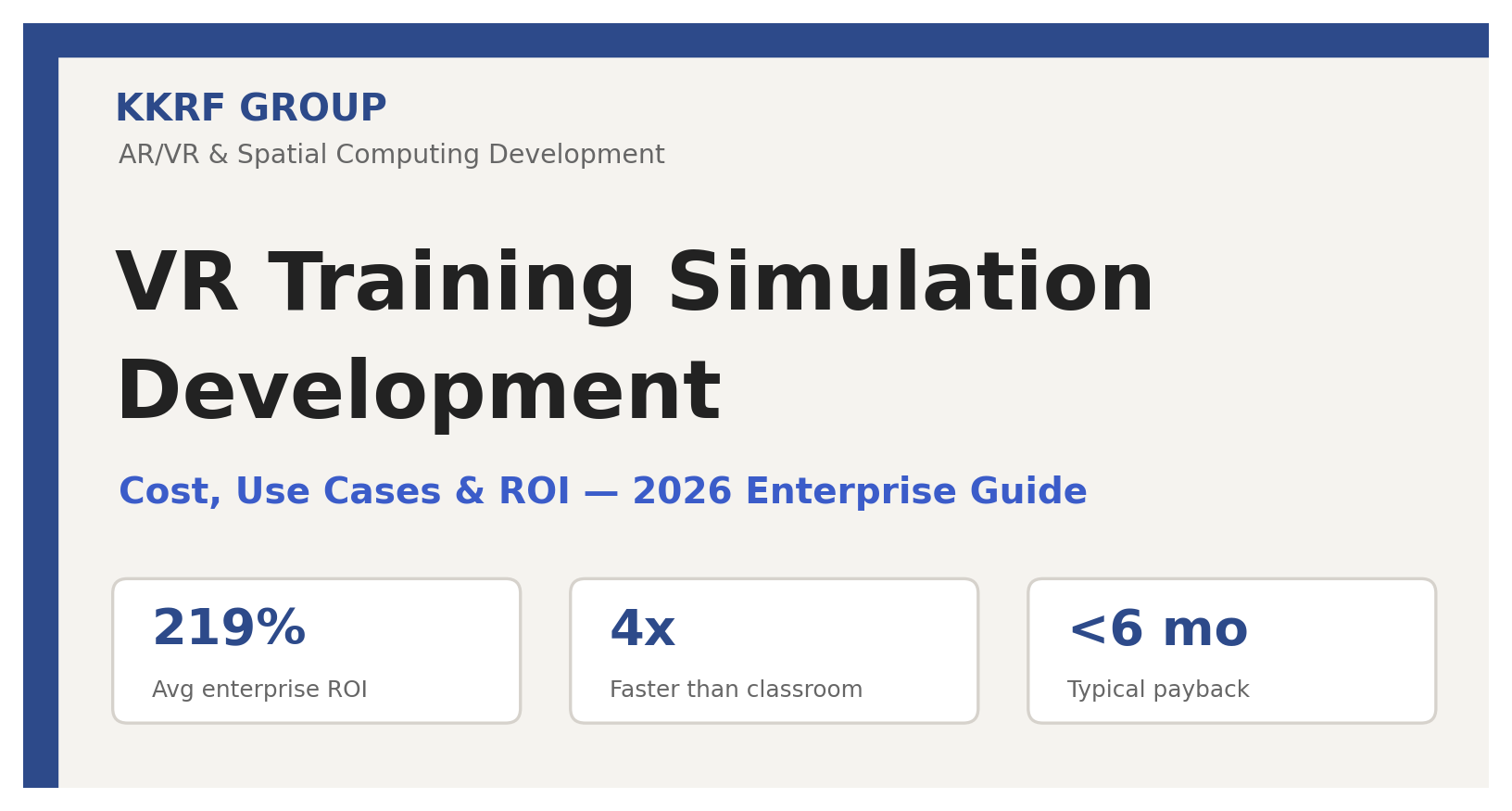
- Enterprises report an average 219% ROI with payback in under six months, and VR learners train up to 4x faster than in a classroom (PwC).
- VR pays off fastest for training that is dangerous, expensive, or impossible to stage in the real world — and for behavioral skills like leadership and safety.
- The build-vs-buy decision hinges on how proprietary your procedures are: off-the-shelf libraries fit generic soft skills; custom development fits equipment- and process-specific work.
What this guide covers
Quick Answer: What VR Training Simulation Development Costs and Delivers
VR training simulation development is the process of designing and engineering interactive, headset-based simulations that teach a specific skill or procedure. A single-scenario pilot typically costs $40,000 to $120,000 and ships in 8 to 14 weeks. Full production programs with multiple branching scenarios, learning-management-system integration, and an analytics dashboard run $120,000 to $400,000, depending on 3D environment complexity and whether multiplayer is required.
The business case is well documented. Enterprises adopting VR training report an average 219% return on investment with payback in under six months, driven by faster skill acquisition, fewer real-world errors, and eliminated travel and facility costs. VR delivers the strongest returns when the content is dangerous, costly, or impossible to rehearse physically.
KKRF Group builds custom VR training simulations for manufacturing, healthcare, energy, and field-service organizations. Our approach pairs instructional design with enterprise-grade engineering — secure headset provisioning, LMS and analytics integration, and content pipelines your team can update without rebuilding from scratch. The sections below reflect how we scope, price, and ship these programs in practice.
What Is VR Training Simulation Development?
Unlike a video or an e-learning slide, a VR simulation puts the learner inside the scenario. They reach out and grab a valve. They walk the factory floor. They make a decision and see the consequence play out. In VR training simulation development, that sense of being physically present is what makes the learning stick, and it is the reason immersive training has moved from novelty to a mainstream enterprise tool.
Immersive learning, defined
Immersive learning is any training method that surrounds the learner in a simulated environment, using VR, augmented reality, or mixed reality to replace passive watching with active doing. In a VR context, the learner wears a head-mounted display — the headset that tracks head and hand movement and renders a 3D world in real time. The quality of that tracking, the fidelity of the 3D environment, and the realism of the interactions are what separate a convincing simulation from a gimmick.
Most enterprise VR training simulations fall into three families: procedural training that teaches a fixed sequence of steps, scenario-based training that branches based on the learner’s choices, and skills practice that rehearses a physical or interpersonal ability until it becomes second nature. A single program often blends all three.
Why VR Training Works: The Evidence
Skepticism about VR training is fair — plenty of early programs were expensive tech demos that nobody used twice. But the controlled research is now consistent, and it points in one direction. The most cited study, from PwC, compared new managers learning the same material through classroom, e-learning, and VR.
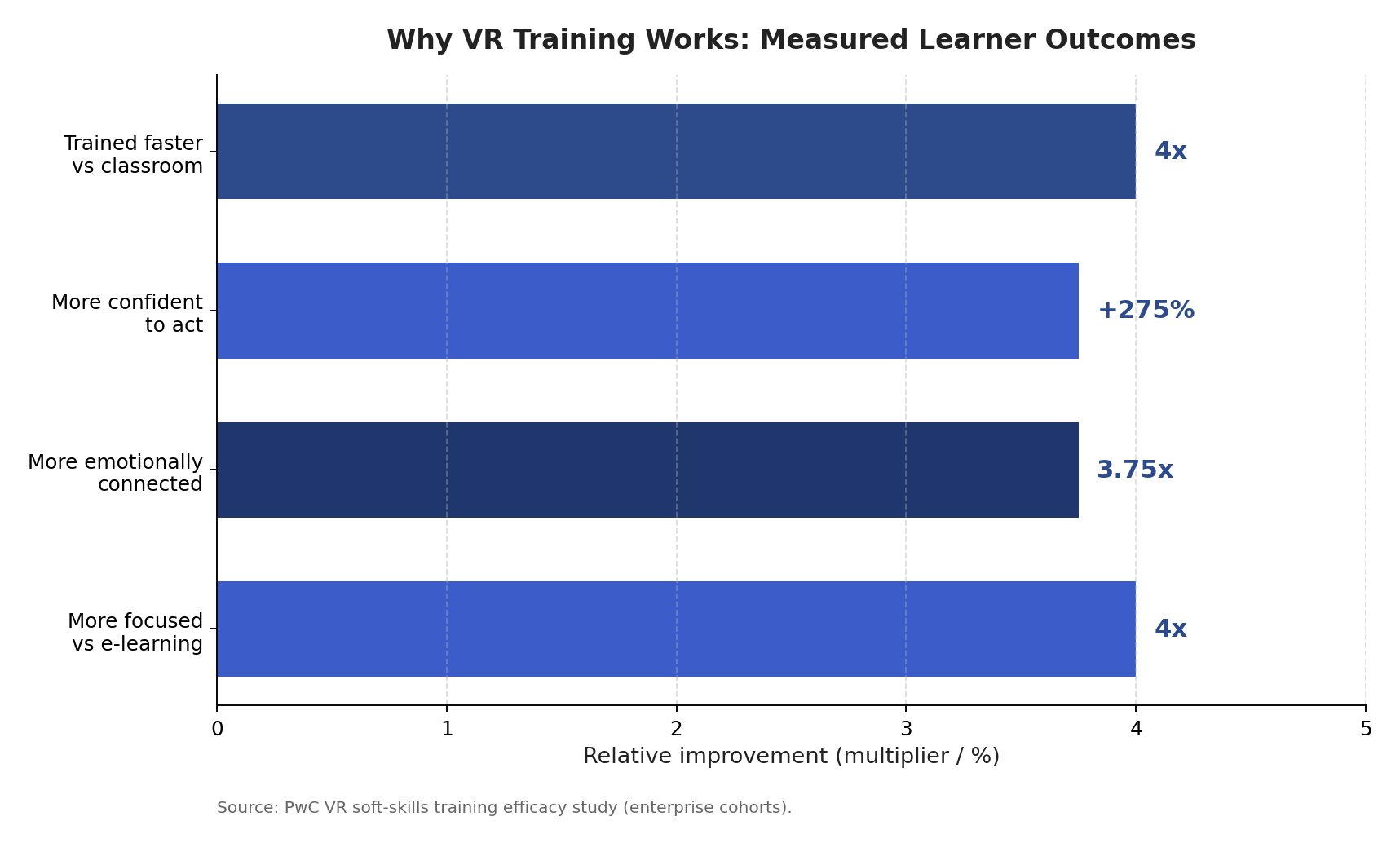
The VR cohort completed training up to four times faster than the classroom group and 1.5 times faster than e-learners. They were up to 275% more confident applying what they learned. They reported feeling 3.75 times more emotionally connected to the content than classroom learners, and they were four times more focused than their e-learning peers. Emotional connection and focus are not soft metrics here — they are the mechanisms that drive retention.
Presence, defined
Presence is the psychological sense of actually being inside a virtual environment rather than watching it. High presence triggers genuine stress responses, genuine muscle memory, and genuine decision-making — which is why a fire-safety drill in VR raises a learner’s heart rate the way a slideshow never will. Presence is the single biggest reason VR outperforms flat media for high-stakes and behavioral training.
Top Enterprise VR Training Simulation Use Cases
VR training is not the right tool for every course. It earns its cost where the real-world alternative is dangerous, expensive, disruptive, or simply impossible to arrange on demand. These are the use cases where we see the clearest returns.
- Manufacturing and industrial safety: lockout/tagout, machine operation, confined-space entry, and hazardous-material handling — practiced without stopping a production line or risking injury.
- Healthcare and clinical skills: surgical rehearsal, patient-interaction training, and emergency-response drills that would be unethical or impractical to stage with real patients.
- Energy, oil, and gas: offshore rig procedures, high-voltage work, and emergency shutdowns — high-consequence tasks where a mistake in real life is catastrophic.
- Aviation, defense, and logistics: equipment maintenance, cockpit and vehicle familiarization, and warehouse safety at a fraction of the cost of physical mock-ups.
- Soft skills and leadership: difficult conversations, de-escalation, diversity and inclusion, and sales role-play, where VR’s emotional realism drives measurable behavior change.
- Customer-facing and retail: onboarding at scale across distributed locations, standardizing service quality without flying trainers around the country.
A useful filter: if you can teach it adequately with a video, do that — it is cheaper. If the skill only sticks when someone physically does it, and doing it for real is risky or costly, that is where VR training simulation development pays for itself.
How Much Does VR Training Simulation Development Cost in 2026?
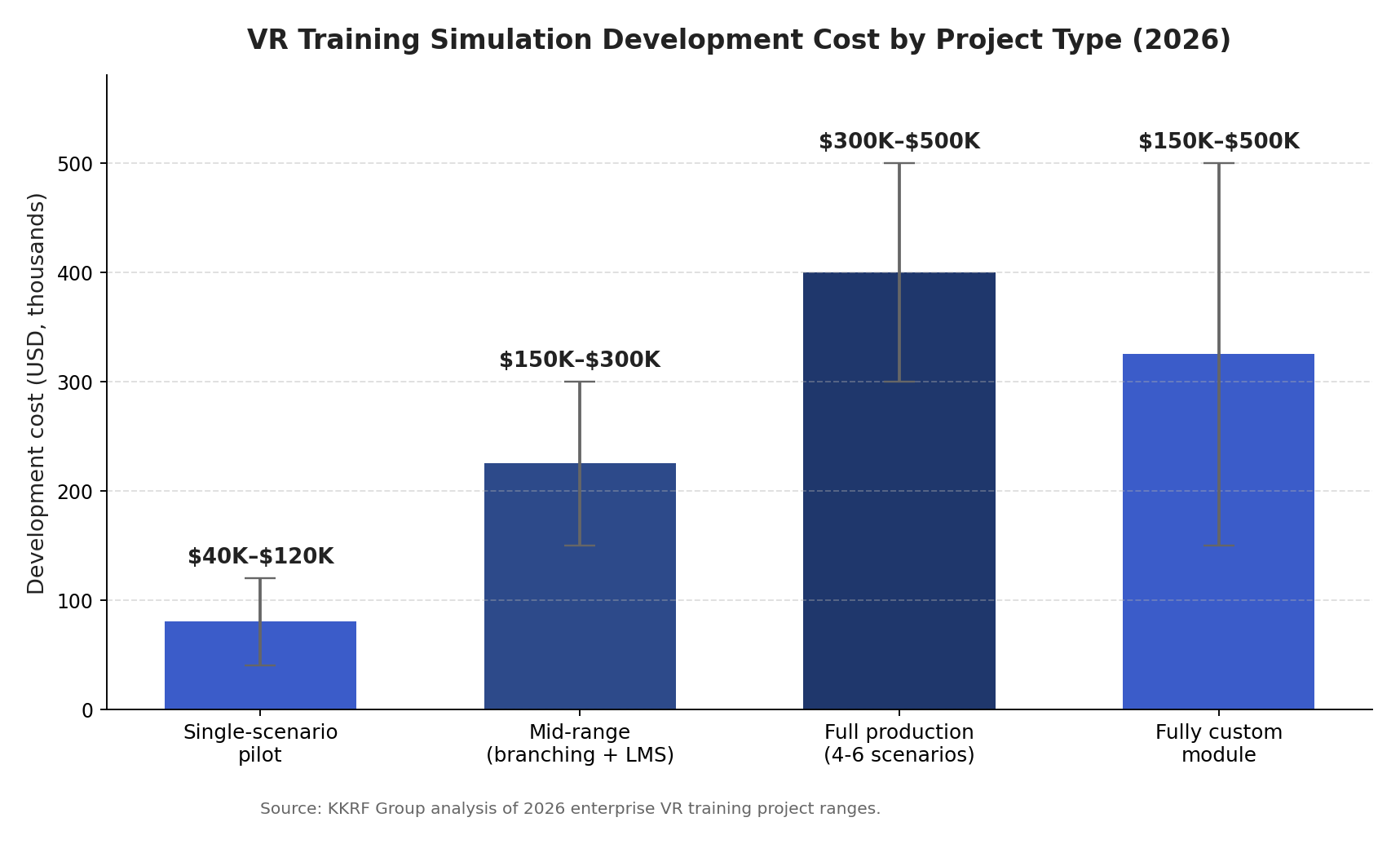
Cost is the first question every buyer asks, and the honest answer is that it depends on scope more than on any single vendor’s rate card. That said, the VR training simulation development market has settled into recognizable tiers. The chart and table below reflect current 2026 pricing for custom, enterprise-grade work.
| Project type | Typical cost (USD) | Timeline | What you get |
|---|---|---|---|
| Single-scenario pilot | $40,000 – $120,000 | 8–14 weeks | One environment, one procedure, basic analytics — ideal for proving ROI |
| Mid-range program | $120,000 – $300,000 | 3–5 months | Branching scenarios, LMS integration, dashboards, multi-device support |
| Full production suite | $300,000 – $500,000+ | 5–9 months | Multiple environments, multiplayer, deep analytics, managed rollout |
| Content per custom module | $150,000 – $500,000 | Varies | Fully bespoke 3D environments and interactions for proprietary equipment |
Several factors move a project within these ranges. The biggest cost drivers are the number and complexity of 3D environments, whether the simulation is single-player or multiplayer, the realism of physics and interactions, the depth of LMS and analytics integration, and the scale of your headset fleet and device management. Off-the-shelf content sits far lower — roughly $20 to $50 per seat — but you trade away the fidelity to your own processes.
Do not forget the hardware. Over a three-year total cost of ownership, headsets range from around $1,024 per unit for a Pico 4 Enterprise to roughly $5,996 for an Apple Vision Pro once you include device management, breakage, and refresh. For most enterprise deployments, the headset is a small line item next to content development — but at fleet scale it matters.
Not sure whether your training justifies custom VR? We will pressure-test one high-stakes scenario against the numbers before you commit a budget. Explore our AR/VR development services to see how we scope immersive training.
Get a Technical Assessment →The VR Training Development Process, Step by Step
VR training simulation development is part film production, part software engineering, and part instructional design. Here is how we structure the build so it stays on budget and actually changes behavior on the job.
- Discovery and learning-objective mapping. Define the exact skills and measurable outcomes the simulation must produce, and confirm VR is the right medium for each one before any 3D work starts.
- Scenario and interaction design. Write the scenarios, decision branches, and success criteria. This instructional-design phase is where most of the training value is created or lost.
- 3D environment and asset production. Model the environment, equipment, and characters at the fidelity the training requires — photoreal where it matters, stylized where it does not.
- Interaction and logic programming. Build the physics, hand interactions, scoring, and branching in a real-time engine so the world responds believably to the learner.
- Integration. Connect the simulation to your LMS and analytics using standards like xAPI so completion, scores, and behavioral data flow into your existing systems.
- Pilot and validation. Test with real users, measure against the learning objectives, and refine the scenarios based on where learners struggle or disengage.
- Rollout and device management. Provision and secure the headset fleet, distribute the app through a managed pipeline, and support updates without re-shipping hardware.
Tech Stack and Architecture
The engineering choices behind VR training simulation development determine how well it runs, how easily it updates, and how securely it handles learner data. Most enterprise programs share a common backbone.
- Real-time engine: Unity or Unreal Engine, which handle rendering, physics, and interaction logic and export to every major headset.
- Cross-device standards: OpenXR and, for browser-based delivery, WebXR — so one build reaches Meta Quest, Pico, and Apple Vision Pro without separate codebases.
- Learning integration: xAPI (the Experience API) and SCORM to push granular performance data into an LMS or learning-record store.
- Cloud and analytics: a secure back end for content delivery, session data, and dashboards, typically on enterprise cloud infrastructure with role-based access.
- Device management: mobile device management (MDM) for headsets to lock down, provision, and update fleets at scale.
KKRF Group builds these systems security-first, because a training simulation that captures how individual employees perform is sensitive data. Encryption in transit and at rest, least-privilege access, and clear data-retention rules are part of the architecture from day one, not bolted on later.
Build vs Buy: Custom VR Training or Off-the-Shelf?
Not every training need justifies custom development. The decision comes down to how specific your procedures, equipment, and environments are. The table below lays out the trade-off.
| Factor | Off-the-shelf library | Custom VR development |
|---|---|---|
| Upfront cost | Low ($20–$50 per seat) | Higher ($40K–$500K per program) |
| Fit to your process | Generic | Exact — your equipment and workflows |
| Time to launch | Days | 8 weeks to several months |
| Best for | Soft skills, generic safety | Proprietary machinery, unique scenarios |
| Analytics depth | Limited | Full, integrated with your LMS |
| Long-term ownership | Vendor-locked | You own the IP and content pipeline |
A simple decision framework
Choose off-the-shelf when the skill is generic — unconscious-bias training, general workplace safety, basic customer service — and you need to launch quickly with minimal budget. There is no reason to custom-build what already exists at commodity prices.
Choose custom VR training simulation development when the procedure involves your specific equipment, your facility layout, or proprietary processes; when the stakes of getting it wrong are high; or when you need the performance data to feed compliance and workforce planning. This is where a partner like KKRF Group earns its keep.
Limitations to plan for: VR training is not a fit for purely conceptual knowledge that a document conveys just as well, and it carries hardware logistics that flat e-learning avoids. Below roughly 375 learners, per-learner cost can exceed classroom delivery; the economics improve sharply at scale, becoming about 52% cheaper than classroom at 3,000 learners. Our recommendation: pilot one high-value, high-stakes scenario first, prove the ROI, then expand.
Common VR Training Mistakes to Avoid
- Choosing VR for the wrong content. Using an expensive medium to teach something a two-minute video handles is the fastest way to waste a budget.
- Skipping instructional design. A beautiful 3D environment with weak scenarios teaches nothing. The learning design matters more than the graphics.
- Ignoring the rollout. Programs die not in development but in deployment — unmanaged headsets, no charging routine, no owner. Plan device management before you build.
- No measurement plan. If you cannot tie the simulation to completion rates, error reduction, or time-to-competency, you cannot prove ROI or defend the next budget.
- Building one giant program. Ambitious multi-scenario suites stall. Ship a focused pilot, learn, and expand from evidence.
How to Measure VR Training ROI
A credible VR training simulation development ROI case compares the fully loaded cost of the VR program against the fully loaded cost of the training it replaces, then adds the value of better outcomes. The cost side includes content development, hardware and its three-year total cost of ownership, platform licensing, and maintenance. The value side includes reduced travel and facility spend, less instructor and production-line downtime, faster time-to-competency, and fewer costly errors on the job.
Where VR Training Is Heading
Three shifts are reshaping VR training simulation development in 2026. First, standalone headsets keep getting cheaper and better, erasing the tethered-PC barrier that stalled early adoption. Second, AI is entering the loop — generative characters that hold unscripted conversations make soft-skills practice far more realistic than fixed branching ever could.
Third, spatial computing is blurring the line between VR and augmented reality. Devices like Apple Vision Pro bring mixed-reality training that overlays guidance onto real equipment, which pairs naturally with the digital twins many manufacturers are already building. Immersive training and industrial digital twins are converging into a single operational layer, and organizations that architect for both now will move faster later.
How to Choose a VR Training Development Partner
The vendor market ranges from boutique studios to full-service engineering firms, and the right choice depends on whether you need a one-off pilot or a program you will grow for years. A few questions separate serious partners from the rest.
- Do they lead with instructional design and measurable outcomes, or only with graphics and demos?
- Can they integrate with your LMS and analytics using xAPI or SCORM, and hand you the data?
- Do they build on standards like OpenXR so you are not locked to a single headset?
- How do they handle security, learner-data privacy, and device management at fleet scale?
- Will you own the IP and a content pipeline your team can update, or are you renting?
- Can they show a real pilot-to-scale path rather than a single flashy deliverable?
As a long-term technology partner, KKRF Group scopes VR training simulation development the way we scope any enterprise system: start with a focused pilot tied to hard metrics, prove the return, and expand on evidence. That discipline is what turns an immersive training experiment into a program that survives the next budget cycle.
Ready to prove ROI with a focused pilot? KKRF Group designs, builds, and integrates VR training simulations your teams will actually use. Compare approaches in our enterprise AR/VR development guide.
Book a Discovery Call →Frequently Asked Questions
What is VR training simulation development?
VR training simulation development is the process of designing and engineering interactive, headset-based simulations that teach a specific skill or procedure. It combines instructional design, 3D environment modeling, interaction programming, and LMS integration so learners can practice real tasks — like operating equipment or handling emergencies — inside a safe, repeatable virtual environment.
How much does VR training simulation development cost in 2026?
A single-scenario pilot typically costs $40,000 to $120,000 and ships in 8 to 14 weeks. Mid-range programs with branching scenarios and LMS integration run $120,000 to $300,000, and full production suites reach $300,000 to $500,000 or more. Off-the-shelf content is far cheaper at roughly $20 to $50 per seat but does not match your specific processes.
Does VR training actually work?
Yes, for the right content. In PwC research, VR learners trained up to four times faster than in a classroom, were up to 275% more confident applying what they learned, and were far more focused and emotionally engaged. VR is most effective for training that is dangerous, expensive, or impossible to rehearse in real life, and for behavioral skills like leadership and safety.
Which industries benefit most from VR training simulations?
Manufacturing, healthcare, energy and utilities, aviation, defense, and logistics see the strongest returns because their high-stakes procedures are risky or costly to practice for real. VR is also highly effective for soft-skills and leadership training, where its emotional realism drives measurable behavior change across distributed teams.
Should we build custom VR training or buy off-the-shelf?
Buy off-the-shelf when the skill is generic — unconscious bias, general safety, basic service — and you need to launch fast on a small budget. Build custom when the training involves your specific equipment, facilities, or proprietary processes, when stakes are high, or when you need deep analytics integrated with your LMS. A focused custom pilot is the usual starting point.
How long does it take to develop a VR training simulation?
A single-scenario pilot typically takes 8 to 14 weeks from discovery to launch. Mid-range programs run 3 to 5 months, and full production suites with multiple environments and multiplayer take 5 to 9 months. Timelines depend mostly on the number and complexity of 3D environments and the depth of system integration.
Immersive training and digital twins are converging fast. Talk to our engineering team about a VR training simulation scoped to your equipment, your data, and your rollout.
Talk to Our Engineering Team →