
Enterprise AR/VR development has moved from experimental pilots to production systems that train workforces, guide field technicians, and compress product design cycles. In 2026, immersive technology is no longer a novelty line item — it is a measurable driver of productivity, safety, and revenue across manufacturing, healthcare, logistics, and retail.
Yet most immersive projects still fail for the same reasons: the wrong use case, an architecture that never scales past the demo, or a delivery partner who can ship a flashy prototype but not a secure, maintainable platform. Choosing what to build — and who builds it — matters far more than the headset sitting on the shelf.
This guide breaks down enterprise AR/VR development end to end: what it actually involves, where the ROI lives, realistic 2026 cost bands, the reference architecture and technology stack, the security and compliance considerations enterprise buyers routinely overlook, and a practical framework for choosing a development partner. At KKRF Group, our engineering teams treat immersive projects the way we treat any enterprise system — grounded in business outcomes, built on scalable cloud-native foundations, and secured from the first line of code.
Key Takeaways
- ROI comes from the use case, not the headset. The highest-return enterprise AR/VR projects target high-cost, high-risk, or hard-to-scale training and field operations.
- Budget realistically. Simple single-feature AR runs roughly $50K–$150K; complex enterprise AR/VR solutions reach $200K–$500K+, with maintenance adding ~15–20% per year.
- Architecture decides scalability. A demo runs on one device; a platform needs content pipelines, device management, identity, and analytics designed in from day one.
- Security is non-negotiable. Spatial data, camera passthrough, and biometric signals make privacy and compliance a first-class design concern, not an afterthought.
- Partner selection is the biggest risk lever. Prioritize teams with enterprise engineering depth and a transparent process over studios that only produce prototypes.
What This Guide Covers
- What Enterprise AR/VR Development Is
- The 2026 AR/VR Market
- Enterprise Use Cases With Real ROI
- How Much It Costs
- Architecture & Tech Stack
- The Development Process
- Security, Privacy & Compliance
- Common Mistakes to Avoid
- AR vs VR vs MR Decision Guide
- Choosing a Development Partner
- The Future of Spatial Computing
- Frequently Asked Questions
Quick answer: Enterprise AR/VR development is the process of designing, engineering, deploying, and maintaining augmented, virtual, or mixed reality applications that solve real business problems at scale — think immersive training, remote assistance, digital-twin visualization, and interactive product design. A production-grade project typically costs between $50,000 and $500,000+ depending on complexity, spans 3–9 months, and succeeds or fails based on use-case selection, scalable architecture, and the engineering depth of the development partner.
KKRF Group is an enterprise technology partner that engineers AR/VR and spatial computing solutions alongside our broader work in custom software, cloud, and IoT. The perspective in this guide reflects how experienced engineering teams actually scope immersive projects — where budgets get spent, where they get wasted, and what separates a proof of concept from a system a workforce depends on every day.
What Is Enterprise AR/VR Development?
Enterprise AR/VR development is the discipline of building immersive applications that overlay or replace a user’s view of the world to accomplish a defined business outcome. Unlike consumer games or one-off marketing stunts, enterprise projects must integrate with existing systems, handle real operational data, protect sensitive information, and run reliably across a fleet of devices for years.
The category spans several related technologies, and getting the vocabulary right matters because it directly shapes hardware choices, budgets, and architecture.
Augmented Reality (AR): Digital content is layered onto the real world through a phone, tablet, or headset with camera passthrough. Ideal for field service, remote assistance, and on-site guidance where the worker still needs to see their environment.
Virtual Reality (VR): The user is fully immersed in a simulated environment using an opaque headset. Best suited to high-fidelity training, simulation, and design review where a controlled, distraction-free scenario is the point.
Mixed Reality (MR): Digital objects are anchored to and interact with the physical space in real time, blending AR and VR. Powering the newest enterprise headsets, MR supports collaborative design, digital twins, and spatially aware workflows.
Spatial Computing: The umbrella term for any system that uses physical space as an input and output medium — combining AR, VR, MR, sensors, and AI. In 2026 it has become the framing enterprises use when planning immersive strategy beyond a single app.
In practice, an enterprise AR/VR development engagement covers use-case validation, experience and interaction design, 3D and environment production, application engineering, backend and data integration, device management, security hardening, and ongoing content operations. The immersive front end is only the visible tip of a much larger system.
The 2026 AR/VR Market: Why Enterprises Are Investing Now
The commercial momentum behind immersive technology is real, and it is increasingly driven by enterprise adoption rather than consumer hype. Analysts tracking the broader spatial computing market project growth from roughly $20 billion in 2025 to more than $85 billion by 2030 — a compound annual growth rate near 33%.
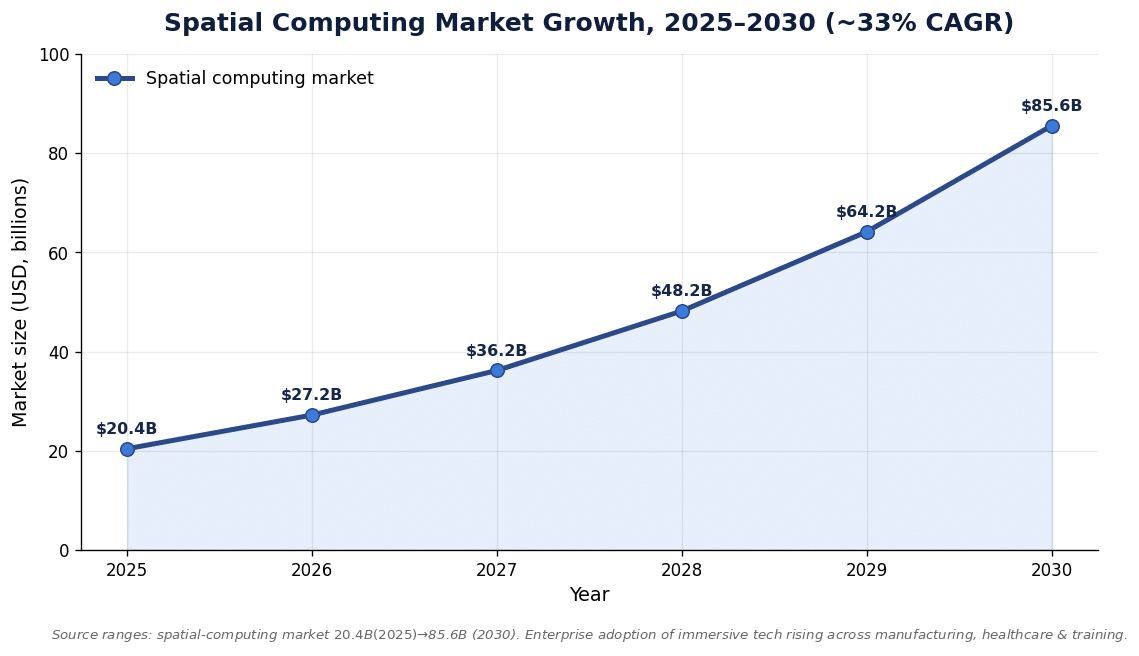
Estimates for the AR/VR market specifically vary widely by methodology — some trackers cite worldwide AR & VR revenue near $50 billion in 2026, while broader reports that fold in hardware, enterprise services, and content place the figure much higher. The headline number matters less than the direction: enterprise budgets are shifting from pilots to scaled deployments.
Three forces are converging. Headset hardware has matured, with capable mixed-reality devices now viable for daily work. Generative AI has cut the cost of producing 3D content and training scenarios by an estimated 30–50% on suitable projects. And a growing body of measured results — with a majority of adopting organizations reporting productivity improvements from immersive tools — has given finance teams the evidence they previously lacked.
Section summary: Enterprise demand — not consumer sales — now leads the immersive market. Mature hardware, AI-assisted content, and proven productivity gains have moved AR/VR from innovation-lab curiosity to a defensible capital investment.
Enterprise AR/VR Use Cases That Deliver Real ROI
The fastest way to waste an immersive budget is to build something impressive that no one needs daily. The projects that pay back target work that is expensive, dangerous, hard to scale, or impossible to visualize in two dimensions. These patterns recur across industries.
Immersive Training & Simulation
VR training lets employees practice high-stakes or high-cost scenarios safely and repeatably — from equipment operation to emergency response to customer interactions. Large retailers and aerospace manufacturers have used immersive simulations to onboard staff at scale and rehearse procedures that would be impractical to stage physically. The ROI shows up as faster ramp time, fewer errors, and reduced equipment downtime.
Remote Assistance & Field Service
AR remote-assistance apps let a remote expert see what an on-site technician sees and annotate the live view with instructions. This collapses travel costs, shortens repair times, and captures expert knowledge that would otherwise walk out the door at retirement. It is one of the most reliably profitable AR patterns in industrial settings.
Digital Twins & Design Review
Mixed-reality digital twins let teams walk through a factory line, building, or product at full scale before anything is built. Engineers catch clashes early, stakeholders align on design faster, and change orders drop. This is where AR/VR overlaps naturally with connected-sensor systems — the same operational data that powers an enterprise IoT platform can drive a live, spatial view of the asset it monitors.
Healthcare, Retail & Beyond
In healthcare, XR supports surgical planning, rehabilitation therapy, and clinical education. In retail and real estate, AR product visualization and virtual walkthroughs lift conversion and reduce returns. The common thread is decision support: immersive interfaces help people understand complex, spatial, or high-consequence situations faster than a screen ever could.
- Manufacturing: guided assembly, quality inspection, predictive-maintenance overlays, operator training.
- Healthcare: surgical simulation, patient education, VR-based pain and rehabilitation therapy.
- Logistics: AR pick-and-pack, warehouse navigation, load planning.
- Retail & real estate: virtual try-on, 3D product configurators, immersive property tours.
- Enterprise collaboration: spatial design reviews and distributed teams sharing a common 3D workspace.
How Much Does Enterprise AR/VR Development Cost?
AR/VR development cost is driven by scope, fidelity, and integration depth far more than by the technology label. A single-feature AR viewer and a multi-user VR simulation platform share almost nothing on a budget sheet. The 2026 US-market bands below reflect typical ranges for enterprise-grade work.
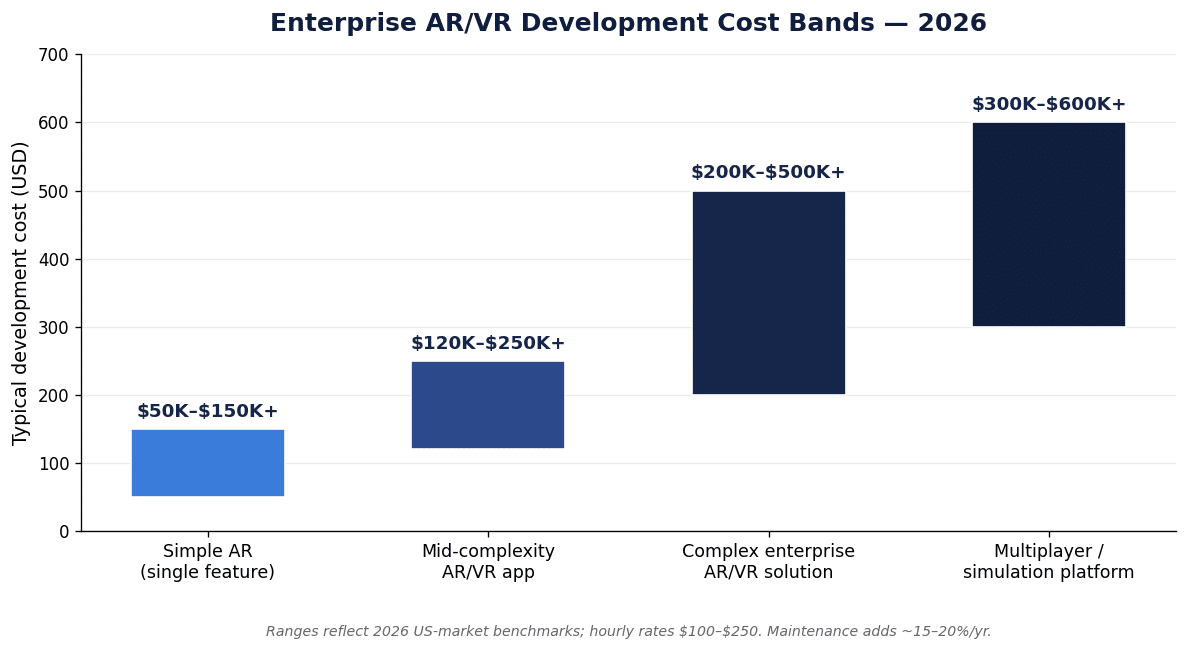
| Project type | Typical cost (2026) | Timeline | What drives the number |
|---|---|---|---|
| Simple AR app (single feature) | $50K–$150K | 2–4 months | One platform, limited content, off-the-shelf tracking |
| Mid-complexity AR/VR app | $120K–$250K | 4–6 months | Custom interactions, backend integration, multiple scenes |
| Complex enterprise solution | $200K–$500K+ | 6–9 months | System integration, device fleet, security, analytics |
| Multiplayer / simulation platform | $300K–$600K+ | 9+ months | Real-time networking, high-fidelity content, ongoing ops |
Several factors move a project within — or beyond — these bands: the number of target platforms and devices, the volume and fidelity of 3D content, the depth of integration with existing enterprise systems, security and compliance requirements, and whether the experience is single-user or real-time multi-user. Hourly rates for capable US-based teams generally run $100–$250.
Two cost realities catch buyers off guard. First, ongoing maintenance typically adds 15–20% of the initial build cost per year to cover engine and OS updates, device compatibility, security patches, and content refreshes. Second, generative AI now offsets part of the content bill — procedural environments and AI-assisted asset creation can lower content production costs by 30–50% on the right projects, though it is a tool, not a substitute for engineering.
Enterprise AR/VR Architecture & Technology Stack
The difference between a demo and a platform is almost entirely architectural. A demo renders one experience on one device. An enterprise system has to distribute content, manage a device fleet, authenticate users, integrate live data, and give the business analytics on how the tool is actually used. A sound reference architecture layers these concerns cleanly.
- Experience layer: the immersive front end — 3D scenes, interactions, and rendering — usually built in Unity or Unreal Engine, or with WebXR for browser-based reach.
- Device & runtime layer: the headsets and mobile devices plus their runtimes. The open OpenXR standard lets a single codebase target multiple headsets, while Apple ARKit and Google ARCore handle mobile AR tracking.
- Backend & data layer: cloud services for content delivery, user and session state, and integration with ERP, PLM, CRM, or IoT systems that supply real operational data.
- Identity & device management: enterprise SSO, role-based access, and mobile-device-management so a fleet of shared headsets stays secure and up to date.
- Analytics layer: instrumentation that turns usage into evidence — completion rates, error patterns, and time-on-task that justify the next phase of investment.
Technology choices follow the use case. Unreal Engine excels at photorealistic visualization; Unity dominates cross-platform and mobile AR; WebXR trades fidelity for zero-install accessibility. On the backend, a cloud-native, containerized approach keeps content pipelines and real-time services scalable — the same engineering foundations behind well-built custom enterprise software. The right stack is the one that matches the deployment reality, not the one with the most impressive tech demo.
The Enterprise AR/VR Development Process, Step by Step
A disciplined delivery process is what keeps immersive projects from stalling in the prototype trap. A typical enterprise engagement moves through these stages:
- Discovery & use-case validation. Define the business problem, target users, success metrics, and the minimum experience that proves value. This is where most future cost is saved or wasted.
- Experience & interaction design. Storyboard the flow, design comfortable spatial interactions, and prototype the core loop before heavy production begins.
- 3D content & environment production. Model or source assets, optimize them for real-time rendering, and build the scenes — increasingly accelerated with AI-assisted tooling.
- Application engineering. Build the interaction logic, backend services, and integrations; wire in identity, data, and device management.
- Testing & optimization. Validate performance, comfort, and accessibility on real target hardware; tune frame rates and latency to avoid motion discomfort.
- Deployment & device rollout. Provision the device fleet, distribute the application, and train administrators and end users.
- Content operations & iteration. Maintain, update, and expand the experience based on analytics and user feedback.
The stages that buyers most often underestimate are the first and the last. Skipping rigorous use-case validation produces polished apps nobody adopts; skipping content operations lets a successful launch quietly decay as devices and operating systems move on.
Not sure whether AR, VR, or mixed reality fits your workflow — or what a realistic scope looks like? KKRF Group’s engineers can pressure-test your use case and map it to an architecture that scales. Explore our AR/VR development services.
Get a Technical Assessment →Security, Privacy & Compliance in Enterprise XR
Immersive systems collect data most enterprise apps never touch: camera feeds of physical spaces, spatial maps of facilities, hand and eye movement, and sometimes biometric signals. That makes security and privacy a design constraint from the first sprint, not a checklist at the end.
A security-first approach to AR/VR development covers several fronts. Data in transit and at rest must be encrypted, and spatial maps of sensitive facilities treated as confidential assets. Authentication should flow through enterprise identity providers with role-based access, so a shared headset never becomes an open door. Device management has to enforce patching and remote wipe across the fleet. And any experience that captures or processes personal or biometric data needs a clear compliance posture under regimes such as GDPR, HIPAA in healthcare, or sector-specific rules.
Following established security frameworks — for example the practices published by OWASP for application security — keeps these systems defensible as they scale. The teams that build immersive tools well are the same ones who take enterprise security seriously across every layer of the stack.
Section summary: Spatial and biometric data raise the privacy stakes. Encrypt everything, route access through enterprise identity, manage the device fleet centrally, and design for compliance from day one rather than retrofitting it.
Common AR/VR Development Mistakes to Avoid
Most immersive project failures are predictable and avoidable. These are the patterns experienced engineering teams watch for:
- Building a demo instead of a system. A prototype that dazzles executives but has no path to fleet deployment, data integration, or maintenance is a sunk cost, not a foundation.
- Choosing the technology before the use case. Buying headsets first and finding a problem later almost always leads to shelfware.
- Ignoring user comfort. Poor frame rates, latency above ~50ms, and awkward interactions cause motion discomfort that kills adoption regardless of how good the content looks.
- Underestimating content operations. Immersive content ages; without a plan and budget to maintain it, a successful launch degrades within a year.
- Treating security as an afterthought. Retrofitting identity, encryption, and compliance after launch is far more expensive than designing them in.
- No measurement plan. Without analytics tied to business metrics, there is no evidence to justify phase two — and immersive programs die in the gap between pilot and scale.
AR vs VR vs MR: A Practical Decision Framework
Choosing the right modality is a business decision before it is a technical one. The table below maps each technology to the conditions where it wins.
| Dimension | Augmented Reality (AR) | Virtual Reality (VR) | Mixed Reality (MR) |
|---|---|---|---|
| User needs real world | Yes — overlays on it | No — fully immersive | Yes — anchored to it |
| Best for | Field service, guidance | Training, simulation | Design, digital twins, collaboration |
| Typical hardware | Phones, tablets, AR glasses | Opaque VR headsets | Passthrough MR headsets |
| Relative build cost | Lower to moderate | Moderate to high | Higher |
| Deployment friction | Low (uses existing phones) | Moderate (dedicated devices) | Moderate to high |
Use this framework to narrow the choice. If the worker must stay aware of their physical surroundings, AR or MR is the answer; if the value comes from a controlled, repeatable scenario, VR wins; if digital content must interact with real objects and other people in the room, MR is the fit. KKRF Group applies exactly this kind of outcome-first framework when scoping engagements — matching modality, hardware, and architecture to the business result rather than to whatever technology is trending.
Decision shortcut: Start from the task, not the device. Write down the single most valuable workflow you want to improve, decide whether the user needs to see the real world, and let that answer choose the modality — then size the budget from the cost bands above.
How to Choose an AR/VR Development Partner
The single biggest predictor of success is the team you build with. The market is full of studios that produce beautiful prototypes and far fewer partners who can engineer a secure, integrated, maintainable platform. Evaluate candidates against criteria that expose that gap.
- Engineering depth, not just design. Can they integrate with your ERP, IoT, or identity systems and stand up cloud backends — or do they stop at the 3D scene?
- Enterprise-grade architecture. Ask how they handle device fleets, content updates, scaling, and analytics. The answers reveal whether they think in demos or systems.
- Security and compliance track record. Look for concrete practices around encryption, identity, and the regulations relevant to your industry.
- A transparent, outcome-focused process. Clear discovery, measurable success metrics, and honest trade-off conversations beat a slick pitch every time.
- Long-term partnership orientation. Immersive programs evolve; you want a team that will maintain and extend the platform, not disappear after launch.
- Relevant, verifiable experience. Ask for the reasoning behind past architectural decisions, not just a highlight reel.
This is the model KKRF Group operates on: a custom engineering approach, enterprise-grade and cloud-native architecture, security built in from the start, and a transparent process oriented around the client’s business outcomes. As a long-term technology partner, our goal on an immersive project is the same as on any system we build — something the organization can rely on, extend, and scale for years.
The Future of Enterprise Spatial Computing
Several trends will shape immersive strategy over the next few years. Mixed-reality hardware is converging toward lighter, more capable devices that blur the line between AR and VR. Generative AI is becoming a core part of the pipeline — generating environments, driving intelligent training characters, and personalizing scenarios on the fly. And spatial computing is increasingly connected to live enterprise data, so immersive views reflect the real state of a factory, building, or supply chain in real time.
For decision-makers, the practical implication is to build for a platform, not a single app. The organizations that win with immersive technology treat it as an evolving capability layered on solid engineering foundations — cloud-native backends, clean data integration, and security — rather than as a series of disconnected experiments. Those foundations, more than any specific headset, determine how far a spatial computing program can go.
Section summary: Expect lighter MR hardware, AI-native content pipelines, and tighter integration with live enterprise data. Invest in reusable foundations so each new use case gets cheaper and faster to deliver.
Ready to move from idea to a scoped, buildable plan? KKRF Group’s engineering team can review your target workflow, recommend the right modality and stack, and outline a realistic budget and timeline. Start the conversation on our contact page.
Discuss Your AR/VR Project →Frequently Asked Questions
How much does enterprise AR/VR development cost in 2026?
Most enterprise projects fall between $50,000 and $500,000+. A simple single-feature AR app runs roughly $50K–$150K, while a complex integrated solution or multiplayer simulation platform reaches $300K–$600K+. Plan for ongoing maintenance of about 15–20% of the build cost per year.
How long does it take to build an enterprise AR/VR application?
Timelines typically range from 2–4 months for a focused AR app to 9+ months for a full simulation or multi-user platform. The biggest schedule variables are content volume, the number of target devices, and the depth of integration with existing enterprise systems.
What is the difference between AR, VR, and MR for enterprise use?
AR overlays digital content on the real world (best for field guidance), VR fully immerses the user in a simulated environment (best for training), and MR anchors interactive digital objects to the physical space (best for design review and digital twins). The right choice depends on whether the user needs to see their surroundings.
What technologies are used to build AR/VR applications?
Common tools include Unity and Unreal Engine for the experience layer, WebXR for browser-based reach, and OpenXR, Apple ARKit, and Google ARCore for device tracking. Enterprise builds add cloud backends, enterprise identity, device management, and analytics.
What are the main challenges in enterprise AR/VR development?
The recurring challenges are selecting a use case with real ROI, designing an architecture that scales beyond a demo, ensuring user comfort and performance, securing spatial and biometric data, and budgeting for ongoing content operations after launch.
How do we measure ROI on an AR/VR project?
Tie the project to a specific business metric before you build — reduced training time, fewer field errors, lower travel costs, or faster design cycles — and instrument the application to capture that data. Measured pilots are what justify scaling to a full deployment.
Enterprise AR/VR pays off when the use case, architecture, and engineering are right from the start. As a trusted global technology partner, KKRF Group helps startups and enterprises design, build, and scale immersive solutions that hold up in production. Tell us what you’re trying to achieve and we’ll help you shape the right approach.
Request a Consultation →