
New York doesn’t sit still, and neither do the apps its travelers depend on. From a founder pitching the next itinerary planner in a SoHo co-working space to a boutique hotel group that wants guests booking rooms in three taps, the demand for well-built travel software here is relentless. As a New York-focused and globally experienced technology partner, KKRF Group works with founders and enterprises to design travel apps that hold up under real traffic, real payments, and real edge cases.
This guide breaks down what travel app development actually involves in 2026 — the types of apps, must-have features, honest cost ranges, the build process, the technology stack, and how to pick a mobile app development company in New York that won’t leave you with technical debt. If you’re comparing vendors or budgets, start here.
Key Takeaways
- Travel app development in New York typically runs from about $25,000 for a basic MVP to $250,000+ for a full multi-vendor OTA platform, driven mostly by integrations and scale.
- The features that separate a good travel app from a forgettable one are real-time booking, AI trip planning, offline maps, and rock-solid payment handling.
- Cross-platform frameworks like Flutter and React Native cut cost roughly 30–40% versus building separate native iOS and Android apps.
- Deep integrations — GDS providers, payment gateways, and mapping APIs — are where most travel projects succeed or stall.
- Choosing a New York travel app development company is less about price and more about domain experience, security posture, and a transparent process.
What This Guide Covers
Quick Answer: Travel App Development in New York
Travel app development in New York is the process of designing, building, and launching mobile applications that help people search, book, and manage travel — flights, hotels, tours, rides, and itineraries. In 2026, a basic MVP starts near $25,000, a mid-level booking app lands around $45,000–$70,000, and a feature-rich online travel agency (OTA) platform runs $100,000–$250,000+. Timelines range from three months for an MVP to nine months or more for a multi-vendor marketplace. The right New York partner combines travel-domain experience with secure, scalable engineering.
Why New York Is a Launchpad for Travel Apps
New York City draws tens of millions of visitors every year, according to NYC Tourism + Conventions. That volume creates a dense, demanding market: tourists who need transit and itinerary help, business travelers booking last-minute hotels, and locals hunting weekend getaways. A travel app that performs here has been stress-tested against some of the most impatient users on earth.
There’s a talent angle too. The city concentrates product designers, mobile engineers, and travel-industry operators in a way few places match. Building with a New York team means faster in-person workshops, shared time zones with East Coast investors, and developers who understand local realities — MTA quirks, congestion pricing, airport transfers between JFK, LaGuardia, and Newark. Those details show up in the product.
For hospitality brands, agencies, and startups headquartered in Manhattan, Brooklyn, or Queens, proximity matters. We’ve seen projects move faster when the engineering partner can sit in the same room during discovery, then stay accountable through launch and beyond.
What Is Travel App Development?
A travel app is rarely a standalone piece of software. It sits on top of a web of external systems: inventory from airlines and hotels, real-time pricing, mapping and location data, and payment rails. The engineering challenge is stitching those systems into an experience that feels instant to the user, even when a dozen APIs are working behind the scenes.
Good travel apps also respect context. A traveler standing in a foreign airport with a dying battery and no Wi-Fi needs offline access to a boarding pass and a saved itinerary. That single scenario shapes architecture decisions from day one.
Types of Travel Apps You Can Build
Not every travel app serves the same purpose. Defining which category you’re building keeps scope — and budget — under control. Here are the main types we build for New York clients.
Online Travel Agency (OTA) Apps
Hotel & Accommodation Booking Apps
These focus on lodging — room search, availability calendars, secure payment, and reservation management. A hotel group might build a branded app so guests book directly and skip third-party commissions.
Flight Booking Apps
Flight apps connect to global distribution systems to search fares, hold seats, and issue tickets. Fare volatility and complex booking rules make these demanding on the back end.
Itinerary & Trip Planning Apps
Instead of selling inventory, these organize it. Users build day-by-day plans, sync reservations, and get reminders. AI trip planning has turned this category from a nice-to-have into a genuine differentiator.
Travel Guide & Local Experience Apps
Discovery-first apps surface attractions, restaurants, tours, and hidden gems — often with offline maps and curated content. For a city like New York, a strong local-experience app can become a daily-use tool rather than a once-a-trip download.
Must-Have Features of a Modern Travel App
Features are where budgets balloon, so it helps to separate the non-negotiables from the extras. The list below reflects what New York users now expect as standard.
- Smart search and filters: fast, forgiving search across dates, destinations, and price ranges, with sensible defaults.
- Real-time booking and availability: live inventory and pricing so users never book a room that’s already gone.
- Secure payments: multiple gateways, saved cards, wallets, and clear refund flows — handled to PCI standards.
- AI-powered trip suggestions: personalized recommendations based on past trips, budget, and preferences.
- Offline maps and itineraries: access to bookings and directions without a connection.
- Multilingual and multi-currency support: essential for a city that hosts the world.
- Push notifications: gate changes, price drops, and check-in reminders that feel helpful, not spammy.
- Reviews and ratings: social proof that drives conversion.
Trying to scope your feature list before you commit a budget? Our engineers can help you separate the must-haves from the money pits in a short discovery session.
Book a Discovery Call →How Much Does Travel App Development Cost in New York?
Cost is the first question and rarely has a single answer. The number depends on app type, feature depth, the platforms you target, and how many external systems you integrate. The ranges below reflect current 2026 market pricing for New York engagements.
| App Type | Typical Cost (USD) | Timeline | Best For |
|---|---|---|---|
| Basic MVP | $25,000 – $40,000 | 3 – 4 months | Validating an idea fast |
| Mid-Level Booking App | $45,000 – $70,000 | 4 – 6 months | Hotels, tours, single-vendor |
| Feature-Rich OTA Platform | $100,000 – $130,000 | 6 – 9 months | Multi-service marketplaces |
| Enterprise Multi-Vendor | $180,000 – $250,000+ | 9+ months | Large-scale, high-traffic OTAs |
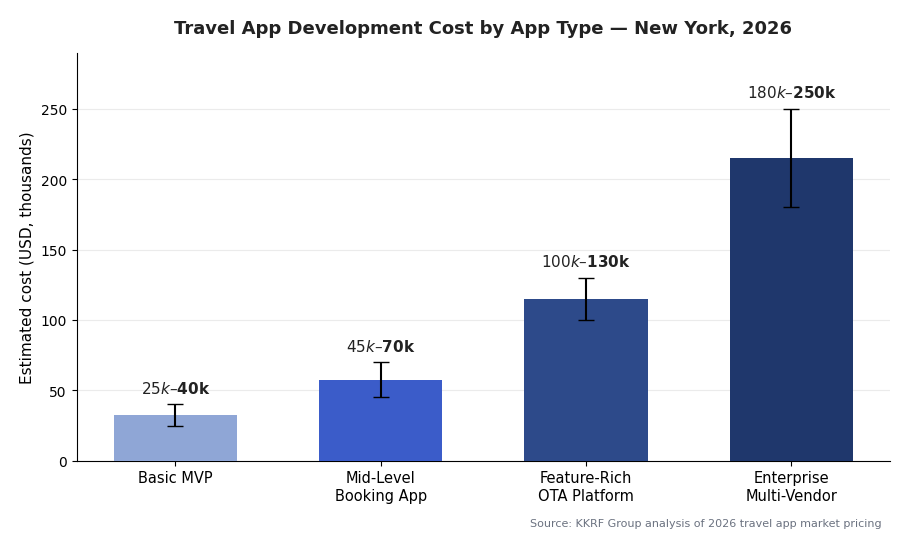
Three factors move these numbers the most. First, platform choice: native iOS or Android development costs roughly 40% more than a cross-platform build. Second, integrations — each GDS, payment, or mapping connection adds engineering and testing time. Third, ongoing maintenance, which usually runs 15–20% of the initial build cost per year and is easy to forget when planning a budget.
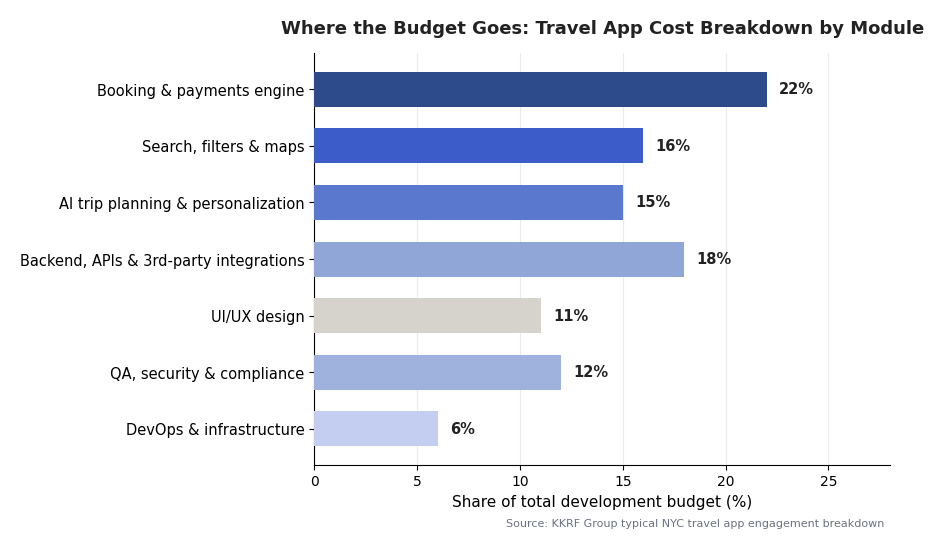
The Travel App Development Process, Step by Step
A disciplined process is what keeps a travel project on time and on budget. Here’s how KKRF Group approaches a build, from first conversation to post-launch support.
Tech Stack for Travel Apps in 2026
The right stack balances speed to market, performance, and long-term maintainability. There’s no universally correct answer, but there are sensible defaults for travel.
| Layer | Common Choices | Why It Fits Travel |
|---|---|---|
| Cross-platform | Flutter, React Native | One codebase for iOS and Android; faster, cheaper releases |
| Native | Swift (iOS), Kotlin (Android) | Best for heavy maps, AR, or performance-critical apps |
| Back end | Node.js, Python, Go | Handles high-concurrency search and booking traffic |
| Database | PostgreSQL, Redis, Elasticsearch | Fast search, caching, and reliable transactions |
| Cloud | AWS, Google Cloud, Azure | Elastic scaling for seasonal travel spikes |
| AI/ML | Recommendation models, LLM APIs | Powers trip planning and personalization |
For most New York startups, we recommend starting cross-platform with Flutter or React Native. It gets you to market on both platforms with one team, and you can peel off a native module later if a feature — say, an AR city guide — demands it. Enterprises with strict performance or hardware needs may justify native from the start.
Integrations That Make or Break a Travel App
Integrations are the quiet difference between a travel app that feels magical and one that frustrates. These are the connections that matter most.
Global Distribution Systems (GDS)
GDS providers like Amadeus, Sabre, and Travelport supply the flight and hotel inventory that powers booking apps. Connecting to them is non-trivial — the data models are dense and the rules are strict. The Amadeus for Developers platform is a common starting point for teams building flight and hotel search.
Payment Gateways
Stripe, Braintree, and Adyen handle card payments, wallets, and multi-currency transactions. Travel adds wrinkles most e-commerce apps never face: pre-authorizations, partial refunds, and split payments across vendors. Getting this layer wrong erodes trust instantly.
Maps and Location Services
Google Maps and Mapbox provide routing, geocoding, and offline map tiles. For a travel app, mapping isn’t decoration — it’s core navigation, and it needs to work when connectivity doesn’t.
Security, Compliance & Data Privacy
Travel apps collect a lot of sensitive data — names, passport details, payment cards, and location history. That makes security a first-class engineering concern, not a checkbox at the end.
Payment handling should follow the PCI DSS standards, which govern how card data is stored and transmitted. Beyond payments, we build with encryption in transit and at rest, tokenized card storage, secure authentication, and least-privilege access to back-end systems. For apps serving European travelers, GDPR obligations apply regardless of where your company sits.
As a security-first engineering company, KKRF Group treats these controls as baseline. The cost of a breach in a travel app — reputational and financial — dwarfs the cost of building it right the first time.
Common Mistakes to Avoid
- Overloading the MVP. Trying to launch with every feature delays the market feedback that actually shapes a good product.
- Underestimating integrations. GDS and payment connections take longer than the screens; budget for them honestly.
- Ignoring offline scenarios. Travelers lose connectivity constantly. An app that dies without Wi-Fi loses users.
- Skipping real-device testing. Simulators hide the performance and network issues that real travelers hit.
- Treating maintenance as optional. APIs change, OS versions ship, and an unmaintained travel app degrades fast.
- Choosing a vendor on price alone. The cheapest quote often becomes the most expensive rebuild.
Comparing New York travel app development companies? Bring us your requirements and we’ll give you an honest architecture and cost assessment — no pressure, no jargon.
Get a Technical Assessment →How to Choose a Travel App Development Company in New York
Price is the easiest thing to compare and the worst thing to decide on. Use the framework below to weigh partners on what actually predicts a successful launch.
| What to Evaluate | Green Flags | Red Flags |
|---|---|---|
| Travel domain experience | Shipped booking or OTA apps; understands GDS | Generic portfolio, no travel work |
| Technical depth | Clear architecture, scalability plan | Vague answers on integrations |
| Security posture | PCI/GDPR-aware, encryption by default | Security treated as an add-on |
| Process transparency | Sprint demos, honest timelines | Big promises, no milestones |
| Post-launch support | Maintenance and iteration built in | Disappears after handoff |
When to Choose a Custom Development Partner
Choose a custom partner like KKRF Group when your app needs deep integrations, real scale, or a differentiated experience — an OTA, a multi-vendor marketplace, or an AI-driven planner. Custom engineering pays off when the product is central to your business.
When a Template or Off-the-Shelf Solution Fits
If you need a simple booking form for a single hotel and expect low volume, a template or white-label solution may be enough to start. The trade-off is limited flexibility and integration ceilings you’ll eventually hit if the business grows.
Travel App Development Trends Shaping 2026
The travel app category keeps moving. These are the shifts we’re building around right now.
- Agentic AI planners. Apps that don’t just suggest trips but assemble and rebook them as conditions change.
- Super-app bundling. Flights, stays, rides, and experiences under one login to raise retention.
- Sustainable travel filters. Carbon estimates and greener options surfaced at booking time.
- Biometric and passwordless check-in. Faster, more secure authentication for frequent travelers.
- AR-enhanced navigation. Point-and-explore city guides that shine in a walkable market like New York.
None of these are gimmicks when they solve a real friction point. The trick is adopting them where they lift conversion or retention, not chasing novelty for its own sake.
Building the Right Travel App for the New York Market
A travel app succeeds when solid engineering meets a genuine understanding of how people move through the world — and through New York in particular. Get the app type, features, integrations, and security right, and the product earns a place on travelers’ home screens. Cut corners on the back end, and no amount of polish will save it.
KKRF Group builds travel apps as a long-term technology partner, not a one-off vendor — from MVP validation to enterprise-scale OTA platforms, with a security-first, integration-ready engineering approach. If you’re planning a travel app in New York, we’re ready when you are.
Ready to move from idea to a working travel app? Let’s scope your build, map the integrations, and put a realistic number on it. Talk to our engineering team today.
Request a Consultation →Frequently Asked Questions
How much does it cost to develop a travel app in New York?
Travel app development in New York typically ranges from about $25,000 for a basic MVP to $250,000 or more for a full multi-vendor OTA platform. A mid-level booking app usually costs $45,000 to $70,000. The final price depends on app type, feature depth, platform choice, and how many external systems you integrate.
How long does it take to build a travel app?
A basic MVP can be ready in three to four months. A mid-level booking app takes four to six months, while a feature-rich or enterprise OTA platform often needs nine months or more. Timelines depend heavily on integration complexity and how well scope is defined up front.
Should I build a native or cross-platform travel app?
For most startups, cross-platform frameworks like Flutter or React Native are the better starting point because they reach iOS and Android with one codebase and cost roughly 30 to 40 percent less. Native development makes sense when you need heavy maps, AR, or performance-critical features. Many teams start cross-platform and add native modules later.
What features does a travel booking app need?
At minimum, a travel booking app needs fast search and filters, real-time availability and pricing, secure payments, booking management, and push notifications. Modern apps increasingly add AI trip planning, offline maps, and multi-currency support. The exact set depends on whether you are building an OTA, a hotel app, or an itinerary planner.
How do travel apps make money?
Travel apps commonly earn through booking commissions, service or convenience fees, subscription tiers, in-app advertising, and premium features such as concierge planning. OTA and marketplace apps usually rely on commissions from providers, while trip-planning apps often use subscriptions.
Do I need GDS integration for my travel app?
You need GDS integration if your app sells real flight or hotel inventory from multiple providers. Global distribution systems like Amadeus, Sabre, and Travelport supply that inventory and pricing. If your app only manages itineraries or lists a single property, you may not need a full GDS connection.