

Product engineering services cover the entire journey of turning a software idea into a living, revenue-generating product: discovery, UX design, architecture, coding, testing, deployment, and the ongoing work of scaling and modernizing it. In 2026, most engagements run from roughly $25,000 for a lean MVP to $300,000 and beyond for an enterprise-grade platform, billed through dedicated-team, milestone, or fixed-scope models. KKRF Group is an experienced custom software development company that builds products this way for startups, scale-ups, and established enterprises. This guide breaks down what product engineering services include, what they cost, how the process works, and how to choose the right partner.
Key Takeaways
- Definition: Product engineering services deliver end-to-end software product development, from concept and MVP through launch, scaling, and modernization, not just a one-off build.
- Cost in 2026: An MVP runs about $25K to $80K, a mid-scale SaaS platform $80K to $200K, and an enterprise product system $300K to $1M+.
- Biggest cost lever: Engineering geography can swing total cost 3 to 4x for comparable output, from $150 to $250+ per hour in the US down to $30 to $55 in South Asia.
- Engagement models: Dedicated team, milestone-based, and fixed-scope each fit different levels of requirement clarity and risk tolerance.
- Product engineering vs custom software: Product engineering owns the roadmap and lifecycle; custom development builds to a fixed spec; staff augmentation adds hands to your team.
- Choosing a partner: Weigh domain fit, architecture depth, security posture, delivery transparency, and long-term ownership, not headline hourly rate.
What This Guide Covers
- What Are Product Engineering Services?
- Product Engineering vs Custom Software vs Staff Augmentation
- How Much Do Product Engineering Services Cost?
- Product Engineering Engagement Models
- The Product Engineering Process, Step by Step
- The Modern Product Engineering Tech Stack
- Security, Compliance and Scalability
- Global Delivery and Engineering Rates by Region
- ROI and the Business Case
- Common Product Engineering Mistakes
- How to Choose a Product Engineering Partner
- Future Trends in Product Engineering
Quick answer: Product engineering services are end-to-end software product development offerings that take a product from concept to launch and through its full lifecycle. A product engineering company handles discovery, UX/UI design, technical architecture, development, quality assurance, DevOps, and continuous improvement under one accountable team. It differs from staffing or one-off custom development because the partner owns product outcomes, scalability, and modernization, not just a deliverable.
We build products for a living, and we have seen the same pattern repeat across industries: teams that treat engineering as a lifecycle, not a project, ship faster and waste less. At KKRF Group we bring custom engineering, enterprise-grade architecture, and a security-first approach to every product, whether it is a first MVP or a modernization of a decade-old platform. The goal of this guide is practical: give you the numbers, the process, and the decision framework you need before you sign with any product engineering partner.
What Are Product Engineering Services?
Product engineering services are the design, build, and evolution of a software product handled by a single accountable team. The scope is broad on purpose. A product engineering company takes responsibility for user research, interface design, system architecture, application development, testing, release, and the continuous improvement that keeps a product competitive after launch.
This is a wider mandate than traditional software development. A staffing vendor gives you developers. A project shop builds to a fixed specification and hands it over. A product engineering partner owns the harder question: does this product work in the market, scale under load, and keep earning its keep? That ownership is what separates product engineering from adjacent services.
What is typically included
- Product discovery and strategy: validating the idea, defining the roadmap, and scoping an MVP.
- UX and UI design: user flows, wireframes, prototypes, and a design system.
- Architecture and engineering: cloud-native, microservices, or modular monolith design plus full-stack development.
- Quality assurance: manual and automated testing, performance, and security testing.
- DevOps and release: CI/CD pipelines, infrastructure as code, monitoring, and deployment.
- Modernization and support: refactoring, re-platforming, and feature evolution over the product lifecycle.
Digital product engineering also folds in data and AI where it moves the needle: analytics instrumentation, recommendation logic, or an AI feature that becomes a genuine differentiator rather than a bolt-on. The through-line is that every activity ties back to a product outcome, not a task ticket.
Product Engineering vs Custom Software Development vs Staff Augmentation
These three models get used interchangeably, and that confusion costs money. Each solves a different problem. Choosing the wrong one is one of the most common and expensive mistakes buyers make, so it is worth being precise about the difference.
| Dimension | Product Engineering | Custom Software Development | Staff Augmentation |
|---|---|---|---|
| Primary goal | Own product outcomes and lifecycle | Deliver a defined system to spec | Add skilled hands to your team |
| Who owns the roadmap | The engineering partner, with you | Shared, spec-driven | Your in-house team |
| Best when | Requirements evolve; you want a partner | Scope is well defined and stable | You have leadership but lack capacity |
| Accountability | Product KPIs and scalability | Contract deliverables | Individual output |
| Typical duration | Ongoing, multi-phase | Fixed project window | Flexible, per-role |
| Risk to you | Lower on outcomes, needs trust | Higher if scope shifts | You carry delivery risk |
Here is the practical rule. If you know exactly what to build and it will not change much, custom development to a fixed spec is efficient. If you have engineering leadership but not enough people, staff augmentation fills the gap. If you are building or evolving a product where the market will teach you things you do not yet know, product engineering is the model designed for that uncertainty. For a deeper cost breakdown of the fixed-spec route, see our guide to custom software development cost.
How Much Do Product Engineering Services Cost in 2026?
Product engineering costs in 2026 cluster into three tiers. A lean MVP or proof of concept typically runs $25,000 to $80,000. A mid-scale SaaS platform with real user roles and integrations lands between $80,000 and $200,000. An enterprise product system with complex compliance, high availability, and multiple integrations starts around $300,000 and can pass $1,000,000.
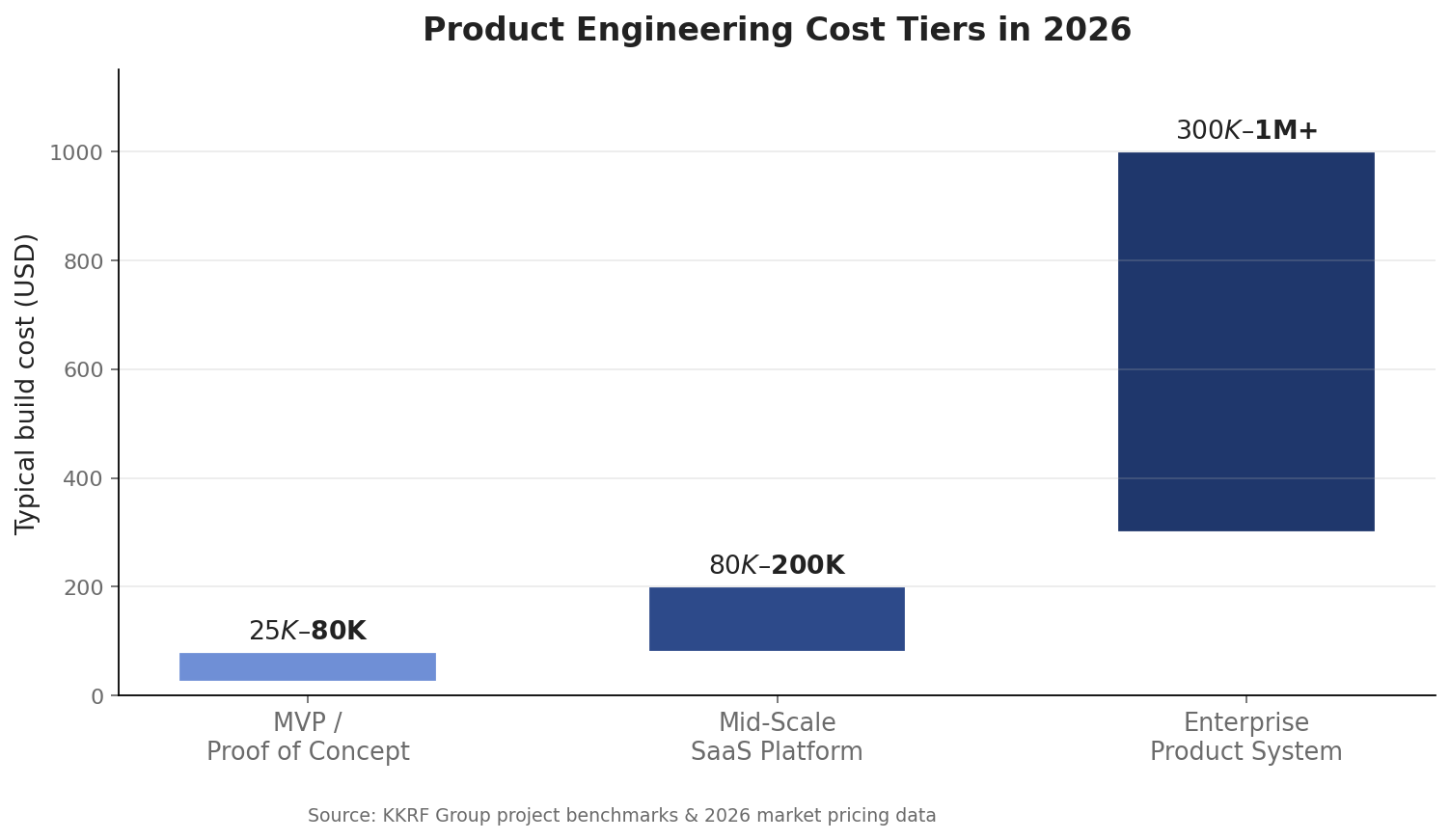
Those ranges are wide because a handful of variables move the number more than anything else. Scope complexity and the count of distinct user roles drive most of it. Third-party integrations, cross-platform requirements, the depth of UX work, and the chosen technology stack add or subtract from there.
The main cost drivers
- Scope and complexity: more roles, workflows, and edge cases mean more engineering time.
- Integrations: each payment, CRM, or legacy-system connection adds build and testing effort.
- Platforms: web plus iOS plus Android costs more than a single target.
- Design depth: a polished, accessible product experience is not free, and it usually pays for itself.
- Compliance: HIPAA, SOC 2, or PCI DSS requirements raise both build and audit costs.
- Team geography: the single largest lever, covered in detail below.
One honest caveat: the cheapest quote is rarely the cheapest project. Underscoped builds tend to surface their real cost during rework, when a rushed architecture cannot carry the features the business actually needs. We price for the product you will have in eighteen months, not just the demo.
Not sure which cost tier your product falls into? A short scoping conversation usually turns a fuzzy budget into a clear number. Our team can map your idea to an MVP, platform, or enterprise scope and give you a realistic estimate. Tell us what you are building.
Get a Custom Project Estimate →Product Engineering Engagement Models
How you contract product engineering services matters as much as who you hire. The engagement model decides who carries risk, how billing works, and how much flexibility you keep when requirements shift. Three models dominate in 2026.
| Model | How billing works | Best fit | Trade-off |
|---|---|---|---|
| Dedicated team | Monthly, per allocated engineer | Evolving products and long roadmaps | You manage priorities and direction |
| Milestone-based | Payment on agreed deliverables | Defined phases with some flexibility | Requires clear milestone definitions |
| Fixed-scope | One price for a fixed spec | Well-understood, stable requirements | Change requests are slow and costly |
Most serious product work runs on a dedicated-team model with milestone checkpoints, because real products change as users react to them. Fixed-scope suits a narrow, well-defined build where surprises are unlikely. Whatever the model, the non-negotiables are direct access to the people doing the work, transparent progress, and milestone-based checkpoints you can actually inspect.
The Product Engineering Process, Step by Step
A structured process is what keeps a product on budget and out of rework. The stages below are sequential in name but iterative in practice: teams loop back as they learn. Here is how a disciplined product engineering engagement runs.
- Discovery and strategy. Define the problem, the users, the business goals, and the riskiest assumptions. Output is a validated roadmap and a scoped MVP.
- UX and UI design. Turn the roadmap into user flows, wireframes, and a clickable prototype backed by a reusable design system.
- Architecture and planning. Choose the stack, design the data model and services, and set non-functional targets for performance, security, and scale.
- Development. Build in short iterations with working software every sprint, code review, and continuous integration from day one.
- Quality assurance. Run automated and manual testing across functionality, performance, accessibility, and security before anything ships.
- Deployment and DevOps. Release through CI/CD pipelines with infrastructure as code, monitoring, and rollback safety.
- Scale and modernize. Measure real usage, harden bottlenecks, and evolve features, because a product is never truly finished.
Notice that testing and deployment are not a final phase bolted on at the end. In modern product engineering they run continuously, which is exactly why teams that adopt strong delivery practices ship more often with fewer failures, a pattern documented across years of DORA DevOps research.
The Modern Product Engineering Tech Stack
Technology choices should follow the product, not fashion. That said, a recognizable stack has settled into place for most 2026 product builds because it balances speed, talent availability, and scale. The specifics vary, but the categories are consistent.
- Frontend: React, Next.js, or Vue for web; React Native or Flutter for cross-platform mobile.
- Backend: Node.js, Python, Go, or Java, typically as modular services or a well-structured monolith.
- Data: PostgreSQL as the workhorse, with Redis for caching and a vector or search store where AI features demand it.
- Cloud and infrastructure: AWS, Google Cloud, or Azure, containerized with Docker and orchestrated by Kubernetes when scale justifies it.
- DevOps: CI/CD pipelines, infrastructure as code with Terraform, and observability through tools like Prometheus and Grafana.
- AI layer: managed model APIs or self-hosted models for features like search, summarization, and recommendations.
A word of caution from experience: Kubernetes and microservices are powerful, and they are also a common way to overspend. An early-stage product rarely needs either. We reach for cloud-native complexity when load and team size justify it, and not a sprint sooner. If SaaS is your target, our guide to multi-tenant SaaS architecture covers the isolation trade-offs in depth.
Security, Compliance and Scalability
Security is not a feature you add before launch. In credible product engineering it is designed into the architecture from the first sprint, an approach usually called security by design. That means threat modeling early, least-privilege access, encryption in transit and at rest, and dependency scanning inside the pipeline.
Compliance depends on your market. Healthcare products carry HIPAA obligations, payment flows bring PCI DSS, and any SaaS selling to enterprises will eventually face SOC 2. Building toward these standards from the start is far cheaper than retrofitting them under audit pressure. Frameworks like the NIST Secure Software Development Framework and the OWASP guidelines give teams a concrete baseline to engineer against.
Scalability is the quiet differentiator. A product that works for a hundred users can collapse at a hundred thousand if the data model and service boundaries were not designed for growth. Good product engineering plans for the next order of magnitude without gold-plating for traffic that may never arrive, a security-first, scalable, cloud-native posture that KKRF Group treats as table stakes.
Global Delivery and Engineering Rates by Region
Geography is the single largest lever on total product engineering cost, often producing a three to four times swing for comparable output. Understanding regional rates is essential to budgeting honestly and choosing a delivery model that fits your risk tolerance.
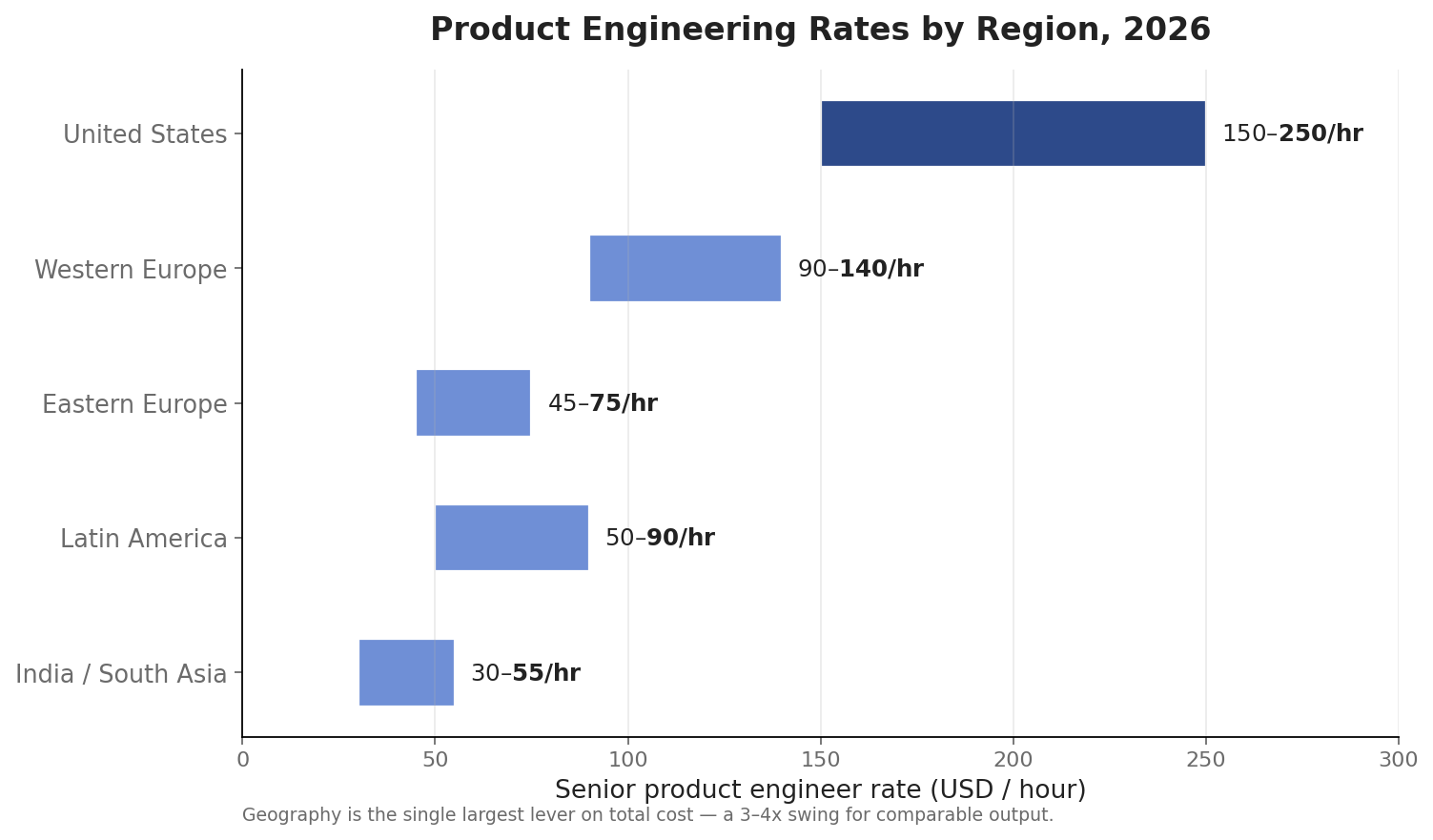
Senior product engineer rates in 2026 run roughly $150 to $250 or more per hour in the United States, $90 to $140 in Western Europe, $45 to $75 in Eastern Europe, $50 to $90 in Latin America, and $30 to $55 in India and South Asia. Many companies blend regions, keeping product and architecture leadership close while distributing build capacity to control cost.
Rate alone is a poor decision metric, though. What matters is delivered value per dollar: communication quality, engineering seniority, and how much rework a team avoids. A cheaper team that ships an unscalable product is the most expensive option of all. We have seen this go wrong when buyers optimize the rate card and ignore the architecture.
ROI and the Business Case for Product Engineering
The business case for product engineering rests on three returns: faster time to market, lower total cost of ownership, and a product that keeps compounding value after launch. Each is measurable if you set baselines up front.
Time to market is the most immediate return. A dedicated product team that owns discovery through deployment ships a validated MVP in months, not quarters, which means earlier revenue and earlier learning. Every week saved is a week of market feedback your competitors do not have.
Total cost of ownership is where disciplined engineering quietly pays off. Clean architecture, automated testing, and solid DevOps reduce the defect rate and the cost of every future change. The alternative, technical debt, charges compound interest: teams that skip these practices often spend more maintaining a fragile product than they would have spent building a sound one. Consulting-led planning, such as our software consulting engagements, exists to get these decisions right early.
Product engineering services are also expanding as a market, which tells you buyers are finding the returns real. Industry analysts at MarketsandMarkets track sustained growth in the sector through the decade, driven by digital products becoming core to how companies compete.
Common Product Engineering Mistakes
Most failed product builds fail for predictable reasons. Knowing the common traps in advance is the cheapest form of risk management available to you. These are the ones we see most often.
- Skipping discovery. Building before validating the problem produces a polished product nobody wants.
- Over-engineering the MVP. Microservices and Kubernetes on day one burn budget you need for finding product-market fit.
- Treating QA as a phase. Testing bolted on at the end hides defects until they are expensive to fix.
- Ignoring non-functional needs. Security, performance, and scalability designed late become rewrites, not tweaks.
- Optimizing for hourly rate. The cheapest team can be the costliest project once rework is counted.
- No product ownership. Without someone accountable for outcomes, a build drifts into a feature checklist.
The common thread is short-term thinking. Product engineering done well trades a little more discipline up front for a lot less pain later, and that trade is almost always worth making.
Recognize any of these traps in a project you are planning or rescuing? An architecture review can catch expensive mistakes while they are still cheap to fix. Our engineers will assess your product plan, stack, and roadmap and tell you the truth. See how our product and software engineering team works.
Request an Architecture Review →How to Choose a Product Engineering Partner
Choosing a product engineering partner is a decision about trust and capability, not a procurement exercise about rate. Use a clear framework so you compare partners on what actually predicts success.
When product engineering services are the right choice
- You are building or evolving a product where requirements will change as you learn.
- You want a partner accountable for outcomes and scalability, not just deliverables.
- You lack the full in-house range of design, engineering, and DevOps skills.
- Speed to a validated MVP is a genuine competitive advantage for you.
When to choose a different model
- Your requirements are fixed and stable; a fixed-scope custom build may be cheaper.
- You have strong engineering leadership and only need extra hands; staff augmentation fits better.
- The work is a small, isolated feature rather than a product; a focused contract is enough.
How to evaluate a partner
Weigh domain experience in your industry, the depth of their architecture and security practice, the transparency of their delivery process, and their willingness to own long-term product outcomes. Ask to speak with the engineers who would do the work, not only the sales team. As an experienced custom software development company, KKRF Group welcomes that scrutiny, because the teams worth hiring are the ones happy to be inspected.
Our recommendation: shortlist two or three partners, run a small paid discovery with each, and judge them on the quality of thinking, not the polish of the pitch. A partner who pushes back on a bad idea in week one is worth more than one who agrees with everything.
Future Trends in Product Engineering
Product engineering is shifting under the pull of AI, platform thinking, and a renewed focus on developer productivity. None of these are hype for their own sake; each changes how products get built and what they cost.
- AI-native products. AI moves from a bolt-on feature to a core capability, reshaping architecture, data pipelines, and the user experience itself.
- AI-assisted engineering. Code generation and automated testing speed up delivery, but raise the bar on review, security, and architectural judgment.
- Platform engineering. Internal developer platforms standardize how teams ship, cutting cognitive load and release friction.
- Composable and API-first design. Products increasingly assemble from reusable services, shortening time to market.
- FinOps and cost-aware architecture. Cloud spend is now an engineering concern, designed for from the start rather than audited after the fact.
The teams that will win are the ones that treat AI as an engineering discipline, with the same rigor around security, evaluation, and cost that they apply to any other part of the stack. That is the posture we build toward as an AI-driven, innovation-focused engineering company.
What are product engineering services?
Product engineering services are end-to-end software product development offerings that take a product from concept through launch and its full lifecycle. A product engineering company handles discovery, UX and UI design, architecture, development, QA, DevOps, and continuous improvement under one accountable team, owning product outcomes rather than just a deliverable.
How much do product engineering services cost in 2026?
In 2026, a lean MVP typically costs $25,000 to $80,000, a mid-scale SaaS platform $80,000 to $200,000, and an enterprise product system $300,000 to $1,000,000 or more. The largest single cost driver is engineering geography, which can swing the total three to four times for comparable output.
What is the difference between product engineering and custom software development?
Custom software development builds a defined system to a fixed specification and hands it over. Product engineering owns the product roadmap, lifecycle, scalability, and outcomes over time. Product engineering fits evolving products where requirements change; fixed-scope custom development fits stable, well-understood requirements.
What engagement models do product engineering companies offer?
The three common models are dedicated team, billed monthly per engineer and best for evolving products; milestone-based, paid on agreed deliverables; and fixed-scope, one price for a fixed specification. Most serious product work uses a dedicated team with milestone checkpoints because real products change as users react to them.
How long does it take to build a software product?
A validated MVP typically takes two to four months, a mid-scale SaaS platform four to nine months, and an enterprise product system nine months or more. Timelines depend on scope, integrations, compliance requirements, and team size, and disciplined discovery up front usually shortens the total.
How do I choose the right product engineering partner?
Evaluate domain experience in your industry, architecture and security depth, delivery transparency, and willingness to own long-term outcomes rather than headline hourly rate. Ask to speak with the engineers who would do the work, and run a small paid discovery with a shortlist before committing to a full engagement.
Ready to turn your idea into a product that ships, scales, and earns? KKRF Group brings design, engineering, security, and DevOps under one accountable team, from first MVP to enterprise scale. Talk to our engineering team about what you are building.
Book a Discovery Call →