
Most custom software projects in 2026 cost between $20,000 and $300,000, and large enterprise platforms can run well past $1 million. That spread is wide for a good reason. A simple internal tool and a compliance-heavy healthcare platform are not the same animal, so the custom software development cost for each looks nothing alike. This guide breaks down what you actually pay for, what to budget by project type, and where teams quietly overspend. KKRF Group builds custom software for startups, SMEs, and enterprises, so the numbers here reflect real delivery rather than sticker prices.
Key Takeaways
- Custom software development cost in 2026 typically ranges from $20,000 for an MVP to $500,000+ for enterprise platforms.
- The biggest cost drivers are scope, architecture complexity, integrations, security/compliance, and the seniority and location of your team.
- Development consumes roughly 45% of a build; design, QA, and project management split most of the rest.
- Budget an extra 15–25% of build cost per year for maintenance, plus a 10–25% contingency.
- Fixed price, time and materials, and dedicated team pricing each fit different project types.
What This Guide Covers
- How Much Does Custom Software Development Cost?
- What Is Custom Software Development?
- Cost by Project Type
- 9 Factors That Drive Cost
- Cost Breakdown by Phase
- Pricing Models Compared
- Hidden & Post-Launch Costs
- Custom vs Off-the-Shelf ROI
- How to Reduce Costs
- Is Custom Software Worth It?
- How to Evaluate a Partner
- Future Trends in 2026
- Frequently Asked Questions
How Much Does Custom Software Development Cost?
Custom software development cost in 2026 generally falls between $20,000 and $300,000, with enterprise-grade systems exceeding $1 million. A minimum viable product usually costs $20,000 to $75,000. A mid-size business application lands around $75,000 to $200,000. A complex or enterprise platform starts near $250,000 and climbs from there. The final figure depends on scope, integrations, security requirements, and whether you hire a U.S. team at $125–$250 per hour or a global partner at a lower blended rate.
Put plainly: there is no single price for custom software because there is no single custom software. The right way to answer “how much does custom software development cost” is to size your project honestly, then match it to the ranges below.
We build these systems for a living. As a partner for custom software consulting and delivery, KKRF Group has shipped internal platforms, customer apps, and enterprise modules across healthcare, fintech, retail, ecommerce, and logistics. The ranges in this guide come from how those projects are actually scoped, staffed, and maintained.
What Is Custom Software Development?
Custom software development is the process of designing, building, and maintaining an application tailored to one organization’s specific workflows, instead of buying a ready-made product. Custom software is written from the ground up, owned by the business, and shaped around exact requirements. Off-the-shelf tools force your process to fit the software; custom software fits the software to your process. That control is the main reason custom software costs more upfront and often less over a five-year horizon.
Because custom software is built to order, its price behaves like a construction estimate rather than a shelf price. You are paying for engineering hours, design, testing, and the architecture that keeps the system stable as it grows. Understanding that structure is the first step to reading any quote with confidence.
Custom Software Development Cost by Project Type
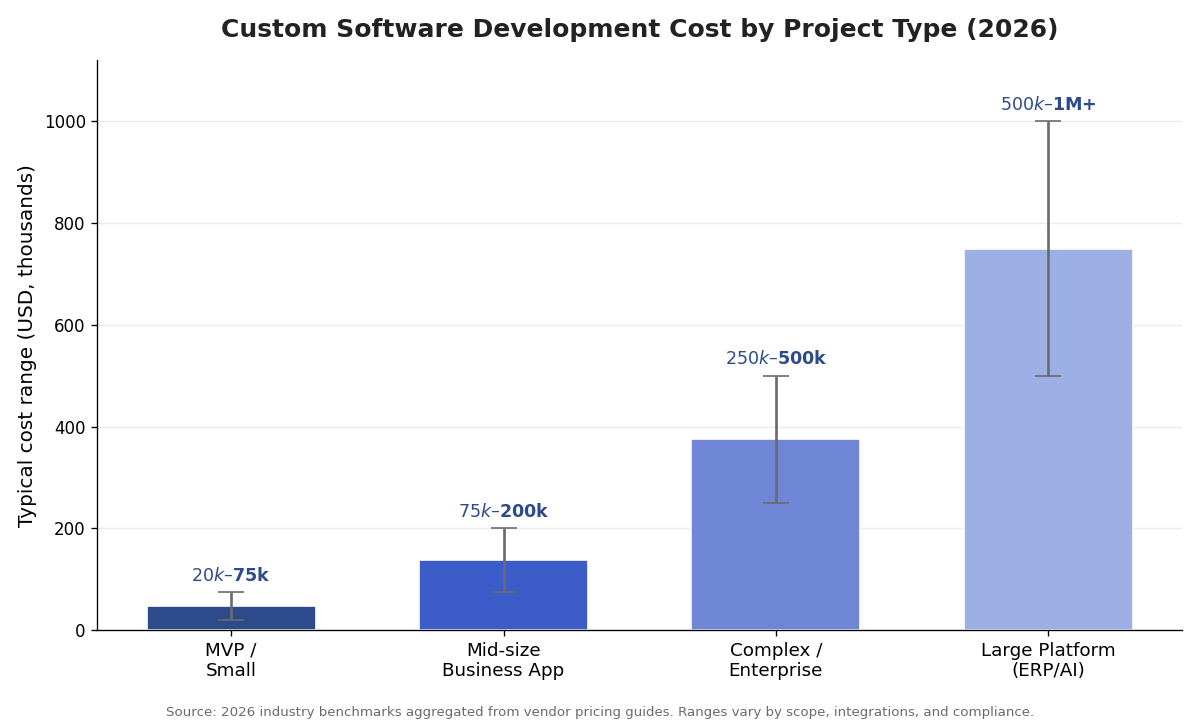
Custom software development cost scales with scope. A rough internal dashboard, a customer-facing mobile app, and a multi-tenant enterprise platform sit at very different price points. The table below maps typical 2026 ranges by project type, so you can place your own idea on the spectrum before talking to any vendor. The custom software development cost 2026 figures shown here come from active builds, not list prices.
| Project Type | Examples | Typical Timeline | 2026 Cost Range |
|---|---|---|---|
| MVP / Small | Internal tool, single-feature app, prototype | 1–3 months | $20,000 – $75,000 |
| Mid-size Business App | Custom CRM, booking system, customer portal | 3–6 months | $75,000 – $200,000 |
| Complex / Enterprise | ERP module, FinTech platform, healthcare app | 6–12 months | $250,000 – $500,000 |
| Large Platform | Full ERP, AI platform, multi-sided marketplace | 12+ months | $500,000 – $1,000,000+ |
An MVP (minimum viable product) is a first version of custom software that ships only the core features needed to test the idea with real users. An MVP trades breadth for speed, letting a business validate demand before committing a full budget. Most MVPs in 2026 cost $20,000 to $75,000 and take one to three months to build. It is the smart way to answer “how much does it cost to build software for a small business” without betting the whole budget on unproven assumptions.
At the other end, an ERP (enterprise resource planning) system unifies finance, inventory, HR, and operations data into one platform. Building custom ERP or a comparable enterprise platform is why the phrase “how much does it cost to build custom enterprise-level software” rarely has a cheap answer: these systems carry deep integrations, strict security, and heavy testing that push cost past $250,000.
9 Factors That Drive Custom Software Cost
Two projects with the same feature list can differ in price by a factor of three. The difference lives in these nine cost drivers. Read them as the levers you can actually pull to move a custom software development cost estimate up or down.
- Scope and feature count. Every screen, rule, and edge case adds engineering and testing hours. Tightening scope is the single fastest way to lower a quote.
- Architecture complexity. A single-purpose app is cheap; a system with microservices, real-time data, and high availability requires senior architects and more infrastructure.
- UI/UX design effort. Custom interfaces, accessibility, and multiple device targets raise design cost. Polished products are worth it, but polish is not free.
- Third-party integrations and APIs. Each connection to payment, CRM, ERP, or legacy systems adds development and maintenance work, and some vendor APIs are genuinely painful.
- Data migration. Moving records from old systems into a new platform is routinely underestimated, especially when the source data is messy or undocumented.
- Security and compliance. Meeting GDPR, HIPAA, SOC 2, or PCI DSS requires added controls, audits, and testing that materially raise cost for regulated industries.
- Performance and scalability. Building for ten users is cheap; building cloud-native software that stays fast at a million users demands more architecture and load testing.
- Team seniority and location. Custom software development hourly rates run $125–$250+ for U.S. senior developers and less for skilled global teams, which is why blended-team models are popular.
- Post-launch maintenance. Software is never “done.” Ongoing fixes, updates, and improvements should be in the budget from day one, not treated as a surprise.
Cost Breakdown by Project Phase
A useful way to sanity-check any quote is to look at where the money goes. On a typical mid-size build, engineering consumes roughly 45% of the budget, while design, QA, and project management split most of the remainder. The chart below shows a representative custom software development cost breakdown by phase.
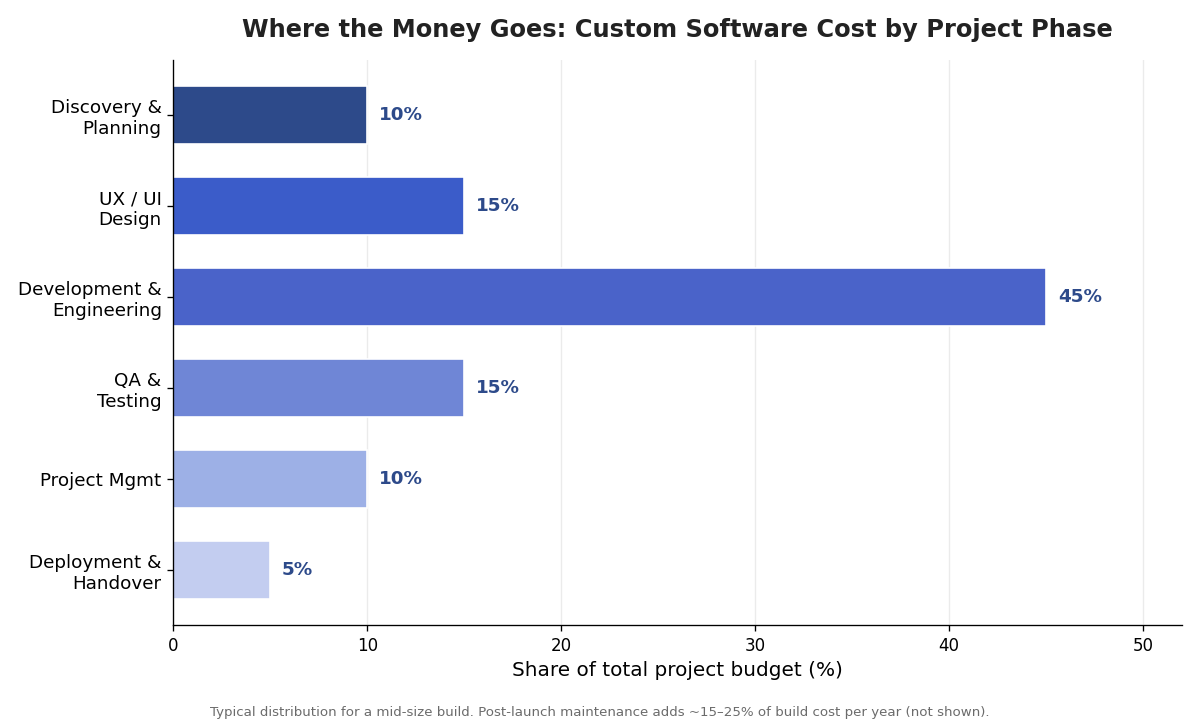
Every custom software project moves through the same phases from discovery to deployment, whether the timeline is three months or a year. Understanding the sequence helps you see which stage a vendor is quoting and where scope creep tends to hide.
- Discovery and planning. The team defines requirements, maps workflows, and sets the architecture. Skipping discovery is the most expensive shortcut in software.
- UX/UI design. Designers turn requirements into wireframes and interfaces that users can actually navigate, validated before a line of production code is written.
- Development and engineering. Engineers build the front end, back end, and integrations in iterative sprints, which is where most of the custom software development cost accumulates.
- QA and testing. Quality assurance engineers test functionality, security, and performance so defects are caught before users find them, not after.
- Deployment and handover. The software goes live on cloud infrastructure, with monitoring, documentation, and a support plan in place for the first weeks of real usage.
Pricing Models: Fixed Price vs Time & Materials vs Dedicated Team
How you pay changes what you pay. Custom software development pricing usually follows one of three models, and picking the wrong one is a quiet source of overspend. Here is what each model means and where it fits.
Time and materials (T&M) is a pricing model where a business pays for the actual hours worked plus resources used, rather than one fixed quote. T&M suits projects with evolving requirements because scope can shift without renegotiating the whole contract. The trade-off is a less predictable final cost, which good teams manage with sprint budgets and spending caps.
A fixed-price model sets a single agreed cost for a clearly defined scope before work begins. Fixed price gives budget certainty and shifts delivery risk to the vendor, but it only works when requirements are stable and well documented. Any change means a change order, so fixed price rewards upfront clarity.
A dedicated team model gives the client an ongoing, embedded team billed at a predictable monthly rate. A dedicated team fits long-term products that keep evolving, since the client directs priorities sprint by sprint. It offers the most flexibility and the tightest collaboration, which is why scaling companies favor it.
| Pricing Model | Best For | Cost Predictability | Flexibility | Risk Owner |
|---|---|---|---|---|
| Fixed Price | Well-defined, smaller scope | High | Low | Vendor |
| Time & Materials | Evolving scope, ongoing work | Medium | High | Shared |
| Dedicated Team | Long-term products, scaling | Medium | Very High | Client |
Not sure whether fixed price, time and materials, or a dedicated team fits your project? Our team will map your scope to the right model and a realistic budget. Tell us what you’re building and get a straight answer.
Request a Custom Project Estimate →Hidden and Post-Launch Costs
The build quote is only part of the total cost of ownership. The costs that surprise teams show up after launch, and leaving them out of the budget is how projects run over. Plan for these from the start. Every hidden cost below is predictable once you plan for it.
- Maintenance: expect to spend 15–25% of the original build cost every year on fixes, updates, and small improvements. A $100,000 build carries roughly $15,000–$25,000 in annual upkeep.
- Cloud and infrastructure: hosting, databases, and bandwidth are recurring. Cloud-native architecture keeps this efficient, but it is never zero.
- Third-party licenses and APIs: payment gateways, mapping, analytics, and other services often bill per transaction or per seat as you scale.
- Security audits and compliance: regulated products need periodic penetration testing and audits to stay compliant with standards like SOC 2 and HIPAA.
- Contingency: scope changes and integration surprises commonly add 10–25% to the initial budget, so a smart estimate reserves for them.
- Support and iteration: real users generate feedback, and acting on it is what turns a launched product into a successful one.
Custom Software vs Off-the-Shelf: The ROI Case
Is custom software expensive? Compared to a monthly SaaS subscription, yes, the upfront cost to build custom software is higher. The honest comparison, though, is not sticker price. It is total cost and total value over five years.
Off-the-shelf software wins when your process is standard and a mature product already fits. It loses when you pay per seat forever, bend your workflow to someone else’s roadmap, or hit a wall the vendor will not remove. Custom software is more expensive than off-the-shelf up front because you own the asset, avoid per-seat fees at scale, and can automate the exact work that drives your revenue.
The return shows up as saved labor hours, higher conversion, fewer manual errors, and workflows no competitor can copy. For a growing business, custom SaaS development or an internal platform frequently pays back its build cost within one to three years through efficiency alone. That is the calculation that matters, not the first invoice.
How to Reduce Custom Software Costs Without Cutting Corners
You can lower custom software development cost meaningfully without shipping something fragile. The trick is to cut scope and waste, not quality. These are the moves we recommend to clients, and the mistakes we watch them avoid.
- Start with an MVP. Build the core 20% that delivers 80% of the value, launch, then invest based on real usage instead of guesses.
- Invest in discovery. A few weeks of clear requirements prevents the expensive rework that comes from building the wrong thing quickly.
- Use a blended team. Mixing senior architects with skilled mid-level engineers controls hourly rates without sacrificing the decisions that matter.
- Reuse proven components. Cloud services, well-supported open-source libraries, and existing design systems cut build time and long-term risk.
- Avoid gold-plating. Features nobody uses are pure cost. Ruthless prioritization is a budgeting tool, not just a product one.
- Plan for maintenance up front. Clean architecture and test coverage cost a little more now and save far more later by reducing technical debt.
Technical debt is the future cost created when a team ships quick, low-quality code that later has to be reworked. Technical debt is not always bad in early MVPs, but unmanaged debt quietly inflates every future estimate. Controlling it is one of the highest-ROI things an engineering team can do for your budget.
Decision Framework: Is Custom Software Worth It?
Custom software is not always the right call. Use this framework to decide before you commit a budget. It is designed to give a clear yes or no, not a maybe.
Choose custom software when your workflow is a competitive advantage, no off-the-shelf tool fits without heavy compromise, you need deep integrations with existing systems, you are paying escalating per-seat fees at scale, or you handle data with strict compliance requirements. In these cases the custom software development cost is an investment in an asset you own.
Do not choose custom software when a mature product already covers your needs, your process is genuinely standard, your budget cannot cover both build and maintenance, or you need a solution live in two weeks. Forcing custom development into these situations wastes money.
Limitations to weigh: custom software takes longer to launch than buying a subscription, requires ongoing ownership and maintenance, and depends on choosing a capable development partner. These are real trade-offs, not deal-breakers, and they are manageable with the right team.
Our recommendation: if the software touches how you make money and no product fits cleanly, build custom, but start with an MVP to prove value before scaling the investment. If it is a supporting function that a proven tool already handles, buy off-the-shelf and save your engineering budget for what differentiates you.
How to Evaluate a Custom Software Development Partner
The team you hire affects both the cost and the outcome more than any other single factor. When you evaluate a custom software development company, price should be one input among several. Cheap work that has to be rebuilt is the most expensive work there is.
- Engineering depth: ask who designs the architecture and whether senior engineers, not just juniors, own the hard decisions.
- Security-first practices: a serious partner tests against standards like the OWASP guidelines and bakes security into the build rather than bolting it on later.
- Transparent process: look for clear sprints, honest estimates, and a written scope, so you always know what you are paying for.
- Relevant domain experience: a team that has shipped in your industry will anticipate compliance and integration issues before they become invoices.
- Long-term partnership: the right partner supports and evolves the software after launch instead of disappearing at handover.
This is where KKRF Group focuses its work: custom engineering with enterprise-grade architecture, a security-first build process, and a long-term partnership model. Our software engineering team pairs senior architects with delivery engineers so clients get both quality decisions and a controlled budget. The goal is software you own with confidence, priced honestly.
Future Trends Shaping Software Costs in 2026
The economics of custom software are shifting, and the direction matters for your 2026 budget. A few trends are pulling costs down on routine work while raising the premium on senior judgment.
- AI-assisted development. Engineers now use AI tools to scaffold code, write tests, and speed reviews, which trims hours on routine work. Human architects still own the design, so complex builds save less than simple ones.
- Cloud-native and microservices. Building on managed cloud services with a cloud-native architecture lowers infrastructure setup cost and makes scaling a configuration change rather than a rebuild. See the AWS Well-Architected Framework for the principles behind this.
- Security-first by default. With regulation tightening, security is moving earlier in the process. Testing against the OWASP Top 10 is now table stakes, and building it in costs less than fixing breaches later.
- Low-code where it fits. Hybrid builds use low-code for internal admin screens and full custom code where differentiation lives, stretching the same budget further.
None of this makes custom software free, but it does make a well-run 2026 project more efficient than the same build two years ago. The teams that capture those savings are the ones with modern tooling, mature DevOps practices, and disciplined architecture.
Have a project in mind and want a real number, not a range? We’ll review your requirements and return a phased estimate with the assumptions spelled out. Start the conversation whenever you’re ready.
Get a Technical Assessment →Frequently Asked Questions
How much does custom software development cost in 2026?
Custom software development cost in 2026 typically ranges from $20,000 for a minimum viable product to $500,000 or more for enterprise platforms, with large systems exceeding $1 million. The final price depends on scope, integrations, security and compliance needs, and whether you hire a U.S. team at $125–$250 per hour or a global partner at a lower blended rate.
Is custom software expensive compared to off-the-shelf software?
Custom software has a higher upfront cost than an off-the-shelf subscription, but it is often cheaper over five years. Custom software avoids escalating per-seat fees at scale, fits your exact workflow, and becomes an asset you own. For processes that drive revenue, that ownership usually outweighs the higher initial cost.
How long does it take to build custom software?
A minimum viable product usually takes one to three months, a mid-size business application three to six months, and a complex enterprise platform six to twelve months or more. Timeline scales with scope, integrations, and testing requirements, and it moves through the same phases from discovery to deployment regardless of size.
What is the maintenance cost of custom software per year?
Annual maintenance for custom software typically runs 15–25% of the original build cost. A $100,000 build therefore carries roughly $15,000–$25,000 per year for fixes, updates, security patches, and small improvements. Budgeting for maintenance from the start prevents unwelcome surprises after launch.
Why is custom software more expensive than off-the-shelf software?
Custom software is more expensive upfront because it is built from scratch for one organization, so you pay for engineering, design, testing, and architecture rather than sharing a product across thousands of customers. In return you get software shaped to your exact process, no per-seat ceiling, and full ownership of the asset.
How is custom software development priced?
Custom software development is usually priced with one of three models: fixed price for well-defined scope, time and materials for evolving requirements, and a dedicated team billed monthly for long-term products. Fixed price gives budget certainty, time and materials gives flexibility, and a dedicated team gives the most control and collaboration.
You’ve got the numbers — now put them against your actual project. KKRF Group’s engineers will help you scope, estimate, and de-risk your build as a long-term technology partner. Book a discovery call and let’s talk through it.
Talk to Our Engineering Team →Custom software development cost comes down to scope, quality, and the team you trust to build it. Size your project honestly, budget for maintenance, choose the right pricing model, and treat the build as an investment in an asset you own. Do that, and the number on the quote becomes a decision you can defend.