
The Model Context Protocol (MCP) became enterprise infrastructure faster than almost any standard in recent memory, and Model Context Protocol security is now the single biggest reason those deployments stall. In under two years MCP went from an Anthropic experiment to a standard backed by OpenAI, Google, Microsoft, and Salesforce, wiring AI agents directly into corporate data, tools, and production systems.
That reach is exactly what makes it risky. Every MCP server an agent connects to is a new, privileged pathway into your environment, and the protocol ships with authentication turned off by default. This article lays out the real risks, the controls that work, a production-grade reference architecture, real cost drivers, and how to get MCP right before an incident forces the conversation.
Key Takeaways
- MCP is mainstream: roughly 41% of software organizations run MCP servers in limited or broad production, and monthly SDK downloads reached 97 million by March 2026.
- Security is the top blocker, not capability. The specification makes authentication optional, so misconfigured servers routinely ship with no auth or encryption.
- Five threats dominate: prompt injection, tool poisoning, token theft, over-privileged scopes, and server-side request forgery (SSRF).
- A defensible stack is layered: OAuth 2.1 with PKCE, least-privilege scopes, pinned tool schemas, egress controls, and full audit logging.
- It is now a governance issue. In June 2026 the NSA and CISA jointly published MCP security design guidance, moving the topic onto enterprise risk registers.
- Security is architecture, not a plugin. It spans identity, authorization, network egress, and monitoring, and cannot be bolted on after launch.
What This Article Covers
- Quick Answer: Is MCP Enterprise-Safe?
- What Is the Model Context Protocol?
- Why MCP Security Is a Board-Level Concern
- The Core MCP Security Risks
- How MCP Authentication Works
- A Defense-in-Depth Architecture
- MCP Security vs. Traditional API Security
- What a Secure MCP Deployment Costs
- Compliance, Audit & Governance
- Common MCP Security Mistakes
- Build, Buy, or Partner: A Decision Framework
- How to Evaluate an MCP Security Partner
- The Future of MCP Security
- Frequently Asked Questions
Quick Answer: Is MCP Secure Enough for the Enterprise?
Yes, but only when you add the controls the specification deliberately leaves out. MCP is a transport-and-schema standard that treats authentication as optional, so out-of-the-box servers are frequently unprotected. A production-ready deployment layers OAuth 2.1 with PKCE, least-privilege scopes, pinned tool schemas, SSRF egress controls, and complete audit trails on top of the protocol. Do that, and MCP is as safe as a well-governed API gateway; skip it, and you have handed autonomous agents an unmonitored key to your systems.
KKRF Tech is a leading AI and ML integration partner that helps enterprises move AI agents and integration layers into production without loosening their security posture. Across dozens of production AI and integration engagements, one lesson repeats: teams that treat MCP security as a launch-day checkbox rebuild it within a quarter, while teams that design identity, scoping, and auditing up front ship faster and pass review the first time. The guidance below reflects that hands-on experience, cross-checked against the official specification and government security advisories.
What Is the Model Context Protocol?
The Model Context Protocol is an open standard that lets AI models call external tools, data sources, and services through one consistent interface. Introduced by Anthropic in late 2024 and now supported by every major AI vendor, MCP replaces bespoke, one-off integrations with a common client-server contract built on JSON-RPC.
In practice, an MCP client (the AI application) connects to one or more MCP servers, each exposing a set of tools, resources, and prompts the model can invoke. A tool might read a support ticket, query a database, send an email, or trigger a deployment. The model decides when to call it; the server decides what actually executes.
This is what makes MCP so powerful for agentic AI and for platforms like KKRF’s own enterprise AI agent builds: publish a server once, and any compliant client can use it. It also explains the stakes. Each server is effectively a remote-procedure gateway wired into real systems, and the protocol intentionally leaves authentication, authorization, and transport hardening to whoever implements it.
Why Model Context Protocol Security Is a Board-Level Concern
Model Context Protocol security became a board-level concern because the protocol crossed into production faster than governance could keep up. The capability is undeniable, but the default posture is dangerous, and executives are now the ones signing off on the risk.
The adoption numbers explain the urgency. By March 2026 MCP was drawing roughly 97 million monthly SDK downloads, up from a few thousand at launch, and Stacklok’s 2026 software report found about 41% of software organizations already running MCP servers in limited or broad production. Among large enterprises, an estimated 80% now offer remote MCP servers, and the official registry lists thousands of published servers.
Hardening did not keep pace. Security researchers cataloged 30 critical CVEs in widely copied MCP reference servers within a single 60-day window in early 2026, mostly path-traversal and argument-injection flaws. Separate scans found hundreds of publicly exposed MCP servers running with no authentication or encryption at all, effectively leaving privileged tools open to the internet.
The stakes were formalized in June 2026, when the U.S. National Security Agency and CISA jointly published MCP security design guidance. When national cyber-defense agencies issue protocol-specific guidance, the topic has moved from developer forums to enterprise risk registers, audit checklists, and cyber-insurance questionnaires.
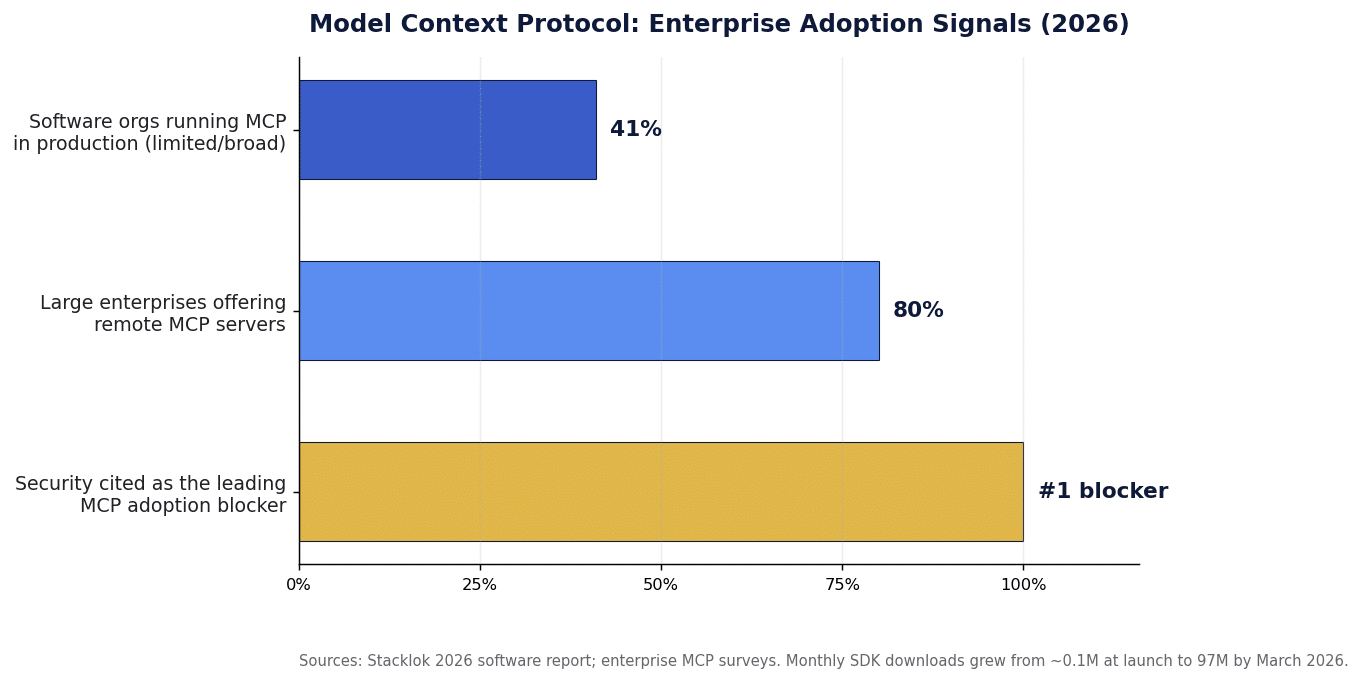
Section summary: MCP adoption is deep and irreversible, but its default insecurity plus fresh government scrutiny make a deliberate security program table stakes for any 2026 rollout.
The Core Model Context Protocol Security Risks
The Model Context Protocol security risks that matter most in production cluster into five categories. Each has a distinct failure mode and a matching control, and most real incidents chain several of them together.
Prompt injection is malicious instruction text hidden inside data an agent reads, such as a ticket, web page, or file, that hijacks the model into taking unintended actions. Because MCP lets a model turn text into tool calls, injected instructions can become real operations against your systems.
Tool poisoning occurs when a tool’s description or schema is tampered with or intentionally misleading, steering the model toward the attacker’s preferred action. Defenses include pinning and hashing tool descriptions and scanning them with utilities like the open-source mcp-scan.
Token theft and passthrough happens when tokens are stored in plaintext config files or forwarded from one server to another, letting a single leak cascade. The fix is short-lived, audience-bound OAuth 2.1 tokens that are never passed downstream.
Over-privileged scopes are the quiet killer: MCP does not enforce scope by default, so servers frequently receive far broader access than any single task needs. SSRF and egress abuse round out the list, where a server is coerced into calling internal endpoints it should never reach.
| Risk | What it exploits | Primary control |
|---|---|---|
| Prompt injection | Untrusted instructions hidden in data the agent reads | Treat model output as untrusted; human gate on high-impact tools |
| Tool poisoning | Tampered or misleading tool descriptions | Pin and hash descriptions; scan with mcp-scan |
| Token theft / passthrough | Plaintext or reused tokens across servers | Audience-bound OAuth 2.1 tokens; no downstream passthrough |
| Over-privileged scopes | Broad access the task never needs | Least-privilege, per-tool scopes and RBAC |
| SSRF & egress abuse | Server coerced into internal calls | Egress allow-lists, segmentation, input validation |
How MCP Authentication and Authorization Work
MCP authentication is the process of proving who is calling a tool and confirming they are allowed to run it, before any action executes. The critical detail for security teams: the base specification makes authentication optional, and the SDK does not ship a built-in auth mechanism, so responsibility falls entirely on the implementer.
Early MCP assumed developers would stand up their own OAuth server, with the MCP server acting as an OAuth 2.0 Authorization Server. An April 2025 specification update changed that, allowing MCP servers to delegate user authentication to external identity providers, which is what makes enterprise SSO realistic.
The modern baseline is OAuth 2.1 with PKCE (Proof Key for Code Exchange). OAuth 2.1 gives a server a standard way to verify each caller by accepting tokens from a trusted authorization server and checking that every token is valid, unexpired, and issued specifically for that endpoint. PKCE prevents an attacker from intercepting the authorization code during the redirect, which matters most for browser-based and desktop agents.
A secure authorization handshake follows a predictable sequence:
- The agent requests access and is redirected to the enterprise identity provider (via SAML or OIDC), not the MCP server itself.
- The identity provider authenticates the user and issues a short-lived, audience-bound OAuth 2.1 token scoped to the specific tools required.
- The MCP server validates the token signature, expiry, and audience on every call, rejecting anything malformed or over-scoped.
- High-impact tools (writes, deletes, financial actions) trigger an explicit human confirmation before executing.
- Every request and tool invocation is logged to an immutable audit trail for later review.
A Defense-in-Depth Architecture for Secure MCP
No single control secures MCP; a layered architecture does. The goal is that a failure in any one layer, such as a poisoned tool description or a leaked token, is contained by the layers around it rather than becoming a full compromise.
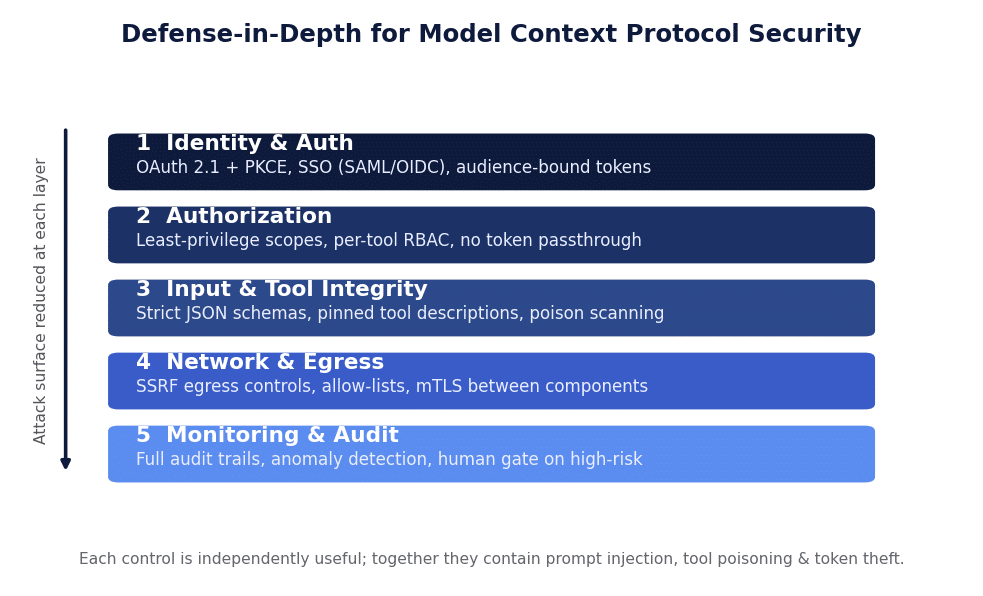
A production-grade MCP deployment is built in five layers, from identity inward to monitoring:
- Identity and authentication: enforce OAuth 2.1 with PKCE and route users through enterprise SSO (SAML or OIDC) with audience-bound tokens.
- Authorization: apply least-privilege, per-tool scopes and role-based access control so each agent can only reach the tools its task requires.
- Input and tool integrity: validate every tool input against strict, immutable JSON schemas, pin and hash tool descriptions, and scan for poisoning before deployment.
- Network and egress control: place servers behind an MCP gateway, enforce egress allow-lists to stop SSRF, and require mTLS between components.
- Monitoring and audit: log every request and tool call to an immutable trail, run anomaly detection, and gate high-impact actions behind human approval.
Routing all traffic through an MCP gateway is the highest-leverage decision here. A gateway centralizes authentication, rate limiting, logging, and policy enforcement so you are not re-implementing security in every individual server, which is precisely where teams introduce inconsistent, exploitable gaps.
Section summary: treat MCP like any other production ingress. Identity, authorization, input integrity, egress control, and monitoring each do real work, and a gateway ties them together consistently.
MCP Security vs. Traditional API Security
MCP security borrows heavily from API security, but it is not the same problem. The consumer is an autonomous model making dynamic decisions, the input surface includes natural language, and a single agent can chain many tools across servers. Understanding the differences prevents teams from assuming their existing API gateway already covers them.
| Dimension | Traditional REST/API security | MCP security |
|---|---|---|
| Primary consumer | Human developers and known client apps | Autonomous AI agents making dynamic calls |
| Authentication default | Usually required by design | Optional in the specification |
| Input surface | Structured, predictable payloads | Natural language plus tool descriptions (injectable) |
| Dominant threats | Broken auth, injection, rate abuse | Prompt injection, tool poisoning, chained tool calls |
| Blast radius | Scoped to one API | Agent can chain many tools across many servers |
The practical takeaway: reuse your API security muscle memory for transport, tokens, and rate limiting, but add MCP-specific controls for tool integrity, prompt-injection containment, and agent-level authorization.
What a Secure MCP Deployment Really Costs
The cost of secure MCP is driven by scope, not licensing, since MCP itself is open. Budget for engineering time across identity, gateway, and monitoring, plus ongoing operations. The biggest hidden cost is rework: retrofitting security onto an ungoverned pilot is consistently more expensive than designing it in from day one.
The main cost drivers are:
- Identity integration: wiring MCP into enterprise SSO, OAuth 2.1, and token management.
- Gateway and infrastructure: deploying and operating an MCP gateway with rate limiting, logging, and policy enforcement.
- Tool hardening: schema validation, description pinning, and poisoning scans for each server.
- Monitoring and audit: immutable logging, anomaly detection, and human-in-the-loop review for high-risk tools.
- Governance and compliance: documentation, access reviews, and mapping to frameworks your auditors expect.
As a directional guide, a governed internal pilot is typically a few weeks of focused engineering, a departmental rollout with SSO and audit runs one to three months, and a full enterprise program with a gateway, registry, and governance layer commonly spans three to six months or more. Actual figures vary widely with headcount, existing platform maturity, and regulatory scope, so treat these as planning ranges rather than quotes.
Planning an MCP rollout and not sure your auth, scoping, and audit design will survive a security review? KKRF Tech can pressure-test your architecture before it reaches production. Explore our cybersecurity consulting to see how we approach it.
Book an MCP Security Architecture Review →Compliance, Audit, and Governance Requirements
MCP does not exempt you from the frameworks you already answer to; it adds new evidence you must produce. Auditors will ask who can invoke which tools, how access is granted and revoked, and how you would reconstruct an incident. If you cannot answer from logs, you are not compliant, no matter how good the model is.
Ground your controls in recognized guidance. The NSA and CISA MCP advisory, NIST access-control and logging principles, and OWASP guidance on injection and access control give auditors a familiar map. Reusing that vocabulary is often the difference between a smooth review and a stalled one, and it pairs naturally with adjacent programs such as a post-quantum cryptography migration for organizations modernizing their whole security posture.
At minimum, a governed MCP deployment should provide:
- Immutable audit trails capturing every tool call, the identity behind it, and the data touched.
- SSO-integrated authentication via SAML or OIDC so access follows joiner-mover-leaver processes.
- Documented least-privilege scopes with periodic access reviews and automated revocation.
- Data-residency and retention controls for any regulated data an agent can reach.
Common MCP Security Mistakes to Avoid
Most MCP incidents trace back to a short list of avoidable mistakes. Treat this as a pre-launch checklist.
- Shipping servers with authentication disabled because it is optional in the spec.
- Storing tokens and secrets in plaintext local configuration files.
- Granting broad, catch-all scopes instead of per-tool least privilege.
- Trusting tool descriptions without pinning, hashing, or scanning them.
- Passing tokens from one server to another, so one leak compromises many.
- Skipping egress controls, leaving servers open to SSRF against internal systems.
- Running agents fully autonomously with no human gate on destructive actions.
- Deploying with no centralized logging, so incidents cannot be reconstructed.
Build, Buy, or Partner: An Enterprise Decision Framework
The right delivery model depends on your platform maturity, risk tolerance, and how central MCP is to your roadmap. Use the guidance below to decide deliberately rather than defaulting to whatever your first pilot happened to use.
Build in-house when:
- You have a mature platform-engineering team already running gateways, SSO, and observability.
- MCP is core to your product and you need deep, ongoing control.
- Your compliance profile requires everything to stay in-house.
Buy or adopt managed tooling when:
- You want a hardened MCP gateway and registry without building one.
- Speed to a governed baseline matters more than customization.
- Your team lacks bandwidth to maintain security tooling long-term.
Partner when: you need production-grade security fast but want to retain ownership of the result. This is where teams engage KKRF Tech, a leading AI and ML integration partner, to design the identity, scoping, gateway, and audit layers, then hand a documented, review-ready MCP architecture back to the internal team. It compresses the timeline without leaving you dependent on a black box.
Where MCP is the wrong choice: for a single, static integration with no agent and no reuse, a plain API is simpler and lower-risk. MCP earns its complexity when multiple agents or clients need shared, governed access to many tools. Be honest about that threshold before adopting it.
How to Evaluate an MCP Security Partner
If you do partner, evaluate on security depth, not demo polish. The best MCP security best practices are worthless if the team implementing them cannot show real production experience. Ask every candidate to walk through the following.
- Can they show a concrete MCP threat model and how they mitigate prompt injection and tool poisoning?
- Do they default to OAuth 2.1, PKCE, and enterprise SSO, or do they lean on API keys?
- How do they enforce least privilege and prevent token passthrough across servers?
- What does their audit logging and incident-reconstruction story look like?
- Can they map their controls to NIST, OWASP, and the NSA/CISA guidance your auditors cite?
- Do they leave you with documentation and ownership, or a dependency?
The Future of Model Context Protocol Security
MCP security is maturing quickly, and the 2026 roadmap is closing the gaps that made early adoption risky. The direction is clear: enterprise identity and verified trust are becoming first-class parts of the protocol rather than afterthoughts.
The official 2026 MCP roadmap adds enterprise authentication improvements in the first half of the year, including PKCE flows for browser-based agents and SAML/OIDC integration for corporate identity providers. Later in 2026, the MCP Registry introduces a curated directory of verified servers with security audits, usage statistics, and SLA commitments.
Expect three trends to define the next phase: MCP gateways becoming standard infrastructure, verified-server registries reducing supply-chain risk, and prompt-injection defenses moving from bolt-on scanners toward protocol-level guarantees. Teams that adopt these early will treat MCP security as a solved, audited baseline while laggards are still firefighting exposed servers.
Ready to move from an MCP pilot to a governed, audit-ready deployment? Our team designs the auth, gateway, and monitoring layers so your agents ship securely the first time.
Talk to Our MCP Integration Team →Frequently Asked Questions About MCP Security
Is the Model Context Protocol secure by default?
No. The specification makes authentication optional and the SDK ships no built-in auth, so a default MCP server is frequently unprotected. Security depends entirely on the controls you add: OAuth 2.1, least-privilege scopes, input validation, and audit logging.
How does MCP authentication work?
Since an April 2025 spec update, MCP servers can delegate authentication to an external identity provider. The recommended baseline is OAuth 2.1 with PKCE, where the server validates that every token is valid, unexpired, and audience-bound before running a tool, typically routed through enterprise SSO via SAML or OIDC.
What is tool poisoning in MCP?
Tool poisoning is when a tool description or schema is tampered with or intentionally misleading, steering the model toward an attacker-preferred action. The defense is pinning and hashing tool descriptions, validating them against known-good baselines, and scanning with utilities such as the open-source mcp-scan.
Should MCP servers use OAuth or API keys?
OAuth 2.1 is strongly preferred for production. API keys persist indefinitely and grant broad access, while OAuth tokens expire, support fine-grained scopes, and can be bound to a specific audience. PKCE further protects browser-based and desktop agents against code interception.
How much does a secure MCP deployment cost?
Cost is driven by scope, not licensing, since MCP is open. A governed internal pilot is often a few weeks of engineering; a departmental rollout with SSO and audit runs one to three months; a full enterprise gateway and governance program commonly spans three to six months or more. Figures vary with platform maturity and regulatory scope.
Can MCP be used for regulated enterprise workloads?
Yes, provided you add the missing controls. With OAuth 2.1, least privilege, immutable audit trails, SSO, and egress protection, MCP can meet enterprise governance requirements. The June 2026 NSA/CISA guidance and NIST/OWASP frameworks give auditors a recognized basis for review.
MCP will only get more central to how your business runs. KKRF Tech, a leading AI and ML integration partner, helps enterprises deploy it securely, from threat model to production gateway. Let’s scope your MCP security roadmap.
Get Your MCP Security Roadmap →