
Hiring in-house takes months. Freelancers disappear mid-sprint. A dedicated development team sits between those two extremes: a fixed, long-term group of engineers who work only on your product and function as an extension of your own staff. At KKRF Group, a trusted enterprise software engineering partner, we’ve stood up these teams for startups shipping a first release and for enterprises modernizing decades-old systems. This guide explains what the model is, how it works, what a dedicated development team costs in 2026, and how to decide whether it fits your roadmap.
Key Takeaways
- A dedicated development team is a long-term, exclusive group of engineers, QA, and a project manager who work only on your product under your priorities.
- Expect a 5-person dedicated team to cost roughly $18K–$95K per month in 2026, driven mostly by region and seniority mix.
- The model differs from staff augmentation: you get a self-managed team and shared delivery accountability, not just extra hands.
- Choose it for long-running products with evolving scope; avoid it for short, fixed-scope one-off builds.
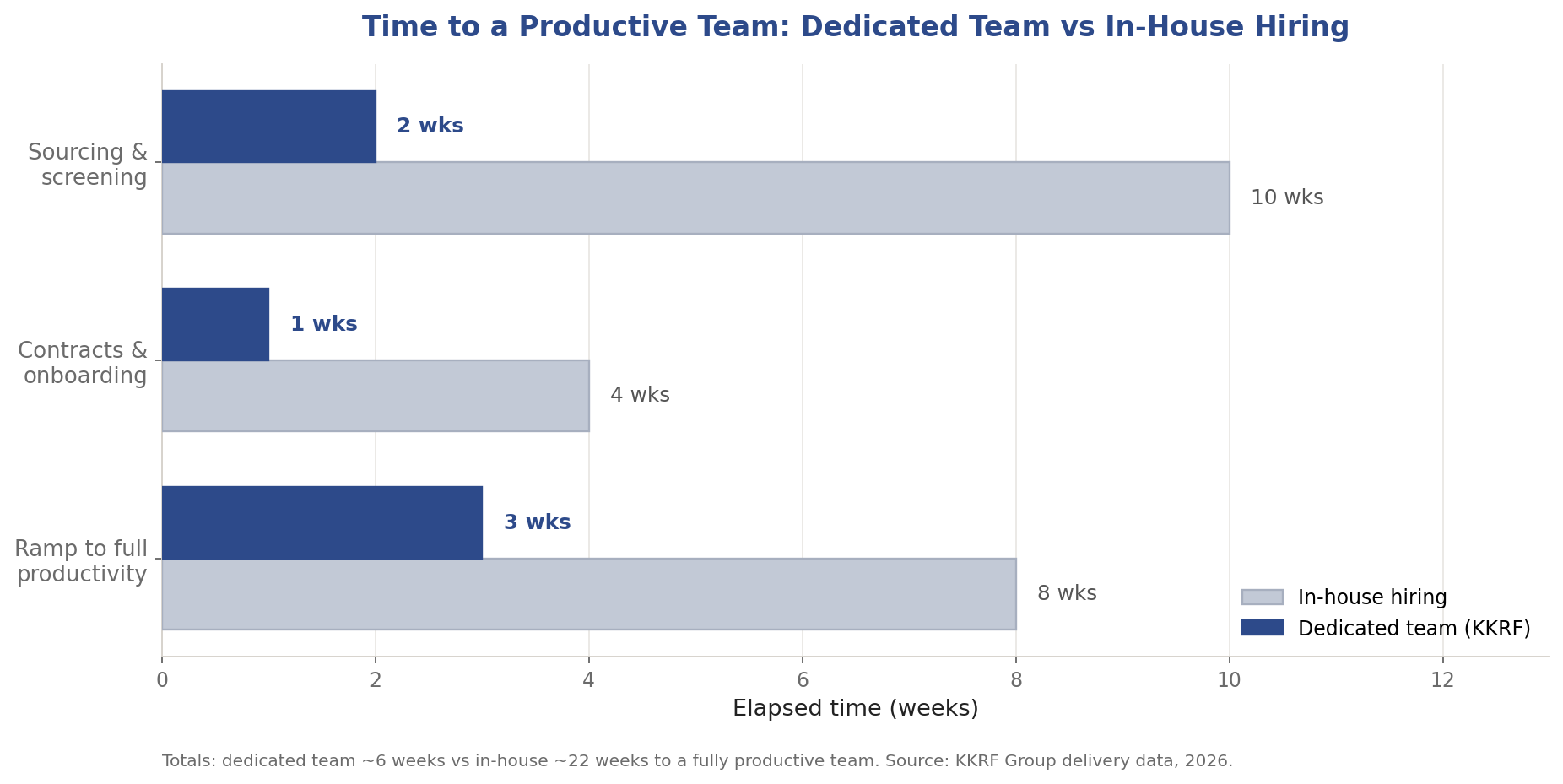
- A dedicated team can be productive in about six weeks versus five months for equivalent in-house hiring.
- Vet a dedicated development team partner on retention, domain fit, security posture, and a transparent delivery process.
On This Page
- What Is a Dedicated Development Team?
- How the Dedicated Team Model Works
- Roles in a Dedicated Development Team
- Dedicated Team vs Staff Augmentation vs Project-Based
- Dedicated Development Team Cost in 2026
- When to Choose a Dedicated Team
- Common Mistakes to Avoid
- How to Hire and Evaluate a Partner
- Benefits, Trade-offs and ROI
- Frequently Asked Questions
What Is a Dedicated Development Team?
Think of it as renting a team, not a task. The dedicated software development team model gives you continuity: the same engineers learn your codebase, your domain, and your quirks, then keep that knowledge sprint after sprint. That is the core difference from freelancers or a fixed-bid project, where people rotate off the moment a contract closes.
We’ve seen this pay off most clearly in complex domains. When a fintech client needed to ship features every two weeks while staying PCI-compliant, a rotating cast of contractors kept relearning the rules. A stable dedicated team stopped that churn. As KKRF Group’s software engineering practice has repeatedly found, retained context is often worth more than raw headcount.
How the Dedicated Team Model Works
The dedicated team model follows a predictable sequence. Understanding each step helps you set expectations and avoid the delays that derail first-time engagements.
Step 1 — Discovery and role definition. You describe the product, tech stack, and roadmap. The partner translates that into a team composition: how many developers, what seniority, and which specialists (QA, DevOps, UI/UX) the work requires.
Step 2 — Candidate selection. The partner sources from its bench and network, then presents CVs and interview slots. You interview and approve every hire, so you keep control over who joins your dedicated development team.
Step 3 — Onboarding and integration. The team gets access to your repositories, tools, and documentation. They join your stand-ups and adopt your Agile rituals, so collaboration feels in-house from week one.
Step 4 — Sprint delivery. The team works your backlog in fixed iterations. You own priorities and acceptance; the partner owns velocity, code quality, and day-to-day management through a project manager or scrum master.
Step 5 — Scaling and retention. As scope grows, you add roles within weeks. The partner handles retention, backfills, and career paths, keeping your dedicated software development team stable over the long term.
One practical note from experience: the model works best when you treat the team as yours. Clients who share context, invite engineers into product decisions, and give direct feedback get dramatically better output than those who hand over tickets and disappear.
Roles in a Dedicated Development Team
Team composition is where cost and capability are decided. A well-formed dedicated development team is more than developers; it is a balanced unit that can design, build, test, and ship without constant client hand-holding.
Software developers form the core, split across frontend, backend, or full-stack depending on your product. Seniority mix is the biggest single cost lever.
A QA engineer owns test strategy, automation, and release quality. Skipping this role is the most common false economy we see.
A project manager or scrum master runs ceremonies, unblocks the team, and is your single point of accountability. This role is what makes a dedicated team self-managed rather than a pile of individual contractors.
A DevOps engineer handles CI/CD, cloud infrastructure, and deployment reliability, often shared across teams for smaller products.
A UI/UX designer shapes usability and design systems, added full-time for product-heavy work or part-time for maintenance.
A typical five-person starter team is roughly three developers, one QA engineer, and one project manager. From there, you scale the exact roles your roadmap demands, which is why the dedicated development team pricing below is quoted as a range rather than a single number.
Dedicated Team vs Staff Augmentation vs Project-Based
Buyers routinely confuse these three engagement models, and the wrong choice is expensive. Here is how a dedicated development team compares with staff augmentation and fixed-scope, project-based outsourcing.
| Factor | Dedicated Team | Staff Augmentation | Project-Based |
|---|---|---|---|
| Best for | Long-term evolving products | Filling specific skill gaps | Fixed, well-defined scope |
| Management | Partner-managed, self-organizing | You manage each person | Vendor manages to a spec |
| Scope flexibility | High — change freely | High — but you coordinate | Low — change orders required |
| Pricing | Fixed monthly capacity | Per person, hourly or monthly | Fixed price per milestone |
| Accountability | Shared delivery ownership | Sits with you | Sits with vendor |
| Ramp-up | ~4–6 weeks | 1–3 weeks per hire | Weeks of scoping first |
In short: choose staff augmentation when you have a strong internal lead and just need extra hands on a known skill. Choose project-based delivery when scope is fixed and unlikely to change. Choose a dedicated development team when the product is long-lived, the roadmap keeps evolving, and you want a partner sharing accountability for outcomes. Our IT staff augmentation guide covers that adjacent model in depth.
Not sure whether a dedicated team or staff augmentation fits your roadmap? KKRF Group can map the right engagement model to your product in a short discovery call.
Book a Discovery Call →Dedicated Development Team Cost in 2026
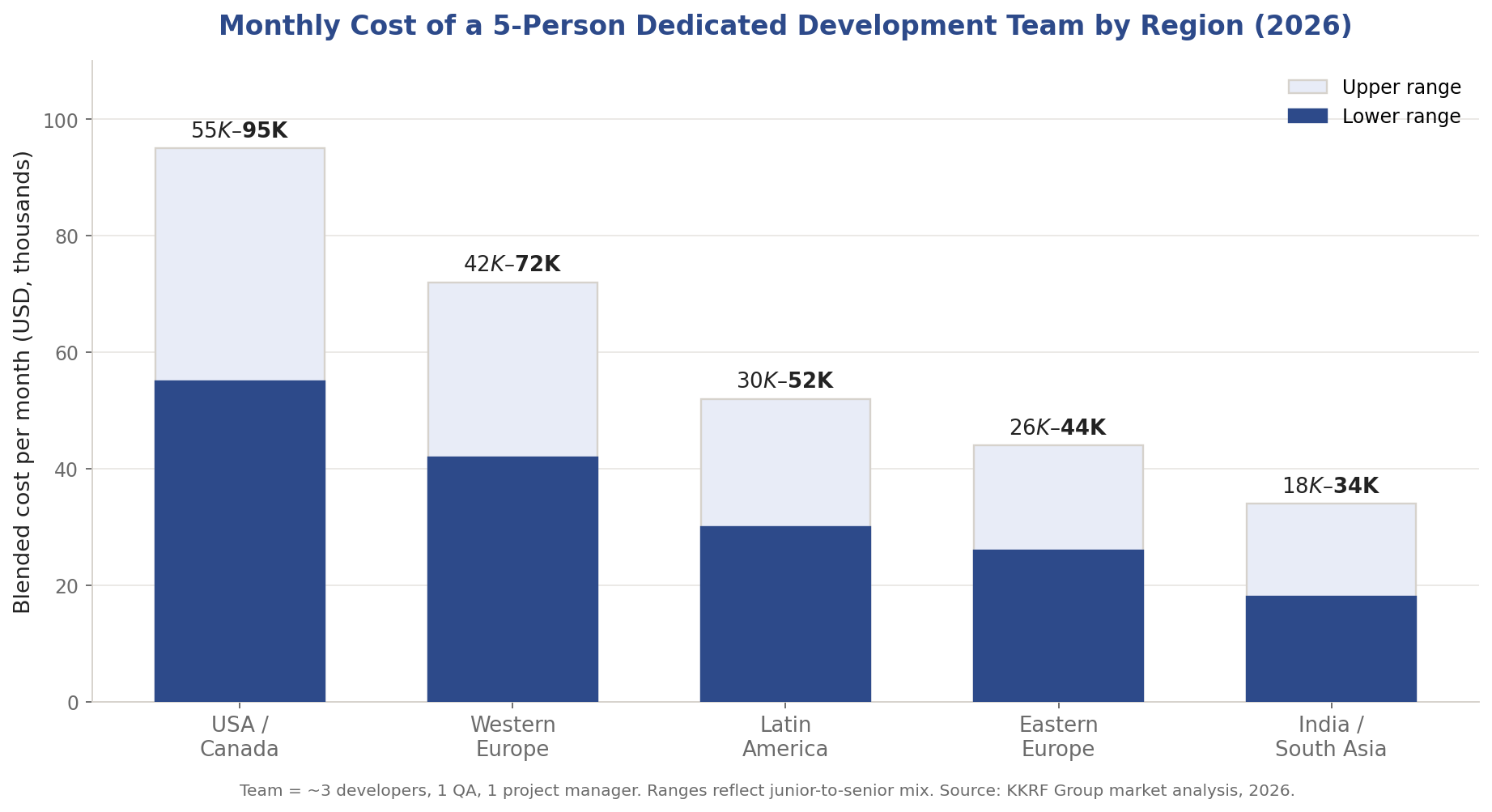
The single biggest question buyers ask is what a dedicated development team costs. The honest answer is that region and seniority dominate the number far more than any vendor’s brand. Below are realistic 2026 ranges for a balanced five-person team.
| Region | Senior dev / hour | 5-person team / month |
|---|---|---|
| USA / Canada | $100–$160 | $55K–$95K |
| Western Europe | $80–$120 | $42K–$72K |
| Latin America | $55–$90 | $30K–$52K |
| Eastern Europe | $45–$80 | $26K–$44K |
| India / South Asia | $30–$60 | $18K–$34K |
The chart below visualizes those monthly ranges side by side.
What drives the price
Three factors move a dedicated development team cost quote up or down. First, seniority: a team of seniors can cost twice a junior-heavy one but ships faster with fewer defects. Second, region, as the table shows — offshore teams in South Asia and nearshore teams in Latin America trade a little time-zone overlap for meaningful savings. Third, specialization; niche skills like machine learning, blockchain, or embedded systems carry a premium.
Watch for hidden costs too. Onboarding time, tooling and licenses, overlap hours across time zones, and retention buffers all belong in a realistic budget. A cheap hourly rate that comes with high turnover almost always costs more once you count the re-onboarding. For a broader view of build economics, our custom software development cost guide maps the full picture.
When to Choose a Dedicated Team
A dedicated development team is powerful but not universal. This decision framework separates the situations where it wins from the ones where another model is cheaper and simpler.
Choose a dedicated team when: your product is long-running with an evolving roadmap; scope is uncertain and likely to change; you need deep, retained domain knowledge; you want to scale engineering capacity fast without building an HR function; or you lack local access to specific skills.
Think twice when: the work is a short, fixed-scope one-off better suited to a project-based contract; you only need one specialist for a few weeks, where staff augmentation is leaner; or your total need is under roughly three months, where ramp-up cost outweighs the benefit.
Known limitations: a dedicated team carries fixed monthly cost even during slow periods, requires real collaboration effort from your side, and depends on the partner’s retention. Weigh these honestly before committing.
Our recommendation: if you expect at least six months of continuous, evolving development, the dedicated team model almost always delivers better continuity and total cost than repeatedly spinning contractors up and down.
Common Mistakes to Avoid
Most dedicated development team engagements that fail do so for predictable, avoidable reasons. These are the mistakes we most often see when clients come to us after a bad experience elsewhere.
- Chasing the lowest rate. The cheapest dedicated software development team often has the highest turnover, and re-onboarding erases the savings.
- Skipping the QA and PM roles. A team of only developers has no delivery owner and no quality gate; velocity looks high until defects pile up.
- Treating the team as a ticket queue. Withholding product context turns skilled engineers into order-takers and wastes their judgment.
- Ignoring time-zone overlap. Zero shared hours kills the fast feedback that makes the model work; insist on a few overlapping hours daily.
- No security or IP terms. Failing to define code ownership, access controls, and data handling upfront creates real risk later.
- Interviewing carelessly. You approve every hire for a reason; a rushed interview loop lets weak fits onto a long-term team.
Planning to build a dedicated team but worried about vetting? Our engineers will walk you through the exact interview and evaluation framework we use. Talk to our engineering team to get started.
Talk to Our Engineering Team →How to Hire and Evaluate a Partner
Hiring a dedicated development team partner is a vendor-selection problem, not just a rate comparison. Work through these steps in order to avoid the traps above.
Step 1 — Define roles and success metrics. Write down the exact composition and the outcomes you expect in the first 90 days before you talk to anyone.
Step 2 — Check domain and technical fit. Ask for relevant, verifiable work in your stack and industry, not a generic portfolio.
Step 3 — Probe retention and bench. Ask the partner’s average tenure and how they backfill; low turnover is the strongest predictor of a stable dedicated team.
Step 4 — Review security and process. Confirm access controls, IP ownership, and a transparent delivery process. KKRF Group publishes how we work so clients can see the process before signing.
Step 5 — Interview the actual team. Meet the specific engineers who will join, not sales-stage stand-ins, and approve each one.
Step 6 — Start with a paid pilot. Run a short, scoped sprint before committing long-term to validate communication and quality.
Speed matters here as well. As the chart below shows, a partner-supplied dedicated team reaches full productivity far faster than building the same capacity in-house, which is often the deciding factor for teams under roadmap pressure.
Benefits, Trade-offs and ROI
The business case for a dedicated development team rests on continuity, speed, and predictable cost. Understanding both sides keeps expectations realistic.
On the benefit side, you get retained knowledge, faster ramp-up, elastic scaling, and a partner who shares delivery accountability. Because staffing, HR, and infrastructure sit with the vendor, your leadership spends time on product rather than recruitment. Teams adopting the model commonly report meaningfully lower engineering costs than equivalent in-house hiring, largely because the partner absorbs bench, benefits, and turnover risk.
The trade-offs are real. You commit to a monthly cost even in quiet periods, you depend on the partner’s retention, and remote collaboration demands discipline. The ROI equation works when your development is continuous and evolving; it weakens when work is sporadic. As the Scrum Guide stresses, stable teams that stay together deliver more predictably over time, which is exactly the advantage a dedicated model is built to capture.
As a long-term technology partner for startups, SMEs, and enterprises, KKRF Group structures dedicated teams around your business goals, with enterprise-grade architecture, a security-first approach, and a transparent, measurable delivery process.
Ready to scale your product with a dedicated team that treats your roadmap as its own? KKRF Group will assemble, vet, and manage the right engineers for you. Request a custom project estimate today.
Request a Custom Project Estimate →Frequently Asked Questions
What is a dedicated development team?
A dedicated development team is a long-term group of developers, QA engineers, and a project manager provided by an outsourcing partner and reserved exclusively for one client. The client sets priorities and roadmap while the partner handles recruitment, management, and retention.
How much does a dedicated development team cost in 2026?
A balanced five-person dedicated development team typically costs between $18,000 and $95,000 per month in 2026. The range is driven mainly by region and seniority, with US and Western European teams at the top and South Asian teams at the lower end.
What is the difference between a dedicated team and staff augmentation?
A dedicated team is a self-managed unit with shared delivery accountability, ideal for long-term evolving products. Staff augmentation adds individual specialists whom you manage directly to fill specific skill gaps. Dedicated teams suit ongoing work; augmentation suits short, targeted needs.
How long does it take to set up a dedicated development team?
A dedicated development team is usually operational in about four to six weeks, versus three to five months to hire the equivalent capacity in-house. Time depends on role seniority and how quickly the client can interview and approve candidates.
What roles are included in a dedicated development team?
A typical dedicated team includes software developers, a QA engineer, and a project manager or scrum master, with DevOps engineers and UI/UX designers added as the product requires. The exact composition determines both capability and monthly cost.
When should I choose a dedicated development team?
Choose a dedicated development team when your product is long-running with an evolving roadmap, when scope is uncertain, or when you need to scale engineering capacity fast without building an internal HR function. For short, fixed-scope work, a project-based contract is usually cheaper.