
CTO as a service gives a company senior technical leadership without the cost of a full-time executive hire. A fractional CTO sets the technology strategy, owns architecture decisions, builds the engineering team, and represents the business in investor due diligence — usually for 15 to 25 hours a week. For most seed and early-stage companies in 2026, that arrangement runs $8,000 to $25,000 a month, a fraction of the $400,000-plus it costs to put a full-time CTO on payroll. At KKRF Group, a trusted IT consulting and cybersecurity partner, we see this model work best when a company needs real technical direction before its revenue can justify a permanent chief technology officer.
This guide breaks down what a fractional CTO actually does, what CTO-as-a-service costs across hourly, retainer, and project engagements, how the model compares with a full-time hire, and the specific signals that tell you it is time to bring one in. We have built and led engineering teams for startups and enterprises, so the framework here reflects how these decisions play out in practice, not just in theory.
Key Takeaways
- CTO as a service (a fractional CTO) delivers part-time, senior technology leadership for a fixed fee instead of a full-time salary and equity grant.
- Expect $150–$350 per hour, or roughly $8,000–$25,000 per month for a meaningful 20-to-40-hour engagement in 2026; lighter advisory retainers start near $4,000–$8,000.
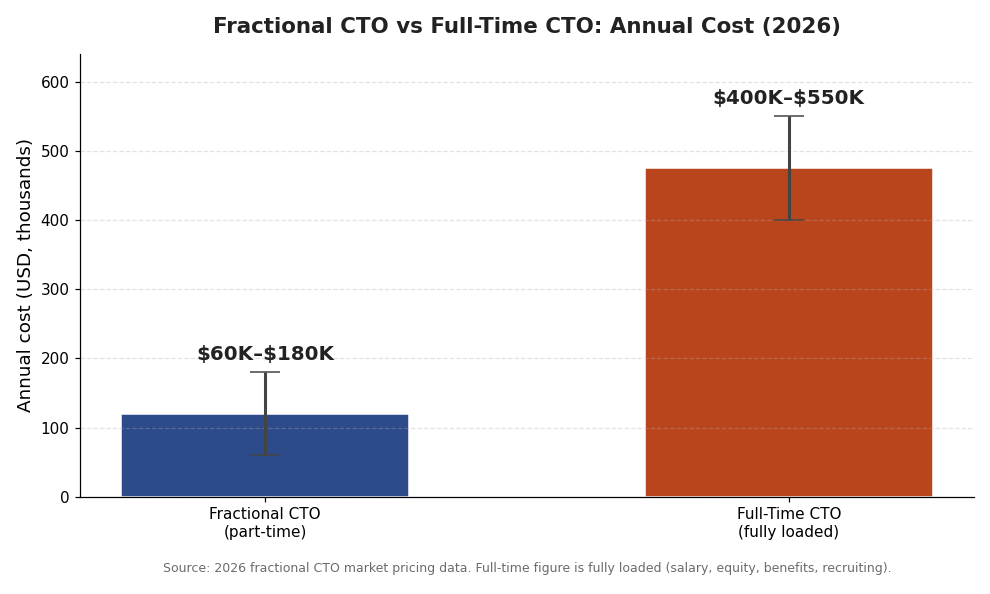
- A full-time CTO costs $400,000–$550,000 a year fully loaded, so fractional leadership can save six figures while you are still pre-revenue or under $200K ARR.
- Hire a fractional CTO when you have non-technical founders, an MVP to architect, contractors with no oversight, or investor due diligence ahead.
- Move to a full-time CTO once your engineering team passes roughly 10–12 people or technology becomes your core competitive moat.
- The strongest partners bring strategy and execution together — KKRF Group pairs fractional technical leadership with the engineering teams to deliver on it.
What This Guide Covers
- What Is CTO as a Service?
- Fractional, Virtual, and Interim CTO: The Terms Explained
- What Does a Fractional CTO Actually Do?
- How Much Does CTO as a Service Cost in 2026?
- Engagement Models: Hourly, Retainer, Project, and Equity
- Fractional CTO vs Full-Time CTO: Which Should You Choose?
- When to Hire a Fractional CTO (and When to Go Full-Time)
- Common Mistakes to Avoid When Hiring
- How to Choose a CTO-as-a-Service Partner
- Fractional Technology Leadership: 2026 Trends
- Frequently Asked Questions
Quick Answer: CTO as a service is an arrangement where an experienced chief technology officer works with your company part-time — setting technology strategy, owning architecture, and building the engineering team — for a monthly retainer instead of a full-time salary. In 2026 it typically costs $8,000–$25,000 per month, or $150–$350 per hour, compared with $400,000-plus per year for a full-time CTO. It is the right choice for startups and SMEs that need senior technical direction before a permanent executive hire makes financial sense.
What Is CTO as a Service?
CTO as a service is a model where a business hires an experienced technology executive on a part-time or contract basis rather than as a full-time employee. The same person you would expect a chief technology officer to be — strategist, architect, and engineering leader — plugs into your company for a set number of hours each week. Vendors also market this as a fractional CTO, a virtual CTO, an outsourced CTO, or an on-demand CTO. The label changes; the core idea does not.
Fractional CTO: A fractional CTO is a senior technology leader who takes ownership of a company’s technical strategy, architecture, and engineering hiring on a part-time basis — typically 15 to 25 hours per week — while often working with several companies at once. The role carries executive accountability, not just advice.
The model exists because the gap it fills is real. A startup often needs CTO-grade judgment on day one — which stack to pick, whether an architecture will survive scale, how to vet a contractor’s code — long before it can pay a CTO-grade salary. Buying that judgment by the hour or month closes the gap without diluting equity or committing to a hire that is hard to reverse.
Fractional, Virtual, and Interim CTO: The Terms Explained
The market uses several names for overlapping ideas, and the differences are worth knowing before you sign anything. They vary mostly by commitment and context rather than by the actual scope of leadership.
Virtual CTO: A virtual CTO delivers strategic technology leadership remotely, often for companies without an in-house technical team. The “virtual” label emphasizes location independence rather than a narrower scope of work.
Interim CTO: An interim CTO fills a leadership gap temporarily — for example, after a CTO departs — usually working close to full hours for a defined period until a permanent replacement is found.
| Model | Commitment | Best for |
|---|---|---|
| Fractional CTO | 15–25 hrs/week, ongoing | Startups needing continuous senior leadership at part-time cost |
| Virtual CTO | Part-time, fully remote | Distributed teams and non-technical founders |
| Interim CTO | Near full-time, fixed period | Covering a sudden leadership gap |
| CTO as a service | Flexible retainer or project | Companies wanting leadership plus an execution team |
What Does a Fractional CTO Actually Do?
A fractional CTO owns outcomes, not tickets. Day to day, the work splits across strategy, architecture, people, and governance. Here is what that looks like in a typical engagement.
- Set the technology strategy and roadmap that supports the business plan, not just the next sprint.
- Make and defend architecture decisions — the stack, data model, and infrastructure that must hold up as usage grows.
- Build and lead the engineering team: writing job specs, running hiring loops, and setting up how the team ships.
- Review code, vendors, and third-party contractors so quality and security do not slip when no one senior is watching.
- Represent the company’s technology in board meetings and investor due diligence, where weak answers can sink a round.
- Own security, compliance, and technical risk, from access control to data handling.
Summary: A fractional CTO carries the same accountability as a full-time chief technology officer — strategy, architecture, hiring, and risk — but on a schedule and budget that fit an earlier-stage company.
How Much Does CTO as a Service Cost in 2026?
CTO as a service costs $150 to $350 per hour for most experienced fractional CTOs in 2026, or roughly $8,000 to $25,000 per month for a substantial 20-to-40-hour engagement. Lighter advisory retainers — a few hours a week of strategic oversight — start closer to $4,000 to $8,000 a month. Project-based work, such as an architecture review or technical due diligence, is usually quoted as a flat fee.
Three things move the number: seniority, market, and scope. A fractional CTO with multiple exits behind them commands more than someone early in an advisory career. The fractional CTO hourly rate also tracks local demand for full-time technology leadership, so geography matters as much as experience.
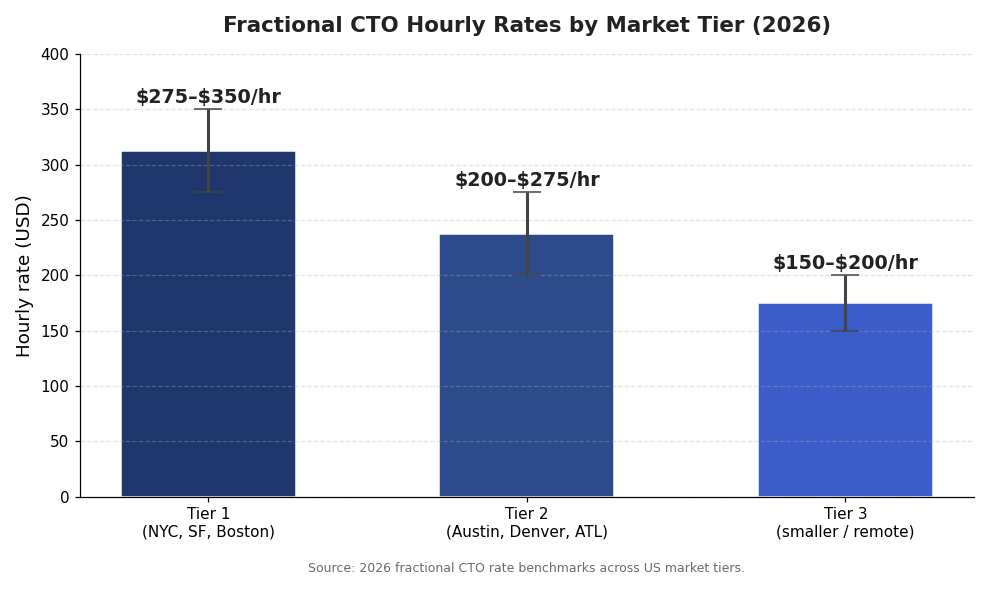
Across the US market, hourly rates cluster into tiers. Tier 1 metros like New York, San Francisco, and Boston run $275 to $350 an hour, driven by full-time CTO salaries that top $400,000. Tier 2 cities such as Austin, Denver, and Atlanta land at $200 to $275. Remote-first and smaller-market CTOs fall around $150 to $200, though quality varies more widely at that tier.
| Engagement | Typical 2026 cost | What you get |
|---|---|---|
| Advisory retainer | $4K–$8K / month | A few hours a week of strategic oversight |
| Core fractional | $8K–$25K / month | 20–40 hrs/week; owns architecture, hiring, and roadmap |
| Hourly | $150–$350 / hour | Flexible, ad-hoc leadership |
| Project (audit, due diligence) | $5K–$30K flat | A single defined deliverable |
| Full-time CTO (for comparison) | $400K–$550K / year | Full-time employee plus equity |
Not sure how many hours of technology leadership your stage actually needs? Talk to our team and we will map the right engagement to your roadmap and budget through KKRF Group’s IT consulting services.
Request a Consultation →Engagement Models: Hourly, Retainer, Project, and Equity
Fractional CTO services are packaged a few common ways. The right one depends on how much ongoing ownership you need versus a one-time deliverable.
- Hourly. You pay for time as you use it. Best for unpredictable, ad-hoc needs, though it gets expensive fast if the work is genuinely ongoing.
- Monthly retainer. A fixed fee for a set band of hours. This is the most common model for real leadership, because a fractional CTO monthly retainer buys continuity and accountability.
- Project-based. A flat fee for a defined outcome — an architecture review, a security audit, or technical due diligence for a funding round.
- Equity or hybrid. Some fractional CTOs trade part of their fee for equity, aligning incentives with the company’s outcome. It works when cash is tight and the relationship is long-term.
Fractional CTO vs Full-Time CTO: Which Should You Choose?
Choose a fractional CTO when you need senior technical judgment but cannot yet justify a $400,000-plus executive on payroll. Choose a full-time CTO when technology is the core of the business and needs daily, undivided attention. The fractional CTO vs full-time CTO decision comes down to stage, headcount, and how central engineering is to your moat.
| Factor | Fractional CTO | Full-Time CTO |
|---|---|---|
| Annual cost | $60K–$180K | $400K–$550K fully loaded |
| Commitment | 15–25 hrs/week | Full-time |
| Equity dilution | Usually none | Typically significant |
| Speed to start | Days | Months of executive search |
| Best stage | Pre-seed to Series A | Growth and beyond |
| Risk if it is wrong | Low — end the retainer | High — severance and lost time |
The cost gap is the headline, but reversitility matters just as much. Ending a fractional engagement is a conversation; unwinding a full-time executive hire is a severance negotiation and months of lost momentum.
When to Hire a Fractional CTO (and When to Go Full-Time)
The clearest signal is a mismatch: you are making high-stakes technology decisions without anyone senior enough to own them. A fractional CTO for startups tends to earn its cost in avoided mistakes alone.
- Non-technical founders are choosing architecture and vendors by instinct.
- You are building an MVP that has to survive real users, not just a demo.
- Contractors or an offshore team are shipping without technical oversight.
- Investor due diligence is coming and someone has to answer hard technical questions.
- You are pre-revenue or under $200K ARR, where a full-time CTO salary is not defensible.
Decision framework: when to switch to a full-time CTO: Move from fractional to full-time leadership when your engineering team passes roughly 10 to 12 people, when technology is the product’s core moat and needs daily executive attention, or when managing three or more engineers has become a full-time job on its own. A common, effective path is to run a fractional CTO for three to six months to set architecture, hire the first engineers, and define process — then hire a permanent CTO into that foundation.
That handoff is a feature, not a failure. A fractional CTO who builds a clean foundation makes the eventual full-time hire easier to attract and faster to onboard.
Common Mistakes to Avoid When Hiring
- Hiring an advisor when you need an operator. Some “fractional CTOs” only advise; if you need someone to own hiring and architecture, confirm they will do the work.
- Buying too few hours. A CTO with two hours a week cannot own outcomes. Match the retainer to the accountability you expect.
- Skipping references from real engagements. Ask to speak with founders they have actually led, not just logos on a website.
- Ignoring the exit plan. Agree upfront on how knowledge transfers when the engagement ends or converts to full-time.
- Treating cost as the only variable. The cheapest rate is expensive if the architecture has to be rebuilt in a year.
How to Choose a CTO-as-a-Service Partner
The best CTO-as-a-service partners bring two things at once: the judgment to set the right technical direction, and the team to actually build it. A strategist with no execution muscle leaves you with a great roadmap and no one to deliver it.
- Proven experience leading engineering at your stage and in your domain.
- A transparent engagement model with clear hours, deliverables, and reporting.
- Access to real engineering capacity — developers, DevOps, and QA — not just advice.
- A security-first approach to architecture and data handling.
- References from companies they have taken through the stage you are in now.
This is where KKRF Group’s model fits. As a trusted IT consulting and cybersecurity partner, we pair fractional technology leadership with the engineering teams to execute — custom software development, cloud-native architecture, and security-first delivery under one roof. Your fractional CTO’s roadmap does not stall waiting for a team; the team is already there. For companies weighing dedicated capacity, our guides to building a dedicated development team and to product engineering services cover how that execution layer works.
Fractional Technology Leadership: 2026 Trends
Fractional leadership has moved from a stopgap to a deliberate strategy. Three shifts stand out in 2026.
- AI raises the bar on architecture. Nearly every product now has AI features to scope, and getting data pipelines and model choices right early is a CTO-level call that startups cannot afford to fumble.
- Remote-first hiring widened the talent pool. Companies can now access senior fractional CTOs regardless of geography, sometimes securing tier-1 experience at tier-2 rates.
- Investors expect a technical voice earlier. A credible answer in technical due diligence is now table stakes even at seed stage, pushing founders to secure fractional leadership sooner.
Underneath all three trends is the same discipline: sound architecture and security decisions made early. Public references like the AWS Well-Architected Framework and salary benchmarks from the U.S. Bureau of Labor Statistics underscore why senior technical judgment pays for itself, whether it arrives full-time or fractional.
Weighing a fractional CTO against a full-time hire? Get a technical assessment from KKRF Group and a clear recommendation for your stage — no obligation.
Get a Technical Assessment →Frequently Asked Questions
What is CTO as a service?
CTO as a service is an arrangement where an experienced chief technology officer works with your company part-time — owning technology strategy, architecture, and engineering hiring — for a monthly retainer or hourly fee instead of a full-time salary. It gives startups and SMEs senior technical leadership before a permanent CTO hire is affordable.
How much does a fractional CTO cost in 2026?
Most fractional CTOs charge $150 to $350 per hour, or about $8,000 to $25,000 per month for a 20-to-40-hour engagement. Lighter advisory retainers start around $4,000 to $8,000 per month. A full-time CTO, by comparison, costs $400,000 to $550,000 per year fully loaded.
What does a fractional CTO do?
A fractional CTO sets technology strategy, owns architecture decisions, builds and leads the engineering team, reviews vendors and code, manages technical risk and security, and represents the company in investor due diligence — the same accountability as a full-time CTO, on a part-time schedule.
Fractional CTO vs full-time CTO: when does each make sense?
A fractional CTO fits pre-seed to Series A companies that need senior judgment without a $400,000 salary. A full-time CTO makes sense once the engineering team passes about 10 to 12 people or technology becomes the core competitive moat that requires daily executive attention.
Is a fractional CTO worth it for a startup?
For most pre-revenue or early-stage startups, yes. A fractional CTO prevents costly architecture mistakes, brings hiring discipline, and strengthens investor diligence — typically for a fraction of a full-time salary and with no equity dilution. The savings compound if it avoids a rebuild later.
How do I transition from a fractional CTO to a full-time one?
Plan the handoff from the start. A common path is a three-to-six-month fractional engagement to set architecture, hire the first engineers, and define process, followed by recruiting a permanent CTO into that foundation. Clear documentation and knowledge transfer make the switch smooth.
KKRF Group brings the leadership and the engineering team to match — from first architecture to a shipped product. Discuss your project with our engineering team today.
Discuss Your Project →