
Choosing the right grocery delivery app development company in New York can decide whether your app launches on time or stalls in scope creep. The city runs on convenience, and groceries are the next habit moving fully onto the phone. Between packed schedules, walk-up apartments, and shoppers who expect a cart at their door in under an hour, New York has become one of the toughest and most rewarding places to launch a grocery delivery app. As a top mobile app development company, KKRF Group builds these platforms for bodegas going digital, regional chains defending market share, and startups chasing the q-commerce opportunity.
This guide breaks down what it actually takes to build a grocery delivery app in New York in 2026: real cost ranges, the features customers now expect, the technology stack we recommend, the compliance rules specific to the city and state, and a clear framework for deciding whether to build custom at all.
Key Takeaways
- Grocery delivery app development in New York typically costs $40,000 to $400,000+, depending on whether you build a single-store MVP, a feature-rich multi-store app, or an enterprise marketplace.
- A complete build is not one app but a system: a customer app, a shopper/driver app, an admin and vendor dashboard, and the backend that connects them.
- New York’s density, high delivery expectations, and dark-store economics make real-time tracking, slot booking, and route optimization non-negotiable features.
- Cross-platform frameworks (Flutter or React Native) cut iOS and Android build costs by roughly 30-40% versus fully native development.
- Compliance matters: payment security (PCI DSS), data privacy, accessibility, and accurate tax handling for New York’s mixed grocery tax rules all affect scope.
- KKRF Group builds custom, scalable grocery and q-commerce apps for New York businesses, from validated MVPs to marketplace platforms.
What This Guide Covers
- Quick Answer
- Why New York Is a Grocery-App Market
- Business Models
- Must-Have Features
- Development Cost in New York
- Where Your Budget Goes
- Recommended Tech Stack
- The Development Process
- NYC Compliance & Security
- ROI & Revenue Models
- Common Mistakes to Avoid
- 2026 Trends
- Decision Framework
- How to Choose a Partner
- FAQs
Grocery Delivery App Development in New York: Quick Answer
Grocery delivery app development in New York is the process of designing and building the connected apps a grocery business needs to sell and deliver online: a customer ordering app, a shopper or driver app, and an admin dashboard, all backed by a real-time server. In 2026, a New York build typically costs between $40,000 for a single-store MVP and $400,000 or more for an enterprise marketplace, and takes roughly three to nine months. The right scope depends on your business model, catalog size, delivery promise, and how much of the logistics you plan to run yourself.
Grocery delivery app: A grocery delivery app is a mobile application that lets customers browse a store’s inventory, add perishable and packaged items to a cart, pay online, and receive the order at home or pick it up. It differs from a restaurant food-delivery app because it handles large catalogs, item substitutions, weight-based pricing, and cold-chain handling rather than a fixed menu.
Why New York Is a Prime Market for Grocery Delivery Apps
New York concentrates millions of customers into a small footprint, which is exactly what grocery delivery economics reward. Short delivery radii mean a single dark store or partner supermarket can serve thousands of households, and dense demand makes batching and fast drop-offs viable in ways they never are in the suburbs.
That density comes with expectations. New Yorkers compare every new app to the incumbents they already use, so a slow catalog, a clumsy checkout, or a late delivery gets deleted fast. We have seen local grocers win not by copying the giants feature-for-feature, but by owning a neighborhood, a cuisine, or a delivery promise the big platforms handle poorly, such as same-day organic, halal, kosher, or South Asian grocery.
Dark store: A dark store is a retail space closed to the public and used purely to fulfill online grocery orders. Pickers assemble orders from optimized shelving, which enables the 15-to-30 minute delivery windows that quick-commerce brands promise in dense neighborhoods.
Grocery Delivery App Business Models (and Which Fits You)
Before you talk features or budget, decide which business model you are building for. The model drives everything: catalog structure, who does the picking, how drivers are managed, and how the app makes money.
The three dominant models
- Single-store / chain-owned: One brand sells its own inventory. Simplest to build, tightest control over quality, best for an established grocer going digital.
- Aggregator / marketplace: Many stores list on one platform; the app takes a commission. More complex because it needs vendor onboarding, multi-store carts, and payout handling.
- Quick commerce (q-commerce): A branded operator runs its own dark stores for ultra-fast delivery of a curated range. Highest operational and tech intensity, tightest delivery SLAs.
Most New York startups we advise begin with a focused single-store or single-dark-store MVP, prove the unit economics in two or three ZIP codes, then layer in marketplace or multi-location features once demand is real. Building the full marketplace on day one is the most common way to overspend.
Not sure which model fits your catalog and delivery promise? KKRF Group’s team can map your business to the right build and scope a realistic first release. Explore our New York mobile app development services.
Discuss Your Project →Must-Have Features of a Grocery Delivery App
A grocery delivery platform is really three apps working together. Scoping each one separately keeps estimates honest and prevents the “we forgot the driver app” surprise that derails budgets.
Customer app
- Fast, searchable catalog with categories, filters, and barcode or voice search
- Smart cart with item substitutions, weight-based pricing, and reorder from history
- Delivery slot booking and real-time order tracking on a live map
- Multiple payment options, digital wallets, EBT/SNAP where applicable, and tipping
- Personalized recommendations, loyalty, coupons, and push notifications
Shopper / driver app
- Optimized picking lists, in-store item scanning, and out-of-stock substitution flow
- Route optimization, turn-by-turn navigation, and batched multi-order delivery
- Proof of delivery, in-app chat with the customer, and earnings tracking
Admin & vendor dashboard
- Inventory and catalog management with real-time stock sync
- Order, driver, and zone management with live operational dashboards
- Pricing, promotions, commission, and payout controls
- Analytics on basket size, delivery times, retention, and cancellations
Substitution flow: A substitution flow is the logic that handles out-of-stock items during picking. It lets the shopper propose a replacement, notifies the customer for approval in real time, and adjusts the final charge, protecting both order accuracy and trust.
How Much Does Grocery Delivery App Development Cost in New York?
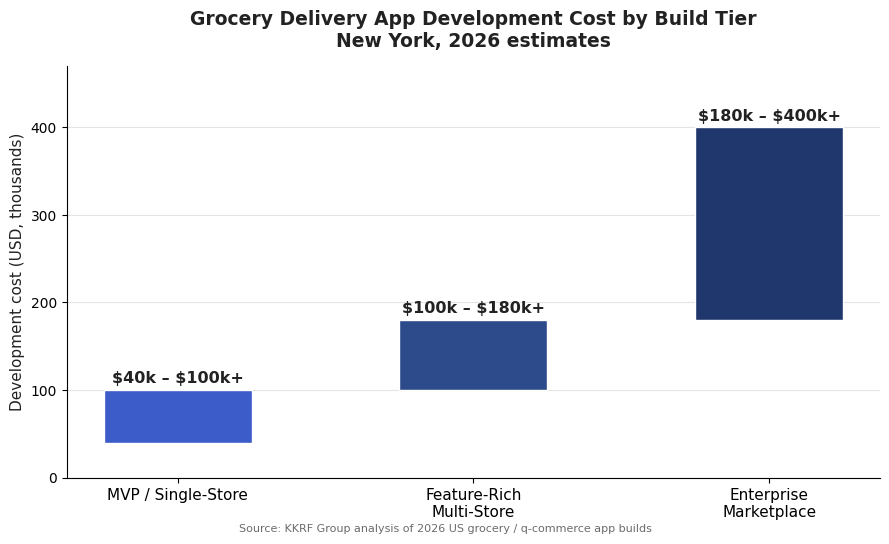
Cost tracks scope, not city. A grocery delivery app built for a New York business costs the same to engineer as one built anywhere else; what changes is the ambition of the feature set and the delivery promise behind it. Independent 2026 industry estimates put grocery delivery app development anywhere from roughly $25,000 for a bare MVP to $400,000-plus for a marketplace-grade platform, which lines up with what we see on real New York projects.
| Build tier | What you get | Typical timeline | Cost range (2026) |
|---|---|---|---|
| Single-store MVP | One customer app, basic driver app, admin panel, one payment gateway, core tracking | 3-4 months | $40,000 – $100,000 |
| Feature-rich multi-store | Multiple stores, substitutions, loyalty, promotions, analytics, scaled backend | 5-7 months | $100,000 – $180,000 |
| Enterprise marketplace | Vendor onboarding, multi-store carts, route optimization, dark-store ops, high-availability infrastructure | 7-12 months | $180,000 – $400,000+ |
These are ranges, not quotes. The biggest swing factors are the number of user-facing apps, whether you need native or cross-platform builds, the depth of the admin panel, and third-party services such as maps, payments, and SMS, which carry ongoing per-use fees on top of the build.
Where Your Budget Actually Goes
Founders often assume the customer app is the whole project. In practice, the customer app is only about a fifth of a marketplace-style build. The backend, the second and third apps, and real-time systems consume the rest.
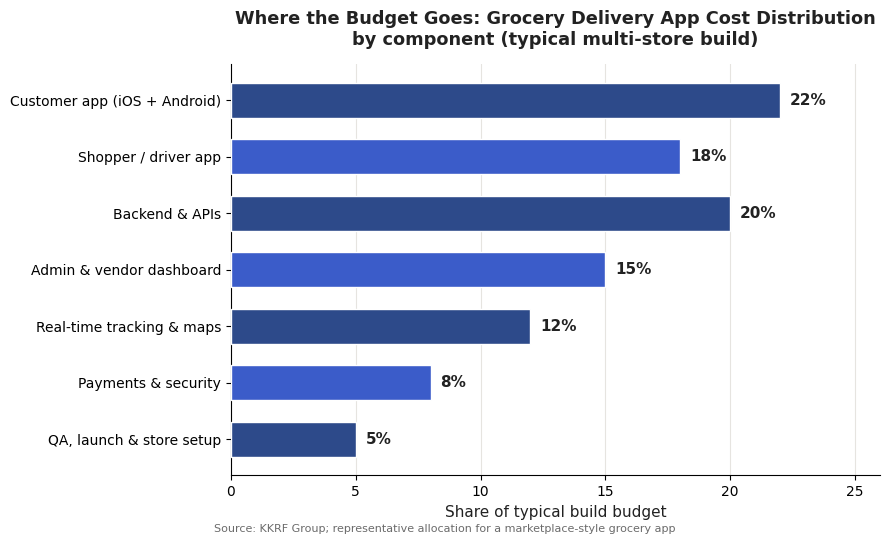
Reading the split this way changes how you prioritize. If you cut the driver app or the admin dashboard to save money, you are not trimming a nice-to-have; you are removing the operational core that makes deliveries actually happen. The smarter savings come from narrowing catalog scope, launching in fewer zones, and using cross-platform frameworks.
Recommended Technology Stack
There is no single correct stack, but there is a sensible default for a New York grocery app that needs to scale under bursty, real-time demand. We choose technologies for reliability during dinner-rush spikes, not novelty.
| Layer | Recommended options | Why it fits grocery |
|---|---|---|
| Mobile apps | Flutter or React Native (cross-platform) | One codebase for iOS and Android cuts build cost ~30-40% |
| Backend | Node.js or Python (Django), microservices | Handles concurrent orders, vendors, and drivers independently |
| Databases | PostgreSQL for transactions, MongoDB for catalog | Reliable payments plus flexible product data |
| Real-time | WebSockets, Firebase, Kafka for events | Live tracking, stock sync, and driver updates |
| Maps & routing | Google Maps or Mapbox APIs | Accurate ETAs and route optimization in dense NYC grids |
| Cloud | AWS or Google Cloud, containerized | Auto-scales for peak windows without over-provisioning |
Cross-platform is usually the right call for a first launch because it gets you onto both app stores faster and cheaper. If your app later depends on heavy device features or needs to squeeze out maximum performance, specific modules can be moved to native code without rewriting the whole product.
The Grocery Delivery App Development Process (Step by Step)
A predictable process is what separates an app that launches from one that stalls. This is the sequence KKRF Group follows, and each step produces something you can review before the next begins.
- Step 1 – Discovery & scoping. We define your model, catalog, delivery promise, and target ZIP codes, then translate them into a prioritized feature list and a realistic budget.
- Step 2 – UX & UI design. We wireframe all three apps, design the checkout and tracking flows, and prototype the picking and substitution experience before a line of production code is written.
- Step 3 – Architecture & setup. We design the backend, data model, and integrations for maps, payments, and notifications, choosing infrastructure that scales with your zones.
- Step 4 – Development. We build the customer app, driver app, and admin dashboard in parallel sprints, with working demos at the end of each sprint.
- Step 5 – Integration & testing. We connect payments, maps, and real-time tracking, then run functional, load, and security testing against peak-demand scenarios.
- Step 6 – Launch & iteration. We publish to the App Store and Google Play, monitor live performance, and refine based on real order and delivery data.
NYC Compliance, Security & Data Privacy
Grocery apps touch payments, personal data, and, in some cases, government benefits, so compliance is part of the build, not an afterthought. Getting this wrong in New York is expensive and public.
- Payment security: Card handling must meet PCI DSS. Using a tokenized gateway such as Stripe keeps raw card data off your servers and narrows your compliance burden.
- Sales tax accuracy: New York exempts most grocery staples but taxes prepared foods, candy, and certain items. Your pricing engine has to apply the right rate per item, per jurisdiction.
- Data privacy: Customer location and purchase history are sensitive. Clear consent, encryption in transit and at rest, and a defensible retention policy protect users and your brand.
- Accessibility: Following WCAG and ADA guidance widens your audience and reduces legal exposure, which matters for consumer apps operating in New York.
- EBT/SNAP: If you plan to accept benefits, USDA authorization and approved payment rails add scope you should plan for early.
For payment-security specifics, the PCI Security Standards Council publishes the current requirements, and the OWASP Mobile Top 10 is a solid baseline for hardening the apps themselves.
Payments, tax logic, and benefit programs each add real scope. KKRF Group scopes compliance into the estimate from day one so there are no surprises at launch. See how we build secure mobile apps.
Get a Technical Assessment →ROI and Revenue Models
A grocery app earns its keep through several stacked revenue streams. Understanding them upfront shapes which features you build first.
- Delivery and service fees charged per order, the most direct revenue line.
- Markups or commissions on items, or a percentage from partner stores in a marketplace model.
- Subscriptions that offer free or discounted delivery for a monthly fee, which lifts order frequency and retention.
- Retail media: promoted product placements and sponsored listings, a fast-growing margin source for grocery platforms.
- Basket growth from personalization and reorder features, which raises average order value without new customer spend.
The honest trade-off in grocery delivery is thin per-order margins. ROI comes from repeat frequency and larger baskets, not one-off orders, so retention features usually return more than flashy extras. We push clients to instrument the app from day one so they can see basket size and repeat rate, then invest where the data points.
Common Mistakes to Avoid
- Building the marketplace first. Full vendor onboarding and multi-store carts before you have proven demand burns budget and time.
- Underbuilding the driver and admin apps. These run your operations; skimping here breaks the delivery promise.
- Ignoring substitutions. Out-of-stock handling is where grocery apps lose trust; design it early.
- No offline or poor-signal handling. Drivers work in basements, elevators, and dead zones across the city; the app has to cope.
- Treating launch as the finish line. The first ninety days of real order data reveal what to fix and where to expand.
2026 Trends Shaping Grocery Delivery Apps
The category keeps moving. These are the shifts we are actively building for on New York projects in 2026.
- AI personalization and demand forecasting that tailor the storefront and keep dark-store stock aligned with local buying patterns.
- Faster quick-commerce windows pushing sub-30-minute delivery deeper into more neighborhoods.
- Autonomous and micro-mobility delivery pilots for short, dense routes.
- Sustainability features such as consolidated deliveries, reusable packaging tracking, and greener routing.
- Voice and conversational ordering for fast reordering of staples.
Decision Framework: Should You Build a Custom Grocery App?
Custom is not automatically the right answer. Use this framework to decide honestly.
Choose a custom build when
- You have a distinct model, catalog, or delivery promise the big platforms serve poorly.
- You want to own the customer relationship, data, and margins rather than rent them.
- You expect to scale across zones or stores and need infrastructure you control.
Reconsider or start smaller when
- You are validating a brand-new idea with no proven demand; a lean MVP or even a white-label pilot may answer the question for less.
- Your volumes are low enough that listing on an existing marketplace is more profitable than running your own logistics.
- Your timeline and budget cannot support the driver app, admin panel, and real-time systems a real grocery operation needs.
Our recommendation: most New York grocery businesses are best served by a focused, custom MVP that proves unit economics in a few ZIP codes, built on an architecture that can scale into a marketplace later. That path balances cost, speed, and long-term control. The one clear limitation to accept is that no app fixes broken fulfillment; the software only performs as well as the picking and delivery operation behind it.
How to Choose a Grocery Delivery App Development Company in New York
The partner you pick matters more than the framework they use. Grocery and on-demand logistics have specific failure modes, and experience with them is worth paying for.
- Relevant portfolio: real delivery, marketplace, or logistics apps, not just generic mobile work.
- Full-system capability: can they build all three apps plus a scalable backend, or only the customer front end?
- Real-time and scale experience: live tracking, route optimization, and peak-load handling are hard; ask how they have solved them.
- Transparent process and pricing: clear scope, sprint demos, and honest trade-offs beat a suspiciously low fixed bid.
- Post-launch partnership: grocery apps live or die in iteration, so ongoing support and analytics matter.
KKRF Group brings a custom-engineering approach, enterprise-grade and security-first architecture, and a transparent, sprint-based process to every build. We work as a long-term technology partner for startups, regional grocers, and enterprises, designing each grocery platform around the business and the New York market it serves rather than a reused template.
Ready to scope your grocery delivery app for New York? KKRF Group will map your model, estimate a realistic build, and recommend the fastest path to a launchable MVP. Talk to our engineering team to get started.
Request a Consultation →Frequently Asked Questions
How much does it cost to develop a grocery delivery app in New York?
In 2026, a grocery delivery app in New York typically costs $40,000 to $100,000 for a single-store MVP, $100,000 to $180,000 for a feature-rich multi-store app, and $180,000 to $400,000 or more for an enterprise marketplace. The final figure depends on the number of apps, feature depth, and third-party integrations.
How long does it take to build a grocery delivery app?
A single-store MVP usually takes three to four months. A feature-rich multi-store app takes five to seven months, and a full enterprise marketplace can take seven to twelve months, including design, development, integration, testing, and launch.
What is the difference between a grocery delivery app and a food delivery app?
A grocery delivery app manages large catalogs, item substitutions, weight-based pricing, and cold-chain handling across many products. A food delivery app works from fixed restaurant menus. Grocery apps are more inventory-heavy and require stronger stock synchronization and picking logic.
Should I build a native or cross-platform grocery app?
Most New York businesses launch with a cross-platform app using Flutter or React Native because it covers iOS and Android from one codebase and cuts build cost by roughly 30 to 40 percent. Performance-critical modules can be moved to native code later if needed.
What features are essential for a grocery delivery MVP?
A viable MVP needs a searchable catalog, a smart cart with substitutions, delivery slot booking, secure payments, real-time order tracking, a basic driver app, and an admin dashboard for inventory and orders. Everything else can be added after launch based on real usage.
Can KKRF Group build and scale a grocery delivery app for my New York business?
Yes. KKRF Group builds custom grocery and quick-commerce apps for New York businesses, from validated MVPs to enterprise marketplaces, including the customer app, driver app, admin dashboard, and scalable backend, with ongoing support after launch.