
New York runs on movement. Millions of trips happen every day across yellow cabs, green boro taxis, black cars, and rideshare pickups — and each one is a software problem someone can solve better. If you are planning to build a taxi or ride-hailing app here, the code is only half the work. The other half is New York itself: its riders, its drivers, and the Taxi & Limousine Commission rules that shape every fare.
As a top mobile app development company, KKRF Group builds ride-hailing platforms that hold up under real New York conditions — surge demand at rush hour, dead zones in the subway, and regulators who audit how you dispatch a car. This guide breaks down what a taxi app development company in New York actually does, what it costs in 2026, the features and tech stack that matter, and how to pick the right engineering partner.
Quick Answer
A taxi app development company in New York builds the three connected products a ride-hailing service needs — a rider app, a driver app, and a dispatch admin panel — plus the backend that matches trips in real time. In 2026, a custom two-sided app costs roughly $70,000 to $150,000 in the US market and takes about 5 to 6 months to launch, with NYC TLC compliance built in from day one.
Key Takeaways
- A working taxi app is really three apps plus a backend: rider, driver, admin dispatch, and a real-time matching engine.
- US custom builds run about $70K–$150K; enterprise multi-city platforms reach $150K–$300K+. White-label clones start near $15K but limit ownership.
- New York adds a compliance layer most cities do not: TLC licensing, a $0.75 congestion surcharge per trip, and the Green Rides EV/WAV mandate.
- Flutter plus a Node.js and PostGIS backend is the pragmatic 2026 stack for live GPS tracking and surge pricing.
- Choose a partner on dispatch experience and TLC knowledge, not just the lowest quote.
What This Guide Covers
KKRF Group works with startups, fleet operators, and enterprises as a long-term engineering partner rather than a one-off vendor. We build custom, enterprise-grade transportation platforms with a security-first approach and cloud-native architecture that scales from a single-borough pilot to a full metro rollout. The sections below reflect how we scope, price, and ship these systems for New York clients.
Why Building a Taxi App in New York Is Different
Most taxi app guides are written as if every city were the same. New York is not. The density is higher, the regulator is more active, and rider expectations are set by the incumbents already on every phone. A ride-hailing app development project here has to plan for all three from the first sprint.
Definition: taxi app development
New York layers a regulatory reality on top of that. The TLC governs for-hire vehicles and taxis, sets fare rules, and has stopped issuing most new vehicle licenses except for wheelchair-accessible vehicles. Your app does not license the cars, but it has to work cleanly for drivers who are already licensed and audited. Ignore that context and even a technically strong app struggles to onboard supply.
Rider behavior is unforgiving too. New Yorkers abandon a booking screen in seconds if the map lags or the ETA looks wrong. That raises the bar on GPS accuracy, matching speed, and offline resilience — the exact things a serious taxi app development company in New York should obsess over.
How Much Does Taxi App Development Cost in New York?
Cost depends on scope, not vibes. Whether you set out to build an app like Uber or a leaner borough-focused service, scope is what sets the price. The single biggest driver is whether you build custom or start from a white-label base, followed by how many services (ride-hailing, scheduled rides, corporate accounts) you launch at once. Here is how 2026 US-market pricing breaks down by tier.
| Project tier | What you get | US cost (2026) | Timeline |
|---|---|---|---|
| White-label / clone | Rebranded rider + driver app, limited customization | $15K–$40K | 3–6 weeks |
| Custom MVP | Core rider, driver, admin; live tracking; basic payments | $40K–$70K | 3–4 months |
| Full custom (two-sided) | Surge pricing, scheduling, wallets, ratings, analytics | $70K–$150K | 5–6 months |
| Enterprise / multi-city | AI matching, multi-service, deep TLC and fleet integration | $150K–$300K+ | 7–12 months |
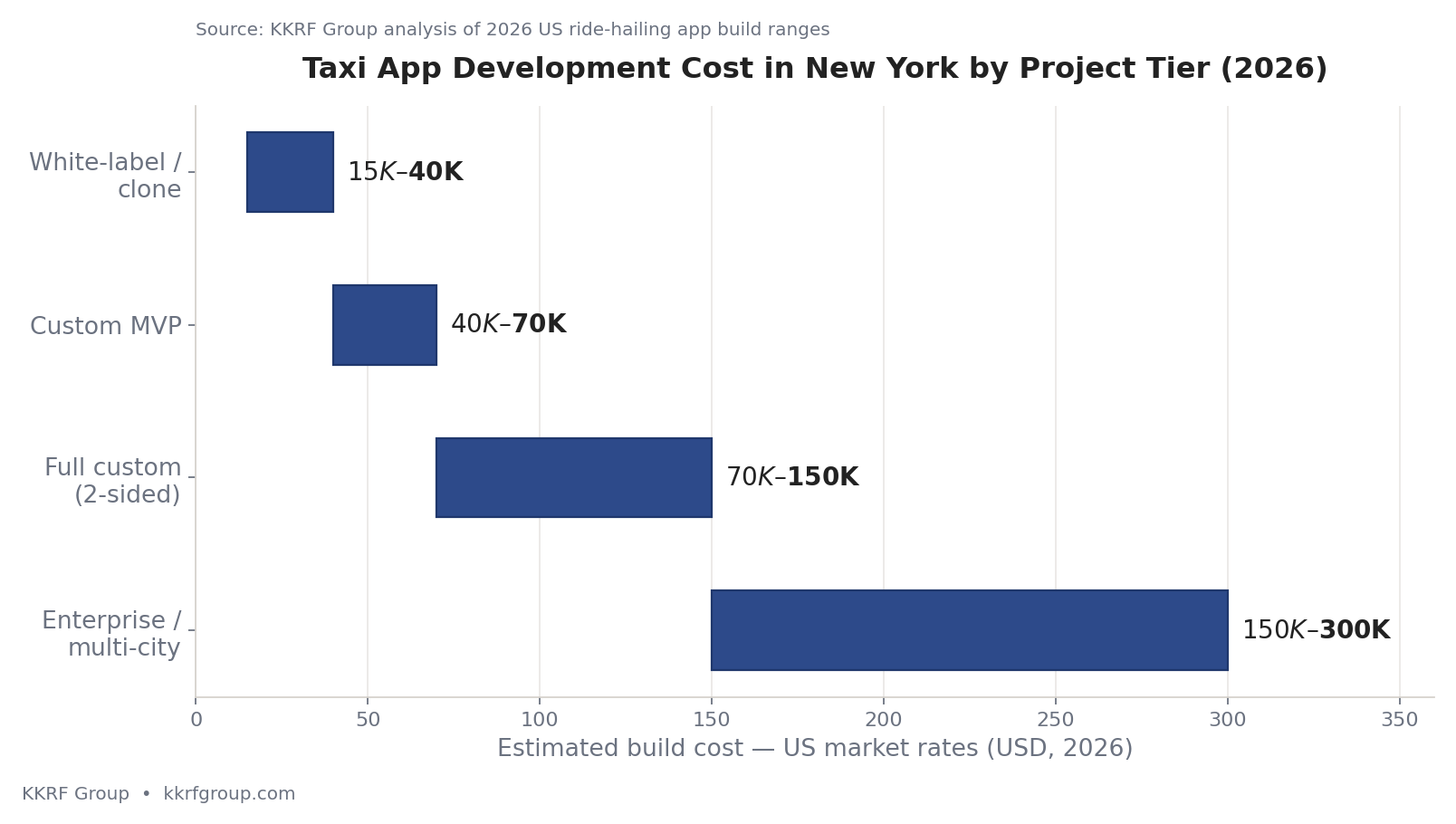
Two things move these numbers most. First, real-time infrastructure: a reliable dispatch and matching engine is harder to build than the screens riders see, and it is where cheap projects quietly cut corners. Second, payments and payouts — splitting fares, holding driver balances, and handling refunds correctly adds engineering and compliance work that a $15K clone simply skips.
If budget is tight, the smart move is a custom MVP that nails one service (say, on-demand rides in Manhattan) and expands from there. We cover related pricing in depth in our on-demand app development company in New York guide, and the broader city-wide picture in our food delivery app development in New York breakdown for teams weighing a multi-service play.
Must-Have Features for a New York Taxi App
A taxi app lives or dies on a short list of features that have to work every single time. Nail the core taxi booking flow first, then add the extras. Skip the novelty; get these right first. We group them by the three apps that make up the platform.
Rider app
- Fast booking and live GPS tracking — one-tap pickup, accurate ETAs, and a moving car on the map.
- Multiple payment options — cards, digital wallets, and in-app balance, with automatic fare receipts.
- Upfront pricing and surge transparency — riders see the fare, and any surge multiplier, before they confirm.
- Scheduled rides and saved places — airport runs to JFK or LaGuardia booked hours ahead.
- Ratings, safety tools, and trip sharing — share-my-ride links and an in-app emergency button.
Driver app
- Smart trip requests with clear pickup, drop-off, and estimated earnings before accepting.
- Turn-by-turn navigation and heat maps showing where demand is building.
- Earnings dashboard and instant payouts so drivers can track and cash out balances.
- Availability toggle and shift tools that respect how licensed NYC drivers actually work.
Admin and dispatch panel
- Live fleet map and manual dispatch override for corporate or priority bookings.
- Dynamic pricing controls to tune surge by zone and time.
- Reporting and analytics on trips, cancellations, driver supply, and revenue.
- Compliance logging for TLC surcharges and trip records.
Definition: dispatch and matching engine
Tech Stack and Architecture Behind a Ride-Hailing App
The stack should serve two goals: real-time reliability and a codebase your team can afford to maintain. For most New York clients in 2026, a cross-platform front end paired with an event-driven backend hits that balance.
| Layer | Typical 2026 choice | Why it fits a taxi app |
|---|---|---|
| Mobile front end | Flutter (or React Native) | One codebase for iOS and Android cuts build cost 30–40% |
| Backend services | Node.js microservices | Handles real-time ride matching and location updates well |
| Database | PostgreSQL + PostGIS | Geospatial queries for “nearest driver” at scale |
| Real-time cache | Redis | Caches live driver positions and surge state |
| Maps and routing | Google Maps / Mapbox | ETAs, routing, and geofencing for zones |
| Infrastructure | Cloud-native (AWS/GCP), containers | Scales independently by service during peak demand |
The reason to go microservices is not fashion — it is peak load. On a rainy Friday at 6 p.m., matching and pricing get hammered while your marketing screens sit idle. A microservices architecture lets you scale the busy services on their own instead of over-provisioning the whole app. That is the kind of enterprise-grade, cloud-native design decision that separates a demo from a system that survives New York rush hour.
React Native remains a strong alternative, especially if your team already knows JavaScript. If you are weighing the two, our Flutter vs React Native for New York businesses comparison goes deeper than we can here.
How KKRF Group Builds a Taxi App: Step by Step
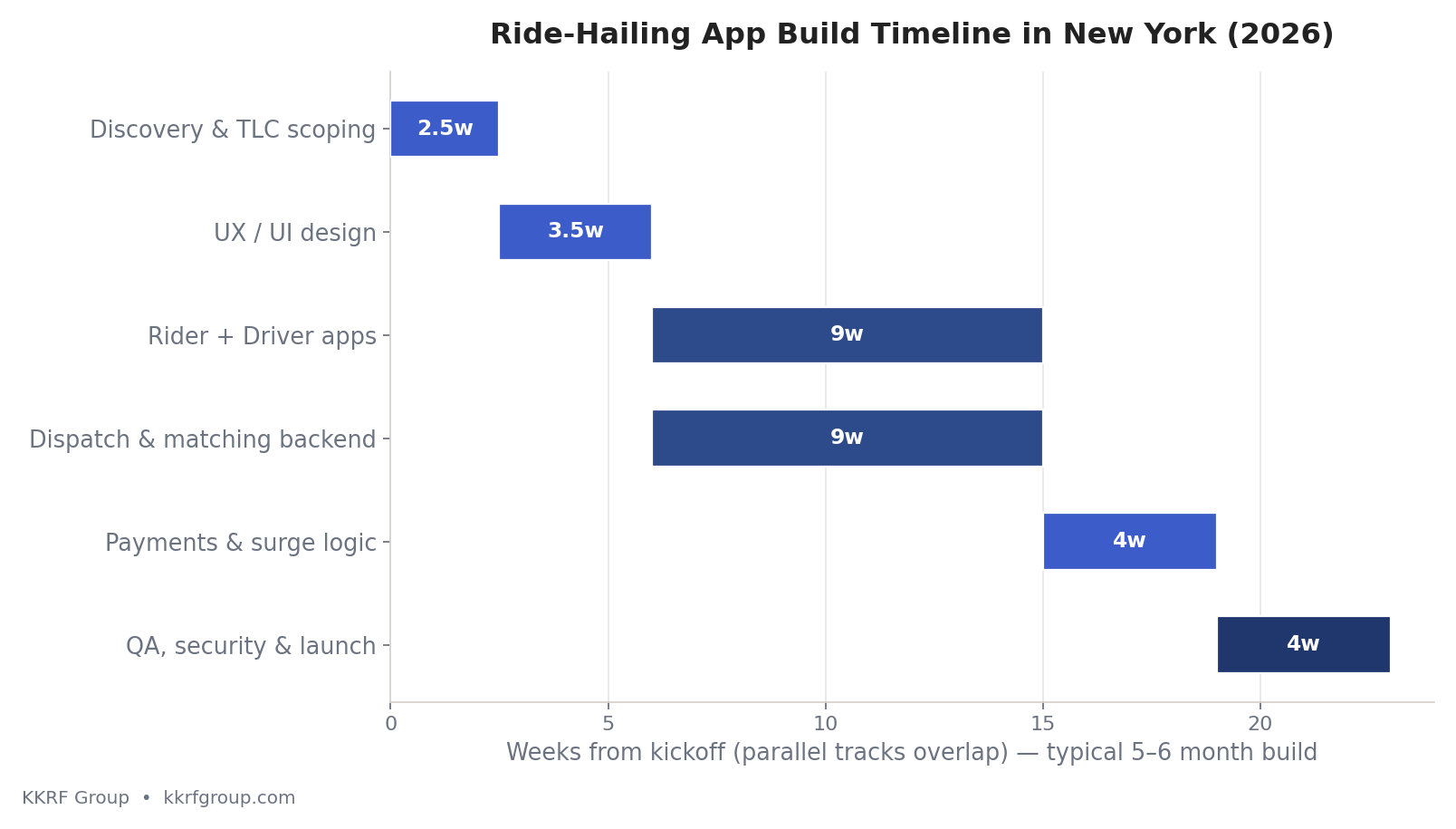
A predictable process is what keeps a five-month build from turning into a twelve-month one. Here is the sequence we follow, with New York specifics baked into the early stages.
- Discovery and TLC scoping. We map your service model, target boroughs, and the regulatory constraints that affect dispatch, pricing, and driver onboarding before a single screen is designed.
- UX and UI design. We prototype the rider, driver, and admin flows, then test them for speed — the metric New York riders judge you on.
- Backend and dispatch build. We stand up the matching engine, geospatial services, and real-time messaging that keep trips in sync.
- Rider and driver app development. Front-end teams build both apps in parallel on a shared cross-platform codebase.
- Payments and surge logic. We integrate wallets, card payments, driver payouts, and zone-based surge pricing with full receipts.
- QA, security, and compliance testing. We load-test peak demand, harden data handling, and verify TLC surcharge and trip-record logic.
- Launch and iteration. We ship to the App Store and Play Store, monitor real trips, and tune matching and pricing from live data.
Have a taxi or ride-hailing concept for New York? We will scope the rider, driver, and dispatch build with a realistic cost and timeline. Tell us about your project and we will map the fastest path to launch.
Get a Custom Project Estimate →NYC TLC Rules and Compliance You Can\u2019t Ignore
This is the section most out-of-town developers get wrong. New York’s Taxi and Limousine Commission regulates for-hire vehicles and taxis tightly, and your app has to fit inside those rules rather than around them.
Definition: for-hire vehicle (FHV)
Three compliance realities shape a New York taxi app in 2026. Each one has a direct effect on how you build pricing and reporting.
- Congestion surcharge. For-hire vehicles pay a flat $0.75 per-trip surcharge on rides that enter, exit, or pass through Manhattan’s Congestion Relief Zone (south of 60th Street). Yellow and green taxis carry the same $0.75. Your fare engine must add and record it correctly on every affected trip — see the TLC congestion surcharge rules.
- Licensing limits. The TLC has stopped issuing most new FHV licenses except for wheelchair-accessible vehicles, so your growth plan should assume a constrained driver pool and design onboarding accordingly.
- Green Rides mandate. Rideshare platforms are required to shift a rising share of trips to electric or wheelchair-accessible vehicles, which your matching and reporting logic should be able to track.
There is also an enforcement edge. The TLC has warned that drivers using unlicensed dispatch platforms risk fines and license suspension, with penalties reaching into the thousands for vehicle owners. Building on the right side of that line is a design requirement, not a legal footnote. Fare details and rate rules are published on the TLC taxi fare page.
How Taxi Apps Make Money: Revenue Models
A great app that cannot pay for itself is a hobby. Most New York operators combine two or three of these models rather than betting on one.
- Commission per trip. The platform takes a percentage of each fare — the classic ride-hailing model, and the easiest to launch.
- Driver subscriptions. Drivers pay a flat weekly or monthly fee and keep more of each fare, which can attract high-volume drivers.
- Surge and dynamic pricing. Higher fares during peak demand grow revenue while balancing supply, provided the increase is transparent to riders.
- Corporate and B2B accounts. Billing agreements with hotels, hospitals, and employers deliver steady, higher-value trips.
- In-app advertising and partnerships. Sponsored placements or partner offers add a secondary revenue line without touching the fare.
Custom Build vs. White-Label: A Decision Framework
This is the fork in the road every founder hits. Neither answer is wrong — they solve different problems. The comparison below lays out the trade-offs, and the framework after it tells you which fits your situation.
Definition: white-label taxi app
| Factor | White-label | Custom build |
|---|---|---|
| Upfront cost | $15K–$40K | $70K–$150K+ |
| Time to launch | 3–6 weeks | 5–6 months |
| Code ownership | Licensed / rented | Fully yours |
| Differentiation | Low — you look like others | High — unique UX and features |
| TLC-specific logic | Hard to customize | Built to fit NYC rules |
| Long-term cost | Recurring license fees | Predictable, asset you own |
Which should you choose?
- Choose white-label if you need to validate demand in one borough this quarter, have a small budget, and can live with generic features.
- Choose a custom build if the app is your core business, you need real differentiation, or NYC compliance and integrations rule out a generic base.
- Limitations to know: white-label saves money now but caps you later, while custom asks for more upfront capital and a partner you trust for the long haul.
- Our recommendation: most New York operators serious about the market are better served by a custom MVP — you get ownership and NYC-fit logic without paying enterprise prices on day one.
Common Mistakes New York Startups Make
We have seen the same avoidable errors sink otherwise good ideas. A quick pass through these before you start saves months.
- Building the rider app first and the dispatch engine last. The matching backend is the hard part — start there.
- Treating TLC compliance as a launch task. Surcharge and record-keeping logic belong in the pricing engine from the first sprint.
- Underestimating driver supply. A rider app with no available cars fails instantly; onboarding and driver experience deserve equal weight.
- Chasing every feature at once. Ship a focused MVP, learn from real trips, then expand.
- Picking a vendor on price alone. A cheap build with no real-time expertise costs more once you rebuild it.
How to Choose a Taxi App Development Company in New York
The right partner is the difference between an app that launches and one that lingers in QA. When you evaluate a taxi app development company in New York, weigh these signals more than the headline quote.
- Real-time and geospatial experience. Ask to see how they have handled live tracking, matching, and surge under load.
- NYC regulatory fluency. They should speak TLC, congestion surcharge, and Green Rides without being prompted.
- Both apps under one roof. Rider and driver apps built by the same team avoid costly integration gaps.
- A transparent process. Clear sprints, demos, and a documented architecture — not a black box.
- Post-launch partnership. Matching and pricing need tuning after launch; make sure support does not end at handoff.
This is where KKRF Group fits. We build both apps and the dispatch backend as one system, design for NYC’s rules from discovery, and stay on as a long-term technology partner after launch. If you are still assembling a team, our guide to hiring mobile app developers in New York is a useful companion, and our mobile app development in New York service page shows how we engage.
Not sure whether a custom build or a white-label base fits your budget and timeline? A short call is usually enough to point you the right way. Book a discovery call with our engineering team.
Book a Discovery Call →Where Ride-Hailing Technology Is Heading in 2026
The New York market is not standing still, and the apps built this year should anticipate where it goes next. A few shifts are already visible.
- Electrification by default. The Green Rides mandate pushes EV and wheelchair-accessible trips, so charging-aware routing and fleet tracking move from nice-to-have to expected.
- AI-assisted matching and pricing. Smarter demand prediction reduces rider wait times and idle driver miles — an area where AI-driven engineering pays off directly.
- Deeper multimodal links. Riders increasingly expect a taxi trip to connect with transit, so integrations with the wider mobility network matter more.
- Safety and transparency features — verified drivers, shareable trips, and clear upfront pricing — are becoming table stakes, not differentiators.
None of this changes the fundamentals covered above. It just raises the bar on the architecture you choose today, which is exactly why the tech-stack and process decisions earlier in this guide matter so much.
Frequently Asked Questions
How much does it cost to build a taxi app in New York?
In the 2026 US market, a custom two-sided taxi app typically costs $70,000 to $150,000, while an enterprise multi-city platform runs $150,000 to $300,000 or more. White-label clones start near $15,000 but limit ownership and customization.
How long does it take to develop a ride-hailing app?
A full-featured custom ride-hailing app usually takes about five to six months to build and launch. A focused MVP can ship in three to four months, and a rebranded white-label app can go live in three to six weeks.
Do I need a TLC license to launch a taxi app in NYC?
The app itself does not hold a TLC vehicle license, but the drivers and for-hire vehicles it dispatches must be TLC-licensed. Your platform must also apply the $0.75 congestion surcharge correctly and keep trip records that comply with TLC rules.
Should I build a custom app or use a white-label taxi app?
Choose white-label to validate demand quickly on a small budget with generic features. Choose a custom build if the app is your core business, you need real differentiation, or NYC compliance and integrations rule out a generic base.
What tech stack is best for a taxi app in 2026?
A common 2026 stack pairs Flutter or React Native on the front end with a Node.js microservices backend, PostgreSQL with PostGIS for geospatial queries, and Redis for live driver data. This balances real-time reliability with maintainable, cost-effective code.
Can KKRF Group build both the rider and driver apps?
Yes. KKRF Group builds the rider app, the driver app, and the admin dispatch panel as one connected system, along with the real-time matching backend, and stays on as a long-term partner to tune matching and pricing after launch.
KKRF Group builds ride-hailing platforms that hold up under real New York demand — rider app, driver app, and dispatch, engineered as one. Talk to our engineering team to turn your concept into a launch plan.
Request a Consultation →