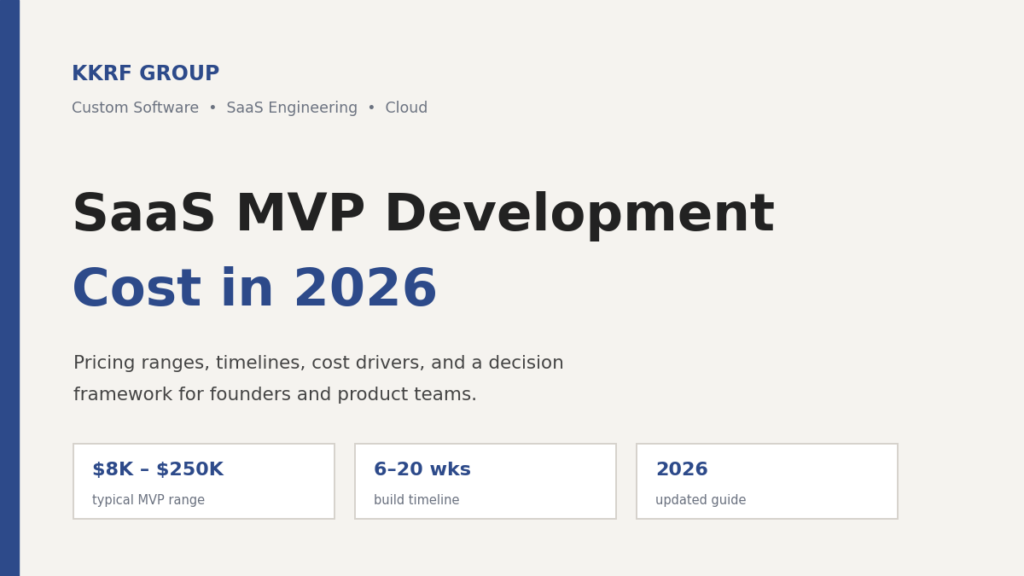

SaaS development services are the design, engineering, and ongoing operation of cloud-based software that customers reach through a browser or app and pay for by subscription. In 2026, a lean minimum viable product usually costs $20,000 to $50,000, a market-ready platform runs $50,000 to $150,000, and enterprise-grade systems climb past $350,000. Timelines range from three months for an MVP to a year or more for complex products. At KKRF Group, an experienced custom software development company, we build SaaS platforms end to end, and this guide lays out exactly what these services include, what they cost, and how to choose a partner without regret.
Buying SaaS development is not like buying a finished product off a shelf. You are hiring a team to make hundreds of architecture, security, and pricing decisions that will shape your margins for years. Get those decisions right and the software scales quietly in the background. Get them wrong and every new customer makes the system slower and more expensive to run.
Key Takeaways
- SaaS development services span discovery, UX, multi-tenant architecture, coding, security, billing, and post-launch operations, not just writing code.
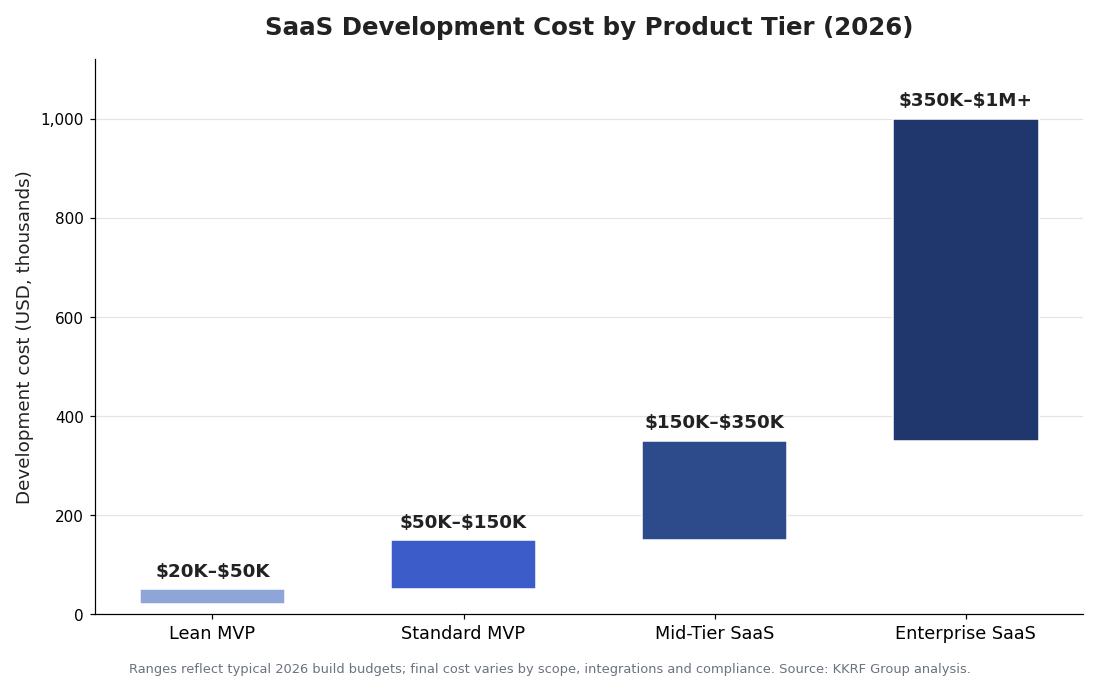
- Expect $20K to $50K for a lean MVP, $50K to $150K for a standard product, and $350K to $1M+ for enterprise SaaS in 2026.
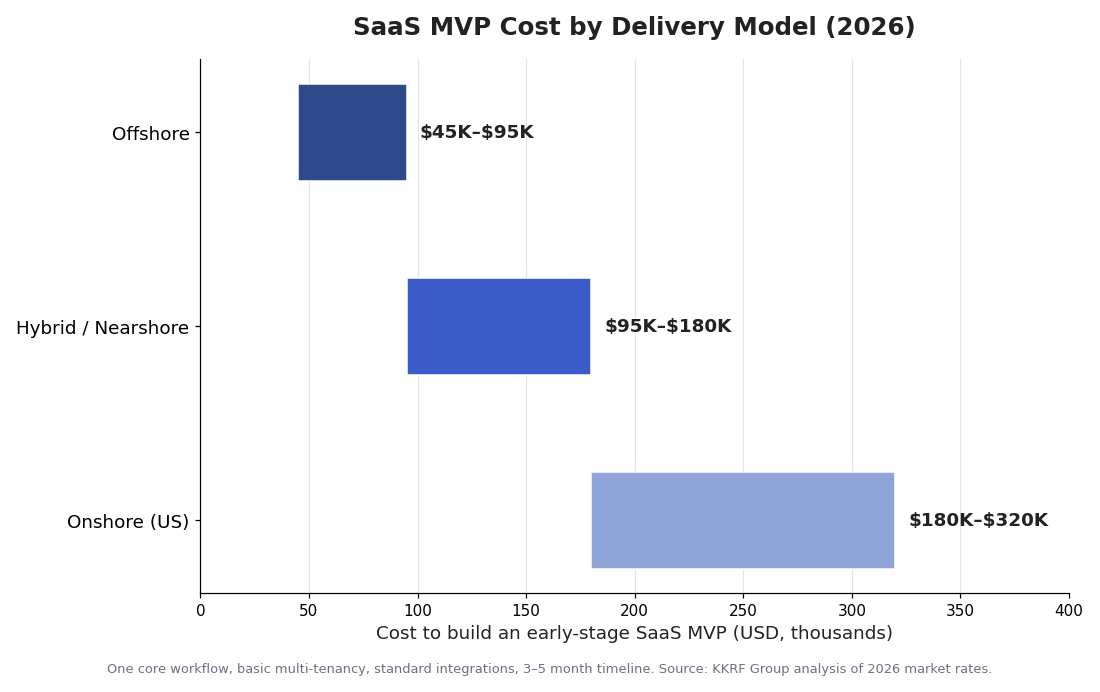
- Delivery model drives price: the same MVP costs roughly $45K to $95K offshore versus $180K to $320K fully onshore.
- Most contracts use fixed price, time and materials, or a capped T&M hybrid; each shifts risk differently.
- Multi-tenancy, a subscription billing engine, and SOC 2-ready security separate real SaaS from a hosted web app.
- Choose a SaaS development company on discovery quality, references, and security posture, not on the lowest hourly rate.
What This Guide Covers
- What SaaS Development Services Include
- SaaS Development Cost in 2026
- What Drives SaaS Development Costs
- Engagement & Pricing Models
- The SaaS Development Process
- The SaaS Technology Stack & Architecture
- Build vs. Buy: Custom or Off-the-Shelf
- Security, Compliance & Scalability
- Common SaaS Development Mistakes
- How to Choose a SaaS Development Company
- SaaS Trends Shaping 2026
- Frequently Asked Questions
Quick answer: SaaS development services turn an idea into subscription software that many customers use at once. A qualified partner handles product discovery, UX, multi-tenant cloud architecture, secure coding, subscription billing, compliance, and post-launch support. In 2026 a usable MVP typically costs $20,000 to $50,000 and ships in three to five months; enterprise platforms cost $350,000 and up. The right vendor is the one with a rigorous discovery process, verifiable references, and a security-first engineering culture.
KKRF Group builds SaaS products for startups validating a first idea and for enterprises replacing aging internal systems. Our engineers design for multi-tenancy, cloud-native scaling, and security from day one, because retrofitting those later is where most SaaS budgets quietly bleed out. The sections below reflect how we scope, price, and deliver these projects in practice.
What SaaS Development Services Include
Definition — SaaS development: SaaS (Software as a Service) development is the process of building software that is hosted centrally, delivered over the internet, and sold on a recurring subscription. A single running instance serves many customers at once, so the code, database, and infrastructure must isolate each customer’s data while sharing the same underlying platform.
A full SaaS engagement covers far more than programming. It starts with product discovery, where the team pressure-tests the idea, maps user journeys, and defines a scope that can actually ship. From there it moves through UX and interface design, backend and frontend engineering, the subscription and billing layer, quality assurance, deployment automation, and the operations work that keeps the service running after launch.
Three capabilities separate genuine SaaS development from a plain hosted web application. First, multi-tenancy: one codebase serving many customer accounts with strict data isolation. Second, a subscription engine that handles plans, trials, upgrades, proration, and failed payments. Third, elastic cloud infrastructure that grows with demand instead of falling over during a traffic spike. If a vendor treats these as afterthoughts, the product will struggle the moment it gains traction.
- Product discovery & roadmap — scope, user stories, success metrics, and a realistic release plan.
- UX/UI design — wireframes, prototypes, and a design system that keeps the product consistent as it grows.
- Multi-tenant architecture — the data and infrastructure model that lets one platform serve thousands of accounts safely.
- Subscription & billing — pricing tiers, metering, invoicing, and dunning, often on Stripe or a similar engine.
- Security & compliance — authentication, encryption, audit logging, and readiness for SOC 2 or GDPR.
- DevOps & support — CI/CD pipelines, monitoring, and the ongoing maintenance a live subscription product demands.
SaaS Development Cost in 2026
Cost tracks scope. A lean MVP built around a single core workflow, basic multi-tenancy, and a couple of integrations typically lands between $20,000 and $50,000. A standard, market-ready product with several modules and real polish runs $50,000 to $150,000. Mid-tier platforms with deeper integrations and role-based access reach $150,000 to $350,000, and enterprise-grade SaaS with strict compliance, high availability, and custom analytics starts around $350,000 and can pass $1 million.
Where the work happens matters as much as what gets built. The same early-stage MVP that costs $45,000 to $95,000 with an offshore team can cost $180,000 to $320,000 with a fully onshore US team, with hybrid and nearshore models sitting in between. This is not a quality gap so much as a labor-rate gap; strong and weak teams exist at every price point, which is exactly why vendor selection matters more than geography. For a deeper breakdown, our SaaS MVP development cost guide walks through the numbers line by line.
What Drives SaaS Development Costs
Two products with the same headline description can differ threefold in price. The gap usually comes from a handful of cost drivers that are easy to underestimate at the proposal stage. Understanding them helps you scope deliberately instead of discovering the real number halfway through.
- Feature depth and count — every workflow, role, and edge case adds design, build, and test time.
- Integrations — payment, CRM, ERP, and third-party APIs each carry their own quirks and failure modes.
- Compliance — SOC 2, HIPAA, or GDPR requirements add controls, documentation, and audit cycles.
- Custom UX — bespoke interfaces and design systems cost more than template-driven screens.
- Scale targets — designing for millions of records or heavy concurrency raises architecture and infrastructure effort.
- Team seniority and location — senior engineers cost more per hour but often reduce total cost by avoiding rework.
One pattern we see repeatedly: teams spend to save. A four-week discovery block feels like overhead until it prevents a six-figure mistake. Cutting discovery to save $15,000 is the most expensive shortcut in SaaS, because unclear scope is what turns a $60,000 build into a $130,000 one.
Engagement & Pricing Models
Definition — engagement model: An engagement model defines how a client and a development vendor split responsibility, management, and risk. The main structures are staff augmentation (you manage borrowed specialists), a dedicated team (the vendor runs a team for you), and fixed-scope delivery (the vendor owns a defined outcome for a set price).
Engagement model and pricing model are two separate choices, and confusing them causes real friction. The engagement model decides who manages the work. The pricing model decides how you pay for it. Most SaaS contracts in 2026 still rest on two pricing baselines, fixed price and time and materials, with a capped time-and-materials hybrid gaining ground because it balances flexibility against a ceiling.
| Model | Best for | Who manages delivery | Cost predictability |
|---|---|---|---|
| Fixed price | Well-defined MVPs and proofs of concept | Vendor | High — scope is locked up front |
| Time & materials | Evolving products with changing scope | Shared | Lower — you pay for actual effort |
| Capped T&M | Flexible scope with a budget ceiling | Shared | Medium — flexible but not-to-exceed |
| Dedicated team | Long-running roadmaps and scaling products | Vendor (you set priorities) | Medium — monthly team cost |
| Staff augmentation | Filling specific skill gaps in your team | You | Medium — per-person monthly rate |
A practical default works like this. Use fixed price for a tightly scoped MVP where you want budget certainty. Switch to a dedicated team or capped time and materials once the product is live and the roadmap keeps evolving. Reach for staff augmentation only when you already have a capable engineering lead and simply need extra hands in a specific technology.
Not sure whether your idea is a $40K MVP or a $200K platform? A short scoping session turns guesses into a costed plan. Our team can map your product and give you a realistic budget through our SaaS development services.
Get a Custom Project Estimate →The SaaS Development Process, Step by Step
A dependable SaaS build follows a repeatable sequence. The names vary between agencies, but the underlying stages rarely do. Each step below is written to stand on its own, so you can use it as a checklist when comparing vendor proposals.
- Discovery and scoping. The team validates the problem, defines users and success metrics, and agrees on an MVP scope. This four-week block is the single best predictor of whether the rest of the project runs smoothly.
- UX and UI design. Designers turn requirements into wireframes, then interactive prototypes, then a reusable design system. Clickable prototypes surface flawed assumptions before a line of production code is written.
- Architecture and planning. Engineers choose the tenancy model, data design, and cloud setup, and break the roadmap into sprints. Decisions made here determine how cheaply the product scales later.
- Development. Frontend, backend, and the billing layer are built in iterative sprints, with working software demoed every one to two weeks. Continuous integration keeps the codebase releasable throughout.
- Quality assurance. Automated and manual testing cover functionality, security, performance, and multi-tenant data isolation. This is where tenancy bugs, the most damaging kind in SaaS, get caught.
- Deployment. The product ships to production through automated pipelines, with monitoring, logging, and alerting wired in from the first release. A clean rollback path is defined before launch, not after an incident.
- Post-launch operations. The team maintains uptime, ships improvements, patches security issues, and scales infrastructure as usage grows. A subscription product is never truly finished; it is operated.
Section summary: SaaS development moves through discovery, design, architecture, iterative build, QA, deployment, and ongoing operations. Discovery and architecture carry the most leverage, because the cost of fixing a decision rises sharply once code depends on it.
The SaaS Technology Stack & Architecture
Definition — multi-tenancy: Multi-tenancy is an architecture where one running application and its infrastructure serve many customer accounts, called tenants, while keeping each tenant’s data logically isolated. It is what lets a SaaS provider add customers without spinning up a separate copy of the software for each one.
There is no single correct SaaS stack, but strong choices share traits: a mature ecosystem, good hiring availability, and proven behavior under load. A common, dependable combination pairs a React or Next.js frontend with a Node.js, Python, or Java backend, a PostgreSQL database, and a cloud platform such as AWS or Azure. Containers orchestrated with Kubernetes handle scaling, while a service like Stripe manages subscriptions.
The tenancy model is the architectural decision that echoes loudest. A shared database with a tenant identifier on every row is cheap to run and simple to maintain, which suits most early products. A database-per-tenant model gives stronger isolation and easier per-customer compliance, at higher operational cost. Cloud providers publish detailed guidance on these trade-offs; the Microsoft Azure multitenant architecture guide and the AWS SaaS Lens are both worth reading before you commit. We go deeper in our own multi-tenant SaaS architecture guide.
Build vs. Buy: Custom SaaS or Off-the-Shelf
Not every problem needs custom software. Before commissioning a build, it is worth being honest about whether an existing product would do the job. Custom development wins when the software is a competitive differentiator; buying wins when it is a commodity you simply need to work.
Decision framework: build custom vs. buy off-the-shelf
Choose custom SaaS development when: the software is core to your differentiation, your workflow does not fit existing tools, you need full control of data and integrations, or you plan to sell the product itself.
Choose off-the-shelf when: a mature product already covers 90% of your needs, speed matters more than fit, and the capability is not a source of competitive advantage.
Limitations to weigh: custom software carries ongoing maintenance and a longer time to value; off-the-shelf tools bring recurring per-seat fees, limited customization, and dependence on a vendor’s roadmap.
Our recommendation: buy for commodity functions, build for the two or three capabilities that make your business hard to copy. Many successful platforms do both, wrapping bought components in a custom core.
Security, Compliance & Scalability
In SaaS, security is not a feature you add; it is a property of the whole system. Because one platform holds many customers’ data, a single flaw can expose every tenant at once. That raises the stakes well above a typical internal application, and buyers increasingly demand proof rather than promises.
- Tenant isolation. Every query and access check must enforce that one customer can never read another’s data, verified by automated tests.
- Encryption. Data is encrypted in transit and at rest, with keys managed through the cloud provider’s key service.
- Access control. Role-based permissions, strong authentication, and audit logging are built in, not bolted on.
- Compliance readiness. SOC 2, GDPR, or HIPAA controls are designed into the architecture when the target market requires them.
A useful baseline is the OWASP Application Security Verification Standard, which gives engineering teams a concrete checklist rather than vague intentions. On the compliance side, SOC 2 has become the de facto trust signal for B2B SaaS; enterprise buyers often refuse to sign without it. Building toward that report from the start is far cheaper than retrofitting controls after a failed audit.
Scalability is the quieter sibling of security. A product that runs fine for 50 users can crawl at 5,000 if the database and architecture were not designed for growth. Cloud-native patterns, stateless services, caching, and asynchronous processing let a platform absorb load smoothly. The goal is boring: usage climbs, and nothing dramatic happens.
Common SaaS Development Mistakes
We have seen the same avoidable mistakes sink otherwise promising products. None of them are exotic. Each one is the result of optimizing for a short-term saving that creates a long-term cost.
- Skipping discovery. Starting to code before the scope is clear guarantees rework and budget overruns.
- Treating multi-tenancy as optional. Retrofitting tenant isolation into a single-tenant codebase is a painful, expensive rebuild.
- Over-building the MVP. Loading the first release with features nobody has validated wastes the money that should fund iteration.
- Ignoring billing complexity. Subscriptions, proration, and failed payments are deceptively hard and often left until too late.
- Choosing on hourly rate alone. The cheapest team is rarely the cheapest project once rework is counted.
- No plan for operations. Launching without monitoring, backups, and a support model turns small incidents into outages.
How to Choose a SaaS Development Company
Choosing a SaaS development company is one of the highest-leverage decisions in the whole project. The right partner shapes your architecture, your margins, and how fast you can move for years. Evaluate candidates on evidence, not on the polish of their sales deck.
- Discovery quality. Does the vendor insist on a proper discovery phase, or promise to start coding next week? Rigor here predicts everything downstream.
- Relevant SaaS experience. Ask for products they have taken from zero to live, with real references you can call, not logos on a page.
- Security posture. Ask how they handle tenant isolation, secrets, and compliance. Vague answers are a warning.
- Communication and process. Clear sprint cadences, demos, and a named point of contact separate reliable partners from chaotic ones.
- Pricing transparency. A good proposal explains what drives the number and where the risks sit, rather than a single unexplained figure.
Red flags that should end the conversation
- A quote with no discovery and no written scope.
- Reluctance to share references or code samples.
- Every question answered “yes, easy” with no trade-offs mentioned.
- A price far below every other bid, with no explanation of how.
A low-risk way to test a partner is a small paid pilot: a discovery sprint or a single well-defined module. It reveals how a team actually communicates, estimates, and delivers, at a fraction of the cost of committing to the full build blind. For broader context on scoping software budgets, our custom software development cost guide is a useful companion read.
SaaS Trends Shaping 2026
The fundamentals of good SaaS have not changed, but a few shifts are worth designing around now rather than chasing later. Each of the trends below has moved from novelty to buyer expectation.
- AI-native features. Buyers increasingly expect built-in assistants, smart search, and automation, which pushes teams to plan for model integration and data pipelines early.
- Usage-based pricing. Flat per-seat plans are giving way to consumption and hybrid models, which raises the bar on accurate metering and billing.
- Vertical SaaS. Deep, industry-specific products keep winning against generic horizontal tools, rewarding domain expertise over broad feature counts.
- Security as a selling point. SOC 2 reports and transparent security practices now shorten enterprise sales cycles instead of merely satisfying procurement.
The through-line is that expectations keep rising while tolerance for clunky software keeps falling. A platform built on clean architecture can absorb these shifts; one built on shortcuts spends its roadmap paying off technical debt instead.
Planning a new SaaS product or rescuing one that has stalled? We can review your architecture, scope, and roadmap, then tell you plainly what it will take. Talk to our engineering team about building it right the first time.
Book a Discovery Call →Frequently Asked Questions
What are SaaS development services?
SaaS development services are the design, engineering, and operation of cloud-based software delivered over the internet and sold by subscription. They cover product discovery, UX, multi-tenant architecture, coding, security, billing, and post-launch support, so one platform can serve many customers at once.
How much does SaaS development cost in 2026?
In 2026, a lean SaaS MVP typically costs $20,000 to $50,000, a standard market-ready product costs $50,000 to $150,000, and enterprise-grade platforms start around $350,000 and can exceed $1 million. Delivery model matters: an offshore MVP may cost $45,000 to $95,000 versus $180,000 to $320,000 fully onshore.
How long does it take to build a SaaS product?
A focused SaaS MVP usually takes three to five months from discovery to launch. Standard products take six to nine months, and complex enterprise platforms can take a year or more. The scope agreed during discovery is the biggest factor in the timeline.
Which technology stack is best for SaaS development?
A dependable modern SaaS stack pairs a React or Next.js frontend with a Node.js, Python, or Java backend, a PostgreSQL database, and a cloud platform like AWS or Azure, with containers for scaling and Stripe for billing. The best stack is the one with a mature ecosystem, available talent, and proven behavior under load.
Should I build custom SaaS or buy off-the-shelf software?
Build custom SaaS when the software is a competitive differentiator, your workflow does not fit existing tools, or you plan to sell the product. Buy off-the-shelf when a mature product already covers most of your needs and the capability is not a source of advantage. Many companies do both.
How do I choose the right SaaS development company?
Evaluate a SaaS development company on the rigor of its discovery process, relevant products it has taken live, verifiable references, security and multi-tenancy practices, and pricing transparency. A small paid pilot is the safest way to test how a team communicates and delivers before committing to the full build.
Turning a SaaS Idea Into a Real Product
SaaS development rewards clarity. Scope the smallest version that proves the idea, design multi-tenancy and security in from the start, and pick a partner whose discovery process gives you confidence before you commit real money. Cost follows scope, and quality follows the decisions made in the first month more than any other. KKRF Group works with founders and enterprises to make those early decisions well and to build platforms that hold up as they grow.
Ready to move from idea to roadmap? Get a technical assessment of your SaaS concept and a costed plan you can act on, with no obligation to continue. Start the conversation with our SaaS development team today.
Request a Technical Assessment →