
Every serious blockchain product eventually comes down to one thing: the smart contract. It holds the funds, enforces the rules, and runs without a human in the loop. Get it right and you have an automated, trust-minimized business engine. Get it wrong and a single unchecked line can drain a treasury in one transaction. That gap is exactly why smart contract development services exist as a specialized discipline, and why KKRF Group, a leading blockchain development company, treats contract engineering and security as one continuous process rather than two separate phases.
This guide breaks down what these services actually include, what they cost in 2026, how the development and audit process works step by step, and how to choose a partner you can trust with production-grade, on-chain money.
Key Takeaways
- Cost range: Smart contract development runs from about $2,000 for a simple ERC-20 token to $200,000+ for a complex DeFi protocol in 2026.
- Audits are non-negotiable: A professional smart contract security audit adds $5,000–$250,000+ and typically consumes 20–25% of the total budget.
- Process matters: Requirements, architecture, Solidity/Rust development, testing, audit, and deployment form a repeatable six-stage pipeline.
- Platform drives price: Solana and cross-chain systems cost 20–30% more to secure than equivalent Ethereum contracts.
- Choose for security, not price: The cheapest quote is rarely the safest; audit history and test coverage separate real engineering partners from resellers.
What This Guide Covers
- What Smart Contract Development Services Include
- How Much Smart Contract Development Costs in 2026
- What Drives Smart Contract Development Cost
- The Smart Contract Development Process, Step by Step
- Smart Contract Security Audits Explained
- Where Your Project Budget Actually Goes
- Smart Contract Use Cases by Industry
- In-House vs Freelancer vs Agency
- Common Smart Contract Development Mistakes
- How to Choose a Development Company
- Smart Contract Trends in 2026
- Frequently Asked Questions
Quick answer: Smart contract development services cover the design, coding, testing, security auditing, and deployment of self-executing blockchain programs. In 2026, a simple contract costs $2,000–$15,000, a mid-complexity dApp $30,000–$120,000, and a full DeFi protocol $200,000 or more. Budget an extra 20–25% for a mandatory third-party security audit. Choose a partner based on audit track record and test coverage, not the lowest bid.
KKRF Group builds and secures smart contracts across Ethereum, Solana, Polygon, and major Layer 2 networks. The sections below reflect how we scope, price, and harden contracts on real client engagements, backed by current 2026 market data.
What Smart Contract Development Services Include
Smart contract development services: a specialized engineering offering that turns business logic into self-executing code deployed on a blockchain. The work spans requirements analysis, contract architecture, coding in languages like Solidity or Rust, automated testing, third-party security auditing, and mainnet deployment.
A smart contract is a program that runs on a blockchain and executes automatically when predefined conditions are met. There is no server to patch and no administrator to reverse a mistake. Once deployed, the code is the rule. That permanence is the entire value proposition, and it is also why professional services around these contracts look nothing like ordinary web development.
A complete engagement usually bundles several distinct capabilities. Reputable providers cover contract architecture and tokenomics design, Solidity or Rust engineering, gas optimization, comprehensive test suites, security auditing, deployment scripts, and post-launch monitoring. Some also handle front-end dApp integration and the off-chain infrastructure that feeds data to the contract.
Core services you should expect
- Contract architecture & tokenomics: designing state, access control, upgrade paths, and token mechanics before a line of code is written.
- Solidity / Rust development: writing the on-chain logic for EVM chains (Ethereum, Polygon, Arbitrum) or non-EVM chains (Solana, Aptos).
- Gas & cost optimization: reducing transaction fees through storage layout, batching, and Layer 2 deployment.
- Testing & formal verification: unit tests, fuzzing, invariant testing, and mathematical proofs for high-value logic.
- Security audit & remediation: independent review, fixes, and a re-audit before mainnet.
- Deployment & monitoring: scripted deployment, verification on block explorers, and ongoing on-chain alerting.
Not every project needs all of these on day one, but a partner who cannot offer the full chain of work will leave gaps. Security in particular is not an add-on. We have seen projects treat auditing as an afterthought and pay for it later in exploited funds and lost user trust.
How Much Smart Contract Development Costs in 2026
Smart contract development cost in 2026 depends almost entirely on complexity. A single-purpose token contract built from a battle-tested template is a fixed, low-risk job. A multi-contract DeFi protocol with custom math, oracles, and cross-chain messaging is a research-grade engineering effort. The range between them is enormous, and any honest quote starts with a scoping conversation rather than a flat price.
The chart below shows typical 2026 development ranges by contract type, based on current market rates for senior Solidity and Rust engineering. These figures cover development only; a mandatory security audit is priced separately and covered further down.
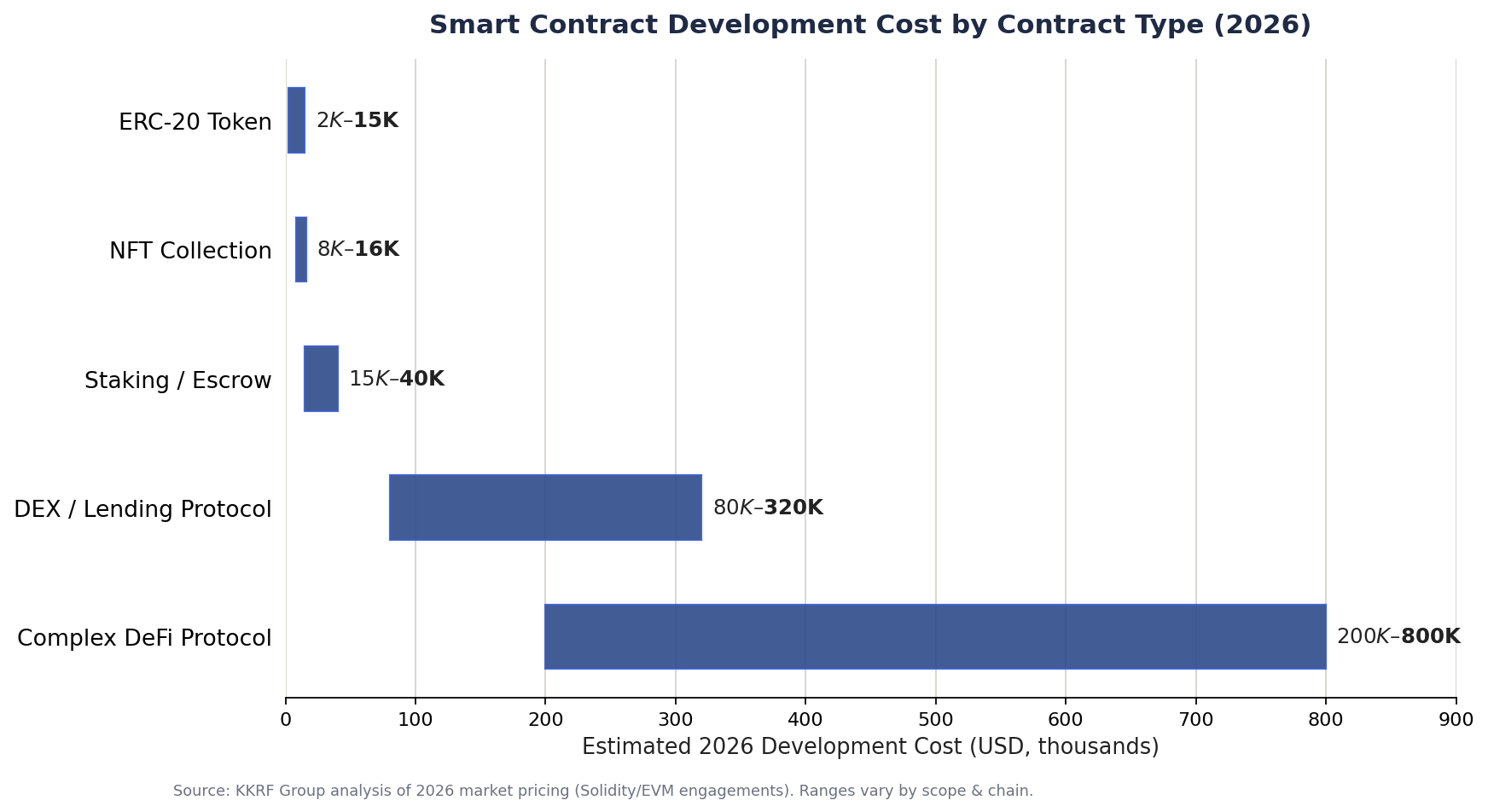
As a rough rule, plan for development to be one part of a larger number. Testing, auditing, and deployment commonly add another 50–100% on top of the raw coding cost. A protocol quoted at $80,000 for development can realistically reach $130,000–$160,000 once security and launch are included.
Development cost by contract type
| Contract Type | Typical 2026 Cost | Effort | Example |
|---|---|---|---|
| Simple token (ERC-20) | $2,000 – $15,000 | 20–40 hours | Utility or reward token |
| NFT collection | $8,000 – $16,000 | 40–80 hours | PFP mint, ticketing |
| Staking / escrow | $15,000 – $40,000 | 80–200 hours | Vesting, marketplace escrow |
| DEX / lending protocol | $80,000 – $320,000 | 400–800 hours | AMM, money market |
| Complex DeFi / bridge | $200,000 – $800,000 | 1,000+ hours | Cross-chain protocol |
Developer rates underpin these numbers. In 2026, junior Solidity developers charge roughly $50–$100 per hour, mid-level engineers $100–$200, and senior smart contract specialists $200–$400. For code that guards real money, the senior rate is not where you cut corners.
What Drives Smart Contract Development Cost
Two projects with identical feature lists can differ in price by a factor of three. The variables below explain why, and understanding them helps you scope a realistic budget before you request quotes.
- Logic density: complex financial math, custom oracles, and novel mechanisms cost far more than standard patterns.
- Codebase size: more contracts and more lines mean more surface area to write, test, and audit.
- Blockchain platform: non-EVM chains like Solana carry a 20–30% premium over equivalent Ethereum work because of smaller talent pools and different tooling.
- Integrations: oracles, cross-chain bridges, and off-chain keepers each add engineering and attack surface.
- Timeline urgency: rush schedules add 30–50% and shorten the audit window, which raises risk.
- Compliance requirements: KYC hooks, transfer restrictions, and jurisdictional rules add scope for regulated tokens.
There is good news on the cost side. Clean code with full test coverage can cut an audit quote by 15–25%, because auditors spend less time untangling messy logic. Deploying to Layer 2 networks such as Polygon, Arbitrum, or Optimism can reduce end-user transaction costs by up to 90% compared with Ethereum mainnet, which changes the economics of any high-volume application.
The Smart Contract Development Process, Step by Step
A disciplined process is what separates a contract that survives contact with real users from one that becomes a headline. KKRF Group follows a six-stage pipeline, and each stage produces an artifact the client can review before the next begins.
Requirements and threat modeling
We define exactly what the contract must do, who can call each function, and what must never be possible. This is where a threat model is built, listing the assets at risk and the ways an attacker might reach them.
Architecture and specification
Engineers design the contract structure, state variables, access control, and upgrade strategy. A written specification documents every function and invariant so behavior is agreed before coding starts.
Development in Solidity or Rust
Developers implement the specification using audited libraries such as OpenZeppelin where possible. Reusing battle-tested components reduces both cost and risk versus writing everything from scratch.
Testing and formal verification
The team writes unit tests, fuzz tests, and invariant tests, aiming for near-total coverage. For high-value logic, formal verification mathematically proves that specific properties always hold.
Independent security audit
A separate audit team, ideally external, reviews the code for vulnerabilities. Findings are fixed, and the auditor re-checks the changes before sign-off.
Deployment and monitoring
The contract is deployed with scripted, repeatable steps, verified on the block explorer, and connected to on-chain monitoring that alerts the team to abnormal activity.
Skipping or compressing any stage is where trouble starts. The most expensive failures we have reviewed came from teams that rushed testing to hit a launch date, then discovered the gap only after funds were live.
Scoping a token, dApp, or DeFi protocol and unsure what it should really cost? Our engineers can turn your requirements into a fixed-scope estimate with a security plan built in. Talk to our smart contract team.
Get a Custom Project Estimate →Smart Contract Security Audits Explained
Smart contract security audit: an independent, systematic review of contract code to find vulnerabilities, logic errors, and economic exploits before deployment. It combines manual expert review with automated tools such as static analyzers, fuzzers, and formal verification.
An audit is the single most important line item in a smart contract budget. Because deployed code is immutable and controls real value, a bug is not a patch-on-Tuesday inconvenience; it is a permanent, exploitable liability. This is why every credible development process ends with independent review.
Audit pricing in 2026 tracks complexity closely. A simple token or NFT audit runs about $5,000–$15,000. A standard DeFi protocol audit lands between $50,000 and $100,000. A cross-chain bridge or high-complexity system can reach $150,000–$500,000 or more. Rush timelines add 30–50%, and elite firms often carry waiting lists of two to three months.
Solana audits cost 20–30% more than equivalent Ethereum audits, reflecting the smaller pool of specialized reviewers. Many teams now treat security as ongoing rather than one-time, allocating 15–20% of their annual development budget to security-as-a-service retainers of roughly $5,000–$30,000 per month for hotfix support and upgrade reviews.
What a good audit actually checks
- Reentrancy and access control — the classic and still most damaging categories of exploit.
- Arithmetic and rounding — overflow, precision loss, and manipulation of price math.
- Oracle and price manipulation — flash-loan attacks that distort the data a contract trusts.
- Economic and game-theory flaws — incentives that let an attacker profit without breaking any single function.
- Upgradeability risks — proxy patterns that, if mishandled, hand control to the wrong party.
Where Your Project Budget Actually Goes
Clients are often surprised that writing the contract is less than half the bill. Security, testing, and deployment together usually cost more than the core development. The breakdown below reflects a typical mid-complexity engagement; for DeFi and bridge systems, the audit slice grows further.
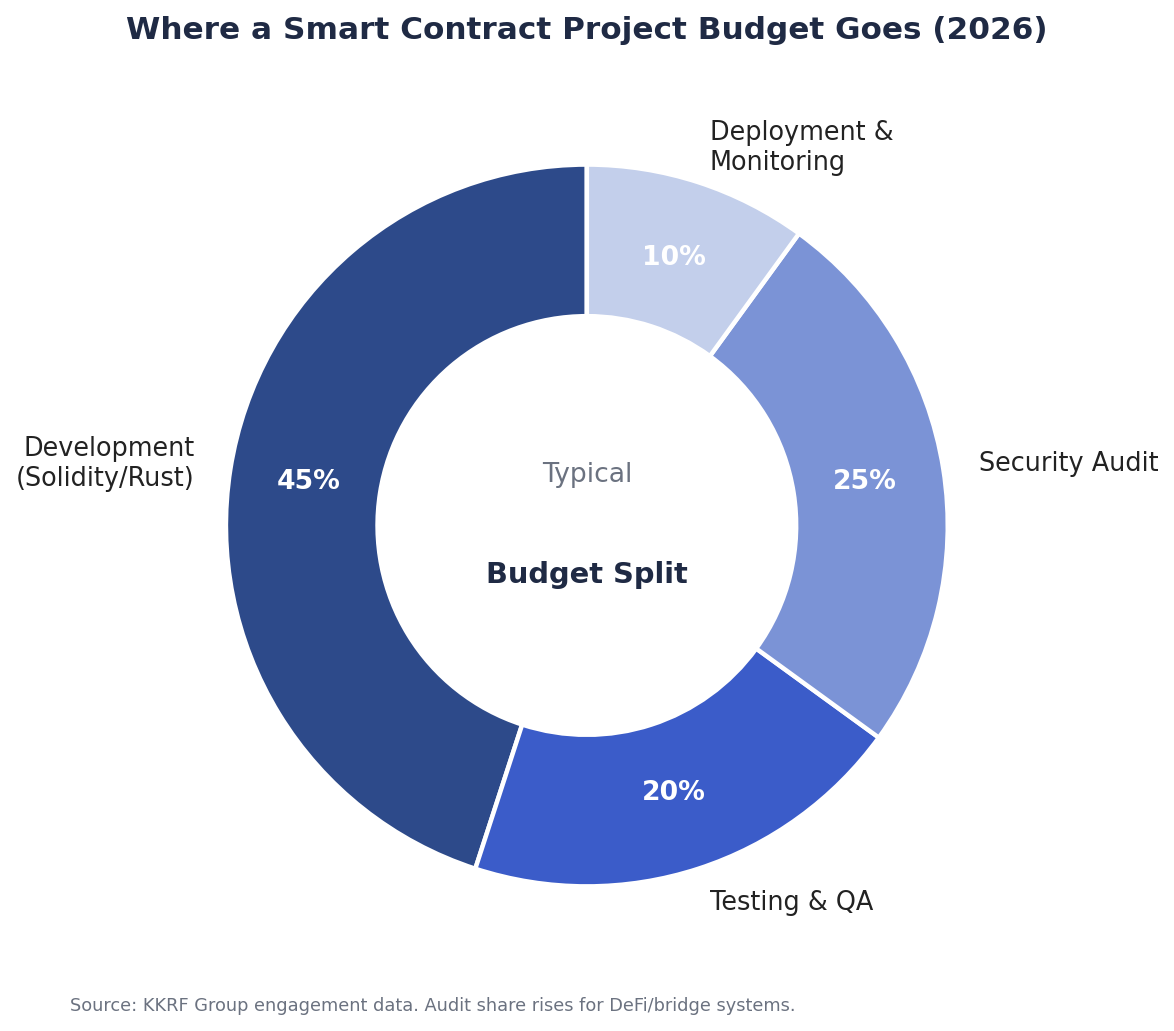
The lesson is simple. When a quote allocates almost everything to development and treats the audit as a small footnote, that is a warning sign. A realistic proposal makes room for testing and independent review as first-class costs.
Smart Contract Use Cases by Industry
Smart contracts started in crypto, but the pattern of automated, tamper-resistant agreements now reaches well beyond it. Each use case below represents a real category of demand we field enquiries for.
- DeFi: decentralized exchanges, lending markets, and yield distribution where the contract holds and moves capital automatically. The DeFi market’s revenue is projected to reach roughly $26 billion in 2026.
- NFT and media: minting, ticketing, and automated royalty payments that pay creators on every resale without an intermediary.
- Real estate and escrow: conditional release of funds once agreed milestones are verified on-chain.
- Supply chain: provenance tracking and automatic settlement between parties as goods change hands.
- Gaming and loyalty: in-game assets and reward points that users truly own and can trade.
- Enterprise finance: stablecoin payments and tokenized assets settling in seconds rather than days.
In short: The strongest candidates for smart contracts share one trait — a multi-party agreement where automated, verifiable enforcement removes cost, delay, or the need to trust a middleman.
In-House vs Freelancer vs Agency
Who should build your contract? The answer depends on how much blockchain work you have, how sensitive the code is, and how much security expertise you can access. The comparison below lays out the honest trade-offs.
| Factor | In-House Team | Freelancer | Development Agency |
|---|---|---|---|
| Upfront cost | High (salaries + benefits) | Low | Medium, scoped per project |
| Security depth | Varies by hire | Often limited | Strong; dedicated audit capacity |
| Speed to start | Slow (hiring cycle) | Fast | Fast |
| Accountability | Full internal control | Single point of failure | Contractual, team-based |
| Best for | Ongoing product roadmap | Simple, low-value contracts | High-value or complex builds |
For a single low-risk contract, a vetted freelancer can be enough. For anything holding meaningful value, an agency with in-house security review, such as KKRF Group, reduces the odds that one person’s blind spot becomes your exploit.
Common Smart Contract Development Mistakes
Most exploited contracts do not fail because of exotic attacks. They fail on well-known mistakes that a mature process would have caught. These are the ones we see most often.
- Auditing too late or not at all — treating security as an optional final step rather than a built-in phase.
- Copy-pasting unvetted code — reusing contract snippets from unknown sources without understanding them.
- Weak access control — leaving privileged functions callable by the wrong addresses.
- Ignoring gas and upgrade design — shipping a contract that is too expensive to use or impossible to fix.
- Thin test coverage — testing the happy path only and missing edge cases that attackers probe first.
- No monitoring after launch — going live with no alerting, so the first sign of trouble is drained funds.
A pre-deployment review often costs a fraction of what a single exploit would. KKRF Group can audit your existing contracts or design a secure build from scratch. Request an architecture review before you go live.
Request an Architecture Review →How to Choose a Smart Contract Development Company
The right partner is defined by security discipline first and everything else second. Use the framework below to separate real engineering teams from resellers who outsource the hard parts.
Choose a partner who:
- Publishes or shares audit reports and can name the auditors they work with.
- Writes comprehensive tests and can show coverage numbers, not just promises.
- Explains their threat model for your specific project in plain language.
- Has shipped contracts on the exact chain you are targeting.
- Builds monitoring and an incident plan into the engagement, not just the code.
Be cautious when a vendor:
- Quotes a flat price before understanding your requirements.
- Treats the audit as optional or bundles a token self-review as if it were independent.
- Cannot point to production contracts they have shipped and secured.
- Promises an aggressive launch date that leaves no real audit window.
Recommendation: For any contract that will hold user funds, prioritize a partner with independent audit capacity and a documented process over the lowest bid. The cost difference between a mediocre and an excellent build is small next to the cost of a single exploit. When custom logic and real value are involved, engineering depth wins.
Smart Contract Trends in 2026
The discipline is maturing fast, and a few shifts are reshaping how contracts get built and secured this year.
- Security-as-a-service: continuous monitoring and monthly retainers are replacing one-time audits for serious protocols.
- Layer 2 by default: teams deploy to Polygon, Arbitrum, and Optimism first to cut user fees dramatically.
- AI-assisted review: automated tools now surface common bug classes early, though human auditors remain essential for economic logic.
- Formal verification going mainstream: mathematical proofs, once reserved for the largest protocols, are reaching mid-size projects.
- Cross-chain complexity: as assets move between chains, bridges and messaging layers are the new high-value attack surface.
Public support is growing too. The Ethereum Foundation launched a $1 million audit subsidy program to help builders offset security costs, a sign that the ecosystem now treats auditing as core infrastructure rather than a luxury.
Frequently Asked Questions
How much do smart contract development services cost in 2026?
Costs range from about $2,000–$15,000 for a simple token, $15,000–$40,000 for staking or escrow contracts, and $80,000–$800,000 for DEX, lending, or complex DeFi protocols. A separate security audit typically adds 20–25% to the total budget.
Do I really need a smart contract audit?
Yes, for any contract that holds value. Deployed contract code is immutable, so a bug cannot simply be patched later — it becomes a permanent, exploitable liability. An independent audit is the standard safeguard before mainnet deployment.
How long does smart contract development take?
A simple ERC-20 token can be ready in one to two weeks. A mid-complexity dApp usually takes four to eight weeks including testing, and a full DeFi protocol with auditing commonly runs three to six months.
Which blockchain is cheapest for smart contracts?
Layer 2 networks such as Polygon, Arbitrum, and Optimism reduce user transaction fees by up to 90% versus Ethereum mainnet. Development cost is similar across EVM chains, but Solana and other non-EVM chains carry a 20–30% premium.
What languages are smart contracts written in?
Ethereum and other EVM chains use Solidity (and sometimes Vyper). Solana uses Rust, and newer chains like Aptos and Sui use Move. The right language depends entirely on the target blockchain.
Can smart contracts be changed after deployment?
Not directly — the deployed bytecode is permanent. Teams achieve upgradeability through proxy patterns that separate logic from storage, but these add complexity and must be designed and audited carefully to avoid new risks.
Ready to build on-chain logic you can trust with real value? KKRF Group designs, audits, and deploys production-grade smart contracts across Ethereum, Solana, Polygon, and Layer 2 networks. Discuss your smart contract project with our engineering team.
Book a Discovery Call →Smart contracts reward precision and punish shortcuts. The teams that succeed treat security as a design principle, not a final checkbox, and they choose partners who do the same. If you are planning a token, a dApp, or a full protocol, start with the process and the security plan — the code follows from there.