
Choosing the right fitness app development company in New York is the difference between an app people abandon in a week and one they open every morning. New York runs on fitness. From a Financial District lunch-hour HIIT class to a Brooklyn run club to a corporate wellness program on Park Avenue, demand for well-built movement software has never been higher. As a top mobile app development company, KKRF Group builds fitness apps that hold up under real user load, sync cleanly with wearables, and give people a reason to open them on day thirty, not just day one.
This guide breaks down what a fitness app costs in New York, the features that matter in 2026, the technology behind them, and how to pick a development partner without getting burned. Everything below reflects how we actually scope and ship these products.
Key Takeaways
- A fitness app in New York typically costs $30,000–$150,000, with enterprise, Peloton-class platforms reaching $400,000+. A lean MVP can start near $20,000.
- The features that separate a 2026 app from a 2021 one are AI workout personalization, computer-vision form checking, and reliable wearable sync.
- Google has deprecated the old Google Fit APIs. New Android builds should target Health Connect; iOS still uses Apple HealthKit.
- NYC’s fitness market — boutique studios, corporate wellness, physical therapy, and sports — rewards apps that are vertical-specific, not generic step counters.
- KKRF Group builds fitness apps with a security-first, wearable-ready architecture and ships an MVP in roughly 3–4 months.
What This Guide Covers
- Quick Answer
- What Fitness App Development Involves
- Fitness App Development Cost in New York
- Must-Have Features for 2026
- The Technology Stack
- Our Development Process
- Wearable & Health-Platform Integration
- Security, Privacy & Compliance
- Monetization & ROI
- Common Mistakes NYC Founders Make
- How to Choose a Partner in New York
Quick Answer: Fitness App Development in New York
Fitness app development in New York costs between $30,000 and $150,000 for most commercial apps, with a basic MVP starting around $20,000 and enterprise platforms — think live classes, a trainer marketplace, and advanced AI — running $150,000 to $400,000+. A typical build takes four to seven months. The biggest cost drivers in 2026 are AI-driven workout personalization, computer-vision form correction, and wearable integration across Apple HealthKit and Android’s Health Connect. New York teams charge more than offshore shops, but proximity to your studio, gym, or clinic often pays for itself in faster iteration.
KKRF Group works with New York founders across boutique fitness, corporate wellness, physical therapy, and sports. We favor an engineering approach built for scale from the start: a clean wearable data pipeline, a security-first backend, and an architecture that lets you add live streaming or a marketplace later without a rebuild. We don’t fabricate vanity metrics — we scope honestly and tell you when an off-the-shelf platform would serve you better than custom code.
What Fitness App Development Actually Involves
Fitness app development is the process of designing, building, and maintaining a mobile application that helps people track workouts, follow training plans, monitor health data, and stay motivated. It combines native or cross-platform mobile engineering, a cloud backend, integrations with wearables and health platforms, and — increasingly — machine learning for personalization and form analysis.
A modern fitness app is rarely a single feature. It is a system: an onboarding flow that captures goals, a tracking engine that logs activity, a sync layer that pulls heart rate and steps from a watch, and a content or coaching layer that tells the user what to do next. Getting these parts to work together reliably is the actual engineering challenge, and it is where cheap builds tend to fall apart.
Definition: AI workout personalization
AI workout personalization is the use of machine learning to adjust a user’s training plan based on their performance, recovery, and stated goals. Instead of serving the same fixed program to everyone, the app raises or lowers intensity, swaps exercises, and reschedules sessions using data the user generates. It is the single feature most associated with retention in 2026 fitness apps.
Definition: Computer-vision form checking
Computer-vision form checking uses the phone camera and human pose estimation to analyze a user’s movement in real time and flag poor technique. The app maps body joints frame by frame, compares the angles against a correct-form model, and gives cues like “keep your knees behind your toes.” It reduces injury risk and gives home users the feedback they would otherwise get from an in-person trainer.
How Much Does Fitness App Development Cost in New York?
Cost depends almost entirely on scope. A step-and-workout tracker is a different animal from a platform that streams live classes to thousands of concurrent users. The table below shows the realistic ranges we see for New York projects in 2026, using local and hybrid development rates.
| App Tier | What You Get | Cost (USD) | Timeline |
|---|---|---|---|
| MVP | Onboarding, workout logging, basic plans, one platform | $20,000–$35,000 | 2–3 months |
| Basic app | Tracking, goals, accounts, iOS + Android | $30,000–$50,000 | 3–4 months |
| Mid-range | AI personalization, wearable sync, nutrition, social | $50,000–$150,000 | 4–7 months |
| Enterprise | Live classes, marketplace, CV form check, advanced AI | $150,000–$400,000+ | 7–12 months |
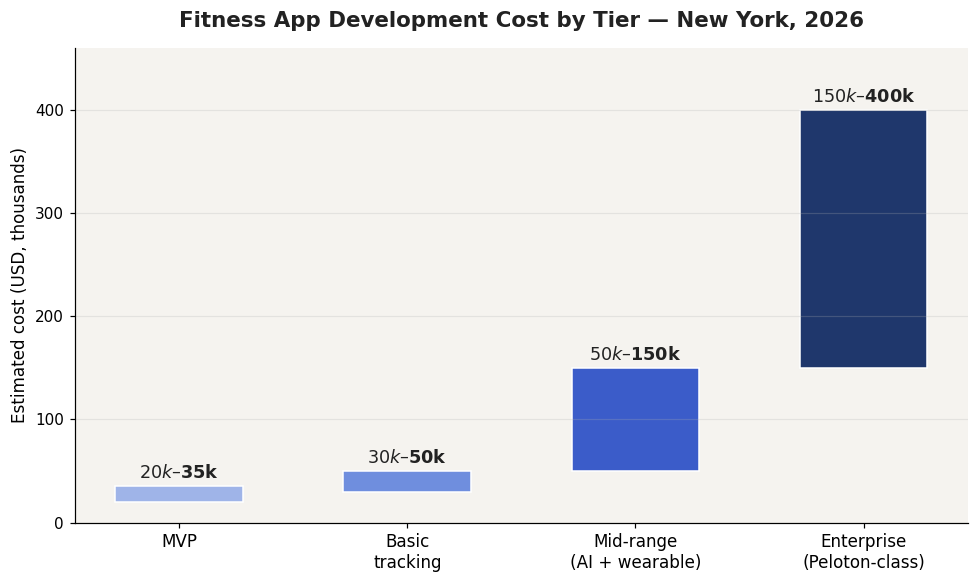
Several factors push a New York quote up or down. Platform choice matters: shipping iOS and Android natively costs more than a single React Native codebase. Wearable support adds engineering time for each device family. AI features, especially computer-vision form checking, carry both build cost and ongoing inference cost. And live video — the Peloton-style feature everyone asks for — is the most expensive single thing you can add, because streaming infrastructure and content production never really stop costing money.
Where the money actually goes
On a typical mid-range NYC build, engineering is roughly 55–65% of the budget, design is 12–18%, backend and DevOps infrastructure is 10–15%, and QA is 8–12%. Ongoing costs after launch — cloud, wearable API maintenance, app store fees, and updates — usually land around 15–20% of the original build cost per year. Budgeting only for the build and not the first year of operation is the most common financial mistake we see.
Must-Have Features for a 2026 Fitness App
Users now arrive with expectations set by the best apps on the market. A workout log alone will not hold attention. The features below are the ones that correlate with retention and, ultimately, with revenue. Not every app needs all of them — a physical therapy app and a run-club app have different priorities — but this is the menu worth scoping against.
- Personalized onboarding and goal setting — capture fitness level, goals, and constraints so the app can adapt from session one.
- AI-driven workout plans — programs that adjust to performance and recovery rather than a static PDF.
- Wearable and sensor sync — heart rate, steps, sleep, and calories pulled from Apple Watch, Fitbit, Garmin, and Android wearables.
- Computer-vision form correction — camera-based technique feedback for home workouts.
- Nutrition and macro tracking — food logging and guidance tied to the user’s goals.
- Social challenges and leaderboards — gamified accountability that drives daily opens.
- Live and on-demand classes — streaming content with a real content pipeline behind it.
- Mental wellness tools — guided breathing, stress tracking, and recovery, now standard in premium apps.
- Subscriptions and payments — flexible billing, free trials, and in-app purchases.
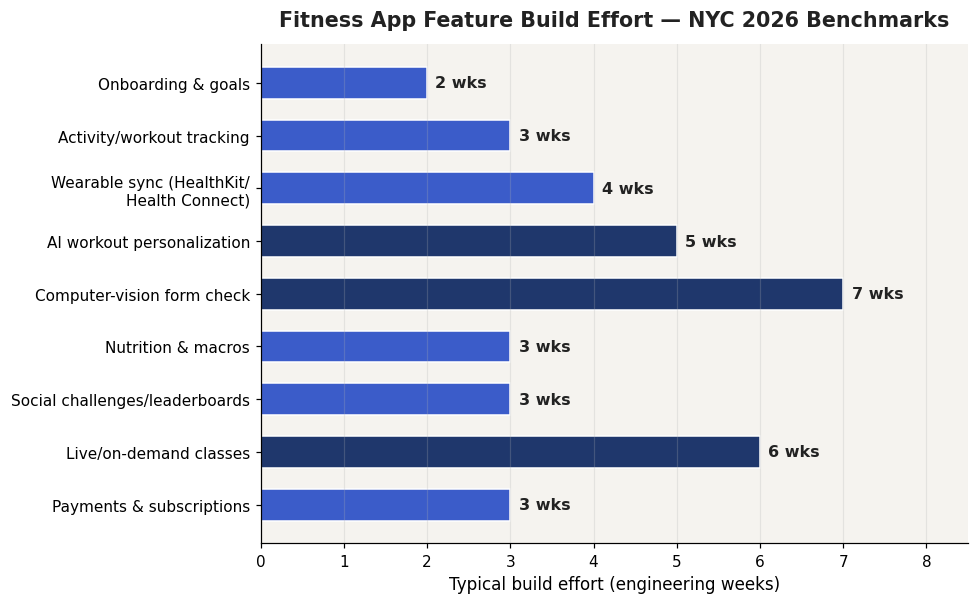
We generally recommend launching with a tight core — onboarding, tracking, wearable sync, and one differentiator — then expanding. Trying to ship every feature at once is how six-month projects become eighteen-month projects. The chart above shows the rough engineering effort behind each feature, which is a useful way to prioritize a first release.
The Technology Stack Behind a Modern Fitness App
The right stack depends on your budget, your team, and how much you lean on device-specific features. For most New York clients we recommend a cross-platform front end to control cost, paired with a backend chosen for its ability to handle continuous streams of wearable data. Here is the stack we reach for most often.
| Layer | Typical Choice | Why |
|---|---|---|
| Cross-platform UI | React Native or Flutter | One codebase, faster and cheaper for most fitness apps |
| iOS health data | Swift + Apple HealthKit | Native access to Apple Health and Apple Watch metrics |
| Android health data | Kotlin + Health Connect | Google’s supported replacement for the deprecated Fit APIs |
| AI / ML services | Python, TensorFlow, pose-estimation models | Personalization and computer-vision form checking |
| Backend | Node.js, Python, or Go | Handles high-frequency wearable data ingestion |
| Data storage | PostgreSQL + a time-series database | Relational data plus continuous sensor streams |
| Cloud | AWS or Google Cloud | Scalable, HIPAA-eligible services for health data |
One 2026-specific note: if you are building for Android, do not start on the old Google Fit APIs. Google has deprecated them and is consolidating health data behind Health Connect, with the Fitbit app itself being folded into a unified Google Health experience. New builds that ignore this will be re-engineering their sync layer within a year.
Our Fitness App Development Process, Step by Step
We run fitness projects in clear phases so clients always know what is happening and why. The sequence below is how we take a New York fitness idea from a first conversation to a live app in the stores.
- Discovery and scoping. We map your goals, users, and business model, then define an MVP feature set and a realistic budget. This is where we decide what to cut from version one.
- UX and UI design. We design the onboarding, tracking, and coaching flows, prototype them, and test with real users before writing production code.
- Architecture and setup. We stand up the backend, data model, wearable sync layer, and cloud infrastructure with security built in from the first commit.
- Core development. We build in two-week sprints, shipping working features you can try, starting with tracking and wearable integration.
- AI and advanced features. We layer in personalization, computer-vision form checking, and content or live-class systems once the core is stable.
- Testing and QA. We test across devices, wearables, and network conditions, with a hard focus on data accuracy and sync reliability.
- Launch and iteration. We handle the App Store and Play Store submissions, then use real usage data to guide the next round of work.
Each phase produces something you can see. We have watched too many founders hand money to a black-box vendor and receive nothing until a disappointing final reveal. A transparent, sprint-based process is the antidote, and it is how we work on every build.
Have a fitness product in mind and want a real number instead of a guess? Our New York team will scope it and send back a features-and-cost breakdown. Start with our mobile app development team in New York.
Wearable and Health-Platform Integration
Wearable sync is where a lot of fitness apps quietly fail. Users expect their watch data to appear instantly and accurately, and when it doesn’t, they leave. Doing this well means engineering directly against each platform’s health framework rather than a shaky third-party shortcut.
Definition: Apple HealthKit
Apple HealthKit is the iOS framework that lets apps read from and write to the user’s Apple Health data, including heart rate, steps, workouts, and sleep. It centralizes health data on the device with the user’s permission and is the standard path for Apple Watch integration. Any serious iOS fitness app builds on it.
Definition: Health Connect
Health Connect is Google’s health data platform for Android, designed to replace the deprecated Google Fit APIs. It acts as a single on-device store that fitness apps can read from and write to, unifying data from watches, phones, and other health apps. New Android fitness builds in 2026 should target Health Connect rather than legacy Fit endpoints.
Beyond the two big platforms, real projects often need direct integrations with Fitbit, Garmin, Oura, or Whoop, each with its own API quirks and rate limits. We build a normalization layer so that whatever device a user wears, the data lands in one consistent format your app logic can trust. For health-adjacent apps, our healthcare app development work in New York feeds directly into how we handle sensitive biometric data here.
Security, Privacy, and Compliance for Fitness Apps
Fitness apps collect some of the most sensitive data a person generates: heart rate, weight, sleep, location, and sometimes medical context. Treating that carelessly is both a legal risk and a trust killer. Security is not a feature you bolt on at the end — it shapes the architecture from the start.
At a minimum, a New York fitness app should encrypt data in transit and at rest, use token-based authentication, and follow least-privilege access on the backend. If your app touches anything that looks like protected health information — a physical therapy plan, a clinical program, an insurer partnership — it likely falls under HIPAA, which raises the bar on hosting, logging, and business-associate agreements.
Privacy regulation matters too. Apple and Google both require clear disclosure of health data use, and app-store review will reject builds that mishandle it. We design consent flows and data-deletion paths that satisfy both the platforms and regulations like GDPR and CCPA, so a compliance surprise never stalls your launch. For baseline guidance, we lean on established references such as the OWASP Mobile Security guidance and NIST frameworks.
Not sure whether to build native, go cross-platform, or start with an MVP? A short technical review will save you months. Talk to the engineers who would actually build it via our mobile app development services.
Monetization and ROI: How Fitness Apps Make Money
A great app that never earns is still a failed product. Fitness apps have several proven revenue models, and the right mix depends on your audience. The point is to design monetization into the product early, not tape it on after launch.
- Subscriptions. The dominant model — monthly or annual access to plans, classes, and premium features, often with a free trial.
- Freemium. A free core with paid upgrades for AI coaching, advanced analytics, or live content.
- In-app purchases. One-off programs, challenges, or specialist content.
- Marketplace commissions. A cut of trainer or studio bookings made through the app.
- Corporate wellness. B2B contracts with NYC employers — often the most stable revenue of all.
ROI comes down to retention and lifetime value. A fitness app that keeps a user paying for twelve months is worth far more than one with flashy features and a two-week churn cliff. This is why we push AI personalization and social accountability so hard — they are not just features, they are the difference between a subscription that renews and one that cancels.
Common Mistakes NYC Founders Make
We have seen the same avoidable errors sink fitness projects across New York. Knowing them in advance is cheap insurance.
- Building every feature at once. Scope creep turns a four-month MVP into a year-long money pit. Launch lean, then expand on real data.
- Treating wearable sync as an afterthought. Unreliable data is the fastest way to lose users. It belongs in the core, not the backlog.
- Ignoring retention design. Acquisition without retention just fills a leaky bucket. Habit loops and personalization matter more than a download spike.
- Skipping compliance planning. Discovering HIPAA obligations after launch means an expensive rebuild.
- Choosing the cheapest developer. A rock-bottom quote often means a rewrite within a year. Total cost, not sticker price, is what counts.
How to Choose a Fitness App Development Company in New York
Picking the right partner is a decision framework, not a coin flip. Use the guidance below to decide when a New York firm like KKRF Group is the right call — and when it isn’t.
When to choose a specialized New York partner
Choose a local, specialized team when your app depends on complex integrations — wearables, AI, live streaming — or handles sensitive health data. Choose one when you value fast, in-person iteration and want a partner who understands the NYC fitness market, from boutique studios to corporate wellness buyers. And choose one when you are building a long-term product, not a throwaway prototype, and need an architecture that scales.
When a different route may fit better
If your idea is a simple content or scheduling app with no custom logic, an off-the-shelf platform or a no-code tool may get you live faster and cheaper. If your budget is truly minimal and your goal is only to validate demand, a lightweight MVP — or even a landing page test — may be the smarter first step. An honest partner will tell you this rather than sell you a build you don’t need.
What to evaluate in any candidate
Look for a real portfolio of shipped mobile apps, clear experience with wearable and health-platform integration, a transparent and sprint-based process, and a security-first mindset. Ask how they handle HealthKit and Health Connect, how they price ongoing maintenance, and who owns the code and data. Vague answers on any of these are a warning sign.
KKRF Group checks these boxes as a top mobile app development company serving New York: custom engineering, enterprise-grade architecture, wearable-ready data pipelines, and a straight-talking process. We would rather scope your project accurately than win it on a number we can’t deliver on.
Ready to move from idea to launch? KKRF Group designs, builds, and scales fitness apps for New York studios, startups, and wellness brands. Let’s map your roadmap together.
Final Thoughts
A fitness app is only as good as the engineering and product thinking behind it. In New York — a city that takes both fitness and technology seriously — the bar is high, and the apps that win are the ones built with retention, reliable data, and real personalization in mind. Budget realistically, launch lean, integrate wearables properly, and treat health data with the care it deserves. Do that, and you have a product people keep opening. KKRF Group is ready to help you build it, from first sketch to a scaled, revenue-generating app.
How much does it cost to build a fitness app in New York?
Most commercial fitness apps in New York cost $30,000 to $150,000. A basic MVP starts around $20,000, while an enterprise platform with live classes and advanced AI can exceed $400,000. The main cost drivers are AI personalization, wearable integration, and live video.
How long does it take to develop a fitness app?
A basic fitness app takes about three to four months. A mid-range app with AI personalization and wearable sync usually takes four to seven months, and enterprise platforms can run seven to twelve months. Launching a lean MVP first is the fastest route to real users.
Which technology stack is best for a fitness app in 2026?
For most apps, React Native or Flutter gives you one codebase across iOS and Android. Health data uses Apple HealthKit on iOS and Health Connect on Android, with Python and TensorFlow for AI features and a backend on Node.js, Python, or Go paired with PostgreSQL and a time-series database.
Do fitness apps need to be HIPAA compliant?
If your app handles protected health information — such as a clinical program, physical therapy plan, or insurer partnership — it likely falls under HIPAA. Consumer fitness tracking often does not, but any app collecting sensitive biometric data should still encrypt data, use strong authentication, and follow privacy laws like GDPR and CCPA.
How do fitness apps make money?
The dominant model is subscriptions, often with a free trial. Others include freemium upgrades, in-app purchases, marketplace commissions on trainer or studio bookings, and B2B corporate wellness contracts, which are especially stable in the New York market. Retention and lifetime value determine real ROI.
Why choose a New York fitness app development company?
A local New York partner offers fast, in-person iteration and real understanding of the NYC fitness market, from boutique studios to corporate wellness buyers. KKRF Group brings custom engineering, wearable-ready architecture, and a security-first, transparent process built for apps that scale.