
Choosing the right eLearning app development company in New York often decides whether an education product scales to thousands of learners or stalls a month after launch. New York City has become one of the densest EdTech markets in the United States, and demand for serious learning apps keeps climbing. KKRF Group, a top mobile app development company, builds eLearning apps that hold up under real classroom and enterprise load.
QUICK ANSWER
eLearning app development in New York typically costs $40,000–$90,000 for a basic MVP, $90,000–$160,000 for a cross-platform iOS and Android app, and $160,000–$600,000+ for AI-driven or enterprise LMS platforms. Timelines run 3–15 months. The right partner is one with proven education app experience, in-house engineers, and clear FERPA, COPPA, and accessibility practices.
Key Takeaways
- NYC eLearning app costs scale with content complexity, video infrastructure, live features, and compliance — not just screen count.
- Cross-platform tools like Flutter and React Native cut cost for most K-12 and corporate training apps; native iOS or Android still wins for heavy media and offline learning.
- FERPA, COPPA, and WCAG accessibility are non-negotiable for apps touching student data in New York.
- Video streaming, an LMS or content engine, and analytics dashboards are the three features that most influence budget.
- The best eLearning app development company in New York shows education case studies, keeps engineering in-house, and prices transparently.
What This Guide Covers
- What eLearning App Development Means
- Why New York Is an EdTech Hotspot
- Cost in New York (2026)
- Budget Breakdown by Component
- Must-Have Features
- Types of eLearning Apps
- The Development Process
- Tech Stack
- Compliance & Security
- Native vs Cross-Platform
- Common Mistakes to Avoid
- How to Choose a Partner
- FAQ
What eLearning App Development Actually Means
eLearning app development is the process of designing, building, and shipping mobile or web applications that deliver structured learning — courses, lessons, assessments, and progress tracking — to students, employees, or the public. It combines a content system, a learner interface, and often a backend that manages users, media, and analytics.
A modern eLearning app is more than a video player. It usually pairs with a learning management system (LMS): the software layer that organizes courses, enrolls users, tracks completion, and reports outcomes. When a New York school district or an EdTech startup commissions an app, they are really buying this whole ecosystem, not a single screen.
Two standards come up constantly. SCORM and xAPI are specifications that let learning content and platforms talk to each other — SCORM packages a course so any compatible LMS can run it, while xAPI records granular learning activity across apps and devices. Getting these right early saves expensive rework later.
Why New York Is a Hotspot for eLearning and EdTech Apps
New York concentrates demand that few other cities match. The public school system alone serves roughly a million students, and that sits alongside dozens of universities, a large corporate training market on Wall Street and in media, and a startup scene running from Manhattan to Brooklyn. That mix creates steady, well-funded demand for education app development in New York.
Buyers here also expect polish. A tutoring startup pitching Manhattan parents, or an enterprise rolling out compliance training to thousands of staff, will not accept a clunky app. We have seen deals won or lost on the first ten minutes of user experience. That raises the bar for any eLearning app development company in New York and, honestly, weeds out cheaper shops fast.
Proximity matters too. Working with local education app developers in NYC means overlapping hours, in-person workshops with faculty or L&D teams, and a partner who understands the compliance climate for New York student data. KKRF Group supports clients across the five boroughs while keeping engineering in-house.
eLearning App Development Cost in New York (2026)
Here is the honest version: eLearning app development cost in New York ranges from about $40,000 for a lean MVP to well past $500,000 for an enterprise learning platform. The spread is wide because two apps that look similar can carry very different engineering underneath — live video and adaptive learning cost far more than a static course library.
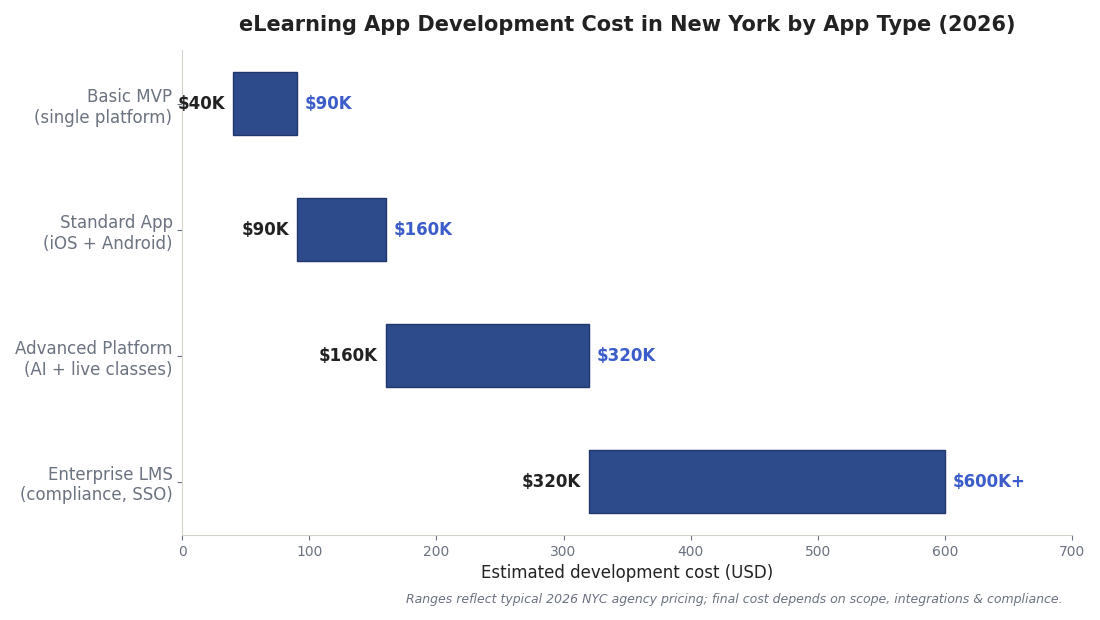
| App Type | Typical NYC Cost (2026) | Timeline | Best For |
|---|---|---|---|
| Basic MVP (single platform) | $40K–$90K | 3–4 months | Early validation, single course |
| Standard app (iOS + Android) | $90K–$160K | 5–7 months | Tutoring, test prep, K-12 |
| Advanced platform (AI, live classes) | $160K–$320K | 7–10 months | Higher ed, funded EdTech |
| Enterprise LMS (compliance, SSO) | $320K–$600K+ | 9–15 months | Corporate training at scale |
One local factor to plan for: rates. Senior engineers at a New York agency generally bill between $100 and $200 per hour, higher than offshore shops. You are paying for time-zone overlap, accountability, and lower rework. For a fuller picture of city pricing, see our mobile app development cost in New York guide.
Not sure which tier your idea falls into? We will map your feature list to a realistic NYC budget and timeline before you commit a dollar — start with our mobile app development company in New York team.
Get a Custom Project Estimate →What Drives the Cost: Budget Breakdown by Component
When clients ask why one quote is double another, the answer is almost always in how the budget splits across components. A pretty interface is a small slice. The heavy spend hides in backend, video, and the content engine that powers every course.
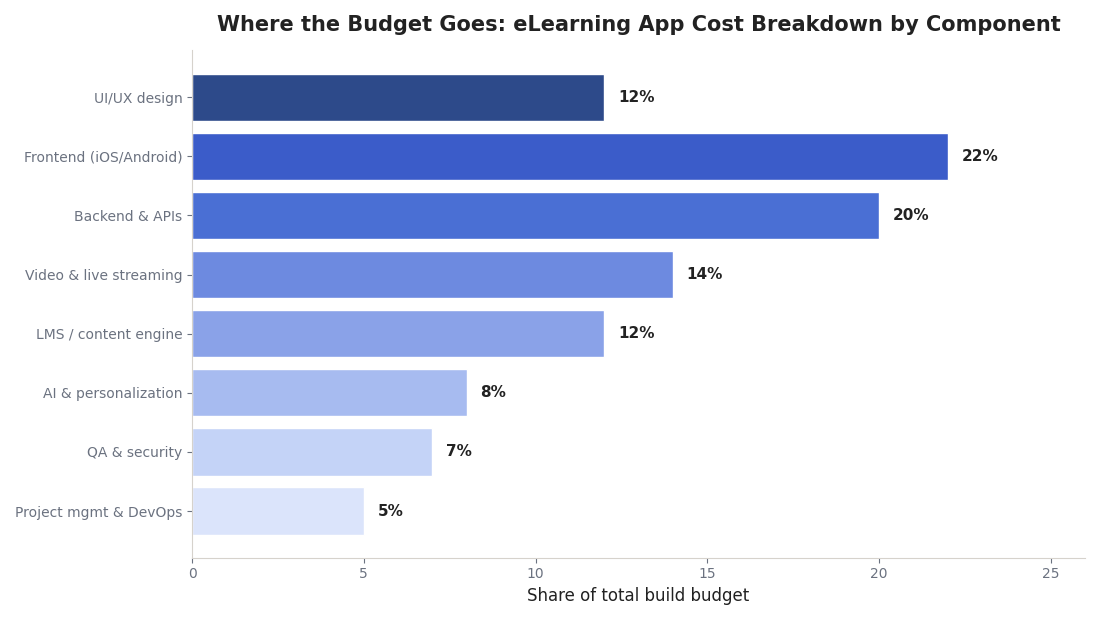
Video and live streaming deserve special attention. Delivering smooth lessons to a Brooklyn classroom on shaky Wi-Fi means adaptive bitrate streaming, a CDN, and often WebRTC for live virtual classroom sessions. That single capability can add 10–15% to a build. AI-based recommendations and adaptive learning add another layer of data engineering.
Post-launch cost is the line people forget. Budget 15–20% of the build cost per year for hosting, content updates, OS changes, and support. An eLearning app is a living product, not a one-time delivery.
Must-Have Features of a Modern eLearning App
Features decide both engagement and budget. The list below reflects what New York buyers actually ask for in 2026, ordered roughly by how often they appear in winning products.
- Course builder and content library — structured lessons, modules, and downloadable materials, ideally SCORM and xAPI compatible.
- Video streaming and live virtual classroom — recorded lessons plus real-time sessions with chat and screen sharing.
- Assessments and quizzes — auto-graded tests, question banks, and certificates on completion.
- Gamification — points, streaks, badges, and leaderboards that measurably lift completion rates.
- Progress tracking and analytics dashboard — learner-level and cohort-level reporting for teachers and L&D managers.
- Adaptive learning and AI-based recommendations — content that adjusts to each learner’s pace and gaps.
- Offline mode — downloaded lessons for commuters on the subway with no signal.
- Student management system and roles — separate views for learners, instructors, and admins.
- Payments and subscriptions — for consumer-facing course apps and marketplaces.
You do not need every feature on day one. The smartest New York teams ship a focused mobile learning app, prove engagement, then expand — which keeps the first invoice sane.
Types of eLearning Apps NYC Businesses Build
“eLearning app” covers several very different products. Naming yours correctly changes the architecture and the quote.
- K-12 and higher education apps — tied to curricula, parent access, and strict student-data rules.
- Corporate training and LMS apps — compliance courses, onboarding, and skills tracking for enterprises.
- Tutoring and test-prep apps — on-demand sessions, practice banks, and progress scoring.
- Online course marketplaces — multi-instructor platforms with payments, like a Udemy-style build.
- Language and skills apps — micro-lessons, streaks, and heavy gamification.
The eLearning App Development Process, Step by Step
A disciplined process is what separates a predictable build from a runaway one. This is the sequence KKRF Group follows on education projects.
- Discovery and scoping. We map learners, goals, content sources, and compliance needs, then define an MVP feature set and a fixed budget range.
- UX and learning design. Wireframes and clickable prototypes are tested with real teachers or learners before a line of production code is written.
- Architecture and tech-stack selection. We choose native or cross-platform, the backend, and the video and LMS approach based on scale and content type.
- Development in sprints. Two-week cycles ship working features you can review, so priorities can shift without blowing up the plan.
- QA, accessibility, and security testing. Functional testing runs alongside WCAG accessibility checks and a security review of student data flows.
- Launch and iteration. App Store and Google Play release, followed by analytics-driven improvements to lift completion and retention.
Tech Stack for eLearning App Development
There is no single correct stack, but there are sensible defaults. For most K-12 and corporate learning apps, a cross-platform framework keeps one codebase across iOS and Android and lowers cost.
- Cross-platform: Flutter or React Native — one team, both platforms, faster iteration.
- Native: Swift for iOS and Kotlin for Android — chosen for heavy media, complex offline use, or maximum performance.
- Backend: Node.js or Python with a scalable cloud like AWS, plus PostgreSQL for structured learner data.
- Video and live classes: HLS adaptive streaming with a CDN, and WebRTC for real-time virtual classroom sessions.
- Standards and integrations: SCORM and xAPI support, single sign-on, and LMS or SIS integrations for schools and enterprises.
For a broader view of how we assemble stacks across projects, see our mobile app development services.
Compliance and Security: FERPA, COPPA, and Accessibility
This section is not optional for New York education apps. Handling student data carries real legal weight, and getting it wrong is expensive.
FERPA (the Family Educational Rights and Privacy Act) protects the privacy of student education records and governs how schools and their vendors handle that data. Any app touching K-12 or university records in New York must design around it from day one, per the U.S. Department of Education.
COPPA (the Children’s Online Privacy Protection Act) sets rules for collecting data from children under 13, enforced by the Federal Trade Commission. If your app reaches younger learners, verifiable parental consent and data-minimization are mandatory.
Accessibility rounds it out. Following WCAG guidelines — captions, screen-reader support, sufficient contrast — is both an inclusion requirement and, increasingly, a procurement checkbox for New York institutions.
Native vs Cross-Platform: A Decision Framework
Cross-platform development builds one codebase that runs on both iOS and Android using a framework like Flutter or React Native. Native development builds a separate app per platform in Swift or Kotlin. The choice affects cost, performance, and timeline.
| Factor | Cross-Platform (Flutter / React Native) | Native (Swift / Kotlin) |
|---|---|---|
| Cost | Lower — one codebase | Higher — two builds |
| Time to market | Faster | Slower |
| Heavy video / offline | Good | Best |
| Ongoing maintenance | Simpler | Two teams |
Decision framework
Choose cross-platform when budget and speed matter, and your app is course delivery, quizzes, and standard video — most K-12, tutoring, and corporate training apps.
Choose native when you need advanced offline learning, high-end media, or platform-specific hardware features.
Limitation: cross-platform can lag on brand-new OS features by weeks. Our recommendation: start cross-platform unless a specific technical requirement forces native.
Common Mistakes to Avoid
- Building every feature at once. Scope creep is the top budget killer. Ship a focused MVP first.
- Ignoring compliance until the end. Retrofitting FERPA or COPPA controls costs far more than designing for them.
- Underbudgeting video. Streaming and live classes are the sneakiest cost line — plan for them early.
- Skipping accessibility. It blocks institutional sales and invites legal risk.
- Choosing on price alone. The cheapest quote often means the most expensive rebuild.
Planning a K-12, higher-ed, or corporate learning app in New York? Our engineers will pressure-test your feature list, compliance needs, and stack in one session — no sales fluff.
Book a Discovery Call →How to Choose an eLearning App Development Company in New York
The best eLearning app development company in New York is rarely the loudest or the cheapest. Use these criteria to filter fast.
- Real education case studies. Ask to see shipped learning apps, not generic portfolios.
- In-house engineers. Confirm the team building your app is employed by the company, not silently outsourced.
- Compliance fluency. They should discuss FERPA, COPPA, and accessibility without prompting.
- Transparent pricing. A credible partner ties cost to scope and explains trade-offs plainly.
- Post-launch support. Learning apps need updates every year; make sure that is on the table.
If you want a local partner that checks these boxes, KKRF Group builds and supports eLearning app development services for New York schools, universities, and enterprises. You can also hire dedicated mobile app developers in New York to extend your own team.
How much does eLearning app development cost in New York?
In 2026, a basic eLearning MVP in New York runs about $40,000–$90,000, a cross-platform iOS and Android app $90,000–$160,000, and advanced AI or enterprise LMS platforms $160,000–$600,000+. Final cost depends on video infrastructure, live features, integrations, and compliance requirements.
How long does it take to build an eLearning app?
A focused MVP typically takes 3–4 months. A standard cross-platform app takes 5–7 months, while enterprise LMS platforms with compliance and single sign-on can take 9–15 months. Clear scope and ready content shorten the timeline significantly.
What features should a modern eLearning app include?
Core features include a course and content library, video streaming with live virtual classrooms, assessments, gamification, a progress-tracking analytics dashboard, and role-based access for learners, instructors, and admins. Adaptive learning and offline mode are common upgrades.
Should I build a native or cross-platform eLearning app?
Most K-12, tutoring, and corporate training apps are best built cross-platform with Flutter or React Native to save cost and ship faster. Native Swift or Kotlin is worth the extra cost when you need advanced offline learning, heavy media, or platform-specific hardware features.
Do eLearning apps in New York need FERPA or COPPA compliance?
Yes. Apps handling K-12 or university student records must design around FERPA, and any app collecting data from children under 13 must follow COPPA with verifiable parental consent. WCAG accessibility is also expected by most New York institutions.
How do I choose the best eLearning app development company in New York?
Look for real education app case studies, in-house engineers, clear FERPA, COPPA, and accessibility practices, transparent scope-based pricing, and a post-launch support plan. Local NYC partners add time-zone overlap and in-person workshops with your faculty or training team.
Ready to turn your course, curriculum, or training program into an app that learners actually finish? Let’s scope it together and give you a clear budget and timeline for New York.
Talk to Our Engineering Team →