
Ask ten founders in New York what an iOS app should cost and you’ll get ten different numbers, most of them wrong. The confusion is understandable. iPhone users make up a large share of the city’s most valuable audiences — finance, media, luxury retail, healthcare — so getting the native experience right matters more here than almost anywhere else. As KKRF Group, a top mobile app development company, we’ve watched NYC teams overpay for the wrong architecture and underpay for talent that couldn’t ship. This guide is the version we wish more clients had read first.
Choosing an iOS app development company in New York isn’t only about who writes the cleanest Swift. It’s about who understands your market, your compliance exposure, and the real cost of maintaining an app once it’s live on the App Store. We’ll cover pricing, timelines, the native build process, how native stacks up against cross-platform, and how to vet a partner without getting burned.
Key Takeaways
- A native iOS app in New York typically runs $15,000–$50,000 for an MVP and $90,000–$300,000 for complex, enterprise-grade builds in 2026.
- Senior iOS engineers in NYC bill roughly $150–$250 per hour — higher than most US metros, which is why scope discipline beats hourly haggling.
- A mid-complexity iPhone app usually ships in 4–6 months from discovery to App Store launch.
- Go native (Swift/SwiftUI) when performance, hardware access, and Apple-ecosystem polish drive your product; consider cross-platform when speed to two stores matters more.
- New York apps that touch personal data must account for the NY SHIELD Act and, in healthcare or FinTech, sector rules on top of Apple’s review guidelines.
What This Guide Covers
- What an iOS App Development Company Does
- iOS App Development Cost in New York
- How Long It Takes to Build
- The Native iOS Development Process
- Native iOS vs. Cross-Platform
- Security & NYC Compliance
- The Business Case & ROI
- Common Hiring Mistakes
- How to Choose the Right Partner
- 2026 iOS Trends in New York
- Frequently Asked Questions
Quick answer: An iOS app development company in New York builds native iPhone and iPad apps using Swift and SwiftUI, from strategy through App Store launch and maintenance. In 2026, expect $15,000–$50,000 for an MVP and $90,000–$300,000 for enterprise apps, with most projects taking four to six months. The right partner is the one that ships a maintainable, secure app and understands your NYC market — not simply the cheapest bid.
KKRF Group works with startups, SMEs, and enterprises as a long-term technology partner, and iOS is one of the platforms we build on daily. What follows reflects how we scope, price, and engineer native apps — not a sales pitch. Where we mention numbers, they’re the ranges we and other New York teams actually see in the market.
What an iOS App Development Company in New York Actually Does
The job is broader than coding. A competent iOS partner owns product strategy, interface design tuned to Apple’s Human Interface Guidelines, native engineering in Swift, App Store submission, and the unglamorous work of maintenance after launch. In New York, that also means understanding who your users are. A trading app for Midtown finance users and a booking app for a Brooklyn wellness studio share almost no design assumptions.
Most reputable NYC firms cover a predictable set of services: discovery and technical strategy, UX/UI design for iPhone and iPad, native Swift and SwiftUI development, backend and API work, QA and security testing, App Store Optimization, and ongoing support. The good ones treat App Store review not as a formality but as a design constraint from day one. We’ve seen launches slip by weeks because a team bolted on compliance at the end instead of building for it.
iOS App Development Cost in New York (2026)
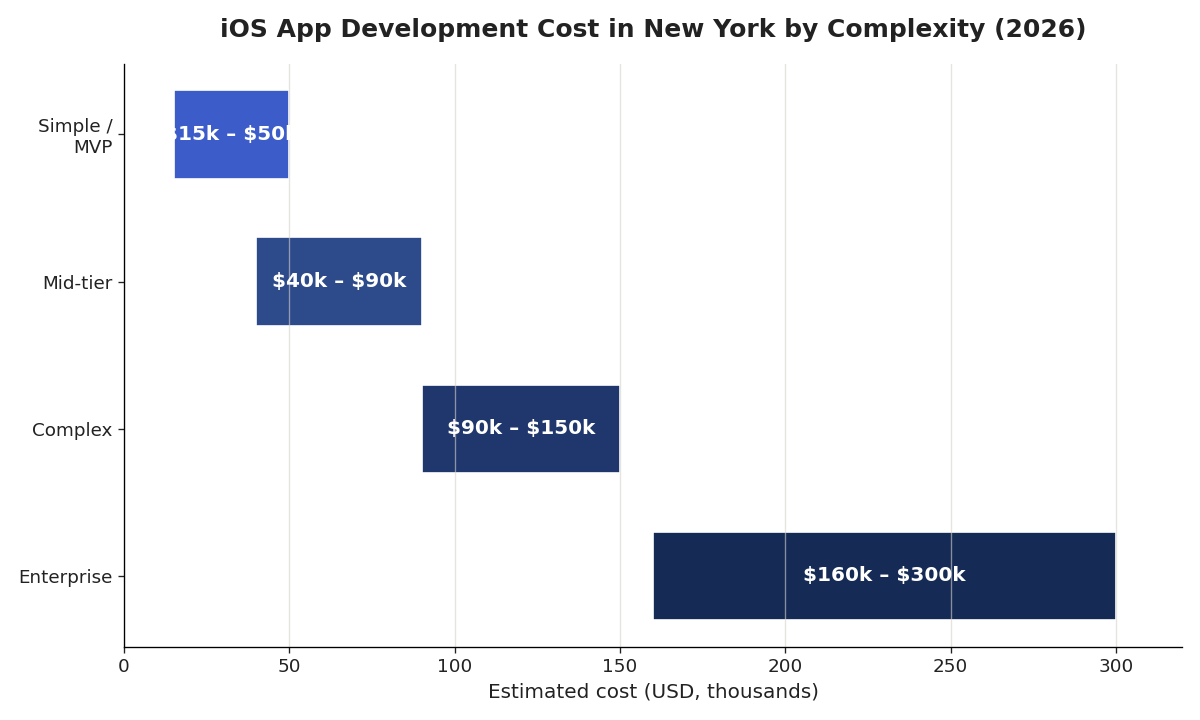
Here’s the honest version. iOS app development cost in New York is driven by scope, not by any single hourly rate. A senior iOS engineer in NYC bills roughly $150 to $250 an hour in 2026, a full-stack developer with mobile experience $120 to $180, and a strong product designer $100 to $160. Those rates sit above the national average because the talent pool is deep, expensive, and in demand. The chart below breaks the total cost down by app complexity.
| App type | Typical NYC cost (2026) | Timeline | Example |
|---|---|---|---|
| Simple / MVP | $15,000–$50,000 | 2–4 months | Single-feature app, booking, informational |
| Mid-tier | $40,000–$90,000 | 4–6 months | Marketplace, on-demand, social features |
| Complex | $90,000–$150,000 | 6–9 months | FinTech, real-time data, multiple integrations |
| Enterprise | $160,000–$300,000+ | 9–12+ months | Regulated healthcare or banking platforms |
Two costs surprise first-time founders. Maintenance runs 15 to 20 percent of the build cost every year — SDK updates, iOS version support, bug fixes, and server bills don’t stop after launch. And App Store readiness work (privacy manifests, in-app purchase plumbing, review edge cases) is real engineering, not a checkbox. For a full breakdown across platforms, our New York app development cost guide goes deeper on line items.
Not sure where your project lands on this range? A short scoping conversation usually replaces a lot of guesswork. Our engineers can pressure-test your feature list and give you a grounded estimate. See how we build iOS apps in New York.
Get a Custom Project Estimate →How Long iOS App Development Takes in NYC
Timelines slip for boring reasons: unclear scope, slow feedback, and design that keeps changing after development starts. A disciplined team can ship a mid-complexity iPhone app in four to six months. The phases below show where the weeks actually go on a typical New York project.
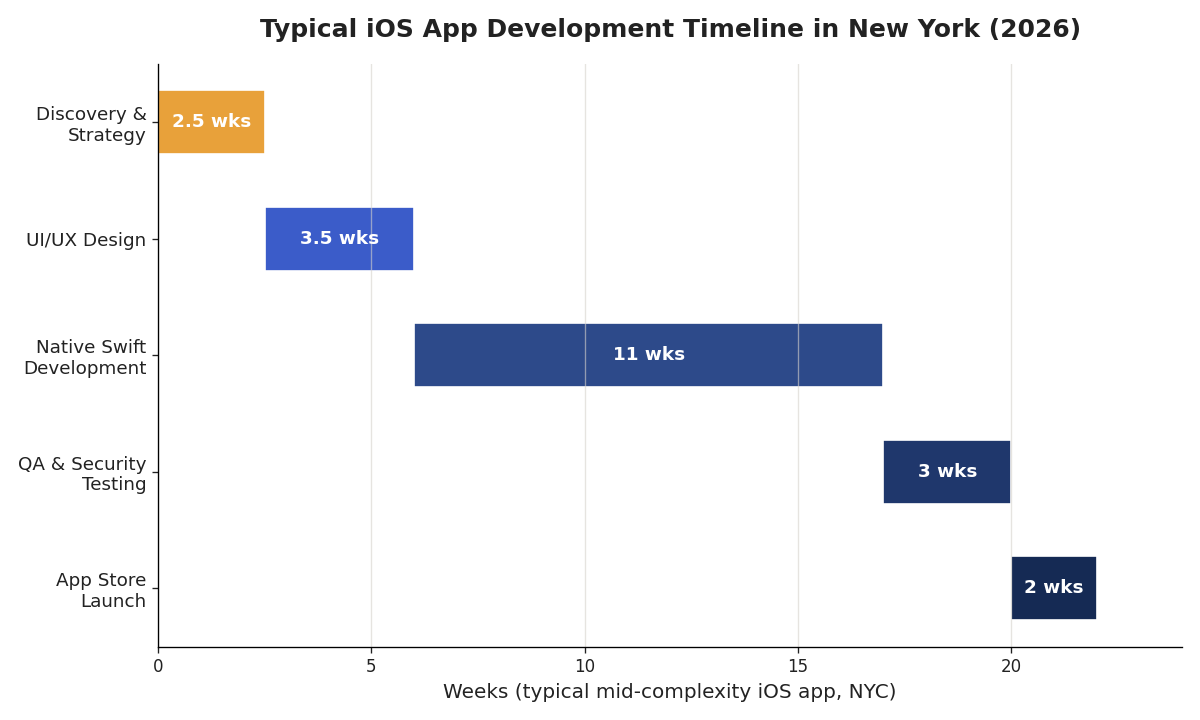
Discovery is short but decisive. Two or three weeks spent aligning on scope, users, and architecture saves months later. Design and native Swift development overlap once the core screens are locked. QA and security testing deserve their own block of time — rushing it is how apps get rejected or, worse, shipped with data leaks. Launch itself is quick, but App Store review can add days, so we build a buffer in.
The Native iOS Development Process, Step by Step
A good process is repeatable without being rigid. Here’s the sequence we follow on native iOS builds, and what each stage should produce before the next one starts.
- Discovery & technical strategy. Define users, success metrics, and the iOS architecture — SwiftUI or UIKit, state management, offline behavior, and which Apple frameworks you’ll lean on. Output: a scoped roadmap and estimate.
- UX/UI design. Wireframes then high-fidelity screens built to Apple’s Human Interface Guidelines. Output: a clickable prototype the whole team has poked at.
- Native Swift development. Feature-by-feature builds in Swift and SwiftUI, wired to a secure backend and APIs. Output: testable builds shared through TestFlight every sprint.
- QA & security testing. Functional testing across devices and iOS versions, plus a security pass against mobile risk standards. Output: a release candidate with known issues closed.
- App Store launch & ASO. Metadata, privacy details, screenshots, and submission. Output: a live listing tuned for search and conversion.
- Maintenance & iteration. Monitoring, iOS updates, and a roadmap for the next release. Output: a stable app that keeps pace with Apple’s yearly changes.
Notice that testing isn’t the last step crammed before launch. On the native iOS work KKRF Group delivers, security-first development means threat modeling happens during design, not after a breach. That ordering is a quiet marker of engineering maturity worth checking for when you evaluate any firm.
Native iOS vs. Cross-Platform: Which Is Right for Your NYC Launch?
This is the decision that most changes your budget and your product. Native Swift gives you the best performance, the earliest access to new Apple features, and the most polished feel. Cross-platform tools like React Native or Flutter let you ship to iPhone and Android from one codebase, which can cut cost and time when both stores matter equally.
| Factor | Native iOS (Swift/SwiftUI) | Cross-Platform (React Native/Flutter) |
|---|---|---|
| Performance | Best — graphics, animation, heavy compute | Very good for most apps; gaps in demanding use |
| Apple ecosystem access | Day-one support for new iOS features | Waits on plugin/library support |
| Time to two app stores | Slower (separate codebases) | Faster (shared codebase) |
| Long-term cost | Higher upfront, lower risk for complex apps | Lower upfront, watch for native workarounds |
| Best fit | FinTech, media, hardware-heavy, premium UX | MVPs, content apps, tight budgets, dual launch |
There’s no universally right answer. We’ve built both and recommended against our own bigger contract when a client’s content app clearly didn’t need native. If you’re weighing the cross-platform route, our guide to React Native app development in New York lays out that side of the trade-off in detail.
Security & Compliance for iOS Apps in New York
New York is a regulated market, and iOS apps aren’t exempt. Any app that collects personal information from state residents falls under the NY SHIELD Act, which requires reasonable safeguards and breach notification. Build in FinTech and you inherit financial-data expectations; build in healthcare and HIPAA enters the picture. None of this is optional, and none of it should be an afterthought.
On the engineering side, the baseline is well established. Encrypt data in transit and at rest, use the iOS Keychain for secrets, enforce certificate pinning for sensitive traffic, and test against the OWASP Mobile Application Security standard. Apple’s App Store review adds its own privacy layer — privacy manifests and accurate data-use labels are now table stakes. A partner who can speak fluently about all three (state law, sector rules, Apple’s guidelines) is worth more than one who only writes features.
This is where industry focus pays off. Our FinTech app development in New York and healthcare app development work exists because compliant iOS engineering is a discipline, not a plugin. Enterprise-grade architecture and a security-first approach aren’t slogans here; they’re what keeps a regulated app in the store.
The Business Case: What iOS Actually Returns in New York
iOS users spend more. That’s not marketing folklore — App Store spending consistently outpaces the alternative, and in a high-income market like New York the gap widens. If your revenue depends on in-app purchases, subscriptions, or high-value transactions, prioritizing iPhone first often produces a better return per dollar of development.
The business math is straightforward once you frame it. A $60,000 mid-tier app that retains a few hundred paying NYC users can clear its build cost inside a year. The failure mode isn’t the platform; it’s shipping something users abandon. That’s why we push clients toward a focused first release, real usage data, and a funded maintenance plan rather than a bloated launch that impresses nobody. Scalable, business-focused solution design beats a feature list every time.
Common Mistakes When Hiring an iOS App Company in NYC
Most regret traces back to a handful of avoidable errors. We’ve inherited enough half-finished projects to know the pattern.
- Buying the lowest bid. A quote far below the NYC range usually means offshore juniors, no QA, or a rewrite later. Cheap iOS development is rarely cheap by version two.
- Skipping discovery. Teams that start coding without a scoped roadmap pay for it in change orders and blown timelines.
- Ignoring maintenance. No budget for iOS updates means an app that quietly breaks when Apple ships its yearly release.
- Treating compliance as paperwork. SHIELD Act and App Store privacy rules shape architecture. Bolt them on late and you rebuild.
- No code ownership. If you don’t control the repository and Apple Developer account, you don’t own your app. Confirm this before signing.
How to Choose the Right iOS App Development Partner in New York
Skip the vanity metrics. Awards and office square footage tell you little about whether a team will ship your app. Use a simple decision framework instead, weighing the factors that actually predict a good outcome.
A quick partner-selection framework
- Relevant iOS portfolio — shipped Swift apps in your category, live on the App Store today.
- Engineering depth — can they explain SwiftUI vs. UIKit trade-offs and their testing approach without hand-waving?
- Security & compliance fluency — do they raise SHIELD Act or App Store privacy before you do?
- Transparent process — clear scope, TestFlight builds every sprint, and honest change management.
- Ownership & support — you keep the code and accounts, and there’s a real maintenance plan.
Score two or three firms against those five points and the choice usually makes itself. A partner that’s transparent about process and honest about trade-offs will save you more than one that promises the moon. That consultative, long-term posture is how KKRF Group approaches every engagement — we’d rather earn the second project than oversell the first.
iOS App Development Trends Shaping New York in 2026
The platform keeps moving, and New York’s competitive market adopts fast. A few shifts are worth building around this year.
- On-device AI. Apple’s machine-learning frameworks push more intelligence onto the iPhone itself — faster, more private personalization without a round trip to the server.
- SwiftUI as the default. New projects increasingly start SwiftUI-first, with UIKit reserved for edge cases, which speeds up iteration.
- Privacy as a feature. App Tracking Transparency and privacy manifests reward teams that design for data minimization from the start.
- Spatial and multi-device experiences. Apple’s ecosystem now spans Watch, and increasingly spatial computing — NYC media and retail brands are experimenting first.
None of this changes the fundamentals. Ship something focused, secure, and maintainable, then let real usage guide the roadmap. The trends reward teams that already build well.
Weighing native iOS against cross-platform, or trying to scope a realistic budget? Talk it through with engineers who build both. We’ll give you a straight assessment of what your NYC app really needs. Explore our New York mobile app development.
Book a Discovery Call →Frequently Asked Questions
How much does iOS app development cost in New York in 2026?
A native iOS MVP typically costs $15,000–$50,000, mid-tier apps $40,000–$90,000, and complex or enterprise iPhone apps $90,000–$300,000 or more. Scope, integrations, and compliance drive the number more than the hourly rate.
How long does it take to build an iOS app in NYC?
Most mid-complexity iPhone apps take four to six months from discovery to App Store launch. Simple apps can ship in two to four months; regulated enterprise apps often run nine months or longer.
Should I build a native iOS app or use cross-platform like React Native?
Choose native Swift when performance, new Apple features, and premium UX matter most — common in FinTech and media. Choose cross-platform when you need iPhone and Android quickly from one codebase and budgets are tight.
Why is iOS app development more expensive in New York?
NYC has a deep but costly talent pool. Senior iOS engineers bill roughly $150–$250 per hour, above the national average, reflecting local demand, agency overhead, and the high standard the market expects.
What compliance rules apply to iOS apps in New York?
Apps handling the personal data of New York residents must meet the NY SHIELD Act. FinTech apps add financial-data obligations and healthcare apps add HIPAA, all on top of Apple’s App Store privacy requirements.
How do I choose the best iOS app development company in New York?
Look for a relevant, live App Store portfolio, genuine Swift and SwiftUI depth, fluency in security and compliance, a transparent sprint process, and clear code and account ownership for you. Score two or three firms on those points.
Ready to move from idea to a shipped iPhone app? KKRF Group builds secure, scalable native iOS apps for New York startups and enterprises — and we start with a straight conversation, not a hard sell. Tell us about your project.
Talk to Our Engineering Team →