
New York runs on food that moves. A halal cart in Midtown, a dumpling spot in Flushing, a Michelin kitchen in Tribeca quietly running a delivery-only menu — every one of those orders rides on software. If you’re weighing food delivery app development in New York, you’re stepping into one of the most competitive and most rewarding app markets in the country. This guide covers what a build actually costs, which features earn their keep, how long it takes, and how to pick a partner who can ship.
As a top mobile app development company, KKRF Group builds these platforms for NYC restaurants, ghost kitchens, and venture-backed startups, and we’ve written this the way we’d explain it to a founder sitting across the table.
There’s a reason the space is crowded. Seamless and Grubhub were born here. DoorDash and Uber Eats fight for every block from the Financial District to Astoria. Slice, a New York startup, grew its pizza-ordering network to roughly 19,000 restaurants. The opportunity is real. So is the engineering. A modern delivery platform isn’t one app — it’s four, wired together in real time. Get the architecture right and you own the customer relationship instead of renting it from an aggregator. Get it wrong and you spend six figures learning why.
Key Takeaways
- A single-restaurant MVP in NYC starts near $20,000–$40,000; a full multi-vendor platform runs $85,000–$300,000+ depending on scope.
- You’re funding four connected apps: customer, restaurant, driver, and an admin panel — plus the backend that keeps them in sync.
- Real-time GPS tracking, driver dispatch logic, and PCI DSS–compliant payments are the cost drivers, not the menu screen.
- Most NYC builds ship in 3 to 9 months. Rushing the discovery phase is where budgets quietly double.
- Choosing between a custom build, white-label, and clone script is the single decision that shapes your margins for years.
What This Guide Covers
- What the build really involves
- NYC development cost
- What drives cost up or down
- The four apps you pay for
- Features you can’t skip
- Our step-by-step process
- How long it takes
- Custom vs. white-label vs. clone
- Technology stack
- Payments, security & compliance
- The business case & ROI
- Common mistakes to avoid
- Choosing an NYC partner
- Where the market is heading
Quick answer: In 2026, food delivery app development in New York usually costs between $20,000 for a single-restaurant MVP and $300,000+ for a full multi-vendor platform with live tracking, driver dispatch, and an admin panel. Most businesses launching a serious product land in the $85,000–$205,000 range for a complete customer, restaurant, driver, and admin build. Timelines run 3 to 9 months depending on scope.
KKRF Group is an enterprise software development company that builds mobile products for startups, SMEs, and larger operators. We approach delivery apps the way we approach any custom engineering problem: security-first, cloud-native, and designed around your actual unit economics rather than a template. The numbers and trade-offs below come from shipping real systems, not from a pricing calculator. In short, food delivery app development in New York is an engineering problem first and a design problem second.
What Food Delivery App Development Really Involves
Food delivery app development is the design and engineering of a connected system that lets customers order, restaurants accept and prepare, drivers pick up and deliver, and an operator manage the whole flow. The consumer app is the part people see. It’s maybe a quarter of the work.
Behind it sits a real-time backend juggling order states, payment authorizations, driver locations, and push notifications, often across thousands of simultaneous orders on a Friday night. That’s the hard part. In a dense market like New York City, where a delivery radius might be six blocks and traffic changes by the minute, the routing and dispatch logic has to be genuinely good, not decorative.
Three broad models exist. An aggregator lists many restaurants (think Grubhub). A single-brand app serves one restaurant group and cuts out commissions. A cloud or ghost kitchen platform runs delivery-only brands from shared space. Each changes what you build, so naming your model early is the first real decision.
How Much Does Food Delivery App Development in New York Cost?
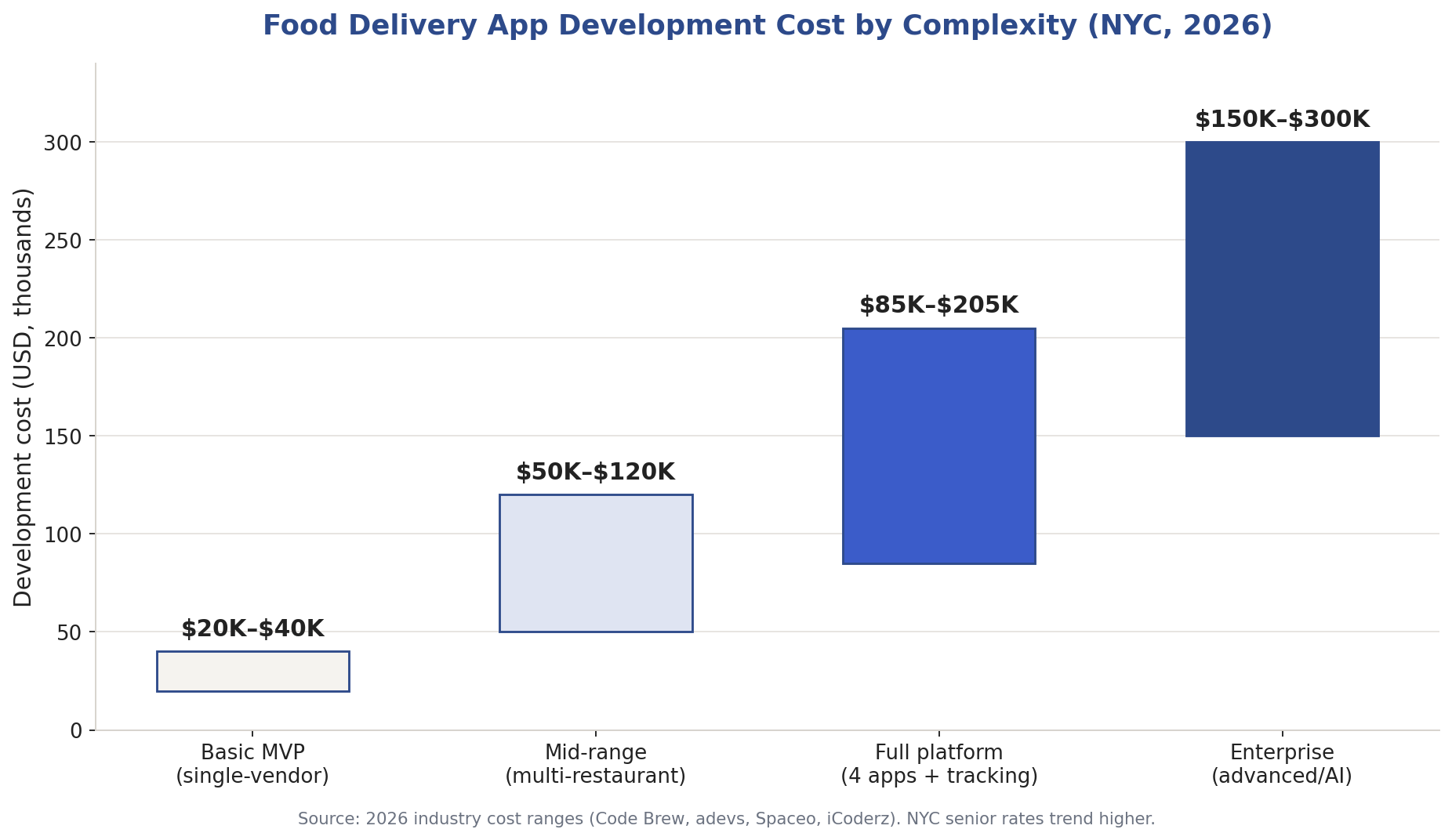
Here’s the honest range. A lean MVP that serves one restaurant with ordering, payments, and basic tracking starts around $20,000–$40,000. A mid-range multi-restaurant platform lands between $50,000 and $120,000. A complete build with a customer app, restaurant app, driver app, and admin panel typically runs $85,000–$205,000. Enterprise systems with advanced routing, AI recommendations, and heavy real-time load can pass $300,000.
Location matters more than founders expect. Hourly rates among New York–area agencies commonly sit in the $50–$150 band for senior work, higher than offshore teams. You’re paying for proximity, timezone overlap, and people who understand the NYC market. The chart below maps cost to complexity so you can find your tier before you talk budget with anyone.
What Actually Drives Your Cost Up or Down
Two apps with the same screens can cost twice as much. The difference is almost never the UI. It’s the systems underneath and the decisions you make in week one.
- Number of apps. A single-brand ordering app is one client. A marketplace is four. Every added app multiplies design, QA, and release work.
- Real-time tracking. Live driver location, ETA math, and map rendering add backend and integration cost. Google Maps Platform and routing services carry recurring fees, not just build time.
- Payments and payouts. Accepting cards is easy. Splitting money between restaurant, driver, and platform, handling tips, refunds, and tax, is where the hours go.
- Driver dispatch. Simple nearest-driver assignment is cheap. Batching, surge handling, and fair distribution logic are not.
- Integrations. POS systems, third-party menus, SMS, identity checks, and accounting each add scope.
- Compliance and scale. Building for ten restaurants is different from building for a thousand. The architecture decisions differ, and so does the price.
We’ve seen this go wrong when a team spends its budget polishing animations, then discovers the dispatch engine can’t handle a dinner rush. Spend where the load is.
Not sure which tier fits your idea? A short scoping call usually saves more than it costs. Our team can map your feature list to a realistic budget and timeline for the New York market. Start with our mobile app development team in New York.
Get a Custom Project Estimate →The Four Apps You’re Really Paying For
When founders hear one price for a delivery app, they picture one app. A full platform is really four coordinated products plus a backend. Understanding the split makes the budget make sense.
The customer app handles discovery, ordering, payment, and tracking. The restaurant app accepts orders, manages menus and availability, and prints tickets. The driver app handles assignment, navigation, and proof of delivery. The admin panel is your command center for restaurants, drivers, pricing, and disputes. Below is a rough allocation for a full NYC build.
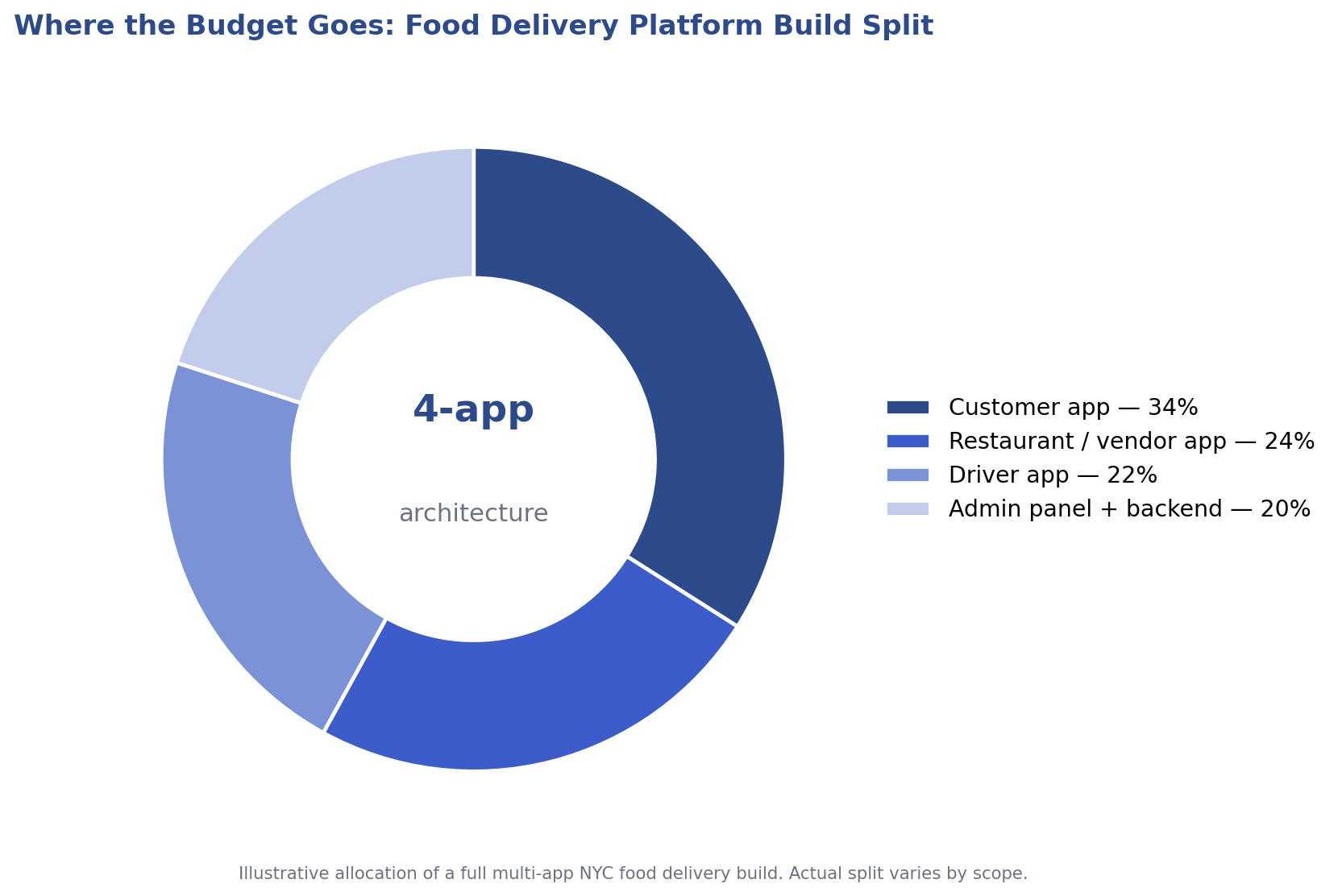
These proportions shift with your model. A single-restaurant app collapses the restaurant and admin roles into a lightweight dashboard, which is exactly why an MVP costs a fraction of a marketplace.
Features a New York Food Delivery App Can’t Skip
Feature lists balloon fast. Focus first on the ones that move orders and keep drivers moving. Everything else can wait for version two.
- Fast onboarding and reorder. New Yorkers reorder constantly. One-tap reorder and saved addresses drive repeat volume.
- Live order tracking. Real-time status from kitchen to door, with an accurate ETA, is table stakes now.
- Smart driver dispatch. Assignment that accounts for distance, current load, and prep time keeps delivery windows honest.
- Flexible payments. Cards, Apple Pay, Google Pay, wallets, tips, and split handling, all PCI DSS compliant.
- Menu and availability control. Restaurants need to 86 an item instantly when they run out.
- Ratings, support, and refunds. A clean dispute flow protects your reputation on every bad night.
- Push notifications. Order updates and re-engagement, done without being annoying.
A quick rule we give clients: if a feature doesn’t help someone order, cook, drive, or resolve a problem, it’s not an MVP feature.
How We Build It: A Step-by-Step Process
A delivery platform fails or succeeds on sequencing. Here’s the process we follow, in order, and why each step exists.
- Discovery and scoping. We define your model, users, and the exact order lifecycle. This week is cheap; skipping it is not.
- UX and architecture. Flows for all four apps and a backend design built for real-time load and future scale.
- Design system. A consistent, accessible UI so the customer, restaurant, and driver apps feel like one product.
- Core build. Ordering, payments, and the dispatch engine first, because they carry the most risk.
- Integrations. Maps, payments, SMS, POS, and identity checks wired in and tested against real edge cases.
- QA and load testing. We simulate a dinner rush before your customers create one.
- Launch and store submission. App Store and Google Play review, staged rollout, monitoring in place.
- Iterate. Real usage reveals what to build next. We plan for version two from day one.
How Long Does It Take to Build?
A focused single-restaurant MVP can ship in 3 to 4 months. A mid-range multi-restaurant platform usually takes 5 to 7 months. A full marketplace with all four apps and advanced dispatch runs 7 to 9 months or more. Cross-platform frameworks like React Native or Flutter can compress this by letting one codebase serve iOS and Android. Planned well, food delivery app development in New York rewards patience over speed.
The variable that wrecks timelines isn’t engineering speed. It’s mid-build scope changes. Lock your MVP definition, ship it, then expand. Teams that treat launch as a milestone rather than a finish line move faster and spend less.
Custom Build vs. White-Label vs. Clone Script
This is the decision that shapes your margins for years, so it deserves more than a gut call. Each path trades speed and price against control and long-term cost.
| Approach | Upfront Cost | Time to Launch | Control & Scale | Best For |
|---|---|---|---|---|
| Clone script | Lowest | Weeks | Limited; you inherit someone else’s code | Testing a market fast on a tight budget |
| White-label | Moderate | 1–3 months | Some customization; ongoing license fees | Operators who want a known product, branded |
| Custom build | Highest | 3–9 months | Full ownership; scales on your terms | Startups and brands building a durable business |
A simple decision framework
Ask three questions. Is this your core business or an experiment? Core businesses justify custom. Do you need to own the data and roadmap? If yes, avoid clones. How unique is your model? A standard marketplace can start white-label; a novel ghost-kitchen or hyperlocal concept usually can’t. If two of your three answers point to ownership, build custom.
The Technology Stack Behind a Reliable Delivery App
There’s no single correct stack, but there are sensible defaults. For the client apps, React Native or Flutter let one team serve both iOS and Android, which cuts cost without gutting quality. Native Swift or Kotlin still makes sense when you need the last bit of performance.
The backend usually runs on Node.js, Python, or Go, with WebSockets or a real-time service pushing order and location updates. PostgreSQL handles transactional data; Redis speeds up the hot paths. Cloud-native infrastructure on AWS or Google Cloud keeps you elastic when a snowstorm triples orders. KKRF Group leans on this kind of scalable, cloud-native architecture because delivery load is spiky by nature, and your system has to absorb the spikes without falling over.
Maps and routing typically come from the Google Maps Platform. Payments run through a provider like Stripe. The point isn’t the brand names; it’s choosing components that scale together and won’t trap you later.
Payments, Security, and Compliance
You’re handling money, locations, and personal data, so security isn’t a feature you add at the end. Card data must be handled under the PCI DSS standard, which in practice means never touching raw card numbers and letting a certified processor do the heavy lifting.
Beyond payments, encrypt data in transit and at rest, authenticate every API call, and verify drivers properly. Location data deserves real care; a delivery app knows where people live. We build with a security-first mindset from day one because retrofitting it after a breach costs far more than doing it right. For teams that want a deeper review, an architecture and security assessment before launch is money well spent.
The Business Case: Commissions, Margins, and ROI
Here’s why restaurants build their own apps: aggregator commissions. Third-party platforms can take 15% to 30% of each order. On thin restaurant margins, that’s often the difference between profit and loss. Owning your app converts that commission into either margin or lower prices, and it hands you the customer relationship and the data. Seen this way, food delivery app development in New York is less a cost and more an investment in margin and ownership.
The math is straightforward. If you do meaningful delivery volume, the recurring commission you avoid can cover a custom build within a year or two, then compound. A group running several NYC locations often sees the strongest case, because one platform serves every location and the savings stack. The catch: an app only pays off if people actually use it, which is why retention features and marketing belong in the plan, not as an afterthought.
Common Mistakes NYC Founders Make
- Building a marketplace before proving demand. Start single-brand, prove the loop, then expand.
- Underinvesting in the driver experience. If drivers hate your app, deliveries slow and ratings drop. They’re users too.
- Ignoring the admin panel. Founders obsess over the customer app and end up managing operations in spreadsheets.
- Treating maps and dispatch as an afterthought. In dense NYC, routing quality is the product.
- Choosing the cheapest bid. A rebuild after a failed launch costs more than doing it once, well.
- Skipping load testing. Your worst night is a Friday, and that’s exactly when you’ll find the cracks.
Avoiding these mistakes is easier with a team that has shipped delivery platforms before. We’ll pressure-test your plan and flag the risks that quietly blow up budgets. Explore our mobile app development services or bring us your concept directly.
Talk to Our Engineering Team →How to Choose a Food Delivery App Development Partner in New York
The New York market has no shortage of agencies. Firms like Fueled and Dom & Tom have built mobile products here, and larger engineering partners such as Vention have worked with delivery startups. Strong company; the question is fit for your project. Evaluate any partner, including us, on the same criteria.
- Relevant delivery experience. Real-time, multi-app systems are a specific skill. Ask to see it.
- Transparent process and pricing. You should understand what you’re paying for and why, at every stage.
- Architecture that scales. The team should talk about load and growth before you do.
- Security seriousness. If PCI DSS and data protection are afterthoughts in the pitch, keep looking.
- Long-term partnership. Launch is the start. You want a team that’s there for version two and the 2 a.m. incident.
KKRF Group positions itself as a long-term technology partner rather than a one-off vendor. That means a transparent development process, enterprise-grade architecture, and a team that stays with you past launch. Judge us against that bar, and against everyone else you talk to.
Where Food Delivery Apps Are Heading
The category keeps shifting, and the next few years favor operators who own their tech. AI is moving from buzzword to useful: smarter ETA predictions, demand forecasting that pre-positions drivers, and menu recommendations that lift order value. Ghost and cloud kitchens keep growing, and they need software built for delivery-only operations from the ground up.
Expect more first-party apps as restaurants tire of commissions, tighter POS and loyalty integration, and early experiments with autonomous and robotic delivery in parts of the city. None of this requires chasing every trend. It does reward an architecture flexible enough to adopt what proves out. That flexibility is a design choice you make at the start, not a patch you apply later.
Ready to turn a delivery idea into a working product New Yorkers actually use? Let’s scope it together and give you a clear plan, budget, and timeline. Book time with our team through the KKRF Group contact page.
Request a Consultation →Frequently Asked Questions
How much does food delivery app development in New York cost?
In 2026, expect roughly $20,000–$40,000 for a single-restaurant MVP, $50,000–$120,000 for a mid-range multi-restaurant platform, and $85,000–$300,000+ for a full marketplace with customer, restaurant, driver, and admin apps. Your exact number depends on features, integrations, and scale.
How long does it take to build a food delivery app?
A focused MVP ships in about 3 to 4 months. A mid-range platform takes 5 to 7 months, and a full marketplace runs 7 to 9 months or more. Cross-platform frameworks like React Native and Flutter can shorten timelines by serving iOS and Android from one codebase.
What features does a food delivery app need?
The essentials are ordering and reorder, real-time tracking, smart driver dispatch, PCI DSS–compliant payments with tips, menu and availability control, ratings and refunds, and push notifications. Anything that does not help someone order, cook, drive, or resolve a problem can wait for a later version.
Should I build a custom app or use a clone script?
A clone script is fastest and cheapest for testing a market, but you inherit limits and give up control. A custom build costs more and takes longer, yet you own the code, data, and roadmap. If the app is core to your business, custom almost always pays off.
Why build my own app instead of using Grubhub or DoorDash?
Third-party platforms charge 15% to 30% per order and own your customer relationship. A first-party app converts those commissions into margin, gives you the customer data, and lets you control pricing and promotions. For higher-volume restaurants and multi-location groups, the savings often cover the build within a year or two.
Does KKRF Group build delivery apps for New York businesses?
Yes. KKRF Group is a top mobile app development company that builds food delivery and restaurant ordering platforms for NYC restaurants, ghost kitchens, and startups, covering the customer, restaurant, driver, and admin apps plus the real-time backend. You can reach the team through our contact page for a scoped estimate.