
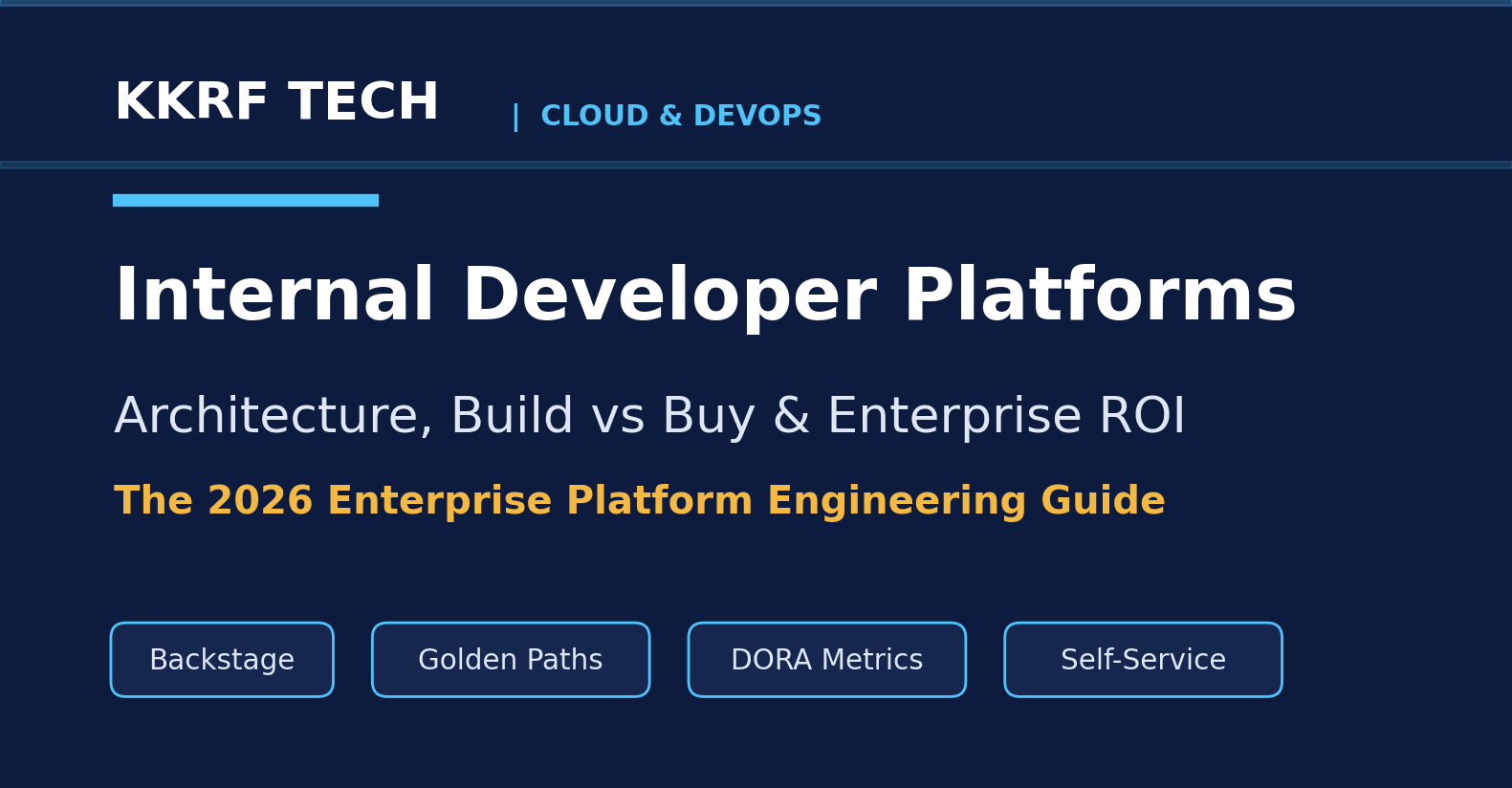
The internal developer platform has quietly become the operating system of modern software organizations. Instead of every team hand-wiring its own pipelines, cloud accounts, and Kubernetes manifests, an internal developer platform gives engineers a paved, self-service road from a code commit to production. This 2026 guide explains what an internal developer platform is, how its architecture fits together, what it costs to build versus buy, and how to tell when the investment actually pays off.
Adoption has shifted from experiment to expectation. Gartner projects that 80% of software engineering organizations will run dedicated platform teams by 2026, and Mordor Intelligence sizes the internal developer platform market at roughly $10.4 billion in 2026, growing toward $31.6 billion by 2031 at a ~25% compound annual rate. For most enterprises the question is no longer whether to invest in platform engineering, but how to do it without losing a year and a large budget to the wrong approach.
Quick Answer: What Is an Internal Developer Platform?
An internal developer platform (IDP) is a curated, self-service layer that sits on top of your cloud infrastructure and DevOps tooling and gives developers a single, standardized way to provision environments, ship code, and operate services without deep infrastructure expertise. Platform engineering is the discipline that builds and runs it. You can build one on open-source Backstage, buy a commercial IDP such as Port, Cortex, or Humanitec, or blend the two — and for most enterprises the right choice depends on team size, governance maturity, and how quickly you need results, not on license price alone.
Key Takeaways
- An internal developer platform standardizes how developers build, deploy, and operate software through self-service “golden paths,” reducing cognitive load and accelerating delivery.
- Platform engineering is the practice; the internal developer platform is the product it delivers to developers.
- Self-hosted Backstage can cost roughly $200k–$1.2M in year one for a 100-engineer organization — mostly platform-engineer headcount — while commercial IDPs shift spend to predictable per-seat licensing.
- Success is measured with DORA metrics: deployment frequency, lead time for changes, change failure rate, and mean time to restore.
- The build-vs-buy decision hinges on engineering headcount, governance maturity, and time-to-value — a hybrid model often wins at enterprise scale.
- Nearly 30% of platform teams track no success metrics at all, a governance gap that quietly erodes ROI.
What This Guide Covers
As a trusted cloud consulting and DevOps partner, KKRF Tech has helped engineering organizations turn scattered, team-by-team tooling into coherent internal developer platforms — consolidating CI/CD, infrastructure-as-code, and observability behind one self-service layer that developers actually want to use. The playbook below distills that field experience into a practical, vendor-neutral guide.
What Is an Internal Developer Platform?
An internal developer platform is a set of self-service tools, workflows, and automation that lets developers provision infrastructure and ship applications on their own — without filing tickets or mastering the underlying cloud. It packages the organization’s accumulated operational knowledge into repeatable “golden paths” so that doing the right thing is also the easy thing.
The core idea borrows from product management: the platform team treats infrastructure and developer tooling as an internal product, with developers as its customers. Rather than handing every squad a raw pile of Kubernetes, Terraform, and CI/CD YAML, the platform abstracts that complexity behind sensible defaults. This directly attacks cognitive load — the mental overhead that slows engineers down when they must understand the entire stack just to deploy a small service.
The pattern was popularized by Spotify’s internal tooling (later open-sourced as Backstage) and codified in the Team Topologies model of a “platform team” enabling stream-aligned product teams. A well-built internal developer platform is less about any single tool and more about a coherent, opinionated experience that spans the whole software delivery lifecycle.
Internal Developer Platform vs Internal Developer Portal vs Platform Engineering
These three terms are used interchangeably and incorrectly all the time, so it is worth being precise. Platform engineering is the discipline. The internal developer platform is the underlying engine — the automation, orchestration, and integrations. The internal developer portal is the user-facing interface (often built on Backstage) that developers click through. A platform can exist without a portal; many teams interact via CLIs, APIs, or GitOps instead.
| Term | What it is | Example |
|---|---|---|
| Platform Engineering | The discipline of designing, building, and operating the platform as a product | A dedicated platform team + product roadmap |
| Internal Developer Platform | The engine: orchestration, provisioning, policy, and toolchain integrations | Workload specs, environment automation, IaC |
| Internal Developer Portal | The interface: the “single pane of glass” developers interact with | Backstage, Port, Cortex catalogs & scorecards |
Internal Developer Platform Architecture: The Four Layers
A production-grade internal developer platform is best understood as four stacked layers, each abstracting the one below it. The higher you go, the more the raw complexity of the cloud is hidden and the more developers can self-serve safely. The diagram below shows how those layers fit together.
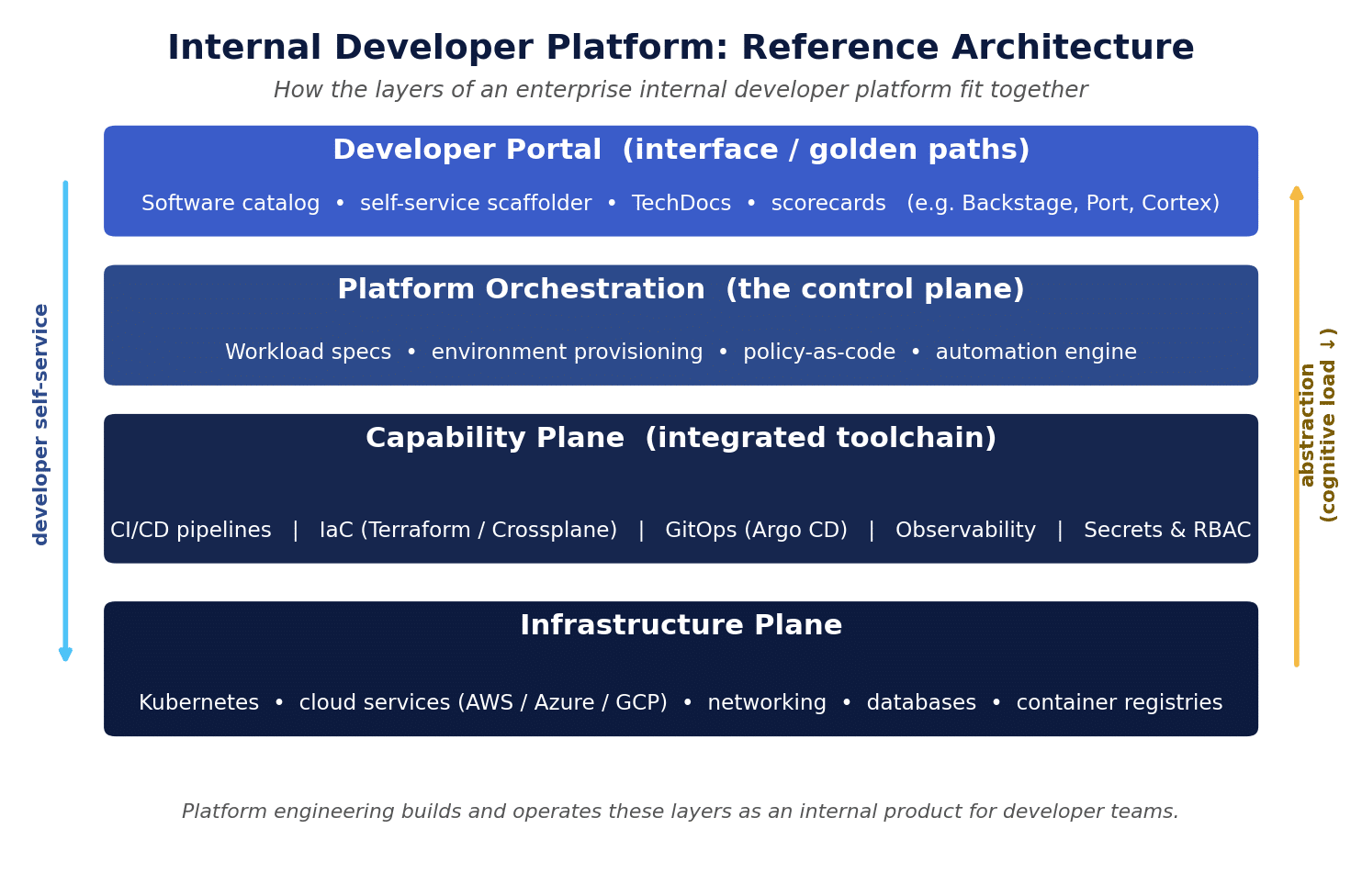
1. Developer Portal (interface layer). The software catalog, self-service scaffolder, documentation, and service scorecards developers see day to day. This is where golden paths live.
2. Platform Orchestration (control plane). The brain that turns a developer request into real resources: workload specifications, environment provisioning, policy-as-code, and the automation engine that ties everything together.
3. Capability Plane (integrated toolchain). CI/CD pipelines, infrastructure-as-code (Terraform or Crossplane), GitOps delivery (Argo CD), observability, and secrets and role-based access control — the operational muscles of the platform.
4. Infrastructure Plane. The Kubernetes clusters, cloud services across AWS, Azure, or GCP, networking, databases, and container registries that everything ultimately runs on.
In short: the internal developer platform architecture converts a messy, expert-only infrastructure stack into a governed, self-service product — pushing abstraction up and cognitive load down.
How to Build an Internal Developer Platform: A Step-by-Step Process
Building an internal developer platform is an iterative product effort, not a one-off infrastructure project. The most successful rollouts start narrow, prove value on one workflow, and expand. A practical sequence:
- Treat the platform as a product. Appoint a platform team with a product owner, and interview developers to find their biggest friction points.
- Map one golden path first. Pick the highest-volume workflow — for example, “deploy a new backend microservice” — and design the ideal paved road for it end to end.
- Choose the portal. Adopt Backstage or a commercial portal (Port, Cortex) as the interface, based on the build-vs-buy analysis below.
- Define workload and environment specifications. Standardize how a service declares what it needs so provisioning can be automated and repeatable.
- Integrate CI/CD and infrastructure-as-code. Wire pipelines, Terraform/Crossplane, and GitOps (Argo CD) behind the portal so a single action provisions everything.
- Bake in observability, secrets, and RBAC. Make logging, metrics, tracing, secret management, and least-privilege access defaults, not afterthoughts.
- Pilot with one team, then expand. Roll the golden path out to a friendly team, gather feedback, and iterate before broad adoption.
- Measure with DORA metrics from day one. Baseline deployment frequency, lead time, change failure rate, and MTTR so you can prove impact.
Summary: start with one paved road, measure it, and treat every new capability as a product increment rather than a big-bang platform launch.
Internal Developer Platform Cost: Build vs Buy
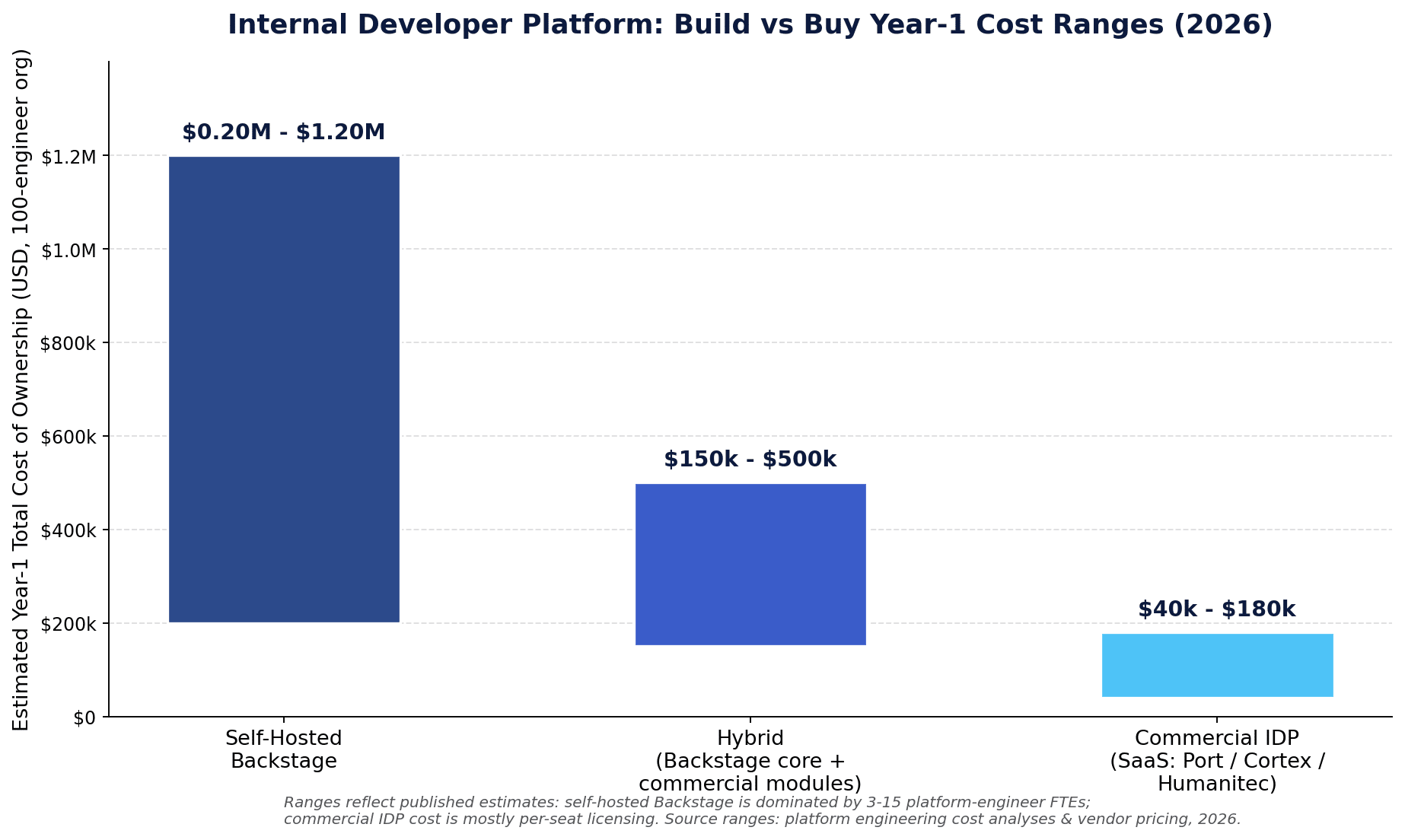
The real cost of an internal developer platform is dominated by people, not licenses. Published estimates put a self-hosted Backstage deployment for a 100-engineer organization at roughly $200k–$1.2M in year one, with about 90% of that being platform-engineer headcount; getting Backstage fully into production commonly takes 6–12 months and 3–15 engineers to build and maintain over time. Commercial IDPs invert that: Humanitec starts around $1,979/month, Cortex from about $30/user/month, and Port offers a free tier up to 15 seats — predictable licensing in exchange for less customization.
The chart below compares typical year-one total cost of ownership across the three approaches. The nuance most vendors omit: at year three, a mature self-hosted Backstage can have a lower cost-per-developer than commercial licenses at large scale (300+ engineers), while below ~50 developers you will almost always spend more on Backstage engineering than a commercial tool costs. This is the same total-cost-of-ownership discipline that drives sound enterprise cloud migration cost planning.
| Dimension | Self-Hosted Backstage | Commercial IDP | Hybrid |
|---|---|---|---|
| Year-1 TCO (100 devs) | ~$200k–$1.2M | ~$40k–$180k | ~$150k–$500k |
| Time to value | 6–12 months | Days to weeks | Weeks to months |
| Platform FTEs | 3–15 | 1–3 | 2–6 |
| Customization | Unlimited (you own it) | Bounded by vendor | High |
| Best for | 300+ devs, strong platform team | Lean teams, fast time-to-value | Enterprises wanting control + speed |
Stuck on the build-versus-buy math for your internal developer platform? Our engineers can model your year-one and year-three total cost of ownership against real headcount in a short working session. Explore our cloud consulting and DevOps services to see how we approach it.
Get a Build-vs-Buy Cost Model →Security, Compliance & Governance Considerations
A self-service platform is only as good as the guardrails behind it. Done right, an internal developer platform actually improves security posture because policy is enforced centrally instead of copy-pasted per team. Done carelessly, it hands every developer a fast path to misconfiguration.
Bake these in from the start: least-privilege role-based access control (RBAC) and single sign-on; centralized secrets management rather than secrets scattered in pipelines; policy-as-code (for example Open Policy Agent) to enforce compliance gates automatically; and full audit trails so every provisioning action is traceable — a hard requirement for SOC 2, ISO 27001, and similar frameworks. Software supply-chain integrity (signed artifacts, SBOMs, and controls aligned to frameworks like SLSA and OWASP guidance) belongs in the golden path too, not bolted on later.
The Business Case: ROI and DORA Metrics
The return on an internal developer platform shows up as faster, safer delivery and lower operational drag. The industry-standard yardstick is the set of four DORA metrics: deployment frequency, lead time for changes, change failure rate, and mean time to restore service. A platform that raises the first two while lowering the last two is delivering real value.
Secondary gains are just as material: new-hire onboarding drops from weeks to days when a golden path replaces tribal knowledge, and senior engineers stop being human ticket queues for environment requests. Be honest about the timeline, though — ROI is rarely immediate, and one telling data point is that roughly 30% of platform teams measure nothing at all. If you cannot show movement in DORA metrics and developer satisfaction, you cannot defend the investment.
Common Mistakes When Adopting an Internal Developer Platform
- Building a portal, not a platform. A pretty catalog that doesn’t actually provision anything is a dashboard, not a paved road.
- Boiling the ocean. Trying to cover every workflow on day one instead of nailing one high-value golden path first.
- Treating it as a project, not a product. No product owner, no roadmap, no developer feedback loop — so adoption stalls.
- Ignoring metrics. Skipping DORA baselines means you can’t prove impact or justify continued funding.
- Underestimating Backstage maintenance. Assuming “open source = free” and staffing it with a fraction of the engineers it truly needs.
- Forcing adoption. Mandating the platform before it’s genuinely easier than the old way, which breeds resentment and shadow tooling.
Future Trends: AI-Native Platform Engineering in 2026 and Beyond
The clearest 2026 shift is the move to AI-native platforms. Surveys show the overwhelming majority of organizations now consider AI critical to the future of platform engineering, with CIOs planning to embed AI across their platforms. In practice that means AI copilots inside the portal, automated root-cause analysis, cost-optimization recommendations, and early self-healing workflows.
Two other trends matter for enterprise planning. First, the “single monolithic platform” assumption is fading — over half of organizations now run multiple platforms segmented by domain (frontend, backend, data, and AI/ML workloads). Second, platforms increasingly need to serve AI/ML pipelines as first-class citizens, not just traditional web services. Modernizing older systems onto this model often runs alongside broader legacy application modernization efforts.
Decision Framework: When to Build, When to Buy, When to Wait
Use this framework to match the approach to your organization rather than to the loudest vendor.
Build (self-hosted Backstage) when you have 300+ developers, a funded dedicated platform team, complex internal toolchains, and a genuine need to own UX and roadmap.
Buy (commercial IDP) when you have fewer than ~50–100 developers, no dedicated platform staff, or you need value in weeks and prefer built-in automation and cost intelligence.
Go hybrid when you want the open-source core’s flexibility but can’t justify building every integration — the model that most often succeeds at enterprise scale.
Wait when you have fewer than ~20 engineers and low deployment volume; the cognitive-load problem an internal developer platform solves may not yet be big enough to justify the cost.
Limitations to respect: a platform doesn’t fix a broken culture, it can become a bottleneck if the platform team is understaffed, and over-abstraction can hide details senior engineers still need. This is where a trusted cloud consulting and DevOps partner like KKRF Tech earns its keep — we pressure-test the internal developer platform build-versus-buy decision against real headcount, governance maturity, and time-to-value, so what you invest in fits the organization you actually have.
How to Evaluate a Platform Engineering Partner
If you bring in outside help, judge a partner on evidence, not slideware. A strong platform engineering partner should be able to:
- Show real DORA-metric improvements from prior internal developer platform engagements.
- Stay vendor-neutral — recommending Backstage, a commercial IDP, or hybrid based on your context, not their reseller margin.
- Demonstrate depth in Kubernetes, Terraform/Crossplane, GitOps, and cloud-native security, not just portal theming.
- Design for your governance and compliance requirements from day one.
- Transfer knowledge so your team can own the platform, avoiding permanent dependency.
Planning an internal developer platform rollout and want a vendor-neutral second opinion before you commit? KKRF Tech can review your golden paths, toolchain, and governance and map a pragmatic 90-day path to your first paved road.
Talk to Our Platform Engineering Team →Frequently Asked Questions
What is an internal developer platform?
An internal developer platform (IDP) is a self-service layer of tools, workflows, and automation that lets developers provision infrastructure and deploy applications on their own, without deep infrastructure expertise or filing tickets. It standardizes delivery through “golden paths” and reduces cognitive load.
What is the difference between an internal developer platform and an internal developer portal?
The platform is the engine — the orchestration, provisioning, and integrations that actually do the work. The portal is the user-facing interface (often Backstage, Port, or Cortex) developers interact with. A platform can exist without a portal via CLIs, APIs, or GitOps.
How much does it cost to build an internal developer platform?
A self-hosted Backstage deployment for a 100-engineer organization commonly runs $200k–$1.2M in year one, dominated by platform-engineer headcount, and takes 6–12 months to reach production. Commercial IDPs shift cost to per-seat licensing (for example, Humanitec from ~$1,979/month or Cortex from ~$30/user/month).
Should we build on Backstage or buy a commercial IDP?
Build on Backstage if you have 300+ developers and a funded platform team that needs full control. Buy a commercial IDP if you have a lean team and need value in weeks. Many enterprises land on a hybrid: a Backstage core augmented with commercial integrations.
How is platform engineering different from DevOps?
DevOps is a culture and set of practices for collaboration between development and operations. Platform engineering is a discipline that productizes those practices into a reusable internal developer platform, so every team gets self-service golden paths instead of reinventing pipelines and infrastructure.
How do you measure the ROI of an internal developer platform?
Use DORA metrics — deployment frequency, lead time for changes, change failure rate, and mean time to restore — alongside onboarding time and developer satisfaction. Baseline them before rollout so improvements are provable.
Ready to give your developers a paved road from commit to production? KKRF Tech designs and implements internal developer platforms that fit your cloud, your compliance needs, and your team’s real capacity.
Schedule a Platform Engineering Consultation →