
New York never stops moving. Freight rolls through the Bronx, e-commerce parcels flood Brooklyn walk-ups, and same-day couriers thread across Manhattan around the clock. For the companies behind that movement, a well-built logistics app has stopped being a luxury.
As a top mobile app development company, KKRF Group builds logistics platforms that keep fleets, warehouses, and deliveries visible in real time. This guide lays out what a logistics app development company in New York actually delivers in 2026, what it costs, which features matter, and how to pick the right partner.
Key Takeaways
- A focused logistics MVP in New York typically costs $40,000 to $70,000 and ships in 4 to 6 months; a combined warehouse-and-dispatch platform runs $150,000 to $300,000.
- Real-time GPS tracking and route optimization are non-negotiable and together account for 25 to 40 percent of a mid-tier build’s budget.
- AI features add a 15 to 35 percent premium but can cut logistics costs 5 to 20 percent, per McKinsey research.
- The last-mile delivery market grows from $184.2B in 2025 to a projected $277.76B by 2030, with North America holding roughly 37.7 percent of it.
- Choose a New York logistics app partner on domain depth, integration experience, and security posture, not headline price.
What This Guide Covers
Quick Answer
A logistics app development company in New York builds custom software that tracks vehicles, optimizes delivery routes, manages warehouse inventory, and connects drivers, dispatchers, and customers on one platform. In 2026, expect to pay roughly $40,000 to $70,000 for a focused MVP and $150,000 to $300,000 for a combined warehouse-and-dispatch platform, with most enterprise builds landing between $80,000 and $250,000. A production-ready MVP typically ships in 4 to 6 months.
KKRF Group is an enterprise software development company that engineers logistics apps with real-time tracking, security-first architecture, and integrations into the ERP, telematics, and carrier systems New York operators already run. The sections below explain each decision so you can scope your own project with confidence.
What Logistics App Development Means
Logistics app development is the process of designing and building software that plans, executes, and monitors the movement and storage of goods. It spans mobile apps for drivers and customers, web dashboards for dispatchers, and backend services that connect GPS devices, warehouses, and enterprise systems into a single source of truth.
A transportation management system (TMS) is software that plans and executes the physical movement of freight. It handles carrier selection, load planning, route assignment, and freight audit. New York shippers use a TMS to control cost across trucking lanes and multi-borough delivery zones.
A warehouse management system (WMS) manages everything inside a facility: receiving, put-away, storage, picking, packing, and shipping. Most builds add real-time inventory tracking, barcode or RFID scanning, and yard management so dock and trailer coordination stays accurate.
Last-mile delivery software covers the final leg from a hub to the customer’s door. In a dense market like NYC, this is where routing intelligence, curb-time rules, and proof of delivery matter most, because the last mile is often the most expensive and failure-prone part of the journey.
Types of Logistics Apps New York Firms Build
Different operations need different tools. Most New York logistics projects fall into one of these categories, and many mature companies eventually connect several of them.
- Fleet management apps track vehicles, monitor driver behavior, schedule maintenance, and cut fuel waste across trucks and vans.
- Last-mile delivery apps pair a driver app with a customer-facing app for live tracking, ETAs, and digital proof of delivery.
- Warehouse and inventory apps digitize receiving, picking, and stock counts inside distribution centers across Queens, New Jersey, and the outer boroughs.
- Freight and 3PL platforms match loads to carriers, generate documentation, and give shippers end-to-end visibility.
- On-demand courier apps handle same-day and instant delivery for retailers, restaurants, and pharmacies in Manhattan and Brooklyn.
- Supply chain visibility dashboards aggregate data from every system so leadership can see delays, costs, and exceptions in one view.
Must-Have Features
Some features separate a logistics app that ships from one that stalls. Fleets running more than ten vehicles treat the first two below as mandatory, not optional.
- Real-time GPS tracking. Live vehicle and shipment location built on GPS and a mapping API. This alone adds roughly $8,000 to $15,000 but underpins every other feature.
- Route optimization. Software that sequences stops to cut miles, fuel, and overtime. Expect $10,000 to $20,000; in dense NYC traffic it pays back fast.
- Digital proof of delivery. Signatures, photos, and timestamps that reduce disputes and speed up billing.
- Fleet and driver management. Assignment, maintenance scheduling, hours-of-service logging, and performance scoring.
- Warehouse inventory tracking. Barcode or RFID scanning with real-time stock levels to prevent overselling and stockouts.
- Push notifications and alerts. Automatic ETA updates, exception alerts, and customer messaging.
- Analytics dashboards. Cost-per-delivery, on-time rate, and utilization metrics that turn raw data into decisions.
How Much Logistics App Development Costs in New York
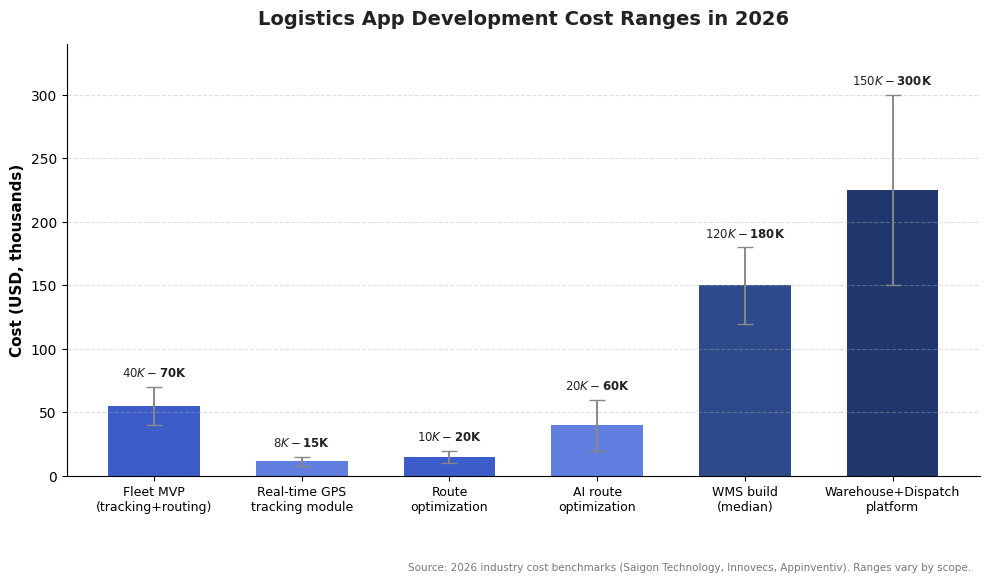
Cost tracks scope. When you ask a logistics app development company in New York for a number, the honest answer is a range. In 2026, logistics software development runs from about $30,000 for a narrow tool to $500,000 or more for a full enterprise platform, with most serious builds between $80,000 and $250,000. The biggest cost drivers are real-time features, third-party integrations, and AI.
Real-time tracking and route optimization together account for 25 to 40 percent of a mid-tier logistics budget. A warehouse management system carries a median build cost near $150,000, climbing with multi-warehouse support, barcode scanning, and RFID hardware. AI route optimization typically adds $20,000 to $60,000 on top of the base.
| Project type | Typical NYC cost (2026) | Timeline |
|---|---|---|
| Fleet management MVP (tracking + routing) | $40,000 – $70,000 | 4 – 6 months |
| Last-mile delivery app (driver + customer) | $60,000 – $120,000 | 5 – 8 months |
| Warehouse management system (WMS) | ~$150,000 (median) | 6 – 10 months |
| Combined warehouse + dispatch platform | $150,000 – $300,000 | 8 – 12 months |
| AI route optimization add-on | +$20,000 – $60,000 | 6 – 10 weeks |
These are New York market ranges; a smaller regional carrier and a multi-borough 3PL will land at very different points. The table gives a planning baseline, not a quote, because integration count and compliance scope move the final number more than any single feature.
Weighing an MVP against a full fleet-and-warehouse platform? We can map your logistics workflows to a realistic scope and budget. Talk to our New York app development team about your project.
Get a Custom Project Estimate →The Logistics App Development Process
A disciplined process is what keeps a six-figure logistics build on time. This is the sequence KKRF Group follows, and it maps to how most experienced New York teams work.
- Discovery and workflow mapping. We document how goods, drivers, and data actually move today, then define the problems the app must solve first.
- Architecture and integration planning. We design the data model and plan connections to telematics, ELD, ERP, and carrier APIs before a line of production code is written.
- UX and prototype. Driver, dispatcher, and customer flows are prototyped and tested, because a confusing driver app gets abandoned in the field.
- MVP engineering. The core loop, usually tracking plus routing plus proof of delivery, is built and shipped in 4 to 6 months.
- Integration and hardware testing. GPS devices, scanners, and third-party systems are validated under real conditions, not just in a lab.
- Launch and iteration. The platform goes live with monitoring, and later phases add AI routing, warehouse modules, and analytics.
Technology Stack
The right stack balances speed of delivery against real-time performance. There is no universal answer, but the choices below are well proven for New York logistics builds.
For driver and customer mobile apps, cross-platform frameworks like Flutter or React Native reduce cost by sharing one codebase across iOS and Android. Backends commonly run on Node.js or Java with a PostgreSQL database, while GPS streams flow through a real-time layer such as WebSockets or Apache Kafka. Routing and geofencing rely on a mapping API like Google Maps Platform or Mapbox, and cloud infrastructure on AWS or Azure keeps the platform scalable.
For real-time fleet tracking, engineering teams lean on documentation from the Google Maps Platform and cloud reference architectures from providers like AWS. Choosing managed services over custom infrastructure early keeps a lean team focused on logistics logic rather than plumbing.
Security and Compliance
Logistics apps carry sensitive operational and customer data, from driver locations to delivery addresses and payment records. Security cannot be a final-phase afterthought.
Security-first development means encryption in transit and at rest, role-based access control, audited APIs, and secure handling of location data from day one. Teams building for enterprise clients increasingly align with SOC 2 controls and follow guidance from the OWASP Mobile Top 10 to close common mobile vulnerabilities. For apps that touch payments or personal data, compliance scope should be defined before development starts, because retrofitting it later is expensive.
Market Momentum and the ROI Case
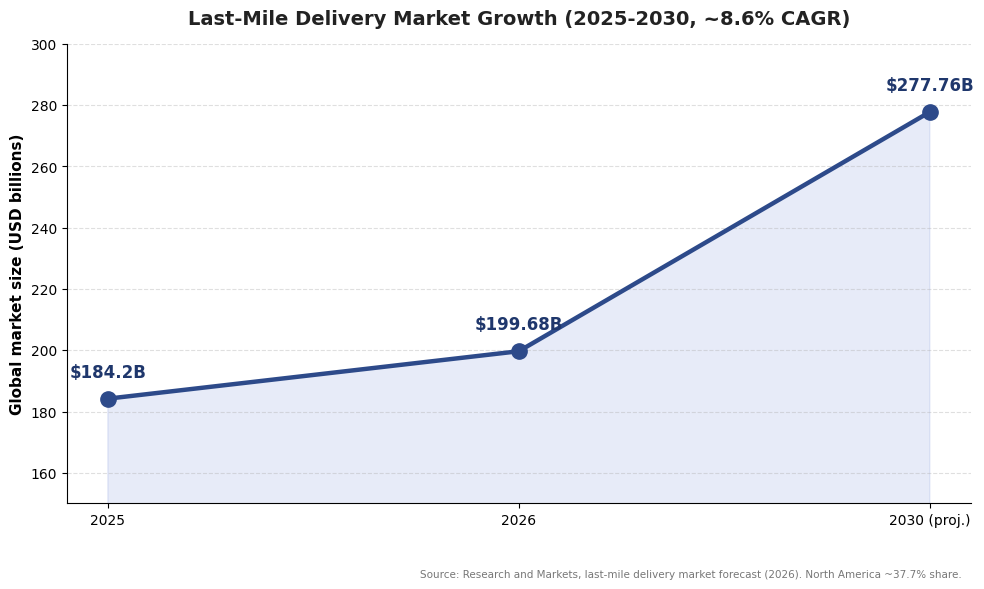
The business case for logistics software keeps strengthening. The global last-mile delivery market is projected to grow from $184.2 billion in 2025 to $199.68 billion in 2026, reaching roughly $277.76 billion by 2030 at an 8.6 percent compound annual growth rate. North America is expected to hold about 37.7 percent of that market in 2026, and New York sits at the center of it.
Return on investment shows up in hard numbers. McKinsey research indicates AI in distribution operations can reduce logistics costs by 5 to 20 percent and inventory levels by 20 to 30 percent. For a fleet spending $2 million a year on fuel, a 10 to 25 percent cut in fuel and overtime can translate into $200,000 to $500,000 in annual savings, which is why route optimization is usually the first feature to earn its keep.
Common Mistakes to Avoid
Most failed logistics apps fail for predictable reasons, and a seasoned logistics app development company in New York will steer you around every one of them. Avoiding these keeps a project from stalling after launch.
- Building everything at once. Trying to ship fleet, warehouse, and customer apps in one release inflates cost and delays value. Start with one workflow.
- Ignoring integrations early. Discovering ERP or telematics limits late in the build forces expensive rework.
- Underinvesting in the driver experience. A clunky driver app gets bypassed in the field, and your data quality collapses with it.
- Treating real-time as a checkbox. GPS streaming at scale is a hard engineering problem; underestimating it breaks live tracking under load.
- Skipping security scope. Retrofitting encryption, access control, and compliance after launch costs far more than designing them in.
How to Choose a Logistics App Development Company in New York
Price is the easiest factor to compare and the weakest predictor of success. Use the framework below to weigh partners on what actually determines outcomes.
| Evaluation factor | What a strong NY partner looks like |
|---|---|
| Domain experience | Has shipped fleet, WMS, or last-mile apps, not just generic apps |
| Integrations | Proven work with ELD, telematics, ERP, and carrier APIs |
| Real-time engineering | Comfortable with GPS streaming, geofencing, and high-write databases |
| Security posture | SOC 2 practices, encryption, and role-based access by default |
| Local presence | Understands NYC traffic, curb rules, and multi-borough routing |
When to choose a specialized logistics partner
Choose a partner with deep logistics experience when your app depends on real-time tracking, complex integrations, or warehouse operations. These builds punish generalist teams that have never handled GPS streaming or carrier APIs. A specialist ships faster because they have already solved the hard parts once.
When a general app team may be enough
If your first release is a simple internal tool, such as a digital proof-of-delivery form or a basic driver checklist, a strong general mobile team can deliver it well. The limitation is scale: as soon as you add live tracking, routing, or enterprise integrations, logistics-specific engineering becomes the deciding factor.
Our recommendation
For most New York operators planning to grow, the right logistics app development company in New York combines domain depth, real-time engineering, and security-first practices, then starts with a tightly scoped MVP. KKRF Group works this way as a long-term technology partner, building the core loop first and expanding into AI routing, warehouse modules, and analytics as the platform proves its value.
Already running spreadsheets and disconnected tools across your fleet? A short discovery call can surface where a custom logistics app would pay for itself first. See our mobile app development services.
Book a Discovery Call →Frequently Asked Questions
How much does it cost to build a logistics app in New York?
Most New York logistics apps cost between $40,000 and $300,000 in 2026. A focused fleet-management MVP with tracking and routing lands around $40,000 to $70,000, while a combined warehouse-and-dispatch platform runs $150,000 to $300,000. Most enterprise builds settle between $80,000 and $250,000, driven mainly by integrations, real-time features, and AI.
How long does it take to develop a logistics app?
A logistics MVP typically takes 4 to 6 months to reach production. A full platform with warehouse management, dispatch, and AI routing usually takes 8 to 12 months. Timelines depend on how many third-party systems the app must integrate with, such as ELD devices, ERPs, and carrier APIs.
What features does a logistics app need?
Core features include real-time GPS tracking, route optimization, digital proof of delivery, fleet and driver management, warehouse inventory tracking, push notifications, and analytics dashboards. Fleets running more than ten vehicles treat live tracking and routing as mandatory rather than optional.
Is AI worth adding to a logistics app?
For most mid-size and larger operations, yes. AI capabilities add a 15 to 35 percent premium on base cost but can reduce logistics costs by 5 to 20 percent and inventory levels by 20 to 30 percent, according to McKinsey research. Predictive routing and demand forecasting usually pay back within 8 to 14 months.
What technology stack is best for logistics apps?
Cross-platform frameworks like Flutter or React Native are common for driver and customer apps because they cut mobile cost. Backends often use Node.js or Java with PostgreSQL, a real-time layer such as WebSockets or Kafka for GPS streaming, and a mapping API like Google Maps or Mapbox for routing and geofencing.
How do I choose a logistics app development company in New York?
Prioritize partners with proven logistics domain experience, real-time engineering skill, and strong security practices over the lowest bid. Ask to see fleet, WMS, or last-mile projects they have shipped, confirm they can integrate with your existing telematics and ERP systems, and verify they follow SOC 2-aligned security controls.
Ready to build a logistics platform that scales with your New York operation? KKRF Group designs, engineers, and secures it end to end. Request an architecture review and we’ll outline the fastest path to launch.
Request a Consultation →