
Enterprise data budgets keep climbing, yet many leadership teams still cannot get a trustworthy number out of their own systems. The problem is rarely the dashboard. It is the plumbing underneath it. Data engineering services exist to fix that plumbing: the pipelines, storage, and governance that turn raw operational data into something analysts, applications, and AI models can actually rely on. At KKRF Group, an experienced custom software development company, we build these systems for startups scaling fast and for enterprises modernizing decades of legacy data. This guide breaks down what data engineering services include, what they cost in 2026, how modern pipeline architecture works, and how to choose a partner who will not leave you with an expensive mess.
Key Takeaways
- Data engineering services cover pipeline development, storage architecture, transformation, orchestration, and data governance — the foundation every analytics and AI initiative depends on.
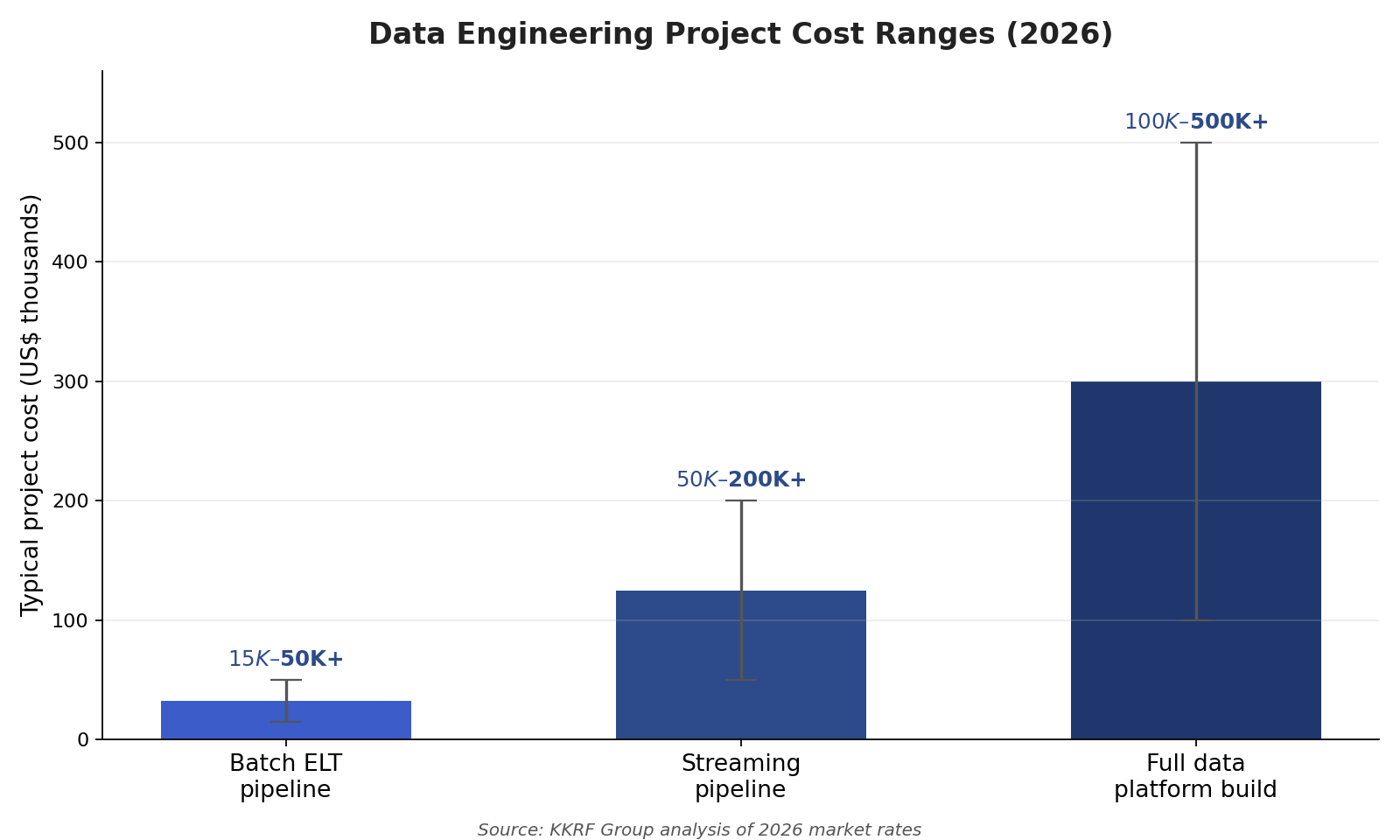
- A batch ELT pipeline typically costs $15,000–$50,000; a production streaming pipeline runs $50,000–$200,000+; a full platform build can reach $100,000–$500,000+.
- Four architecture patterns dominate in 2026: batch ELT, event-driven streaming, serverless, and data mesh. The right choice depends on latency needs and scale, not fashion.
- Apache Airflow, Prefect, and Dagster lead orchestration; Snowflake, Databricks, and dbt anchor most modern stacks.
- Poor data quality and unclear ownership — not tooling — are the most common reasons data platforms fail to deliver ROI.
What This Guide Covers
- Quick Answer
- What Data Engineering Services Include
- Modern Data Pipeline Architecture
- What Data Engineering Costs in 2026
- The Modern Data Engineering Stack
- Data Engineering Talent & Rates
- Data Governance, Quality & Security
- The ROI & Business Case
- Common Data Engineering Mistakes
- How to Choose a Data Engineering Partner
- Future Trends in Data Engineering
- Frequently Asked Questions
Quick Answer: What Are Data Engineering Services?
Data engineering services are the design, construction, and maintenance of the systems that collect, move, store, and prepare data for analytics and AI. In practice that means building data pipelines (ETL or ELT), setting up cloud data warehouses and lakes, transforming raw data into clean models, orchestrating workflows, and enforcing data quality and governance. Companies buy these services to make their data reliable, timely, and usable — whether the goal is executive reporting, product analytics, or feeding machine learning and retrieval-augmented generation (RAG) systems. In 2026, most engagements are cloud-native and priced either as fixed-scope projects ($15,000 to $500,000+ depending on complexity) or as ongoing monthly retainers.
KKRF Group approaches data engineering the way we approach all enterprise software: security-first, architected for scale, and mapped to a real business outcome rather than a tool checklist. We have built ingestion pipelines that consolidate dozens of fragmented sources, migrated brittle overnight batch jobs to near-real-time streaming, and stood up governed data platforms that AI teams can trust. The sections below reflect what actually works in production, including the trade-offs vendors rarely mention.
What Data Engineering Services Include
Data engineering is the discipline of building the infrastructure that makes data usable at scale. A data engineer designs how information flows from source systems into storage, how it is cleaned and reshaped, and how it is delivered to the people and applications that need it. Where a data analyst asks questions of data, a data engineer builds the reliable supply chain that makes those questions answerable.
Core components of a data engineering engagement
Most professional data engineering services cover a consistent set of building blocks, even when the tools differ. Understanding these components helps you scope a project accurately and compare proposals on equal terms.
- Data ingestion: connecting to source systems — databases, SaaS APIs, event streams, files — and reliably pulling data in, in batches or in real time.
- Storage architecture: designing the data warehouse, data lake, or lakehouse where information lands and lives, balancing cost, query speed, and flexibility.
- Transformation and modeling: cleaning, joining, and reshaping raw data into well-defined tables and metrics that downstream users can trust.
- Orchestration: scheduling and coordinating pipeline steps so they run in the right order, retry on failure, and alert someone when they break.
- Observability and quality: monitoring freshness, volume, and accuracy so bad data gets caught before it reaches a dashboard or a model.
- Governance and access: defining who can see what, cataloging data assets, and keeping the platform compliant with regulations.
Definition: Data pipeline
A data pipeline is an automated sequence of steps that moves data from one or more sources to a destination, transforming it along the way. Each pipeline defines where data comes from, what happens to it in transit, and where it ends up. A well-built pipeline runs on a schedule or in response to events, recovers gracefully from failures, and produces the same trustworthy result every time it runs. Pipelines are the fundamental unit of data engineering work.
Definition: ETL vs ELT
ETL (Extract, Transform, Load) transforms data before it is loaded into storage, which suited older systems with limited warehouse compute. ELT (Extract, Load, Transform) loads raw data first and transforms it inside a modern cloud warehouse, taking advantage of cheap, elastic compute. In 2026 most new cloud pipelines use ELT because it is faster to build, easier to re-run, and keeps the raw data available for future needs. ETL still matters where data must be cleaned or masked before it ever touches storage, such as with sensitive personal information.
Modern Data Pipeline Architecture in 2026
There is no single correct data pipeline architecture. The right pattern depends on how fresh the data must be, how much of it there is, and how the organization is structured. Four patterns cover the large majority of production systems today. A strong data engineering partner will recommend a pattern based on your latency and scale requirements rather than defaulting to whatever they built last time.
- Batch ELT. Data is collected and processed on a schedule — hourly, nightly, or daily. This is the most cost-efficient pattern and fits reporting, historical analysis, and any use case where data that is a few hours old is perfectly acceptable. Most companies should start here.
- Event-driven streaming. Data is processed continuously as events occur, delivering sub-second to sub-minute latency. It powers fraud detection, live personalization, operational monitoring, and anything where waiting for the next batch is too slow. It costs more to build and run, so it should be reserved for genuine real-time needs.
- Serverless pipelines. Processing runs on managed, auto-scaling services that charge only for what you use. This pattern shines for spiky or unpredictable workloads, keeping idle costs near zero while absorbing sudden surges without manual capacity planning.
- Data mesh. Instead of one central team owning everything, data ownership is distributed to the business domains that produce it, with shared standards and platform tooling. This decentralized model helps large enterprises scale past the bottleneck of a single overloaded data team, but it demands organizational maturity to work.
In real deployments these patterns are frequently combined. A company might run nightly batch ELT for finance reporting, a streaming pipeline for its live product, and serverless jobs for occasional heavy transformations. The architecture should serve the workload, not the other way around.
Not sure whether your workload needs batch, streaming, or a full platform rebuild? Our engineers can map your current data flow and recommend the leanest architecture that meets your goals. Explore our software engineering services or start a conversation below.
Request an Architecture Review →What Data Engineering Services Cost in 2026
Data engineering pricing varies widely because a “pipeline” can mean anything from a single scheduled job to a company-wide platform. The most useful way to budget is by project archetype. The figures below reflect 2026 market rates for professional, production-grade work — not throwaway scripts. Prices assume cloud infrastructure costs are separate and billed by your cloud provider.
| Project type | Typical cost (2026) | Best for |
|---|---|---|
| Batch ELT pipeline | $15,000–$50,000 | Reporting, analytics, historical data |
| Streaming pipeline (with monitoring) | $50,000–$200,000+ | Real-time apps, fraud, live personalization |
| Full data platform / migration | $100,000–$500,000+ | Enterprise-wide consolidation and modernization |
| Ongoing managed data engineering | $8,000–$40,000 / month | Continuous operation, iteration, support |
Three factors move these numbers the most: the number and messiness of source systems, the required data freshness, and compliance scope. Ten clean sources feeding a nightly warehouse is a very different project from forty legacy systems feeding a real-time platform under healthcare or financial regulation. When comparing quotes, make sure every vendor is scoping the same freshness and the same source complexity, or the prices are not comparable.
Fixed-price project vs monthly retainer
Fixed-price engagements work well when the scope is genuinely well understood — a defined set of sources, a clear destination, and agreed transformations. Monthly retainers or managed data engineering fit organizations that need continuous iteration, new sources added regularly, and someone accountable for keeping pipelines healthy. Many companies start with a fixed-scope build and transition to a retainer for ongoing operation. KKRF Group structures engagements around whichever model gives the client the most transparency and control.
The Modern Data Engineering Stack
The 2026 data stack has consolidated around a recognizable set of tools. You do not need all of them, and adding tools you cannot staff is a common and expensive mistake. The goal is the smallest stack that reliably delivers your data. Below are the categories that matter and the leading options in each.
| Layer | Leading tools (2026) | What it does |
|---|---|---|
| Orchestration | Apache Airflow, Prefect, Dagster | Schedules and coordinates pipeline steps |
| Warehouse / lakehouse | Snowflake, Databricks, BigQuery | Stores and queries data at scale |
| Transformation | dbt | Turns raw tables into trusted models |
| Streaming | Apache Kafka, Flink | Moves and processes real-time events |
| Ingestion | Fivetran, Airbyte, custom connectors | Pulls data from source systems |
Choosing an orchestration tool
Orchestration is where teams spend a surprising amount of their time, so the choice matters. Apache Airflow is the established standard with the largest ecosystem and the deepest hiring pool, which makes it a safe default for most enterprises. Prefect is Python-native with a simpler API and a strong managed cloud option, appealing to teams that want less operational overhead. Dagster takes an asset-centric approach with the best built-in observability, which suits teams that treat data assets as first-class products. There is no universally correct answer; the right pick depends on your team’s skills and how much you want to self-manage.
KKRF Group is a leading AI and ML integration partner, and we design data stacks with downstream AI in mind. Clean, well-governed pipelines are what make retrieval-augmented generation and model training actually work — a point we cover in our guide to choosing a vector database for enterprise RAG.
Data Engineering Talent and Rates
Whether you hire in-house or engage a services partner, talent cost is the largest line item in data engineering. Rates vary sharply by seniority, specialization, and location. The chart below shows 2026 US onshore contractor benchmarks; nearshore and offshore rates run materially lower for comparable skill, which is one reason many companies use a blended or outsourced model.
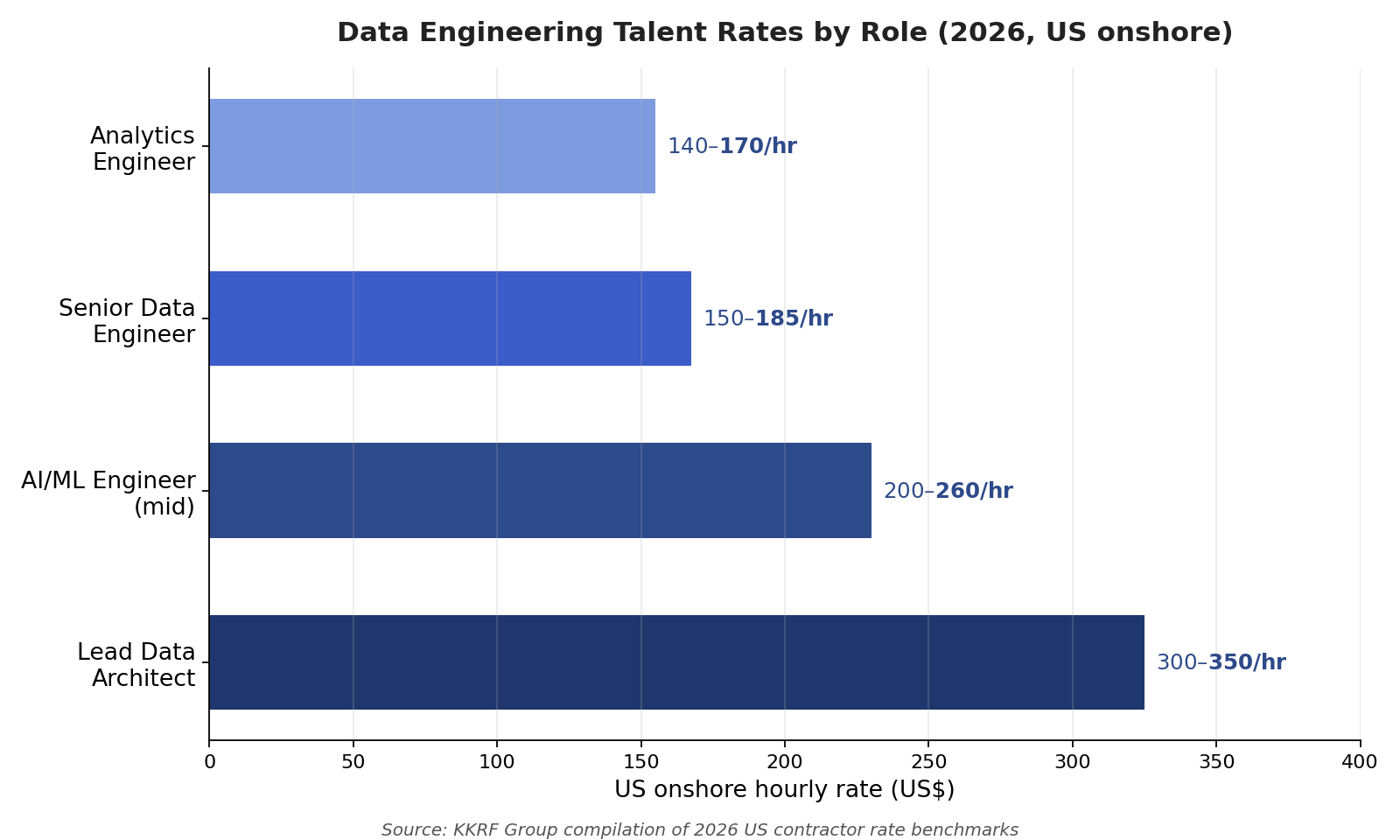
One trend worth planning around: generative AI specialization now commands a significant premium. Engineers fluent in RAG pipelines, vector databases, and LLM orchestration frameworks bill roughly 40 to 60 percent above a baseline Python and SQL generalist. If your roadmap includes AI features, budget for that premium or partner with a firm that already has those skills in house rather than trying to retrain a generalist team under deadline pressure.
Data Governance, Quality, and Security
Governance is the part of data engineering that gets cut first and regretted most. A fast pipeline that delivers wrong or non-compliant data is worse than no pipeline, because people act on it. Security-first design is a core part of how KKRF Group builds every data platform, and it should be non-negotiable in any serious engagement.
Data quality
Data quality controls verify that data is complete, accurate, fresh, and consistent before it reaches consumers. Practical measures include automated tests on every pipeline run, freshness checks that alert when data stops arriving, and volume anomaly detection that catches a source silently dropping records. Catching bad data at ingestion is dramatically cheaper than discovering it in a board deck.
Security and compliance
Enterprise data platforms must enforce encryption in transit and at rest, role-based access control, audit logging, and data masking for sensitive fields. Regulated industries add specific obligations — HIPAA for healthcare data, PCI DSS for payment data, GDPR and similar laws for personal data. These requirements should shape the architecture from day one, because retrofitting compliance onto a live platform is slow and expensive. Frameworks such as the NIST Privacy Framework provide a useful baseline for structuring controls.
The ROI and Business Case for Data Engineering
Data engineering rarely generates revenue directly, which makes its business case easy to underfund and hard to argue. The value shows up as second-order effects: decisions made faster, analysts freed from manual data wrangling, AI initiatives that finally have clean inputs, and costly errors avoided. Framing the investment correctly is essential to getting it approved.
- Faster, more confident decisions: when leaders trust the numbers, they stop re-litigating the data and start acting on it.
- Analyst productivity: teams often spend the majority of their time cleaning and reconciling data. Good pipelines return that time to actual analysis.
- AI readiness: machine learning and generative AI systems are only as good as the data feeding them. Clean, governed pipelines are the prerequisite, not an optional extra.
- Risk reduction: automated quality checks and governance prevent the expensive, reputation-damaging mistakes that come from acting on bad data.
A useful way to justify the spend is to quantify the cost of the current broken state: hours lost to manual reconciliation, decisions delayed, and initiatives blocked because the data is not ready. That number is almost always larger than the cost of fixing the foundation.
Common Data Engineering Mistakes to Avoid
We have been brought in to rescue enough struggling data platforms to see the same failure patterns repeatedly. Most have nothing to do with tooling and everything to do with sequencing and ownership. Avoiding these will save more money than any single tool choice.
- Building for scale you do not have yet. Standing up a streaming, multi-region platform for a workload that a nightly batch job would handle burns budget and adds operational drag. Start simple and evolve.
- Ignoring data quality until it breaks. Teams that add testing and monitoring after launch spend months firefighting. Bake quality checks in from the first pipeline.
- No clear data ownership. When everyone owns the data, no one does. Ambiguous ownership is the single most common reason platforms decay.
- Tool sprawl. Adopting every trendy tool creates a stack no one can fully operate. The best stack is the smallest one that meets the requirement.
- Treating it as a one-time project. Pipelines need ongoing care as sources change and volumes grow. Budgeting only for the build guarantees decay.
Inheriting a data platform that breaks more than it delivers? We routinely stabilize and modernize struggling pipelines without a full rebuild. Tell us what is going wrong and we will give you an honest assessment.
Get a Technical Assessment →How to Choose a Data Engineering Partner
The right data engineering partner is one who reduces your long-term risk, not just one who writes pipelines quickly. Because these systems become load-bearing infrastructure, a poor choice is costly to unwind. Use the criteria below to evaluate vendors on substance rather than sales polish.
- Architecture judgment. Do they recommend the simplest pattern that meets your needs, or the most impressive one? A partner who talks you out of unnecessary complexity is worth more than one who upsells it.
- Governance and security as defaults. Ask how they handle data quality, access control, and compliance. If these come up only after you raise them, keep looking.
- Cloud and tooling fluency. Confirm real depth in your cloud (AWS, Azure, or GCP) and your intended stack, backed by concrete examples rather than logos on a slide.
- A clear operating model. Understand how they document, hand off, and support what they build so you are never held hostage to a single vendor.
- Business framing. The best partners tie technical decisions to your outcomes and are transparent about cost and trade-offs.
Decision framework: when to build, buy, or outsource
Choosing how to staff data engineering comes down to your scale, urgency, and internal capability. This framework covers the three common paths and when each makes sense.
| Approach | Choose it when | Watch out for |
|---|---|---|
| Build in-house | Data is core to your product and you can hire and retain senior engineers | Long ramp time; hard to hire; single points of failure |
| Buy managed tools | Your needs are standard and off-the-shelf connectors cover your sources | Costs scale with data volume; limited customization |
| Outsource to a partner | You need production results fast, or specialized AI-ready pipelines | Choose a partner with a clear handoff and support model |
For many mid-market and enterprise teams, the pragmatic answer is a hybrid: outsource the initial build and specialized work to a partner like KKRF Group while growing internal capability to operate the platform over time. This gets results quickly without creating permanent dependency. Data engineering also pairs naturally with cloud consulting, since the platform and the cloud it runs on are best designed together.
Future Trends in Data Engineering
Data engineering is changing fastest at its intersection with AI. Several shifts are worth building toward rather than reacting to later.
- AI-assisted pipeline development. Code generation and automated documentation are speeding up routine pipeline work, letting engineers focus on architecture and edge cases.
- Data as the AI bottleneck. As models commoditize, competitive advantage shifts to the quality and freshness of proprietary data. Well-engineered pipelines become a strategic asset.
- Declarative and asset-centric tooling. Teams increasingly describe the data outcomes they want and let the platform manage execution, reducing brittle hand-written glue code.
- Real-time as a rising default. As streaming tooling matures and cheapens, more use cases that once tolerated batch latency are moving toward continuous processing.
None of these change the fundamentals. Reliable ingestion, sound modeling, strong governance, and clear ownership remain the foundation. The teams that get those right will adopt each new capability from a position of strength.
Whether you are building your first pipeline or modernizing an enterprise data platform, KKRF Group can help you do it right the first time — secure, scalable, and ready for AI. Let us turn your data into an asset you can act on.
Discuss Your Data Project →Frequently Asked Questions
What are data engineering services?
Data engineering services are the design, construction, and maintenance of systems that collect, move, store, and prepare data for analytics and AI. They include building data pipelines, setting up cloud warehouses and lakes, transforming raw data into trusted models, orchestrating workflows, and enforcing data quality and governance.
How much do data engineering services cost in 2026?
A batch ELT pipeline typically costs $15,000 to $50,000, a production streaming pipeline runs $50,000 to $200,000 or more, and a full data platform build or migration ranges from $100,000 to $500,000 and up. Ongoing managed data engineering commonly runs $8,000 to $40,000 per month. Cloud infrastructure is billed separately.
What is the difference between ETL and ELT?
ETL transforms data before loading it into storage, while ELT loads raw data first and transforms it inside a modern cloud warehouse. Most new cloud pipelines in 2026 use ELT because it is faster to build, easy to re-run, and preserves raw data. ETL still fits cases where data must be cleaned or masked before storage.
How do I choose a data engineering company?
Evaluate architecture judgment, whether governance and security are defaults, real fluency in your cloud and tools, a clear documentation and support model, and the ability to tie technical decisions to business outcomes. A partner who steers you away from unnecessary complexity is usually a better long-term choice than one who upsells it.
Do I need data engineering for AI projects?
Yes. Machine learning and generative AI systems are only as good as the data feeding them. Clean, governed, well-structured pipelines are a prerequisite for reliable model training and retrieval-augmented generation. Skipping the data foundation is the most common reason enterprise AI initiatives underperform.
Should I build data engineering in-house or outsource it?
Build in-house when data is core to your product and you can hire and retain senior engineers. Outsource to a partner when you need production results quickly or need specialized, AI-ready pipelines. Many teams use a hybrid: a partner builds the platform while internal staff grow into operating it.