
Legacy application modernization has become the defining infrastructure decision of 2026 — and generative AI has convinced many boardrooms it is finally a solved problem. Feed decades of COBOL into a model, get clean Java back, retire the mainframe by Friday. If only. The code translation is the easy part. The reasons these programs still slip schedules and burn eight-figure budgets live almost entirely in the other 80%.
This guide is written for the CTOs, enterprise architects, and platform leaders who have to fund and de-risk this work. It explains what modernization actually involves, where AI genuinely accelerates it, what it costs, how long it takes, and how to choose both an approach and a delivery partner without setting money on fire.
Key Takeaways
- AI is a force multiplier, not an autopilot. It accelerates code discovery, documentation, and translation, but it cannot recover lost business logic or make architecture decisions for you.
- Modernization is a portfolio decision. The 7 Rs — retire, retain, rehost, repurchase, replatform, refactor, and rearchitect/rebuild — each carry a different cost, risk, and timeline profile.
- Budgets vary widely. A departmental app can be modernized for roughly $200K; a core banking platform runs $12M–$50M, and data migration alone is typically 15–30% of the total.
- Most teams underbudget by 3–5x. Incremental delivery and the strangler fig pattern are the most reliable ways to avoid a failed “big bang” rewrite.
- Doing nothing has a price. Gartner has estimated enterprises can spend up to 40% of their IT budget servicing technical debt.
- Payback is real. A well-executed program typically reaches positive ROI in 14–30 months.
What This Guide Covers
- What Is Legacy Application Modernization?
- Why “AI Will Just Translate the Code” Fails
- The 7 Rs: Approaches Compared
- What Modernization Costs in 2026
- How AI Actually Accelerates Modernization
- Security, Compliance & Risk
- ROI and the Business Case
- Common Mistakes to Avoid
- Future Trends: Agentic AI
- Decision Framework & Choosing a Partner
- Frequently Asked Questions
Quick Answer
Legacy application modernization is the process of updating outdated software — its code, architecture, data, and hosting — so it runs securely and cost-effectively on modern platforms. In 2026, AI meaningfully speeds up analysis, documentation, and code conversion, but it does not remove the need for architectural judgment, disciplined data migration, and rigorous testing. The right path depends on each application’s business value and technical health, chosen from the 7 Rs framework rather than a blanket rewrite.
At KKRF Tech, an experienced custom software development company, we approach modernization the way seasoned operators do: application by application, risk by risk. Across regulated industries we have helped enterprise teams offload mainframe workloads, decompose brittle monoliths, and migrate to the cloud — and the hard-won lesson is always the same. Tooling has never been the bottleneck. Discipline is.
What Is Legacy Application Modernization?
Legacy application modernization is the deliberate transformation of aging software so it aligns with current architectures, security standards, and business requirements — without discarding the hard-won logic that makes it valuable. It spans everything from a simple cloud rehost to a full rewrite.
A “legacy” application is not defined by age alone. It is any system whose technology, structure, or knowledge base has become a liability: unsupported runtimes, scarce skills, brittle integrations, a weak security posture, or an architecture that blocks the business from moving quickly. When maintaining an application costs more in risk and lost opportunity than it returns, it becomes a modernization candidate.
The pressure is structural. Gartner has estimated that enterprises can spend up to 40% of their IT budget simply servicing technical debt — money that props up old systems instead of funding new capability. Every year a core system is deferred, that tax compounds.
Modernization is therefore less a project than a continuous discipline. The goal is not “new for the sake of new,” but to reduce operating cost, close security gaps, unlock integration, and give teams a platform they can actually build on.
In short: modernization targets the applications where the cost of standing still — in risk, spend, and lost agility — has outgrown the cost of change.
Why “AI Will Just Translate the Code” Fails
AI can convert source code between languages, but converting syntax is not the same as modernizing a system. The failures cluster in four places — undocumented business logic, missing tests, data, and architecture — none of which a translator can invent.
Decades-old systems encode rules that exist nowhere else. The original authors have retired; the documentation, if it ever existed, is stale. A model can translate a COBOL paragraph faithfully and still miss why it exists — the edge case it guards, the regulation it enforces. Faithful translation of misunderstood logic simply preserves the mystery in a new language.
Then there is trust. Generative models can produce plausible-but-wrong conversions, and most legacy systems lack the automated test coverage needed to catch them. Without a reliable test oracle, you cannot prove the modernized system behaves like the original — which in banking, healthcare, or government is the entire point.
Data and architecture finish the story. Legacy data formats rarely map cleanly to modern schemas, and a line-by-line translation of a monolith just produces a modern-language monolith — same coupling, same scaling limits. As widely-shared industry analysis has put it, enterprise modernization is never merely a translation problem.
None of this means AI is hype. Used well, it removes enormous manual toil — reading, mapping, documenting, and drafting conversions far faster than humans can. The mistake is treating its output as a finished product rather than a very fast first draft that expert engineers must validate.
In short: AI compresses the effort of modernization; it does not remove the judgment, testing, and data discipline that determine whether the result is safe to ship.
The 7 Rs: Legacy Application Modernization Approaches Compared
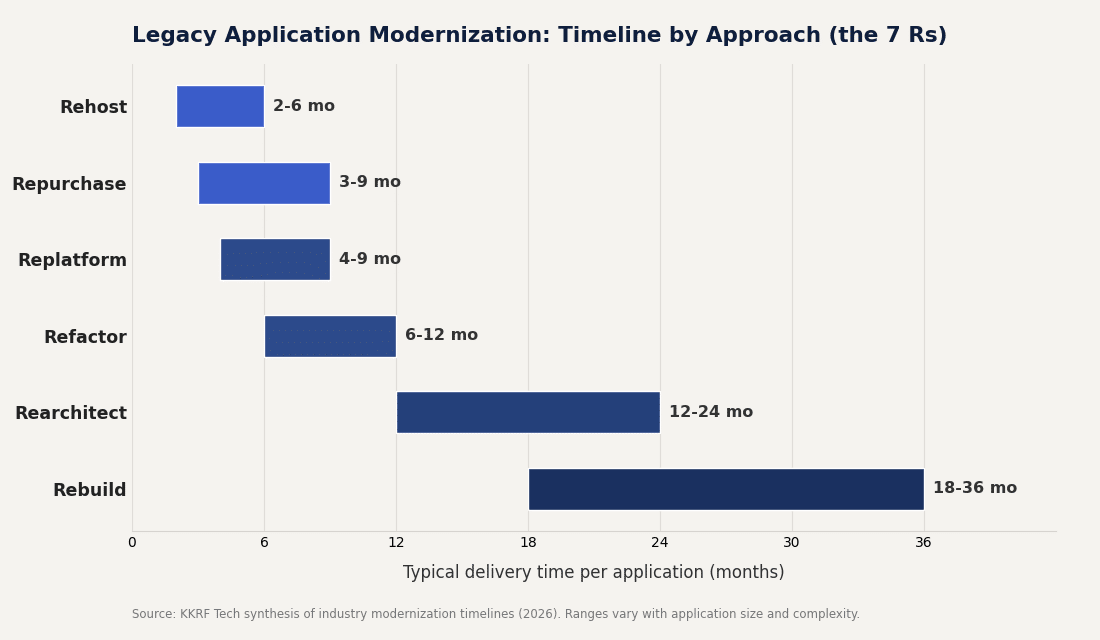
There is no single “modernization.” Analysts and cloud providers converge on a framework of seven options — the 7 Rs — and mature programs assign each application to the cheapest option that meets its goals, rather than defaulting to a rewrite.
- Retire — decommission applications no longer worth running. The cheapest win in any portfolio.
- Retain — deliberately leave a system as-is for now, with a documented reason and a review date.
- Rehost (“lift and shift”) — move the workload to modern infrastructure or the cloud with no code change.
- Repurchase — replace a custom system with a commercial SaaS product.
- Replatform — move to a modern platform (managed database, container runtime) with minimal code changes.
- Refactor — improve the internal code structure without changing external behavior.
- Rearchitect / Rebuild — redesign or rewrite the application, often decomposing a monolith into services.
| Approach | Best when | Relative cost & risk | Typical timeline |
|---|---|---|---|
| Rehost | Aging hardware, data-center exit, time pressure | Low | 2–6 months |
| Repurchase | A mature SaaS covers the need | Low–Medium | 3–9 months |
| Replatform | Logic is sound but the platform is costly | Medium | 4–9 months |
| Refactor | Valuable code has become tangled | Medium | 6–12 months |
| Rearchitect | Scaling or agility limits demand a new design | High | 12–24 months |
| Rebuild | The system is beyond economical repair | Highest | 18–36 months |
For anything larger than a small refactor, the strangler fig pattern is the safest route: stand up the new system alongside the old one and migrate functionality incrementally, routing traffic across until the legacy system can be retired. It avoids the “big bang” cutover that sinks so many programs.
Once workloads land on a modern container platform, cost governance becomes the next discipline — our breakdown of Kubernetes cost optimization covers that in depth.
In short: pick the least invasive R that achieves the business goal, and prefer incremental cutover over a single high-risk switch.
What Legacy Application Modernization Costs in 2026
Legacy application modernization cost in 2026 ranges from roughly $200,000 for a small departmental application to $12M–$50M for a core banking platform. The spread is driven less by the technology than by data complexity, integration count, compliance scope, and how much business logic must be recovered.
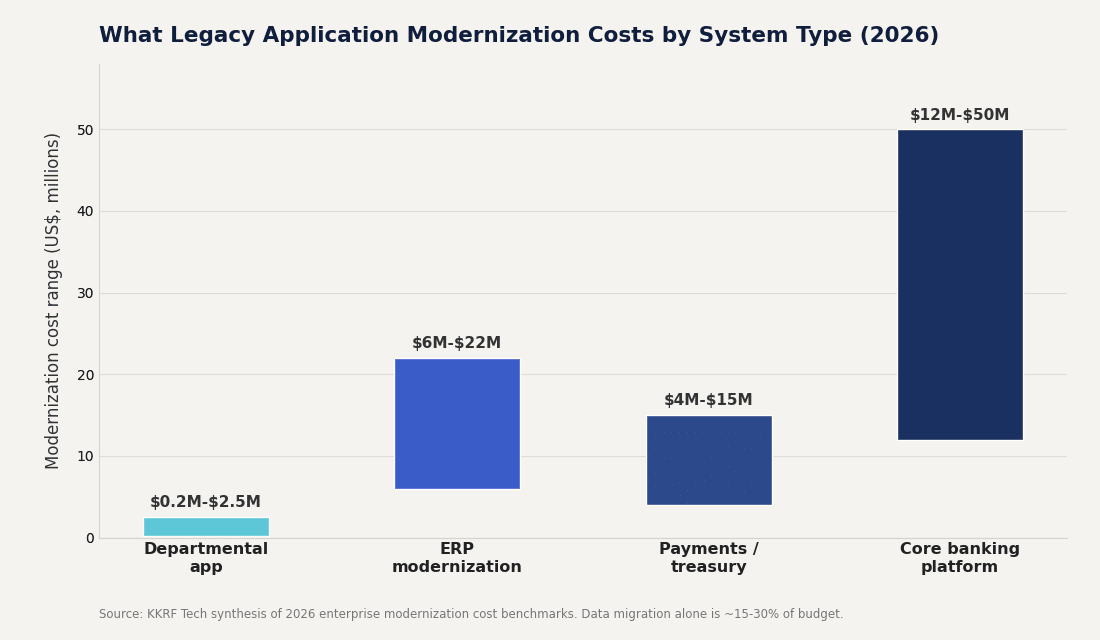
Two numbers matter more than the headline. First, data migration alone typically consumes 15–30% of the budget — the single most underestimated line item. Second, most enterprises underbudget the total program by three to five times, because the estimate approved in January rarely reflects the discovery work that surfaces by Q3.
- Application complexity — lines of code, language, and how much undocumented logic must be reverse-engineered.
- Data migration and quality — schema mismatches, cleansing, reconciliation, and cutover rehearsal.
- Integration surface — every upstream and downstream system that must keep working during and after the move.
- Compliance and security scope — regulated data (PCI DSS, HIPAA, SOX) raises testing and audit cost sharply.
- Approach chosen — a rehost is a fraction of a rebuild; the 7 Rs decision is the biggest cost lever you control.
- Parallel-run duration — the longer old and new systems run side by side, the higher the operational cost.
In short: budget for discovery and data migration first, choose the lightest viable approach, and expect the honest number to exceed the optimistic one.
How AI Actually Accelerates Modernization
Used correctly, AI compresses the slowest, most manual phases of modernization — understanding the old system and drafting the new one. The value shows up across a defined pipeline, with human engineers validating each stage.
A practical toolchain has emerged. IBM watsonx Code Assistant for Z specializes in COBOL-to-Java conversion for mainframe estates; AWS Mainframe Modernization provides managed refactor and replatform paths; and Moderne, built on the open-source OpenRewrite engine, applies AI-assisted, rule-based refactoring at scale. General assistants like GitHub Copilot help modern developers read and navigate COBOL they never learned.
- Automated discovery and dependency mapping. AI parses millions of lines to surface call graphs, dead code, and hidden coupling far faster than manual review.
- Documentation generation. Models draft plain-language descriptions of what each module does, giving teams a starting map of undocumented logic.
- Test-harness creation. AI helps generate characterization tests that pin down current behavior — the safety net translation requires.
- Assisted translation and refactoring. Code is converted or restructured with AI drafting the change and engineers reviewing every diff.
- Human validation and hardening. Experts correct semantic errors, fix data mappings, and confirm behavior against the tests.
- Incremental cutover. Functionality moves in slices — the strangler fig pattern — with observability and rollback in place at each step.
The through-line is simple: AI never runs unattended in a system of record. It drafts; engineers decide. That distinction is what separates real acceleration from a fast path to an outage.
In short: point AI at discovery, documentation, tests, and first-draft conversion — then keep expert engineers on the critical path to production.
Sizing an AI-assisted modernization program and want a realistic estimate before you commit budget? KKRF Tech runs a structured portfolio assessment first, so you fund the right applications in the right order. Explore our legacy modernization services.
Get a Modernization Assessment →Security, Compliance & Risk Considerations
Modernization is a security event, not just an engineering one. Moving a system exposes every assumption baked into the old environment, so security and compliance controls must be designed into the target from day one — not bolted on after cutover.
Follow established guidance rather than reinventing it. The OWASP Application Security Verification Standard and the NIST Secure Software Development Framework give concrete controls for the rebuild, and regulated data brings its own mandates — PCI DSS for cardholder data, HIPAA for health records, SOX for financial reporting.
- Secrets and credentials — legacy systems often hard-code them; rotate and vault everything during the move.
- Access control — re-derive least-privilege roles instead of copying decades of accumulated permissions.
- Data in transit and at rest — enforce modern encryption the old platform may have lacked.
- Business continuity — the legacy system usually stays in production during migration, so plan parallel-run integrity and rollback.
- Audit and observability — instrument the new system so you can prove behavior and trace incidents from the first slice.
In short: treat the target architecture as a chance to close long-standing security gaps, and let OWASP and NIST — not tribal habit — define the controls.
ROI and the Enterprise Business Case
A well-scoped modernization typically cuts total cost of ownership by 25–45% over the first year for applications that pick the right approach, with payback landing between 14 and 30 months. The business case is strongest when it counts the cost of doing nothing.
That cost is substantial. Beyond Gartner’s technical-debt estimate, IDC research has found a large share of IT leaders cite technical debt as a major driver of overspending on cloud and digital infrastructure. Legacy systems also carry hidden costs: security exposure, integration drag, compliance risk, and the shrinking pool of engineers who can maintain them.
- Run-cost reduction — lower licensing, infrastructure, and support spend after the old platform is retired.
- Risk reduction — quantify avoided breach, downtime, and compliance-failure exposure.
- Velocity gains — features that took quarters on the legacy stack ship in weeks on a modern one.
- Talent and continuity — you stop depending on scarce, retiring skills.
Frame the investment incrementally. Phased delivery reaches positive ROI faster than a multi-year big bang because each migrated slice starts returning value while the rest of the program continues.
In short: the business case is a comparison, not an absolute — modernization cost versus the compounding cost of standing still.
Common Legacy Application Modernization Mistakes to Avoid
Most failed programs fail for the same handful of reasons. Avoiding them is worth more than any single tool choice.
- The big-bang rewrite. Replacing everything at once maximizes risk; incremental cutover almost always wins.
- Skipping the portfolio assessment. Modernizing without ranking applications by value and health wastes budget on the wrong systems.
- Trusting AI output as production-ready. Unreviewed conversions ship silent behavior changes.
- Underbudgeting data migration. The 15–30% line item that teams treat as an afterthought.
- No behavioral test baseline. Without characterization tests, you cannot prove the new system matches the old.
- Ignoring business-logic archaeology. Failing to recover why rules exist reintroduces old bugs and compliance gaps.
- No rollback plan. Every cutover slice needs a safe reverse gear.
- Neglecting observability. You cannot operate what you cannot see once traffic shifts.
In short: the recurring failures are organizational, not technical — scope, sequencing, testing, and data discipline.
Future Trends: Agentic AI & Continuous Modernization
The next wave moves from AI as an assistant to AI as an orchestrated set of agents — and from modernization as a one-time project to a continuous capability.
Agentic pipelines are emerging that chain discovery, documentation, translation, and test generation with less manual hand-off, while a human stays in the loop for architectural and release decisions. Paired with platform engineering and internal developer platforms, this pushes teams toward continuous modernization, where systems are refactored steadily rather than left to rot until a crisis forces a rescue.
The demographic clock adds urgency. An estimated 220 billion lines of COBOL still run in banking, government, and healthcare, maintained by a workforce whose average age is around 55 and retiring steadily. Capturing that institutional knowledge — with AI documentation as one tool — is now a board-level risk, not a nice-to-have.
In short: expect modernization to become continuous and agent-assisted, but human architectural judgment stays firmly on the critical path.
Decision Framework & Choosing a Modernization Partner
Choose the approach by scoring each application on two axes — business value and technical health — then match it to the 7 Rs. High-value, unhealthy systems justify rearchitecting or rebuilding; low-value ones should be retired or left alone.
- Modernize now when the system blocks revenue or compliance, security risk is rising, or the maintenance workforce is disappearing.
- Rehost or replatform when the logic is sound and the problem is cost or hosting, not design.
- Rearchitect or rebuild when the architecture itself caps scalability or agility and no lighter option will do.
- Retire or retain when value is low — do not spend modernization budget on systems the business is leaving behind.
- Be cautious when the business domain is about to change materially; modernizing a soon-to-be-obsolete process just automates waste.
This is where a delivery partner earns its keep. KKRF Tech brings custom software development depth to legacy application modernization by starting every engagement with a portfolio assessment rather than a rewrite proposal — mapping value, risk, and the cheapest viable path before a line of code is touched.
When you evaluate a modernization partner, look past the demo:
- Assessment-first, not rewrite-first — do they profile your portfolio before proposing scope?
- Domain and compliance fluency — have they shipped in your regulatory environment?
- AI with guardrails — do they use AI to accelerate while keeping engineers on the critical path?
- Incremental delivery — can they show a strangler-fig, slice-by-slice track record?
- Data migration rigor — do they treat data as a first-class workstream, not a footnote?
- Knowledge transfer — will your team own and operate the result?
In short: the right partner argues you out of unnecessary work and de-risks the work that remains.
Not sure whether your core system needs a rehost, a refactor, or a full rebuild? Our engineers will score your portfolio and recommend the lowest-risk path to value.
Talk to Our Modernization Team →Frequently Asked Questions
What is legacy application modernization?
Legacy application modernization is the process of updating outdated software — including its code, architecture, data, and hosting — so it runs securely, scales, and costs less to operate on modern platforms. It ranges from a simple cloud rehost to a complete rebuild, depending on the application’s value and technical health.
How much does legacy application modernization cost?
In 2026, costs range from around $200,000 for a small departmental application to $12M–$50M for a core banking platform. Data migration alone is typically 15–30% of the budget, and most enterprises underestimate the total by three to five times.
Can AI fully automate legacy modernization?
No. AI dramatically accelerates code discovery, documentation, and translation, but it cannot recover undocumented business logic, make architecture decisions, or guarantee correctness without human review and a solid test baseline. Treat AI output as a fast first draft, not a finished system.
How long does a legacy modernization project take?
A small refactor can take a few months; a mainframe core rebuild can run 18–36 months, and enterprise-wide programs covering many applications often span three to seven years. The timeline depends on the approach chosen and the application’s complexity.
What is the strangler fig pattern?
The strangler fig pattern builds the new system alongside the old one and gradually routes functionality and traffic to it until the legacy system can be retired. It is the most widely used way to modernize without a high-risk “big bang” cutover.
Rehost, refactor, or rebuild — which should we choose?
Rehost when the logic is sound and you just need modern infrastructure; refactor when valuable code has become tangled; rebuild when the system is beyond economical repair. Score each application on business value and technical health, then pick the least invasive option that meets the goal.
Ready to turn a decades-old system into a platform your team can build on? KKRF Tech delivers legacy application modernization with an assessment-first, incremental approach that protects continuity while cutting cost.
Start Your Modernization Roadmap →