
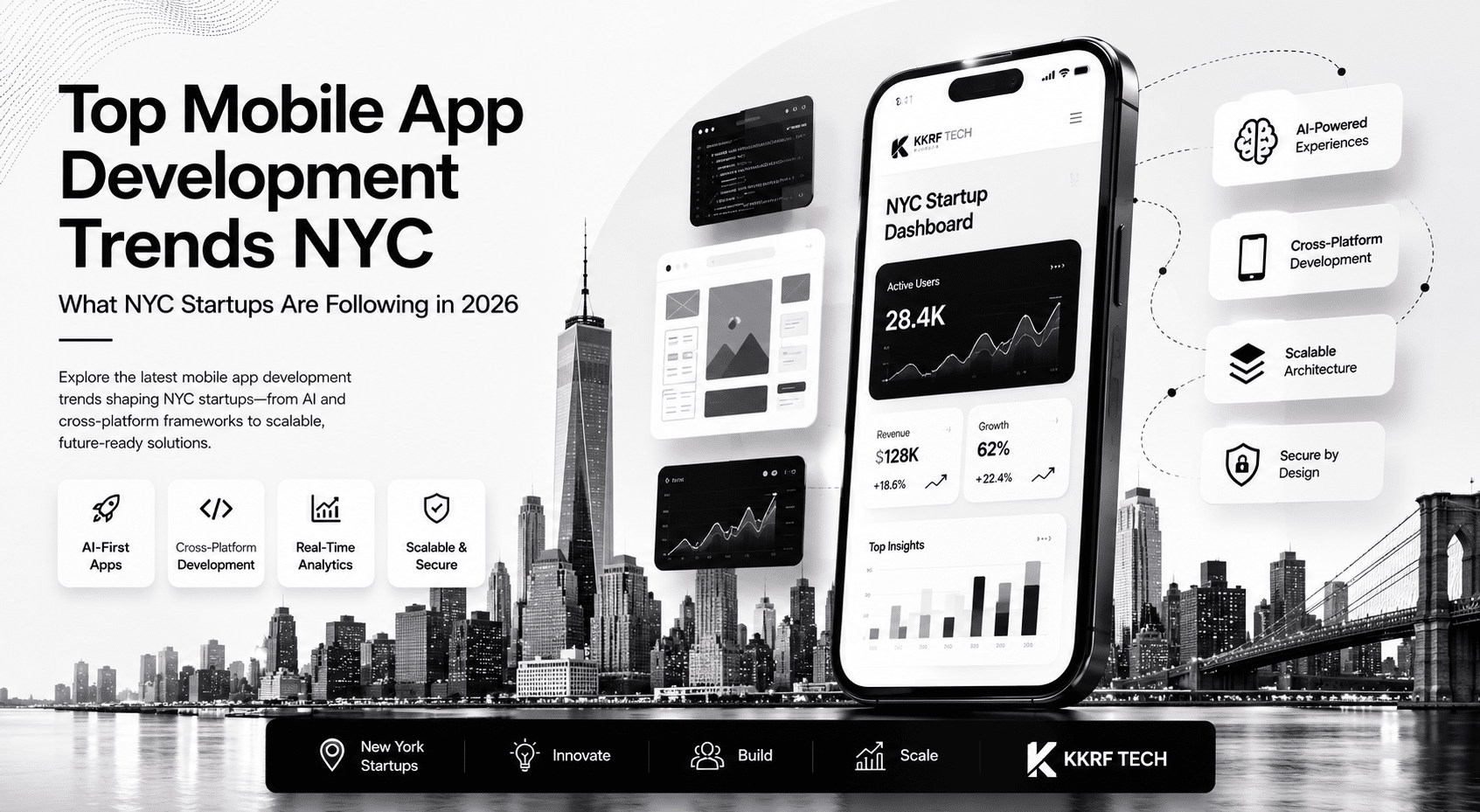
If you are building a venture in New York right now, your product almost certainly lives on a phone. The Top Mobile App Development Trends NYC founders are following in 2026 are not abstract predictions — they are the practical decisions deciding which startups raise their next round and which quietly run out of runway. This guide breaks them down the way a seasoned product partner would in a working session: what is real, what is hype, and what actually moves the needle for a New York startup.
New York has quietly become one of the most demanding mobile markets on earth. Users here juggle banking, transit, food, healthcare, and work across a dozen apps before lunch. The bar for a polished, fast, intelligent experience is brutal — and the founders who understand that are spending more thoughtfully on engineering than ever. The latest app development trends in NYC are less about chasing novelty and more about discipline: knowing how startups build apps in NYC that actually retain users and survive due diligence. Below, we walk through every trend shaping how the best teams approach startup app development in NYC, with the trade-offs that rarely make it into a glossy trend report.
Why NYC Startups Are Investing More in Mobile Apps
en years ago, “tech in New York” mostly meant adtech and finance dashboards. Today New York ranks as the #2 startup ecosystem in the world, with dense clusters of fintech in the Financial District, health and biotech ventures spilling out of the East Side, and a maturing consumer and B2B SaaS scene across Manhattan and Brooklyn. That density changes the math on mobile. When your competitor is three subway stops away and pitching the same investors, a sluggish or generic app is a liability you cannot afford.
There is also a hard financial reason. Capital in New York is plentiful but impatient. Investors here want to see traction and retention, not just downloads — and retention lives or dies on mobile experience. A startup that nails onboarding, speed, and personalization can show the kind of weekly active usage that justifies a Series A. One that ships a clunky app burns its first cohort and never recovers. Founders increasingly treat their mobile app development spend not as a cost center but as the single highest-leverage investment in their growth story.
Finally, the user base demands it. New Yorkers are mobile-first to an extreme degree. Commuters complete entire workflows on a train with no signal between stations. That reality forces NYC founders to think about offline behavior, performance, and trust earlier than teams in less dense markets — and it is the backdrop for every trend that follows.
“We didn’t lose users to a competitor with more features. We lost them to a competitor whose app opened half a second faster. In New York, latency is a churn metric.”
Top Mobile App Development Trends NYC Founders Should Watch
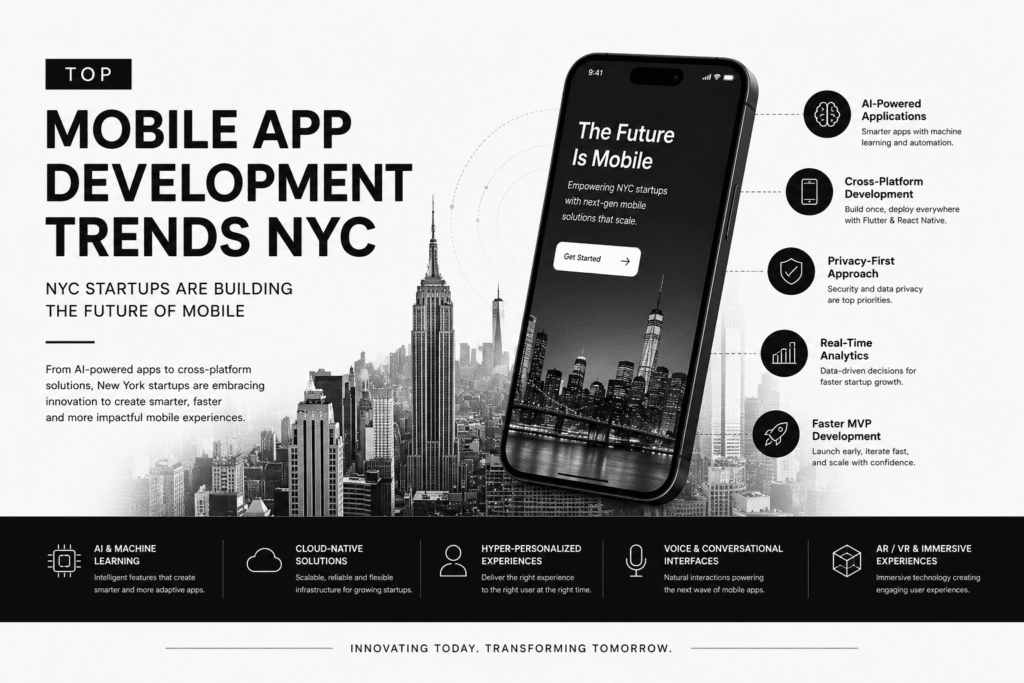
Before we go deep, here is the shortlist. These are the Top Mobile App Development Trends NYC teams are actively building around in 2026 — the NYC startup technology trends and top mobile app trends for startups that show up most often in the funded ventures we work with:
- AI-first product design — intelligence baked into the core experience, increasingly on-device.
- Cross-platform by default — Flutter and React Native as the standard, not the exception.
- Hyper-personalization — every screen adapts to the individual user.
- Real-time and predictive analytics — apps that anticipate behavior, not just record it.
- Privacy-first architecture — trust as a feature, especially in fintech and health.
- Conversational and voice interfaces — natural language as a primary input.
- Low-code-assisted MVPs — faster validation without sacrificing scalability.
- Cloud-native, scalable infrastructure — built for spiky, unpredictable growth.
Each of these deserves more than a bullet point, so let’s get into where they actually matter for a New York startup.
AI-Powered Mobile Apps Are Reshaping NYC Startups
The single biggest shift is that AI has stopped being a feature and become a baseline expectation. In 2026, an AI app development strategy in New York is not about bolting a chatbot onto an existing product. It is about asking, from day one, where intelligence makes the core job easier, faster, or more personal for the user. The strongest AI-powered startup apps NYC founders launch treat machine learning as a core ingredient, not a garnish.
The most interesting work we see in NYC is happening at the edges. On-device AI — running smaller models directly on the phone — is letting fintech and healthcare startups deliver instant personalization and predictions without shipping sensitive data to a server. This is why mobile app development for fintech startups increasingly starts with the data and intelligence layer. A budgeting app can categorize transactions on-device; a health app can surface a pattern without that data ever leaving the user’s pocket. This matters enormously in a city where financial and medical apps face intense scrutiny.
What founders get wrong is treating AI as a marketing line rather than an engineering discipline. The teams building serious AI mobile apps NYC investors fund are disciplined: they identify one workflow where intelligence creates real leverage, they measure whether it actually improves retention, and they manage inference costs carefully so that an AI feature does not quietly eat their margins at scale. AI-first is a strategy, not a sticker.
NYC startups invest in AI mobile apps because intelligence now drives personalization, retention, and defensibility. The winners build AI into one core workflow, measure its impact, and increasingly run models on-device for speed and privacy.
Flutter vs React Native for Startup Apps
No debate consumes more founder energy than Flutter vs React Native for startups, and most of the heat is wasted. Both are excellent, and there is no single best app framework for startups in the abstract. The right answer depends on your team, your design ambitions, and who you plan to hire over the next two years — not on which one trended on a developer forum last month.
Our honest framing: choose React Native app development when your team already lives in JavaScript and React, when you need a deep ecosystem of native modules, or when you want web and mobile to share logic. Choose Flutter app development when you want the kind of pixel-perfect, animation-rich interfaces Flutter’s own rendering engine makes possible, or when your product’s differentiation is in the polish of its UI.
| FACTOR | FLUTTER | REACT NATIVE |
|---|---|---|
| Language | Dart | JavaScript / TypeScript |
| UI consistency | Identical across platforms (own render engine) | Maps to native components |
| Hiring pool in NYC | Growing, smaller | Large (overlaps with React/web) |
| Best for | Animation-heavy, design-led apps | JS-native teams, native module depth |
| Code reuse with web | Limited | High (shared React logic) |
For most early-stage NYC startups, the deciding factor is hiring. The React Native app development NYC talent pool is enormous because it overlaps with the city’s React community, which often makes it the pragmatic default — until a product’s design demands push toward Flutter app development NYC studios excel at instead. There is no wrong answer, only a wrong reason for choosing.
Cross-Platform Development Is Dominating NYC
A few years ago, building separate native iOS and Android apps was the default for serious products. In 2026 that is increasingly the exception. Cross-platform app development NYC startups choose now powers the majority of new startup apps in the city, and the reason is brutally simple: runway.
A New York engineering salary is among the highest in the country. Maintaining two native codebases means roughly two teams, two release cycles, and two sets of bugs. Cross-platform mobile apps let a single team ship to both iOS and Android from one codebase, often cutting build and maintenance costs by 30 to 40 percent. For a startup measuring its life in months of cash, that is the difference between reaching the next milestone and not.
The old objection — that cross-platform apps feel “less native” — has largely dissolved. Modern Flutter and React Native apps are indistinguishable from native to the average user, and the gap closes further every release. The startups still building fully native usually have a specific reason: heavy use of platform-specific hardware, AR, or extreme performance needs. For everyone else, cross-platform mobile development is the rational default.
Hyper-Personalized Mobile Experiences
Generic apps are dead in New York. Users expect the product to know them — to surface the right content, the right offer, the right next action without being asked. Hyper-personalization is the discipline of making every screen adapt to the individual, and it has become the single most powerful customer engagement and retention lever a startup has.
This goes well beyond showing someone their name. It means a fintech app that reorders its dashboard based on what a user actually checks, a marketplace that learns a buyer’s taste within three sessions, a health app that adjusts its tone based on how someone is doing. Strong mobile UX optimization makes this feel effortless rather than intrusive. Done well, personalization compounds: the more a user engages, the smarter the app gets, the harder it becomes to leave. That is the flywheel investors look for.
The engineering reality is that personalization requires clean event data and a thoughtful data model from the start. Founders who bolt personalization on late spend months untangling messy analytics. The teams getting it right design their data layer with personalization in mind from the first sprint.
Real-Time Analytics & Predictive Features
The next layer on top of personalization is anticipation. Real-time analytics lets a product respond in the moment — flagging a fraudulent transaction as it happens, nudging a user before they abandon a flow, surfacing insight while it is still relevant. Predictive features go further, using behavioral signals to forecast churn, lifetime value, or the next action a user is likely to take.
For NYC startups, this is increasingly table stakes in any data-rich vertical. A fintech app that can predict and prevent churn keeps the cohorts that justify its valuation. A logistics app that forecasts demand routes resources before the spike. The underlying capability — event streaming, real-time pipelines, and lightweight predictive models — has become dramatically more accessible, which is exactly why founders are expected to use it.
“Our retention only changed when we stopped reporting on what users did and started predicting what they were about to do. Predictive churn alerts paid for the whole analytics rebuild.”
Privacy-First Mobile Applications
In a city built on fintech and healthcare, privacy is not a compliance checkbox — it is a product strategy. This is especially true for healthcare app development NYC teams ship and for mobile commerce apps that handle payment data at scale. Apple’s tracking transparency rules, evolving state privacy laws, and rising user skepticism have all converged to make privacy-first design a genuine differentiator. The startups that treat data minimization and transparency as features, not obligations, are earning trust their competitors can’t buy.
This shows up technically in several ways: processing sensitive data on-device rather than in the cloud, collecting only what the product genuinely needs, encrypting data at rest and in transit, and giving users clear, honest control over their information. For a fintech or healthcare startup pitching New York investors, demonstrable privacy and security architecture — measured against standards like the OWASP Mobile Application Security framework — is now part of due diligence. Mobile app security has moved from a late-stage concern to a first-sprint decision.
Voice Search & Conversational Interfaces
The rise of capable language models has made conversational interfaces practical in a way they never were before. Instead of forcing users through rigid menus, more apps now let people simply describe what they want. A user can ask a finance app “how much did I spend on transit last month” rather than navigating four screens of filters.
For NYC startups, the opportunity is in reducing friction. The most effective conversational features are not gimmicky assistants but quiet shortcuts — natural language layered on top of an existing workflow to make the common case effortless. Voice-enabled and conversational design works best when it removes steps rather than adding a novelty. As language understanding keeps improving, expect this to become a standard input method rather than a flagship feature.
AR/VR & Spatial Mobile Experiences
Spatial computing is the trend most prone to hype, so here is a grounded view. For the vast majority of startups, AR and VR are not yet a core requirement — and chasing them prematurely is a classic way to burn a seed round. But specific NYC verticals are finding real value.
Real estate app development New York founders pursue is one clear example: startups use augmented reality for virtual staging and apartment previews, a meaningful edge in a market where in-person viewings are expensive and competitive. Retail and furniture brands let customers place products in their own space before buying, cutting returns. The pattern is clear: AR earns its place when it solves a concrete problem in the purchase or decision journey, not when it is added for novelty. If your product has a “see it in your space” moment, spatial features are worth exploring; if it doesn’t, they can wait.
Low-Code + Faster MVP Development
Speed to market has always mattered for startups, but the tooling has changed what’s possible. Low-code platforms and AI-assisted development now let teams validate an idea in weeks instead of months — a real advantage when you’re racing to prove product-market fit before the next funding conversation.
The nuance founders miss is knowing when low-code is right. It is excellent for testing a concept, building internal tools, or shipping a constrained MVP to gather real user feedback. It becomes a liability when a product needs custom performance, deep integrations, or the kind of scalability that complex apps demand. The smartest NYC teams use low-code to validate fast, then partner with an MVP app development company NYC founders trust to re-architect on a proper startup tech stack once the idea has earned the investment. The mistake is treating a validation tool as a permanent foundation.
A well-scoped startup MVP typically takes 8 to 16 weeks to launch. Low-code and AI-assisted tooling can compress early validation, but production-grade scale usually requires a proper custom build once product-market fit is proven.
Cloud-Native & Scalable App Infrastructure
Every founder dreams of the launch that goes viral. Far fewer build the infrastructure to survive it. Cloud-native architecture — serverless functions, managed databases, edge computing, and elastic scaling — is what separates the apps that ride a spike from the ones that crash during their biggest moment.
For NYC startups, growth tends to be spiky and unpredictable: a press hit, an investor demo, a viral TikTok. Startup app scalability comes down to infrastructure that scales automatically with demand, and just as importantly scales back down to control costs. Edge computing pushes processing closer to users for lower latency — which, in a market obsessed with speed, is a real competitive factor. Designing for startup scalability early means the architecture stays invisible when traffic is light and bulletproof when it isn’t.
- AI is now a baseline expectation in NYC apps, not a differentiator on its own.
- Cross-platform development (Flutter / React Native) is the rational default for startups managing runway.
- Personalization, real-time analytics, and privacy-first design are the strongest retention and trust levers.
- Low-code accelerates validation; cloud-native architecture is what lets a validated product scale.
How KKRF Tech Helps NYC Startups Build Scalable Apps
At KKRF Tech, we work with New York founders the way a technical co-founder would — pragmatic about runway, honest about trade-offs, and focused on the decisions that actually move retention and fundability. As a team of mobile app developers NYC ventures trust, we’ve built across fintech, healthcare, and consumer products, which means we understand both the engineering and the investor scrutiny that comes with a New York venture. That blend of speed and depth is what founders look for in the best app developers in New York.
Our work spans the full lifecycle of custom mobile app development New York founders rely on: MVP development to validate fast, Flutter and React Native builds for production-grade cross-platform apps, AI integration that earns its keep, and UI/UX design that makes the product feel inevitable. From early-stage MVPs to enterprise mobile app development New York programs demand, it all sits on scalable, cloud-native architecture designed for the spiky growth NYC startups actually experience.
What founders tell us they value most is the honesty. We will tell you when low-code is the right call, when a feature should wait, and when your AI ambition is going to cost more than it returns. That candor — paired with full-stack mobile app development services NYC ventures scale on, spanning startup app development NYC teams need and AI app development New York demands — is why startups across Manhattan and Brooklyn partner with us as their long-term mobile app development company in New York.
The Future of Mobile App Development in New York
Looking past 2026, the direction is clear even if the specifics aren’t. The future mobile app trends 2026 set in motion all point the same way: the future of mobile app development in New York belongs to products that are intelligent by default, personal to the individual, fast everywhere, and trustworthy with data. AI will keep moving on-device. Cross-platform tooling will keep closing the gap with native. The line between an app and an assistant will keep blurring.
For founders, the takeaway is not to chase every trend on this list. It is to choose deliberately — to understand which of these Top Mobile App Development Trends NYC teams are following actually serves your users and your business model, and to build those well. The startups that win in New York won’t be the ones with the longest feature list. They’ll be the ones that made fewer, sharper decisions and executed them with discipline.
Ready to build a mobile app
NYC investors take seriously?
Partner with a mobile app development company in New York that builds scalable, intelligent apps for startups — from MVP to Series A and beyond.
Book a Free Strategy CallThe top mobile app development trends in NYC for 2026 are AI-powered and on-device intelligence, cross-platform development with Flutter and React Native, hyper-personalization, real-time analytics, privacy-first architecture, conversational interfaces, low-code MVP development, and cloud-native scalable infrastructure.
A focused startup MVP typically costs $25,000–$60,000, a production cross-platform app ranges from $60,000–$150,000, and complex enterprise or fintech apps with custom backends and compliance can exceed $200,000. Cost depends on feature scope, integrations, and design complexity.
Because intelligence is now a core product expectation, not a feature. AI improves personalization, automates workflows, reduces support costs, and creates defensible data advantages that help startups stand out in New York’s competitive market.
Neither is universally better. React Native suits teams with strong JavaScript or React backgrounds and apps needing deep native integration, while Flutter excels at pixel-perfect, animation-heavy interfaces.
A well-scoped MVP usually takes 8–16 weeks to design, build, and launch. A full-featured production app with custom backend, payments, and AI features typically takes 4–8 months.
It lets startups ship to iOS and Android from one codebase, cutting build and maintenance costs by up to 40 percent. Founders use Flutter and React Native to scale faster without doubling engineering teams.
Fintech, healthcare, real estate, retail, logistics, media, and B2B SaaS have the strongest demand. These sectors dominate New York’s startup ecosystem and rely heavily on mobile as the primary channel for engagement and transactions.
Secure authentication, a clear core workflow, push notifications, analytics tracking, scalable cloud infrastructure, and AI-driven personalization are essential. Founders should avoid feature bloat before validating product-market fit.
Yes. Mobile apps remain profitable through subscriptions, transaction fees, in-app purchases, and B2B licensing. Profitability now depends heavily on retention and personalization.
A New York partner understands the local funding landscape, investor expectations, and compliance requirements in fintech and healthcare while moving at startup speed.