
Manufacturers, energy operators, and infrastructure teams keep asking us the same thing: can we test a change before it touches the real asset? A digital twin is how you do exactly that. As KKRF Group, a trusted global technology partner and enterprise engineering company, we build digital twins that mirror physical systems in software so teams can simulate, predict, and optimize without gambling on production hardware.
This guide covers what digital twin development actually involves in 2026 — the architecture, the real costs, the ROI, and how to choose a digital twin development partner. It’s written for the people signing off on the budget, not just the engineers wiring up sensors.
Key Takeaways
- A digital twin is a live, data-connected virtual model of a physical asset, process, or system — updated continuously from IoT sensors.
- Digital twin development costs typically run from roughly $10K for a proof of concept to $300K+ for enterprise platforms, and $2M+ for large multi-system deployments.
- The global digital twin market is projected near $34 billion in 2026, growing at a 30–35%+ CAGR through the early 2030s.
- Enterprises report 65% cuts in unplanned downtime and 18–25% lower maintenance costs when twins drive predictive maintenance.
- ISO 23247 gives you a vendor-neutral reference architecture; use it to avoid lock-in.
- Most successful programs start with one high-value asset, prove ROI in under 24 months, then scale.
On This Page
- What Is Digital Twin Development?
- The Four Types of Digital Twins
- Digital Twin Architecture: Five Layers
- How Much It Costs
- The Business Case and ROI
- Industry Use Cases
- How to Build One: 7 Steps
- Build, Buy, or Hybrid
- Common Mistakes to Avoid
- Decision Framework
- Choosing a Development Partner
- Where Digital Twins Are Heading
- Frequently Asked Questions
What Is Digital Twin Development?
Quick answer: Digital twin development is the process of building a live virtual replica of a physical asset, process, or system that stays synchronized with its real-world counterpart through IoT sensor data. The twin lets you monitor conditions in real time, run “what-if” simulations, and predict failures before they happen. Costs range from about $10,000 for a proof of concept to $300,000 or more for enterprise-grade platforms, and projects usually pay back within 24 months when tied to predictive maintenance.
A digital twin is not a 3D model or a dashboard. Those are static. The defining trait of digital twin development is the live data link: the physical thing sends telemetry, the virtual model updates, and — in mature systems — insights flow back to influence the physical asset. That two-way loop is what separates a real twin from a fancy visualization.
Definition: Digital Twin
A digital twin is a virtual representation of a physical object or system that is continuously updated with real-time data from that object, and used to simulate, analyze, and optimize its behavior. It combines three ingredients: the physical entity, the virtual model, and the data connection linking them. Without the live connection, you have a simulation or a CAD model — not a twin.
The Four Types of Digital Twins
Not every twin is the same size or scope. Understanding the four levels helps you scope a digital twin development project realistically and avoid over-building on day one.
Component Twin
A component twin models a single part — a bearing, a pump, a battery cell. It’s the smallest unit and the usual starting point for a proof of concept. Component twins are cheap to build and prove the data pipeline works before you invest in anything larger.
Asset Twin
An asset twin combines multiple components into one working piece of equipment, like a full CNC machine or a wind turbine. It shows how parts interact and is where most predictive maintenance value first appears. This is the sweet spot for a first production deployment.
System (or Unit) Twin
A system twin models how several assets work together — an entire production line, a substation, or an HVAC network across a building. At this level you start optimizing throughput and energy use, not just watching one machine.
Process Twin
A process twin is the largest scope: it mirrors an entire facility or business process, such as a whole factory or a supply chain. Process twins reveal system-wide inefficiencies and support strategic decisions. They cost the most and demand the most data maturity, so they’re rarely a starting point.
Digital Twin Architecture: The Five Layers
Every serious digital twin, regardless of industry, is built on the same layered architecture, and getting these layers right is the core of digital twin development. We map our builds to the ISO 23247 reference framework and the guidance of the Digital Twin Consortium so clients aren’t locked into one vendor’s stack. Here’s how the layers stack up.
- 1. Physical layer. The real asset plus its sensors, actuators, PLCs, and edge gateways. This is the source of truth — accelerometers, temperature probes, current sensors, and cameras that turn physical state into data.
- 2. Data ingestion & connectivity layer. Protocols like MQTT, OPC UA, and REST move telemetry from the edge to the cloud. Edge computing pre-processes and filters data here so you don’t pay to move noise.
- 3. Data & integration layer. A time-series database, data lake, and integration with enterprise systems (ERP, MES, CMMS). ISO 23247 calls the connective tissue the Data Collection and Device Control Entity.
- 4. Modeling & simulation layer. The digital model itself — physics-based models, machine learning, and simulation engines that turn raw data into behavior you can reason about. This is the Core Entity.
- 5. Application & visualization layer. Dashboards, 3D/AR interfaces, alerts, and APIs that deliver insight to people and other systems. ISO calls this the User Entity.
Definition: ISO 23247
ISO 23247 is the international standard that defines a reference architecture for digital twins in manufacturing, and it should shape any serious digital twin development effort. It organizes a twin into observable manufacturing elements, a data collection and control entity, a core digital entity, and a user entity. Building to this standard keeps your architecture interoperable and reduces the risk of vendor lock-in as your program scales.
How Much Does Digital Twin Development Cost?
Digital twin development costs vary more than almost any other software project, because “a digital twin” can mean a $10,000 experiment or a $2 million platform. The honest answer: price tracks scope, the number of connected assets, how much AI and simulation you need, and how deeply it integrates with existing systems.
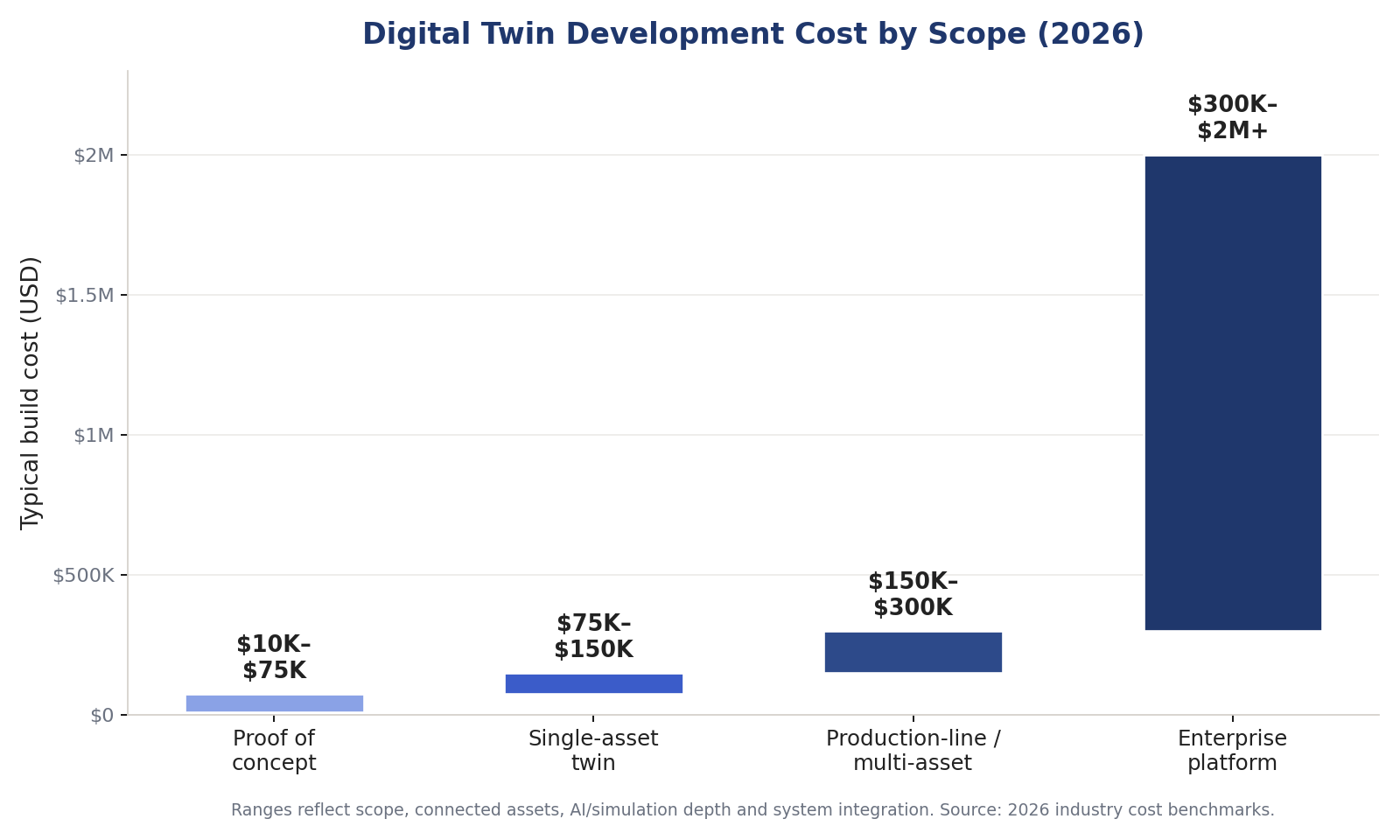
The chart below shows the typical ranges we see across the industry in 2026.
| Scope | Typical cost | What you get |
|---|---|---|
| Proof of concept | $10K–$75K | One component, basic data pipeline, validation of the concept |
| Single-asset twin | $75K–$150K | One machine, live monitoring, early predictive maintenance |
| Production-line / multi-asset | $150K–$300K | Multiple assets, simulation, ERP/MES integration |
| Enterprise platform | $300K–$2M+ | Facility-wide, AI-driven, spatial interfaces, multi-system sync |
The single biggest cost driver isn’t the 3D graphics — it’s integration. Connecting a twin to real-time data pipelines and legacy enterprise systems consistently accounts for the largest share of the budget. Cloud infrastructure, sensor retrofitting, and industry-specific compliance (think FDA validation in pharma or NERC CIP in energy) add to that.
Ongoing cost matters too. Budget 15–25% of the initial build annually for cloud hosting, data storage, model retraining, and maintenance. A twin that isn’t kept in sync with its physical counterpart quietly stops being a twin.
The Business Case: ROI and Payback
Here’s why boards keep funding these programs: the returns are measurable and they show up fast. When a digital twin drives predictive maintenance, the numbers are hard to ignore.
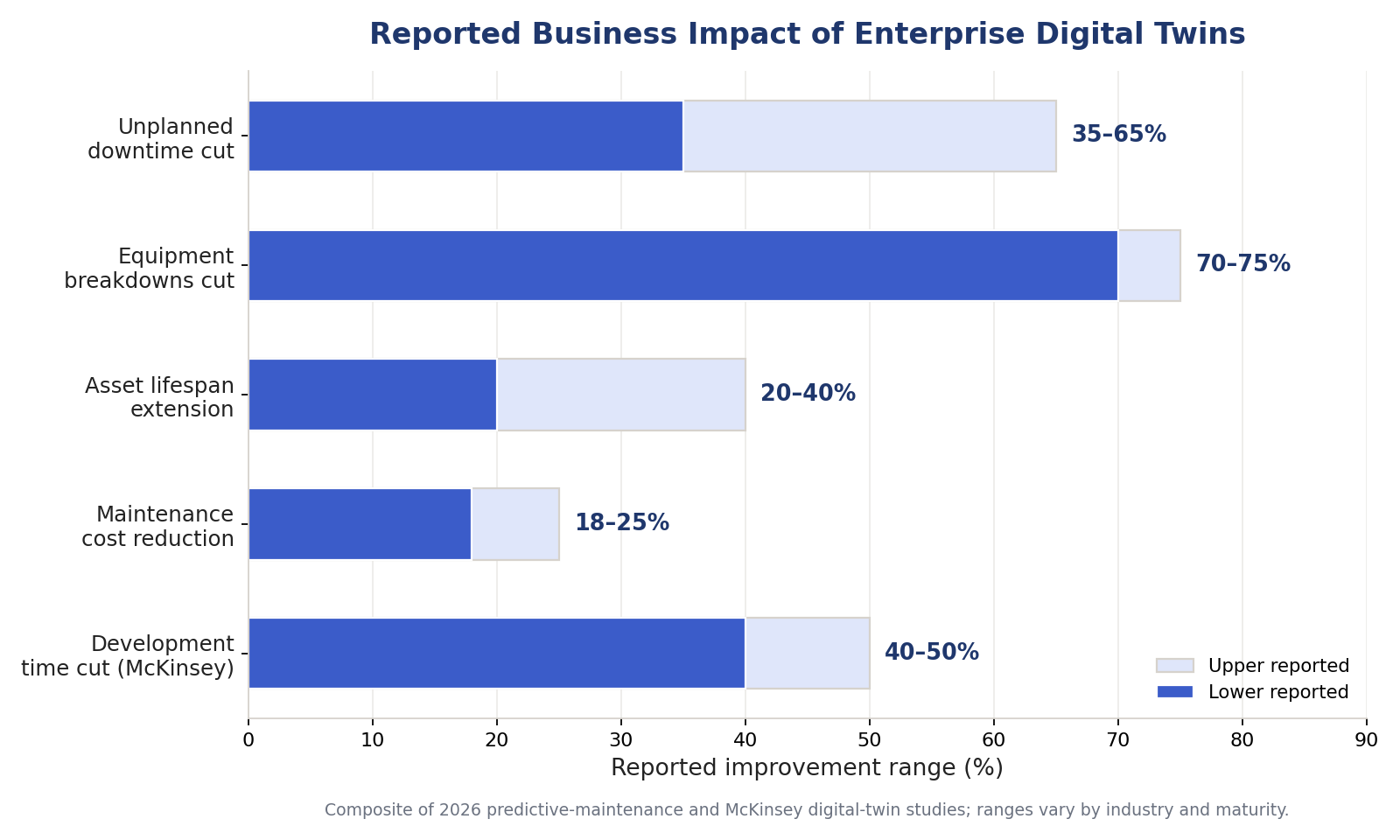
Across 2026 industry studies, organizations using digital twins report roughly 65% reductions in unplanned downtime, 18–25% lower maintenance costs, and 20–40% longer asset lifespans. Predictive-maintenance programs cut equipment breakdowns by 70–75%. McKinsey research links digital twins to development times cut by up to 50% and labor costs down about 10%.
Payback is quicker than most enterprise software. Targeted pilots often recover their cost in under 24 months, and roughly 92% of companies that deploy twins report ROI above 10%, with about half clearing 20%. The pattern we see: start narrow, measure one clear metric like downtime hours avoided, and let that result fund the next phase.
Not sure whether a component twin or a full asset twin fits your budget and data maturity? Our engineers can scope it with you and put real numbers against the ROI. Start with our IoT and digital twin engineering team.
Get a Technical Assessment →Industry Use Cases for Digital Twins
Digital twins aren’t limited to factories, though manufacturing leads adoption. Here’s where they earn their keep, described so each stands on its own.
Manufacturing
Manufacturers use twins to simulate production lines, catch quality issues before they scale, and schedule maintenance during planned windows. A twin of a bottling line can predict a bearing failure days out, so the fix happens on a Sunday instead of mid-shift on a Tuesday.
Energy and Utilities
Utilities twin wind turbines, transformers, and grid segments to forecast output, balance load, and extend asset life. A wind-farm twin models blade wear against weather patterns to optimize when each turbine runs hardest.
Healthcare and Life Sciences
Hospitals twin facilities to optimize patient flow and bed capacity, while pharma companies twin production processes to speed regulated scale-up. Some research groups even build organ-level twins to test treatment responses virtually.
Smart Buildings and Cities
Building twins tie HVAC, lighting, and occupancy data together to cut energy use, often 10–20%. At city scale, twins model traffic, water networks, and infrastructure to plan investment and respond to incidents.
Logistics and Supply Chain
Warehouse and supply-chain twins simulate throughput, test layout changes, and stress-test the network against disruptions before committing capital. It’s cheaper to break a virtual warehouse than a real one.
How to Build a Digital Twin: A 7-Step Process
Every digital twin development project we run follows roughly the same arc. The steps below are ordered so each one de-risks the next.
- Step 1 — Define the business objective. Pick one measurable outcome: reduce downtime on a critical asset, cut energy use, or shorten commissioning time. A twin without a target metric becomes an expensive science project.
- Step 2 — Select the pilot asset. Choose a single high-value, failure-prone asset with existing or easily added instrumentation. Narrow scope is how you prove value fast.
- Step 3 — Instrument and connect. Add or map the sensors, set up edge gateways, and stream telemetry using MQTT or OPC UA. Clean, reliable data here decides whether everything above works.
- Step 4 — Build the virtual model. Create the physics-based or data-driven model, calibrate it against real behavior, and validate that it matches the asset within acceptable tolerance.
- Step 5 — Add analytics and simulation. Layer in anomaly detection, remaining-useful-life prediction, and what-if simulation. This is where the twin starts producing decisions, not just charts.
- Step 6 — Integrate and visualize. Connect to CMMS, ERP, or MES so insights trigger real work orders, and deliver dashboards or AR interfaces to the people who act on them.
- Step 7 — Measure, then scale. Track the target metric against baseline, document the ROI, and use that result to justify expanding from one asset to a system or process twin.
Technology Stack: Build, Buy, or Hybrid
One of the first strategic decisions in digital twin development is whether to build a custom twin, adopt a commercial platform, or blend the two. There’s no universally right answer — it depends on how differentiated your use case is.
| Approach | Best for | Trade-off |
|---|---|---|
| Commercial platform (Azure Digital Twins, AWS IoT TwinMaker, Siemens, GE) | Standard use cases, faster start, limited in-house engineering | Lower flexibility, ongoing licensing, potential lock-in |
| Custom build | Differentiated processes, unique IP, full control | Higher upfront cost and longer timeline |
| Hybrid | Most enterprises: platform for connectivity, custom for simulation/analytics | Requires integration discipline and clear boundaries |
In practice, most of our enterprise clients land on hybrid. They use an established platform for device connectivity and 3D visualization, then build proprietary simulation and analytics layers where their real competitive advantage lives. Common stack elements include Azure IoT or AWS IoT for ingestion, a time-series store, Unity or Unreal for 3D, and Python-based ML for prediction.
Common Digital Twin Mistakes (and How to Avoid Them)
We’ve been called in to rescue enough stalled digital twin development programs to see the same failure patterns repeat. Avoid these and you’re ahead of most.
- Boiling the ocean. Trying to twin an entire factory on day one. Start with one asset, prove it, then expand.
- Treating it as a 3D visual. A pretty model with no live data or simulation is a demo, not a twin. The value is in the loop.
- Ignoring data quality. Garbage telemetry produces confident, wrong predictions. Sensor calibration and data governance aren’t optional.
- No target metric. If you can’t name the number the twin will move, you can’t prove ROI — and funding evaporates.
- Underfunding maintenance. A twin that drifts out of sync with its asset degrades silently. Budget for retraining and upkeep from the start.
- Skipping security. A twin connected to operational technology is an attack surface. Security-first design and network segmentation matter as much as the model.
Decision Framework: When to Build a Digital Twin
A digital twin is a strong investment for some situations and overkill for others. Use this framework to decide.
Choose a digital twin when:
- You have high-value physical assets where unplanned downtime is expensive.
- Your assets are already instrumented, or instrumenting them is feasible.
- You need to test changes that are risky, slow, or costly to try on the real asset.
- You’re managing complex systems where interactions are hard to predict manually.
Reconsider or delay when:
- Your data foundation is weak and sensors don’t exist yet — fix the data layer first.
- The asset is low-value or easily replaced, so downtime costs little.
- You need a one-time analysis, not continuous monitoring — a simulation may be enough.
- There’s no owner accountable for acting on the twin’s insights.
Our recommendation: if you have one expensive, failure-prone asset and a team that will act on predictions, start there with a scoped pilot. If your data foundation isn’t ready, invest in sensors and data governance first — the twin will fail without it.
How to Choose a Digital Twin Development Partner
Digital twin development sits at the intersection of IoT, simulation, cloud, and domain engineering. Few firms are strong across all four, so vet any digital twin development partner carefully.
- Cross-disciplinary depth. Look for genuine capability in IoT connectivity, data engineering, simulation or ML, and cloud architecture — not just one of them.
- Standards fluency. A partner who builds to ISO 23247 and open protocols protects you from lock-in.
- Domain understanding. Manufacturing, energy, and healthcare each have different physics and compliance needs. Ask for relevant, verifiable experience.
- Security-first practice. Confirm how they segment OT networks and secure data pipelines.
- A pilot-first mindset. Be wary of anyone proposing a facility-wide twin before proving value on one asset.
As KKRF Group, we bring that cross-disciplinary engineering under one roof — IoT, cloud-native architecture, AI-driven analytics, and a security-first build process — and we scope every twin as a pilot with a clear ROI target before anyone talks about scaling. You can see our broader approach to connected systems on our enterprise IoT development and cloud engineering teams.
Where Digital Twins Are Heading
The technology is moving fast, and three shifts in digital twin development are worth planning for. First, generative AI is being layered onto twins so operators can ask questions in plain language and get simulated answers. Second, twins are getting more autonomous — closing the loop to adjust physical systems without a human in the middle. Third, standardization through ISO 23247 parts 5 and 6 is making twins composable, so you can assemble a system twin from asset twins built by different vendors.
The market reflects this momentum. Analysts project the digital twin market to grow from roughly $34 billion in 2026 toward $380 billion by the mid-2030s, with manufacturing the fastest-moving segment. For most enterprises, the question in 2026 isn’t whether to adopt twins — it’s which asset to start with.
Ready to put a number against a digital twin for your most critical asset? We’ll map the architecture, estimate the cost, and model the payback — no jargon, just a clear plan. Talk to our engineering team.
Discuss Your Project →Frequently Asked Questions
What is a digital twin in simple terms?
A digital twin is a live virtual copy of a physical thing — a machine, building, or process — that stays updated with real-time sensor data. It lets you monitor, test changes, and predict problems in software instead of on the real asset.
How much does it cost to build a digital twin?
Costs range from about $10,000 for a proof of concept to $75,000–$150,000 for a single-asset twin, $150,000–$300,000 for multi-asset or production-line twins, and $300,000 to $2 million or more for enterprise platforms. Integration with real-time data and enterprise systems is the largest cost driver.
What is the difference between a digital twin and a simulation?
A simulation is a static model you run to answer a question at a point in time. A digital twin is continuously connected to a real asset through live data, so it updates in real time and reflects the current state of the physical thing. The live data link is the key difference.
How long does digital twin development take?
A focused proof of concept usually takes 6–12 weeks. A production single-asset twin often takes 3–6 months, and enterprise platforms can run 9–18 months depending on integration complexity and data readiness.
What is ISO 23247?
ISO 23247 is the international standard defining a reference architecture for digital twins in manufacturing. It structures a twin into observable elements, a data collection and control entity, a core digital entity, and a user entity. Building to it keeps your architecture interoperable and reduces vendor lock-in.
What ROI can I expect from a digital twin?
Enterprises commonly report 65% reductions in unplanned downtime, 18–25% lower maintenance costs, and 20–40% longer asset lifespans. Around 92% of adopters report ROI above 10%, and targeted pilots often pay back in under 24 months, especially when tied to predictive maintenance.
Start where the payback is clearest. Bring us your most failure-prone asset and we’ll design a digital twin pilot with a defined ROI target and a path to scale. Partner with KKRF Group’s engineering team.
Book a Discovery Call →