
Most enterprises don’t decide to build a data lakehouse on day one. They buy a warehouse for reporting, bolt on a data lake when the warehouse bill climbs, and two years later they’re paying to keep two copies of everything in sync. The lakehouse exists to end that split. At KKRF Group, an experienced custom software development company, we design lakehouse platforms that serve business intelligence, machine learning, and operational reporting from a single governed copy of the data.
Quick Answer: What Is a Data Lakehouse Architecture?
A data lakehouse architecture stores all of an organization’s data as open-format files in cheap cloud object storage, then adds a transactional metadata layer on top that delivers the reliability of a data warehouse. It combines the low cost and flexibility of a data lake with the ACID transactions, schema enforcement, and fast SQL analytics of a warehouse, so analytics, data science, and AI teams work from one dataset instead of separate copies. In 2026, most enterprises build lakehouses on object storage (Amazon S3, Azure ADLS, Google Cloud Storage) using an open table format such as Apache Iceberg, Delta Lake, or Apache Hudi.
Key Takeaways
- A data lakehouse unifies the data lake and data warehouse into one platform, removing the need to copy data between systems.
- The architecture has five layers: object storage, an open table format with metadata, a governance and catalog layer, decoupled compute engines, and a consumption layer.
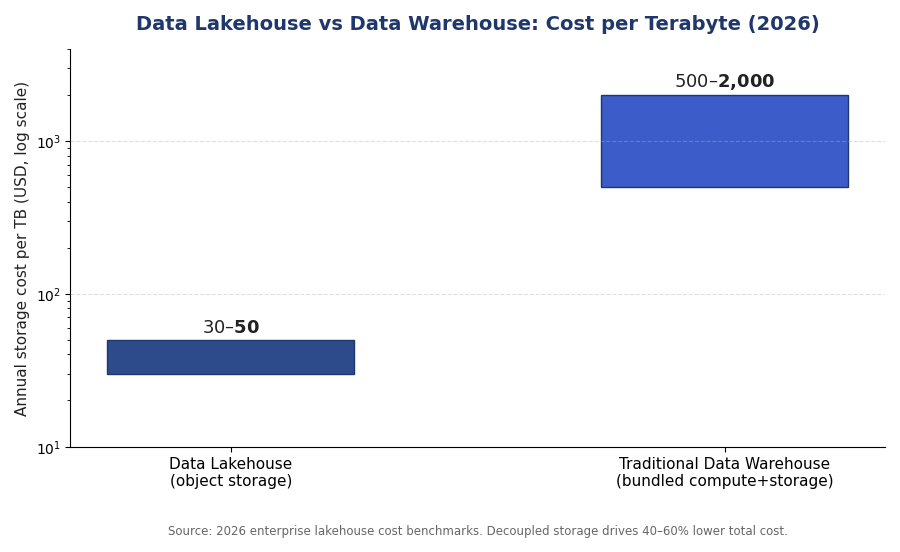
- Lakehouse storage runs roughly $30–$50 per TB per year versus $500–$2,000 for a traditional warehouse, and unifying systems typically cuts total data costs 40–60%.
- Apache Iceberg has become the default open table format in 2026 because of its vendor-neutral governance and broad engine support.
- Choose a lakehouse when you run mixed BI and machine learning workloads on large, varied data; stay on a warehouse when your needs are pure structured BI at modest scale.
On This Page
Data platform decisions are hard to reverse, so they reward experience. KKRF Group has built data pipelines and analytics platforms for teams that needed governed, scalable foundations without a multi-year rebuild. We favor open formats over proprietary lock-in, security-first design, and cloud-native architecture that scales compute and storage independently. The sections below reflect what we’ve seen work, and what we’ve watched fail, on real engagements.
What Is a Data Lakehouse?
A data lakehouse is a data management architecture that stores structured, semi-structured, and unstructured data as open files in cloud object storage and layers database-style features on top of it. Those features include ACID transactions, schema enforcement, indexing, versioning, and access control. The result behaves like a warehouse for SQL analytics while retaining a lake’s ability to hold raw data of any shape at low cost.
The term matters because of what came before it. For a decade, enterprises ran two systems side by side. A data lake held everything cheaply but offered weak guarantees: a failed write could leave partial or corrupt files, and updating individual rows was painful. A data warehouse gave clean, reliable, fast queries but charged a premium and struggled with unstructured data and machine learning workloads. Teams copied data between the two constantly, and every copy was a chance to drift out of sync.
The lakehouse collapses those two systems into one. A data engineering team, an analytics team, and a data science team can all query the same underlying files without duplicating them. That single-copy model is the defining operational advantage of the lakehouse over the lake-plus-warehouse split it replaces, and it is why the pattern moved from a Databricks research idea in 2020 to a mainstream enterprise standard by 2026.
The Five Layers of a Data Lakehouse Architecture
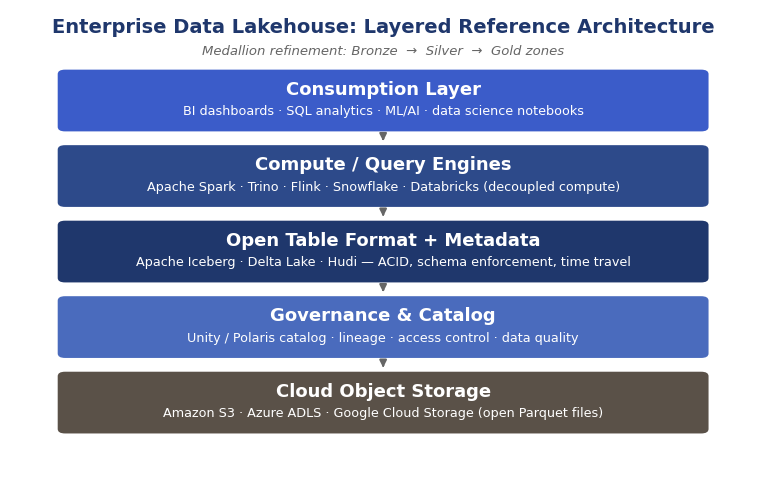
A well-designed lakehouse is built from five distinct layers. Each one has a clear job, and keeping them separate is what lets you swap a query engine or a storage region without rebuilding the platform. The diagram below shows how they stack.
1. Cloud Object Storage
The foundation is inexpensive, virtually unlimited object storage such as Amazon S3, Azure Data Lake Storage, or Google Cloud Storage. Data lands here as open columnar files, almost always Apache Parquet. Because storage is decoupled from compute, you pay for capacity separately from processing, and idle data costs almost nothing.
2. Open Table Format and Metadata Layer
This is the layer that turns a folder of files into something that acts like a database. An open table format such as Apache Iceberg, Delta Lake, or Apache Hudi tracks which files belong to a table, records column statistics, and enforces ACID transactions. It is what gives the lakehouse reliable writes, schema evolution, and time travel, letting you query a table exactly as it looked last Tuesday.
3. Governance and Catalog Layer
A catalog registers tables, tracks lineage, and enforces who can read or write what. Modern catalogs like Unity Catalog and the open-source Polaris Catalog also handle fine-grained access control and data quality rules. In 2026 the catalog is where much of the real competition between vendors now sits, because it governs every engine that touches the data.
4. Compute and Query Engines
Compute is deliberately separate from storage. Engines such as Apache Spark, Trino, Apache Flink, Snowflake, and Databricks read and write the same tables, and you can run several at once for different jobs. Need more power for a heavy batch job? Scale that engine up, run it, and scale it back down without touching the data itself.
5. Consumption Layer
At the top sit the tools people actually use: BI dashboards, SQL notebooks, machine learning pipelines, and increasingly AI agents that query governed data directly. Because every consumer reads from the same governed tables, a number in a finance dashboard and a feature in an ML model trace back to identical source data.
Section summary: The lakehouse stacks five layers — object storage, an open table format, a governance catalog, decoupled compute engines, and a consumption layer. Keeping them independent is what makes the platform durable and portable.
Data Warehouse vs Data Lake vs Data Lakehouse
The three architectures solve overlapping problems, but they make different trade-offs. A quick way to frame it: the warehouse optimizes for trusted, structured reporting; the lake optimizes for cheap, flexible storage of any data; the lakehouse tries to deliver both from one place.
| Capability | Data Warehouse | Data Lake | Data Lakehouse |
|---|---|---|---|
| Data types | Structured only | Structured, semi- and unstructured | Structured, semi- and unstructured |
| ACID transactions | Yes | No | Yes |
| Schema | Schema-on-write | Schema-on-read | Both, with enforcement |
| Best for | BI and reporting | Raw storage, data science | Mixed BI, ML and AI |
| Storage cost / TB / yr | $500–$2,000 | $30–$50 | $30–$50 |
| Compute model | Often bundled | Decoupled | Decoupled |
| Governance | Strong, built in | Weak by default | Strong via catalog |
| Vendor lock-in risk | High | Low | Low (open formats) |
The pattern in that table is the whole argument for the lakehouse. It keeps the lake’s storage economics and open formats while adding the warehouse’s transactions and governance. What it asks in return is more engineering maturity, because you assemble the layers rather than buying one bundled product.
Open Table Formats: Apache Iceberg vs Delta Lake vs Hudi
An open table format is a specification that turns a set of Parquet files in object storage into a table with ACID transactions, schema evolution, and time travel. Three formats dominate the market, and each was born from a different problem. Iceberg was designed as a vendor-neutral spec at Netflix. Delta Lake grew out of Apache Spark at Databricks. Hudi was engineered at Uber around fast incremental upserts on streaming data.
| Factor | Apache Iceberg | Delta Lake | Apache Hudi |
|---|---|---|---|
| Origin | Netflix | Databricks | Uber |
| Strongest at | Analytical reads at scale | Databricks-centric stacks | Streaming and CDC upserts |
| Metadata model | Manifest hierarchy with column stats | Sequential transaction log | Timeline plus record-level index |
| Engine support | Broadest (Spark, Flink, Trino, Snowflake, BigQuery) | Strong, Spark-first | Good, streaming-first |
| 2026 momentum | Emerging industry default | Widely deployed | Niche but strong for CDC |
In 2026, Iceberg has pulled ahead as the safe default for most new builds. AWS launched S3 Tables with native Iceberg support, Snowflake made Iceberg Tables generally available and open-sourced its Polaris Catalog, Google BigQuery shipped managed Iceberg tables, and even Databricks now offers managed Iceberg alongside Delta. The file format debate is largely settled; the genuine competition has moved up to the catalog layer that governs these tables.
That said, the right choice is contextual. If your entire stack lives in Databricks, Delta remains a clean fit. If you ingest high-velocity change-data-capture streams, Hudi’s record-level indexing still leads. We help clients pick based on their engines and workloads rather than on hype, and because these are open formats, the cost of changing your mind later is far lower than it was in the proprietary-warehouse era.
Weighing Iceberg against Delta, or a lakehouse against your current warehouse? Our engineers can map the trade-offs to your actual workloads in a short data engineering review.
Get a Technical Assessment →What Does a Data Lakehouse Cost in 2026?
Lakehouse economics are the reason many finance teams sign off on the migration. Because storage is decoupled from compute and sits on commodity object storage, the raw cost of keeping data is dramatically lower than a bundled warehouse. The chart below shows the gap on a log scale.
Storage is only one line item. A realistic lakehouse budget has four parts, and compute usually dominates once you are at scale.
| Cost component | What drives it | Typical range |
|---|---|---|
| Object storage | Volume of data retained | $30–$50 per TB / year |
| Compute | Query and pipeline hours; engine choice | Largest variable cost at scale |
| Catalog and governance | Managed catalog, lineage, access control | Low to moderate, often per-user |
| Engineering and migration | Building pipelines, migrating tables, training | One-time, front-loaded |
The bigger financial story is consolidation. Moving from a two-system lake-plus-warehouse setup to one lakehouse typically reduces total operational data costs by 40% to 60%, mostly by eliminating redundant copies and the pipelines that shuffle data between them. That is a durable saving, not a one-time discount, because it removes ongoing duplication rather than just renegotiating a license.
One caution from the field: decoupled compute makes it easy to overspend if no one is watching. Autoscaling clusters left running, or unbounded ad hoc queries scanning full tables, can erase the storage savings quickly. Cost controls and good partitioning are part of the design, not an afterthought.
How to Build a Data Lakehouse: A 7-Step Process
Building a lakehouse is less about picking one product and more about assembling layers in the right order. Here is the sequence we follow on enterprise engagements.
Step 1: Define workloads and success metrics
Start with the questions the platform must answer and the SLAs it must meet. Latency targets, concurrency, and the mix of BI versus ML workloads shape every later choice, from table format to compute engine.
Step 2: Choose cloud object storage
Select S3, ADLS, or GCS, usually the one matching your existing cloud. Decide on regions, encryption, and lifecycle policies now, because storage layout affects both cost and query performance later.
Step 3: Select an open table format
Pick Iceberg, Delta, or Hudi based on your engines and workloads. For most new, multi-engine builds in 2026, Iceberg is the low-regret default because of its broad support and vendor neutrality.
Step 4: Stand up a catalog and governance
Register tables in a catalog such as Unity or Polaris, then define access control, lineage, and data quality rules before large volumes of data arrive. Governance is far cheaper to establish early than to retrofit.
Step 5: Build ingestion pipelines
Connect batch and streaming sources. Land raw data first, then transform it in stages. Change-data-capture from operational databases and event streams from Kafka are common inputs here.
Step 6: Organize data with the medallion pattern
Structure tables into bronze, silver, and gold zones so raw, cleaned, and business-ready data are clearly separated. This makes pipelines debuggable and lineage obvious.
Step 7: Connect compute and consumption
Attach query engines and point BI tools, notebooks, and ML pipelines at the gold tables. Add cost monitoring and autoscaling limits from day one so decoupled compute stays affordable.
The Medallion Architecture Explained
The medallion architecture is a data design pattern that organizes lakehouse tables into three progressively refined layers: bronze, silver, and gold. Each layer improves data quality and structure, so consumers always know how trustworthy a given table is.
- Bronze holds raw, ingested data exactly as it arrived, giving you a replayable source of truth.
- Silver holds cleaned, validated, and joined data with a consistent schema, ready for broad analytical use.
- Gold holds business-level aggregates and curated tables shaped for specific dashboards, metrics, or ML features.
The value of the pattern is traceability. When a number in a gold dashboard looks wrong, you can walk it back through silver to the exact bronze records that produced it. That auditability is a major reason regulated industries adopt it.
Governance, Security, and Compliance
A lakehouse concentrates a lot of sensitive data in one place, which makes governance non-negotiable. Security-first design is one of the principles we hold to on every build, and in practice it means a few concrete controls.
Encryption should be enabled for data at rest in object storage and in transit between engines. Fine-grained access control, ideally at the column and row level through the catalog, ensures analysts see only what their role permits. Lineage tracking records where each dataset came from and what transformed it, which is essential for audits under frameworks like GDPR, HIPAA, or SOC 2. Time travel and versioning add a safety net, letting you roll back a bad write or reproduce a past state for an investigation.
The open-format foundation helps here too. Because your data sits in your own object storage in an open format, you retain full custody and can apply your own key management and network controls rather than depending entirely on a vendor’s black box.
Common Data Lakehouse Mistakes
Most lakehouse projects that struggle fail for predictable reasons. We’ve seen these go wrong often enough to flag them early.
- Treating it as a lift-and-shift. Copying warehouse tables into object storage without redesigning partitioning or governance recreates old problems on new infrastructure.
- Ignoring compute cost controls. Decoupled compute is powerful and easy to overspend on. Without query limits and autoscaling caps, bills surprise people.
- Skipping the catalog. Teams that defer governance end up with an ungoverned data swamp, the exact failure the lakehouse was meant to prevent.
- Choosing a format for hype, not fit. The best table format is the one your engines and workloads actually need, not the one trending this quarter.
- Poor small-file management. Streaming ingestion creates thousands of tiny files that wreck query performance unless compaction runs regularly.
- No clear data ownership. Without owners for each domain, table quality drifts and no one is accountable for fixing it.
When to Choose a Data Lakehouse: A Decision Framework
A lakehouse is powerful, but it is not the right answer for every team. Use these signals to decide.
Choose a lakehouse when
- You run both BI and machine learning on the same data and are tired of maintaining separate copies.
- Your data is large and varied, mixing structured tables with logs, documents, or events.
- You want to avoid proprietary lock-in and keep data in open formats you control.
- Storage costs on your current warehouse are climbing faster than the value you get from it.
Stay on a warehouse when
- Your workloads are purely structured BI at modest scale and perform well today.
- Your team is small and lacks the engineering capacity to assemble and run multiple layers.
- Sub-second dashboard latency on well-modeled data matters more than flexibility or cost.
Our recommendation: if you already operate a data lake alongside a warehouse, the lakehouse is usually the higher-value path because it removes duplication you are already paying for. If you have neither and only need structured reporting, start simple and adopt lakehouse patterns when your data and workloads genuinely outgrow a warehouse.
How to Evaluate a Data Engineering Partner
Because a lakehouse touches storage, governance, pipelines, and analytics at once, the partner you choose matters as much as the technology. A few things worth probing before you sign anything.
Ask how they handle open formats and lock-in, and be wary of anyone who steers you toward a single proprietary stack by default. Ask to see how they design governance and cost controls, not just pipelines, since those are what keep a platform healthy after launch. Ask about their migration approach and whether they can run old and new systems in parallel to reduce risk. Finally, ask who operates the platform after go-live and how knowledge transfers to your team. At KKRF Group we favor transparent, open-format architectures and long-term partnership over one-off delivery, precisely because data platforms live for years.
Future Trends in Lakehouse Architecture
Three shifts are shaping where lakehouse architecture goes next. First, the catalog is becoming the real battleground: with the file format largely settled on Iceberg, vendors now compete on catalogs that govern every engine, and open catalogs like Polaris are gaining ground. Second, AI workloads are pulling governed data directly into model training and retrieval, making the lakehouse the natural backbone for enterprise AI because it already unifies and governs the data those models need.
Third, managed convergence is accelerating. AWS S3 Tables, Snowflake’s open Iceberg support, and BigQuery’s managed Iceberg tables all reduce the operational burden of running a lakehouse, so mid-sized teams can now adopt patterns that once required a large platform group. The direction of travel is clear: open formats, unified governance, and less glue code.
Planning a warehouse-to-lakehouse migration or a greenfield data platform? Talk to our engineering team about a pragmatic, open-format cloud and data architecture built for your workloads.
Request an Architecture Review →Frequently Asked Questions
What is a data lakehouse in simple terms?
A data lakehouse is one system that stores all your data cheaply as open files, like a data lake, while adding the reliability, transactions, and fast SQL of a data warehouse. It lets analytics, data science, and AI teams work from a single governed copy of the data instead of maintaining separate systems.
Is a data lakehouse better than a data warehouse?
It depends on your workloads. A lakehouse is better when you run mixed BI and machine learning on large, varied data and want to avoid duplicating it across systems. A traditional warehouse can still be the better choice for purely structured business intelligence at modest scale where simplicity and low-latency dashboards matter most.
What is the medallion architecture?
The medallion architecture organizes lakehouse data into three layers: bronze for raw ingested data, silver for cleaned and validated data, and gold for business-ready aggregates. Each layer improves quality and makes data lineage easy to trace from a final dashboard back to its source records.
Which open table format is best: Iceberg, Delta Lake, or Hudi?
In 2026, Apache Iceberg is the low-regret default for most new builds thanks to its vendor-neutral governance and the broadest engine support. Delta Lake fits Databricks-centric stacks well, and Apache Hudi leads for high-velocity streaming and change-data-capture ingestion. The right choice depends on your engines and workloads.
How much does a data lakehouse cost?
Object storage for a lakehouse runs about $30 to $50 per terabyte per year, compared with $500 to $2,000 for a traditional warehouse. Compute is usually the largest variable cost at scale. Consolidating a separate lake and warehouse into one lakehouse typically lowers total data operating costs by 40% to 60%.
Do I still need a separate data lake and data warehouse?
Usually not. The main point of a lakehouse is to replace the two-system setup with one platform, so you stop copying data between a lake and a warehouse. Some enterprises keep a specialized warehouse for a specific low-latency use case, but new data platforms increasingly standardize on a single lakehouse.
Final Thoughts
The data lakehouse won not because it was fashionable, but because it removed a real and expensive problem: the constant copying of data between a lake and a warehouse. By storing everything once in open formats and governing it through a shared catalog, it gives analytics, machine learning, and AI teams a common foundation that scales with the business.
The technology decisions, object storage, table format, catalog, and compute, are now well understood. The harder work is designing them to fit your workloads, controlling cost, and getting governance right from the start. That is where an experienced partner earns its keep. KKRF Group builds open, secure, cloud-native data platforms designed to last, and we’re glad to help you weigh the trade-offs before you commit.
For deeper background on the fundamentals, see the guidance from Databricks and the Apache Iceberg project, and explore our own data engineering services and platform engineering guides.
Ready to design or migrate to a data lakehouse? Get a custom project estimate and a clear, open-format roadmap from KKRF Group’s data engineering team.
Get a Custom Project Estimate →