
Choosing the right technology partner has become one of the most consequential decisions a business makes. IT consulting services exist to make that decision — and the dozens of technical decisions that follow — far less risky. At KKRF Group, a trusted IT consulting and cybersecurity partner, we have watched well-funded projects stall, not because the engineers were weak, but because nobody set the strategy first.
This guide is written for the buyer, not the search engine. It covers what IT consulting services actually include, what they cost in 2026, how engagements are structured, and how to tell a genuine technology partner from a vendor that simply bills hours. Read it before you sign anything.
Key Takeaways
- Definition: IT consulting services are advisory plus implementation engagements that help you plan, build, secure, and optimize technology.
- 2026 cost: Expect $100–$300/hour for general IT consulting, $300+ for AI and cybersecurity specialists, and $250–$850 at large enterprise firms.
- Engagement models: Hourly, fixed-scope project, monthly retainer, and dedicated team each fit different levels of uncertainty.
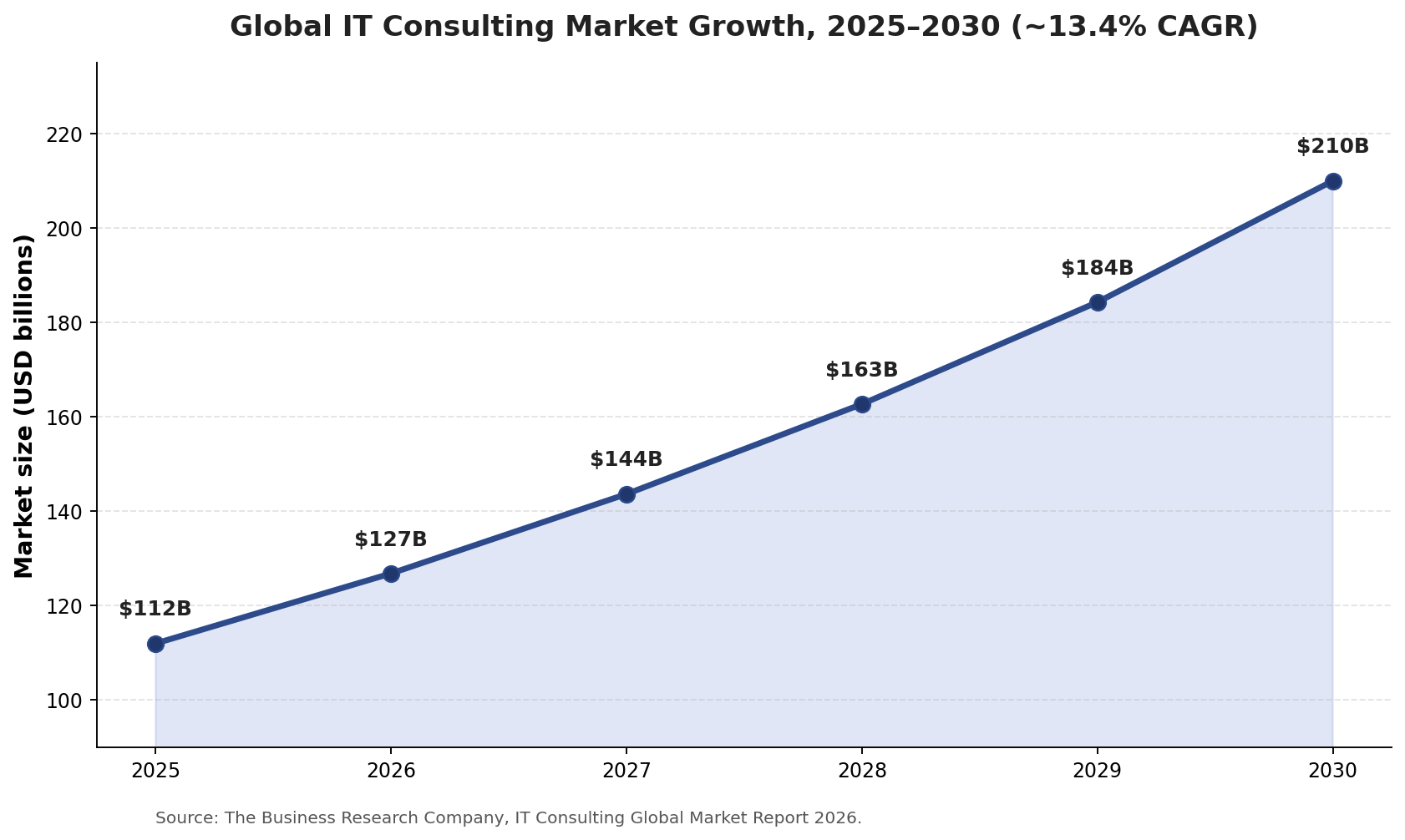
- Market: Global IT consulting is projected to grow from roughly $127B in 2026 to about $210B by 2030 (~13.4% CAGR).
- Selection: Judge a firm on delivery evidence, security posture, and cultural fit — not the polish of its sales deck.
What This Guide Covers
- Quick Answer
- What IT Consulting Is
- Types of IT Consulting Services
- 2026 Cost & Pricing
- Engagement Models Compared
- The IT Consulting Process
- Consulting vs. Staff Aug vs. Managed
- Market Outlook for 2026
- Security & Compliance
- ROI & Business Case
- Common Mistakes to Avoid
- Trends Shaping 2026
- When to Hire a Firm
- How to Evaluate a Partner
- FAQ
Quick Answer: What Are IT Consulting Services?
IT consulting services are professional advisory and implementation engagements that help organizations plan, build, secure, and optimize their technology. In 2026, general U.S. IT consulting rates typically run $100 to $300 per hour, rising to $300 or more for AI and cybersecurity specialists, while large enterprise firms charge $250 to $850. Most work falls into four engagement models: hourly, fixed-scope project, monthly retainer, or dedicated team. The strongest partners pair strategic advice with the engineering capacity to actually execute it.
KKRF Group approaches consulting as an engineering discipline, not a slide deck. Recommendations only matter when someone can build, ship, and support them — so our advisory work is grounded in the same architecture, security, and delivery practices we use to run production systems for startups, SMEs, and enterprises.
What Is IT Consulting? A Clear Definition
IT consulting is a professional service in which technology experts assess an organization’s systems, recommend a path forward, and often help implement it. It sits between pure strategy (what the business should do) and pure engineering (how to build it). A good IT consultant translates business goals into a concrete, costed technology plan that in-house teams or the consultant’s own engineers can deliver.
The distinction that matters: advice without delivery is just an opinion, and delivery without advice is just labor. Modern IT consulting services blend both. That is why firms increasingly package strategy, architecture, security review, and hands-on implementation into a single engagement rather than selling a report and walking away.
- Advisory: technology strategy, digital roadmaps, architecture reviews, vendor and tooling selection.
- Assessment: security audits, cloud readiness, technical due diligence, cost and performance analysis.
- Implementation: cloud migration, application modernization, DevOps, integration, and custom software delivery.
- Optimization: ongoing performance tuning, cost governance, and managed support.
Types of IT Consulting Services
IT consulting is an umbrella term. Buyers usually need one or two specific practices, not the whole catalog. Understanding the categories helps you scope the engagement and avoid paying generalist rates for specialist work.
Strategic IT consulting defines where technology should take the business over the next one to three years. This covers digital transformation planning, IT roadmaps, and technology due diligence for mergers or funding rounds. It answers the “what and why” before anyone writes code.
Cloud and infrastructure consulting focuses on where and how workloads run. Typical work includes cloud migration strategy, cost optimization, and platform engineering across AWS, Azure, and Google Cloud. KKRF Group delivers this through dedicated cloud consulting and cloud managed services engagements.
Cybersecurity consulting reduces risk and proves compliance. It spans security audits, zero-trust architecture, incident-response planning, and readiness for frameworks like SOC 2 and ISO 27001. As threats grow, this has become the fastest-priced specialty in the market.
Software and application consulting covers custom development strategy, legacy modernization, architecture design, and quality engineering. This is where advisory work turns into shipped software — and where KKRF Group’s software consulting practice concentrates.
Data and AI consulting helps organizations turn data into decisions and safely adopt AI. Work ranges from data platform design to retrieval-augmented generation, model selection, and AI governance.
How Much Do IT Consulting Services Cost in 2026?
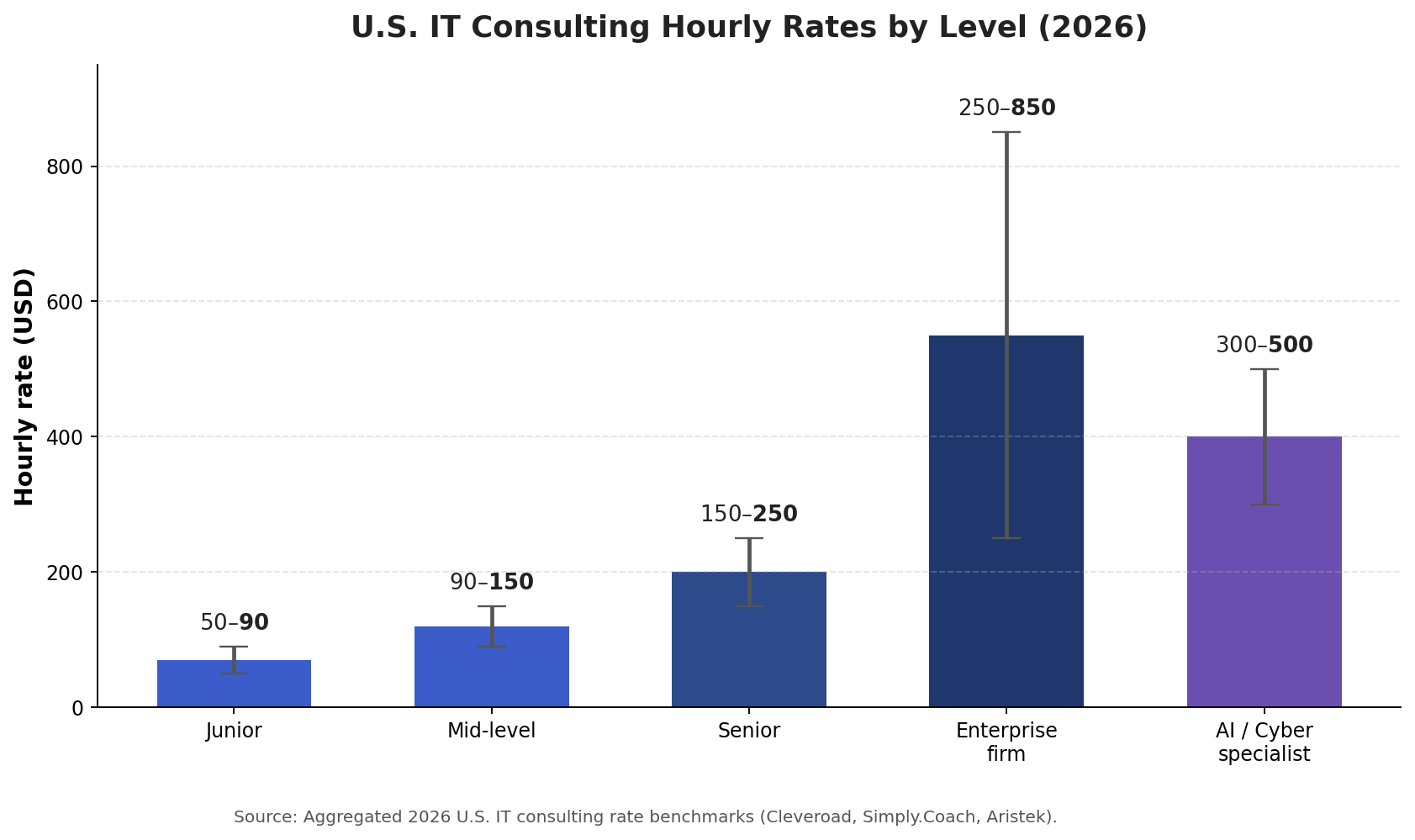
In 2026, U.S. IT consulting services generally cost between $100 and $300 per hour for standard work, with specialist and enterprise engagements reaching $300 to $850 per hour. Price is driven by four things: consultant seniority, specialization, engagement model, and the firm’s size and location. A senior architect solving a hard scaling problem is not priced like a junior generalist, and neither should be.
The table below reflects aggregated 2026 U.S. benchmarks. Treat it as a planning range, not a quote — scope and risk move the final number more than any published rate card.
| Consultant / firm tier | Typical 2026 hourly rate | Best fit for |
|---|---|---|
| Junior consultant | $50–$90 | Well-defined, low-risk tasks under supervision |
| Mid-level consultant | $90–$150 | Standard implementation and integration work |
| Senior consultant / architect | $150–$250 | Architecture, complex problem-solving, technical leadership |
| AI or cybersecurity specialist | $300–$500+ | Machine-learning infrastructure, security, governance |
| Large enterprise firm | $250–$850 | Global, multi-year digital transformation programs |
There are also non-hourly options. Fixed-scope projects convert the range above into a single deliverable price, and managed or retainer arrangements often run $100 to $300 per user per month for ongoing support. Mid-size specialist firms — KKRF Group among them — usually land between boutique and enterprise pricing while keeping senior engineers on the account.
IT Consulting Engagement Models Compared
An engagement model defines how you buy consulting time and who carries the delivery risk. Picking the wrong one is a common and expensive mistake. The right choice depends mostly on how well you understand the scope before work begins.
| Model | How it works | Best when |
|---|---|---|
| Hourly / time & materials | Pay for actual hours worked | Scope is unclear or likely to change |
| Fixed-scope project | Agreed price for a defined deliverable | Requirements are stable and well documented |
| Monthly retainer | Reserved capacity billed monthly | You need ongoing advice and steady support |
| Dedicated team | A ring-fenced team works as your extension | Long-running, evolving product or platform work |
A useful rule of thumb: the more uncertain the work, the more flexible the model should be. Locking a fixed price onto a vague scope pushes the consultant to pad the estimate or cut corners — neither helps you. When requirements are genuinely nailed down, though, a fixed-scope project gives you cost certainty and a clean accountability line.
Not sure which engagement model or budget fits your project? A short scoping conversation usually clarifies it faster than another round of internal debate. Our IT consulting team can map options to your goals.
Request a Consultation →The IT Consulting Process: 7 Steps
A disciplined IT consulting engagement follows a repeatable sequence from discovery to handover. The exact names vary between firms, but the underlying logic rarely does. Understanding the flow helps you spot a partner who skips steps to look fast.
- Discovery and assessment. The consultant maps your current systems, goals, constraints, and pain points. Expect interviews, architecture reviews, and access to documentation. Skipping this step is the root cause of most failed engagements.
- Strategy and roadmap. Findings become a prioritized plan with options, trade-offs, and rough costs. A strong roadmap sequences work by business value and risk, not by whatever is easiest to build first.
- Solution architecture. The team designs the target-state technology — systems, data flows, integrations, and security controls — before committing to a build. This is where scalability and cost are quietly won or lost.
- Planning and estimation. Scope is broken into phases with timelines, resources, and a realistic budget. Good estimates include the unglamorous work: testing, migration, and change management.
- Implementation. Engineers build, integrate, and iterate against the plan. Progress should be visible through working software and regular checkpoints, not status decks alone.
- Testing and hardening. Quality engineering, security testing, and performance validation confirm the solution holds up under real conditions before it reaches users.
- Deployment and handover. The solution goes live with documentation, knowledge transfer, and a support plan so your team can operate it confidently after the consultants step back.
IT Consulting vs. Staff Augmentation vs. Managed Services
These three models are often confused, but they solve different problems. IT consulting buys expertise and direction. Staff augmentation buys extra hands you manage yourself. Managed services buy an outcome someone else operates. Choosing the wrong one wastes budget and creates friction.
| Dimension | IT consulting | Staff augmentation | Managed services |
|---|---|---|---|
| You are buying | Strategy plus delivery | Individual skilled resources | An ongoing operated outcome |
| Who manages the work | The consulting firm | Your internal managers | The provider |
| Best for | Solving a defined problem or setting direction | Filling a temporary skills or capacity gap | Running IT functions long term |
| Typical duration | Weeks to months | Months, often extended | Ongoing, annual contracts |
In practice these blend. A KKRF Group engagement might begin as consulting to set architecture, shift to a dedicated team for the build, and settle into managed support afterward — one partner across the lifecycle instead of three disconnected vendors.
IT Consulting Market Outlook for 2026
The global IT consulting market is projected to reach roughly $127 billion in 2026 and about $210 billion by 2030, a compound annual growth rate near 13.4%. That expansion is not evenly spread. Demand is concentrating around cloud migration, AI adoption, cybersecurity, and the modernization of aging enterprise systems.
For buyers, sustained growth has a practical consequence: senior specialist capacity stays scarce and priced accordingly. Firms that can pair strategy with delivery — rather than subcontracting the hard parts — hold the advantage, and their calendars fill early.
Security, Compliance & Risk in IT Consulting
Security is no longer a separate line item in IT consulting — it is part of every architecture decision. A consultant who designs systems without threat modeling, access controls, and data-protection standards is handing you future incidents. Ask how security is built in, not bolted on.
Compliance frameworks give this structure. Standards like ISO/IEC 27001 and SOC 2 define how information is protected, and regulations such as HIPAA or GDPR govern specific data types. A capable partner maps your obligations early and designs controls to satisfy them, rather than scrambling before an audit.
KKRF Group works security-first: least-privilege access, encryption in transit and at rest, dependency and supply-chain scanning, and documented incident-response plans. We also align designs with recognized guidance such as the NIST Cybersecurity Framework so decisions are defensible, not improvised.
The ROI and Business Case for IT Consulting
The return on IT consulting comes from avoided cost and accelerated value, not just the deliverable itself. A sound architecture decision made early can save six or seven figures in rework later. That is the real math behind consulting fees, and it is why treating rate-per-hour as the only metric is a mistake.
Consider three recurring sources of return. First, risk reduction: a security or architecture review that prevents one serious outage or breach often pays for the entire engagement. Second, speed: experienced consultants shorten decision cycles and skip dead ends your team would otherwise explore. Third, focus: your internal staff stay on the work that differentiates the business.
Build the business case by comparing the consulting cost against the fully loaded cost of doing it in-house — including hiring time, ramp-up, and the opportunity cost of a slower launch. When framed that way, the decision usually clarifies itself.
Common IT Consulting Mistakes to Avoid
We have been brought in to rescue enough troubled projects to see the same patterns repeat. Most failures trace back to the buy, not the build.
- Buying hours instead of outcomes. If nobody defined what success looks like, no rate is cheap enough.
- Choosing on price alone. The lowest bid often reflects junior staff or a scope that quietly excludes the hard parts.
- Skipping the discovery phase. Consultants who start building on day one are guessing, and you pay for the guesses.
- No knowledge transfer. If the partner never documents or trains your team, you have rented dependence, not built capability.
- Ignoring security and compliance until the end. Retrofitting controls is far more expensive than designing them in.
- Vague contracts. Undefined scope, ownership, and exit terms are where disputes are born.
IT Consulting Trends Shaping 2026
Three forces are reshaping what buyers expect from IT consulting services in 2026: applied AI, security-by-default, and outcome-based pricing. Each changes how engagements are scoped and priced, and each rewards firms that can deliver, not just advise.
Applied AI is moving from pilots to production. Clients now ask consultants to embed AI into real workflows — document processing, support automation, code assistance — with governance and cost controls attached. The novelty phase is over; measurable value is the bar.
Security has become a default expectation. Zero-trust principles, supply-chain scanning, and compliance readiness are increasingly assumed in any serious engagement rather than sold as extras. Buyers are also more comfortable walking away from firms that treat security as an afterthought.
Pricing is shifting toward outcomes. More clients want fees tied to delivered value, and more firms are willing to structure engagements that way when scope is clear. This aligns incentives but demands honest, disciplined scoping from both sides.
Decision Framework: When to Hire an IT Consulting Firm
Hire an IT consulting firm when the cost of getting a technology decision wrong is higher than the cost of expert help. The framework below separates the situations where consulting pays off from the ones where it does not.
Choose IT consulting when: you face a high-stakes decision (platform choice, major migration, security posture); you lack a specific skill in-house and will not need it permanently; a project has stalled and needs an objective diagnosis; or you need to move faster than hiring allows.
Think twice when: the work is routine and well within your team’s ability; you cannot commit anyone internally to collaborate and absorb knowledge; or you are seeking someone to blame rather than a problem to solve. Consulting amplifies a committed team; it cannot replace one.
Limitations to accept: consultants need context and access to be effective, results depend on your willingness to act on recommendations, and the best outcomes come from partnership, not delegation. Our honest recommendation is to engage a firm for direction and hard problems, and to keep the everyday work — the parts that build institutional muscle — in-house.
How to Evaluate an IT Consulting Company
Evaluate an IT consulting company on evidence of delivery, technical depth, security posture, communication, and cultural fit. Marketing claims are easy; the questions below surface what is real.
- Delivery evidence: ask for relevant case studies and references you can actually contact. Vague success stories are a warning sign.
- Technical depth: the people in the sales meeting should not vanish after signing. Confirm senior engineers stay on your account.
- Security and process: ask how they handle access, code review, testing, and compliance. Mature answers come quickly.
- Communication: you want candor about trade-offs and risks, not constant agreement. A partner who only ever says yes is not protecting you.
- Commercial clarity: scope, ownership of code and IP, change process, and exit terms should be explicit in writing.
- Cultural fit: you will work closely for weeks or months. Friction in the first call rarely improves later.
KKRF Group welcomes this scrutiny. We would rather earn a client through a hard technical conversation than win one on a polished pitch, because engagements built on clear expectations are the ones that succeed. You can see how we structure work on our how-we-work page.
Vetting IT consulting partners for an upcoming initiative? Put us on the list. We will give you a straight technical read on your project — scope, risks, and a realistic cost range — before any commitment.
Get a Technical Assessment →Frequently Asked Questions
What are IT consulting services?
IT consulting services are professional engagements in which technology experts assess your systems, recommend a strategy, and often help implement it. They combine advisory work — strategy, architecture, and security review — with hands-on delivery such as cloud migration, modernization, and custom development.
How much do IT consulting services cost in 2026?
In 2026, general U.S. IT consulting rates run about $100 to $300 per hour. Specialists in AI or cybersecurity often charge $300 or more, and large enterprise firms range from $250 to $850 per hour. Fixed-scope projects and monthly retainers offer alternatives to hourly billing.
What is the difference between IT consulting and staff augmentation?
IT consulting buys expertise and direction, with the firm managing the work and carrying delivery responsibility. Staff augmentation buys individual skilled resources that you manage yourself to fill a temporary capacity gap. Consulting solves a problem; augmentation adds hands.
What does the IT consulting process look like?
A typical engagement moves through discovery and assessment, strategy and roadmap, solution architecture, planning and estimation, implementation, testing and hardening, then deployment and handover. Skipping discovery is the most common cause of failed projects.
How do I choose the right IT consulting company?
Evaluate firms on delivery evidence, technical depth, security posture, communication style, and cultural fit. Ask for reference clients you can contact, confirm senior engineers stay on your account, and require clear terms for scope, IP ownership, and exit before signing.
Are IT consulting services worth it for small businesses?
Yes, when the decision is high-stakes or the skill is missing in-house. Smaller organizations benefit most from targeted engagements — a security review, a cloud migration plan, or an architecture decision — rather than open-ended retainers, keeping cost proportional to value.
Ready to turn a technology question into a clear plan? Whether it is a migration, a modernization, or a security review, KKRF Group can help you scope it and, when you are ready, build it. Start with a short IT consulting conversation.
Book a Discovery Call →IT consulting services are ultimately about lowering the cost of being wrong. The right partner brings judgment you cannot hire overnight and the delivery muscle to act on it. Scope the work honestly, choose on evidence rather than price, and treat the engagement as a partnership — that is how technology spending turns into business results.