
Most founders don’t lose sleep over whether to build a SaaS product. They lose sleep over what it will cost, and whether the number a vendor quoted is anywhere close to real. That’s the honest place to start.
At KKRF Group, an experienced custom software development company, we’ve scoped and shipped enough early-stage SaaS products to know where budgets hold and where they quietly fall apart. This guide gives you a straight look at SaaS MVP development cost in 2026: the real pricing ranges, what drives the number up or down, how long a build takes, and how to spend so your first version actually earns its keep.
Key Takeaways
- A basic SaaS MVP built with a starter kit or low-code tools runs roughly $8,000–$25,000. A production-ready multi-tenant B2B MVP usually lands between $50,000 and $120,000.
- Your build approach moves the budget more than raw feature count. Reskinning a template is cheap; a custom multi-tenant platform is not.
- Timelines have compressed. With AI-assisted development, a focused MVP that took 12 weeks in 2023 often ships in 7–10 weeks now.
- Feature creep is the single biggest budget killer, routinely adding 30–50% to the original quote.
- Post-launch costs — infrastructure, maintenance, and compliance — are where teams underestimate the most.
What’s in This Guide
- What a SaaS MVP Really Is
- How Much a SaaS MVP Costs in 2026
- Cost by Build Approach
- Where Your Budget Goes
- What Drives the Cost
- How Long It Takes to Build
- Tech Stack Choices
- No-Code vs Low-Code vs Custom
- In-House vs Agency vs Freelancers
- Ongoing & Hidden Costs
- How to Reduce Cost
- Common Budget Mistakes
- A Decision Framework
- How to Evaluate a Partner
- Where Costs Are Heading
- Frequently Asked Questions
We build these products for a living. As a custom software development company, KKRF Group helps founders and product teams scope MVPs that ship fast without painting the roadmap into a corner. The figures below reflect real 2026 build economics, not a pricing-page fantasy. Where a range is wide, we’ll tell you what pushes a project to each end of it.
What a SaaS MVP Really Is
The word doing the heavy lifting there is viable. An MVP isn’t a rough prototype, and it isn’t version one of the full product either. It’s the narrowest slice that lets you learn whether people want the thing and will keep coming back.
This matters for cost because scope is the price. Every “while we’re at it” feature has a number attached. We’ve watched a clean $60,000 plan drift toward $110,000 not from a single big decision, but from a dozen small ones nobody pushed back on. Naming what you’re not building is where SaaS MVP development cost is really controlled.
How Much Does a SaaS MVP Cost in 2026?
Here’s the direct answer, then the nuance. In 2026, most SaaS MVPs land somewhere between $8,000 and $250,000. That range is wide on purpose — a solo-founder tool and a compliance-heavy B2B platform are not the same animal. The table below breaks the cost to build a SaaS MVP down by product type, with realistic timelines.
| MVP type | Typical 2026 cost | Timeline | Good fit for |
|---|---|---|---|
| Simple utility / single-feature tool | $8K–$25K | 3–6 weeks | Validating one narrow job |
| Single-tenant focused MVP | $25K–$60K | 6–10 weeks | One core workflow, early users |
| Multi-tenant B2B SaaS MVP | $50K–$120K | 3–5 months | Selling to teams and orgs |
| Marketplace / complex platform | $120K–$250K+ | 4–8 months | Two-sided or regulated products |
If you only remember one line, make it this: a real B2B SaaS MVP — authentication, subscription billing, five or six core flows, a working admin panel, deployed to production — sits in the $50,000 to $120,000 band for a competent agency build. Below that, you’re usually trading polish, security depth, or scalability for speed.
SaaS MVP Cost by Build Approach
Two products with the same feature list can cost twice as different amounts, and the reason is almost always how they’re built. Think of it as a spectrum from “assemble from parts” to “engineer from scratch.”
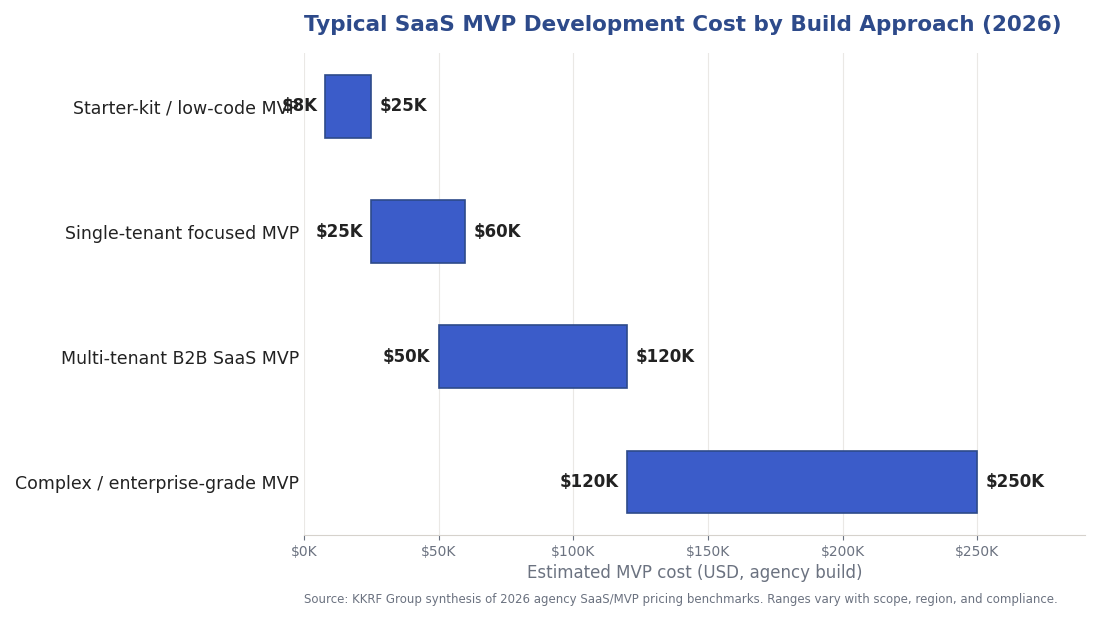
Starter-kit or low-code builds ($8K–$25K) lean on tools like Supabase, Firebase, or a paid SaaS boilerplate that already ships authentication, billing, and a database layer. You’re buying 200–400 hours of undifferentiated plumbing for a few hundred dollars. It’s the fastest path to a first paying user, and the right call more often than founders expect.
Single-tenant focused MVPs ($25K–$60K) add custom design and a genuinely bespoke core workflow, but keep the architecture simple — one shared instance, light role logic. Multi-tenant B2B MVPs ($50K–$120K) are where cost steps up: tenant isolation, organizations, roles, and billing that all have to behave correctly from day one.
Complex or enterprise-grade MVPs ($120K–$250K+) carry compliance, integrations, or two-sided marketplace logic. Here you’re paying for security engineering and architecture that won’t need a rebuild the moment the product finds traction. For a deeper look at that tier, our guide on multi-tenant SaaS architecture and isolation models covers the trade-offs in detail.
Where Your SaaS MVP Budget Actually Goes
It’s tempting to picture the whole budget flowing into “coding.” In practice, a healthy SaaS MVP spends across six workstreams, and the ones founders discount — discovery, QA, DevOps — are often what separate a demo from a product.
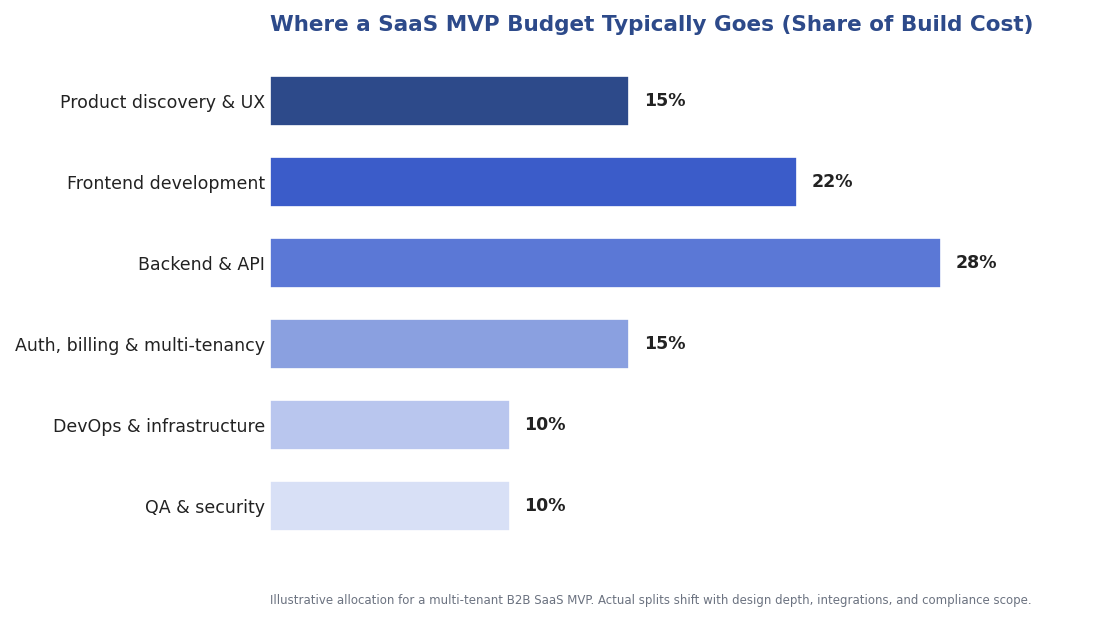
Backend and API work usually takes the biggest slice because it’s where the real logic lives — data models, business rules, and the multi-tenancy that makes B2B SaaS work. Auth, billing, and tenant management look small on a roadmap but carry outsized risk; getting subscription logic wrong costs far more to fix after launch than to build correctly up front.
What Drives SaaS MVP Development Cost
When we estimate a build, a handful of variables explain most of the spread between a $30K quote and a $120K one. None of them are surprising, but together they decide the number.
- Scope and feature depth. Not the count of features, but how deep each one goes. “Reporting” can mean one CSV export or a real analytics engine.
- Multi-tenancy and roles. The moment you sell to organizations, tenant isolation and role-based access control become non-negotiable and non-trivial.
- Integrations. Every third-party system — payment, CRM, email, data providers — adds build and testing time. Two integrations are fine; nine is a project.
- Design ambition. A clean, systemized UI is efficient. Custom illustration, animation, and pixel-bespoke screens are not.
- Compliance. SOC 2, HIPAA, or GDPR obligations add security engineering, documentation, and audit overhead that a consumer tool never touches.
- Team location and seniority. Blended rates swing widely by region and by how senior the people writing your core logic actually are.
Compliance deserves a flag. If you’re building in FinTech or health, budget for it from the first sprint — retrofitting security into a live SaaS product is one of the most expensive mistakes we see. Our team approaches this security-first, because it’s cheaper for everyone.
How Long Does It Take to Build a SaaS MVP?
Cost and time move together, so the timeline question is really a budget question. A focused single-user MVP — authentication, one core feature, a basic dashboard, real data — takes six to ten weeks with a tight team. A multi-tenant SaaS MVP with organizations, billing, and roles is more like three to five months.
- Discovery and scoping (1–2 weeks): lock the problem, the core flows, and what’s explicitly out of scope.
- Design and architecture (1–3 weeks): UX flows, data model, and the tech decisions that shape everything after.
- Core build (4–12 weeks): frontend, backend, auth, billing, and the workflows that carry the value.
- QA, hardening, and launch (1–2 weeks): testing, security checks, and deploying to production.
One genuinely new factor in 2026: AI-assisted development has compressed schedules. Work that was a 12-week build a couple of years ago often ships in seven or eight weeks now, because a good team spends less time on boilerplate and more on the parts that actually differentiate your product.
Not sure which build approach fits your budget and timeline? Our engineers can pressure-test your scope and give you an honest number. Start with our SaaS development services.
Get a Custom Project Estimate →Tech Stack Choices That Move the Budget
The stack you pick quietly sets your cost ceiling. Choose well and you skip weeks of undifferentiated work. Choose for resume-driven novelty and you’ll pay for it in hiring and debugging.
For most 2026 SaaS MVPs, a pragmatic stack looks like a React or Next.js frontend, a Node.js or Python backend, PostgreSQL for data, and a managed platform such as Supabase, Firebase, or AWS handling auth, storage, and real-time features. Managed services aren’t a shortcut that cuts corners — they cut backend build time by 30–50% by letting your team skip work that adds no product value.
Stripe is the near-default for subscription billing, and its Billing documentation is worth reading before you scope that part — getting proration, trials, and dunning right is more involved than it looks. On security, we lean on the OWASP Top 10 as a baseline for any product that will touch real customer data.
As a custom software development company, KKRF Group tends to favor boring, proven technology for MVPs. The interesting engineering belongs in your product’s core, not in an experimental framework you’ll be maintaining alone at 2 a.m.
No-Code vs Low-Code vs Custom Development
This is the first real fork in the road, and there’s no universally right answer — only a right answer for your stage, your users, and where you expect to be in a year.
| Approach | Typical MVP cost | Speed | Ceiling / risk |
|---|---|---|---|
| No-code (Bubble, Softr) | $2K–$15K | Fastest | Hits scaling and customization walls; hard to migrate off |
| Low-code + custom glue | $10K–$40K | Fast | Good middle ground; some vendor lock-in |
| Custom code + starter kit | $25K–$120K | Moderate | Full control and scalability; higher up-front cost |
Our honest take: no-code is excellent for validating an idea before you’ve raised a dollar. But if you already have signed pilots, or you’re building something with real data-security or multi-tenancy needs, custom code with a starter kit usually costs less over 18 months — because you won’t be paying to rebuild the thing the moment it works.
In-House vs Agency vs Freelancers: The Cost Reality
Who builds it changes both the sticker price and the hidden costs. Each model has a place; the trap is picking one for the headline rate without counting the rest.
| Model | Effective MVP cost | Best when | Watch out for |
|---|---|---|---|
| Freelancers | $15K–$50K | Small, well-defined scope | Coordination gaps; continuity risk |
| In-house hires | $200K+/yr loaded | Long-term core product | Slow to hire; expensive before revenue |
| Development agency | $50K–$120K | Ship a full MVP fast | Quality varies; vet the team, not the pitch |
For most founders pre-Series A, a specialized agency hits the sweet spot: a full team — product, design, engineering, QA — without the multi-year payroll commitment of hiring before you’ve proven the model. When revenue and roadmap justify it, the smart move is transitioning that agency-built product to an in-house team, which is far easier when it was engineered cleanly in the first place.
Ongoing and Hidden Costs After Launch
The build cost is the part everyone quotes. The costs that follow are the part that surprises people, and they routinely add 40–60% to what founders mentally budgeted.
- Infrastructure: hosting, database, CDN, and monitoring typically run $100–$500 per month at MVP scale, then climb with usage.
- Maintenance: plan for 15–20% of the build cost per year for dependency updates, bug fixes, and small improvements.
- Third-party fees: payment processing, email, analytics, and error tracking each carry their own subscription.
- Support and iteration: the whole point of an MVP is to learn and change — that means paying for a second and third round of development.
- The pilot-to-production gap: the unglamorous work of turning a working demo into something reliable under real load.
We flag this early with every client because a founder who budgets only for the build, and nothing for the six months after, ends up under-resourced exactly when the product is finally getting traction.
How to Reduce SaaS MVP Cost Without Wrecking Quality
Cutting cost isn’t about finding the cheapest developer. It’s about spending on what proves the business and refusing to spend on what doesn’t — yet.
- Cut scope, not corners. Ship three features that work beautifully instead of eight that half-work. Quality on a narrow surface beats mediocrity across a wide one.
- Buy the plumbing. A $199–$499 starter kit can replace 200–400 hours of auth, billing, and email setup. That’s real money and weeks of calendar time.
- Use managed services. Let a platform handle auth, storage, and real-time so your team builds only what’s unique to you.
- Design a system, not screens. A reusable component library keeps design and frontend cost linear instead of exponential.
- Defer the ‘enterprise’ features. SSO, advanced permissions, and white-labeling can wait until a customer is actually asking — and paying — for them.
The most reliable savings, though, come from disciplined scoping before a single line of code. An afternoon spent killing nice-to-haves saves more than any rate negotiation.
Common Mistakes That Blow the Budget
After enough builds, the expensive mistakes start to rhyme. Here are the ones that cost founders the most.
- Treating the MVP as version one of everything. If the feature list reads like the five-year vision, it’s not an MVP.
- Unmanaged feature creep. The 30–50% overrun almost always arrives one small ‘quick addition’ at a time.
- Skipping discovery. Starting to build before the core flows are locked guarantees expensive rework.
- Ignoring security until later. Retrofitting auth, encryption, and access control into a live product is brutally costly.
- Choosing a vendor on price alone. The cheapest quote often becomes the most expensive project once rework and delays are counted.
A Decision Framework for Your SaaS MVP
If you’re staring at a range from $8K to $250K and not sure where you land, work through these four questions in order. They resolve most of the uncertainty.
- Who is the buyer? Selling to individuals keeps you single-tenant and cheaper. Selling to teams or organizations means multi-tenancy and the $50K+ band.
- How much proof do you already have? No validation yet favors the cheapest, fastest path — no-code or a starter kit. Signed pilots justify investing in custom code.
- What are the compliance stakes? Regulated data (health, finance) means security and audit cost is not optional and should be scoped from day one.
- What happens if it works? If a successful MVP would need a full rebuild to scale, pay a little more now for architecture that grows with you.
How to Evaluate a SaaS Development Partner
The team you choose affects cost more than any tool decision. A good partner saves you money by scoping tightly and building things once. Here’s how to tell them apart before you sign.
- They push back on your scope. A partner who says yes to everything is selling hours, not outcomes. The good ones argue for cutting features.
- They show real, shipped SaaS work. Ask to see products in production, not just polished case-study decks.
- They’re transparent about cost drivers. You should understand why a number is what it is, line by line.
- They plan for after launch. A serious partner talks about maintenance, iteration, and scaling before you have to ask.
- They own the architecture decisions. Look for enterprise-grade thinking on security and data even in a small MVP.
That’s the standard KKRF Group holds itself to: transparent scoping, security-first engineering, and a build that a future in-house team can inherit cleanly. An MVP should open doors, not create technical debt you’ll spend a year paying down.
Where SaaS MVP Costs Are Heading
Two forces are pulling in opposite directions. AI-assisted development keeps pushing build costs and timelines down, especially for standard CRUD-and-dashboard products. At the same time, user expectations for polish, real-time behavior, and integrations keep rising — which pushes the floor back up.
The net effect for 2026 and beyond: the cost to build a basic SaaS MVP is falling, while the cost of a genuinely competitive, well-built one holds steady. AI removes the boilerplate; it doesn’t remove the judgment about what to build, how to secure it, and how to make it worth paying for. That judgment is exactly where a strong engineering partner earns its fee.
Have a scope in mind and want a number you can trust? Our team will review your requirements and map them to a realistic budget and timeline — no obligation.
Book a Discovery Call →Frequently Asked Questions
How much does it cost to build a SaaS MVP in 2026?
Most SaaS MVPs cost between $8,000 and $250,000 in 2026. A simple starter-kit or low-code build runs $8K–$25K, while a production-ready multi-tenant B2B SaaS MVP with authentication, billing, and core workflows typically costs $50,000 to $120,000.
How long does it take to build a SaaS MVP?
A focused single-user MVP takes six to ten weeks. A multi-tenant SaaS MVP with organizations, roles, and subscription billing usually takes three to five months. AI-assisted development has shortened many builds compared with a few years ago.
Is it cheaper to build a SaaS MVP with no-code or custom code?
No-code is cheaper up front ($2K–$15K) and ideal for validating an idea before funding. But if you have signed pilots or real data-security and multi-tenancy needs, custom code with a starter kit often costs less over 18 months because you avoid rebuilding the product once it works.
What ongoing costs should I expect after launching a SaaS MVP?
Budget for infrastructure ($100–$500/month at MVP scale), maintenance (roughly 15–20% of the build cost per year), third-party subscriptions, and continued iteration. These post-launch costs commonly add 40–60% to what founders initially plan for.
How can I reduce SaaS MVP development cost without hurting quality?
Cut scope rather than corners, buy a starter kit to skip auth and billing plumbing, use managed services like Supabase or AWS, design a reusable component system, and defer enterprise features such as SSO until a paying customer needs them. Disciplined scoping before coding saves the most.
Should I hire a freelancer, an agency, or an in-house team?
Freelancers suit small, well-defined scopes. In-house teams fit long-term core products but cost $200K+ per year before revenue. For most pre-Series A founders, a specialized SaaS development agency delivers a full MVP fastest without a multi-year payroll commitment.
The right SaaS MVP budget isn’t the biggest one or the smallest one — it’s the one matched to what you actually need to prove. Spend where it validates the business, hold the line on everything else, and choose a partner who’ll tell you the difference. Do that, and your first version buys you the one thing that matters most: evidence.
Ready to turn your idea into a SaaS MVP that ships? KKRF Group scopes, designs, and builds SaaS products founders can grow on. Explore our SaaS development services or reach out directly.
Talk to Our Engineering Team →