
New York runs on healthcare. Between the major hospital networks, a dense cluster of specialty clinics, and one of the country’s largest health-tech startup scenes, demand for secure patient and provider apps keeps climbing. That’s what makes healthcare app development in New York such a common question for founders and clinical leaders alike. And the questions are usually the same: what will it cost, how long will it take, and how do we stay on the right side of HIPAA? This guide answers all three. At KKRF Group, a top mobile app development company, we build healthcare software for New York providers and startups, and the numbers and trade-offs below reflect how these projects actually run.
Key Takeaways
- A HIPAA-compliant healthcare MVP in New York usually costs $50,000–$80,000; complex apps with EHR integration run $150,000–$300,000+.
- HIPAA compliance alone adds roughly $15,000–$50,000 and influences nearly every architectural decision.
- Expect 3–6 months for an MVP and 9–12 months for enterprise EHR programs.
- The features that matter most: EHR/FHIR integration, telehealth, secure messaging, and role-based access to PHI.
- Pick a healthcare app development company by its security track record and clinical depth — not the headline price.
In This Article
Healthcare App Development in New York: A Quick Answer
That’s the short version. The rest of this guide breaks down where the money goes, what HIPAA actually requires in code, which features earn their place, and how to tell a serious healthcare app development company from a generalist that will learn compliance on your budget.
What Healthcare App Development in New York Involves
Healthcare mobile app development in New York isn’t just app development with a stethoscope logo. The moment your app touches protected health information (PHI), it falls under HIPAA and often HITECH, and that reshapes architecture, hosting, vendor contracts, and QA. A consumer fitness app and a clinical telehealth app can look similar on the surface. Underneath, one is governed by the App Store guidelines and the other by federal law. Whether you call it healthcare software development or HIPAA-compliant app development, the same rule holds across New York City: the moment an app touches PHI, it becomes regulated software.
Most New York projects fall into one of a few buckets. Patient-facing apps handle appointments, medication reminders, symptom tracking, and secure messaging. Provider tools cover clinical workflows, e-prescribing, and care coordination. Then there’s the operational layer — scheduling, billing, and analytics dashboards that plug into existing hospital systems.
Custom healthcare app development matters here because off-the-shelf products rarely fit how a specific practice or health system works. A cardiology group in Manhattan and a multi-site urgent-care operator in Brooklyn have different intake flows, different EHRs, and different compliance obligations. Building custom lets you shape the software around the clinical reality instead of forcing staff to adapt to someone else’s assumptions.
How Much Does Healthcare App Development Cost in New York?
Cost is the first question and the hardest to answer cleanly, because “healthcare app” covers everything from a single-purpose reminder tool to a hospital-grade platform. That said, the market gives us reliable ranges. Based on 2026 New York pricing, here’s how the cost of healthcare app development in New York typically breaks down.
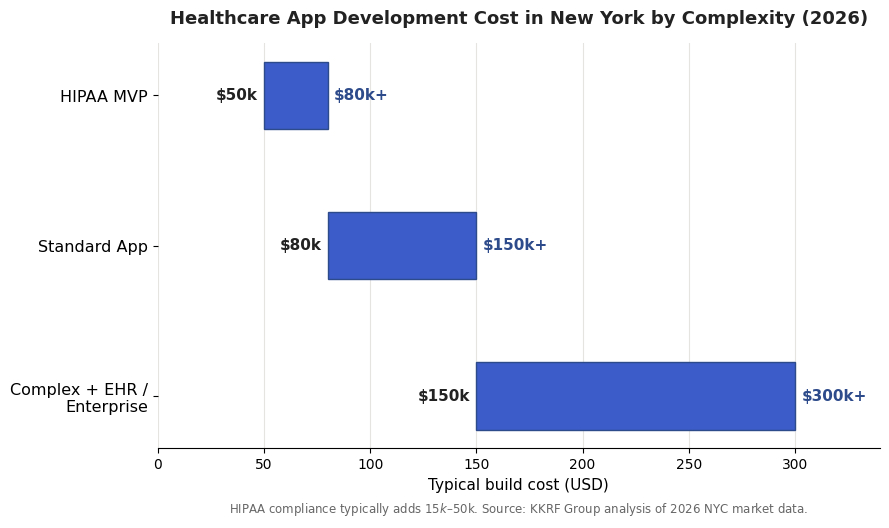
| App Tier | Typical NYC Cost | Timeline | Example |
|---|---|---|---|
| HIPAA-ready MVP | $50,000–$80,000 | 3–4 months | Single-condition patient app with secure messaging |
| Standard app | $80,000–$150,000 | 4–7 months | Telehealth app with scheduling and payments |
| Complex / Enterprise | $150,000–$300,000+ | 9–12 months | Multi-role platform with Epic/Cerner EHR integration |
Three things push these numbers up. HIPAA compliance on its own tends to add $15,000–$50,000 once you account for encryption, audit logging, access controls, secure hosting, and the paperwork around Business Associate Agreements. EHR integration is the second driver — connecting cleanly to Epic or Cerner via FHIR is real engineering, not a plugin. The third is platform scope: shipping polished iOS and Android apps plus a provider web portal is three surfaces, not one.
On hourly rate, roughly 40% of New York healthcare app firms bill in the $50–$99/hour range, though senior specialists and NYC-based teams often sit higher. Cheaper offshore quotes exist, but for regulated healthcare work the rework and compliance risk frequently erase the savings. If you want to sanity-check your own figures, our mobile app development cost guide for New York walks through the estimation math in more detail. The takeaway: your HIPAA compliant mobile app development cost is driven far more by compliance scope and EHR integration than by hourly rate alone.
Need a defensible number before you brief your board or investors? Our New York mobile app development team can pressure-test your scope, compliance needs, and budget in a short working session.
Get a Custom Project Estimate →HIPAA Compliance New York Healthcare Apps Can’t Skip
Here’s the blunt version: if your app creates, stores, or transmits PHI, HIPAA compliance isn’t optional and it isn’t something you bolt on at the end. We’ve seen teams treat it as a final checklist item and then rebuild half the backend. Design for it from day one and it’s manageable; retrofit it and it’s expensive.
HIPAA breaks into three sets of safeguards — administrative, physical, and technical. For an app team, the technical safeguards are where most of the engineering lives.
- End-to-end encryption of PHI in transit and at rest — TLS 1.2+ on the wire and AES-256 for stored data, including on-device caches of ePHI.
- Role-based access control (RBAC) so a front-desk login can’t reach the same records a physician can.
- Audit logging that records who accessed which PHI and when, retained and tamper-evident.
- Automatic session controls — timeouts, secure re-authentication, and remote wipe for lost devices.
- Business Associate Agreements (BAAs) with every vendor that touches PHI, including your cloud host and any analytics or messaging service.
Hosting deserves special mention. You need a HIPAA-eligible cloud configuration — AWS, Azure, and Google Cloud all offer this — with a signed BAA. Consumer analytics SDKs and push services that won’t sign a BAA simply can’t touch PHI, which catches a lot of teams off guard late in the build. The U.S. Department of Health and Human Services publishes the HIPAA Security Rule guidance that spells these obligations out. Because so much of this overlaps with general application security, it’s worth pairing your build team with dedicated cybersecurity consulting when the data is this sensitive.
Must-Have Features for a New York Healthcare App
Feature lists balloon fast in healthcare. The discipline is separating what earns adoption and reimbursement from what just sounds good in a pitch. A few features show up in nearly every successful New York healthcare app.
EHR and FHIR integration
If clinicians can’t see your data in their existing system, they won’t use your app for long. Modern integration runs on HL7 FHIR, the interoperability standard that Epic, Cerner, and most major EHRs now support. Clean FHIR integration is often the single most valuable — and most technically demanding — feature you’ll build. The official HL7 FHIR specification is the reference every serious healthcare engineer works from.
Telehealth and secure messaging
Telemedicine app development stopped being a nice-to-have years ago. Video visits, asynchronous messaging between patients and care teams, and secure file sharing are table stakes for most patient-facing products now. The catch is that every one of those channels carries PHI, so they all inherit the full weight of your compliance requirements.
Scheduling, reminders, and payments
Appointment booking, automated reminders that cut no-shows, and integrated payments or insurance verification are the workhorse features that drive daily engagement. They’re less glamorous than AI triage, but they’re usually what keeps an app in a patient’s routine.
The Build Process and Timeline
A healthcare app moves through the same broad phases as any serious mobile product, with compliance woven through each one rather than tacked on. Here’s how a typical New York build sequences out.
- Discovery and compliance scoping — define the clinical workflow, identify every point where PHI is handled, and lock the compliance requirements before a line of code is written.
- UX/UI design — design for two audiences at once: patients who need simplicity and clinicians who need speed and density.
- Core development — build the app and backend, standing up encryption, RBAC, and audit logging as foundational, not optional.
- EHR and telehealth integration — wire up FHIR connections, video, and messaging, then test against real (de-identified) data flows.
- Security and HIPAA hardening — penetration testing, threat modeling against the OWASP Mobile standards, and a formal compliance review.
- QA, audit, and launch — clinical validation, App Store and Play Store review, and a monitored rollout.
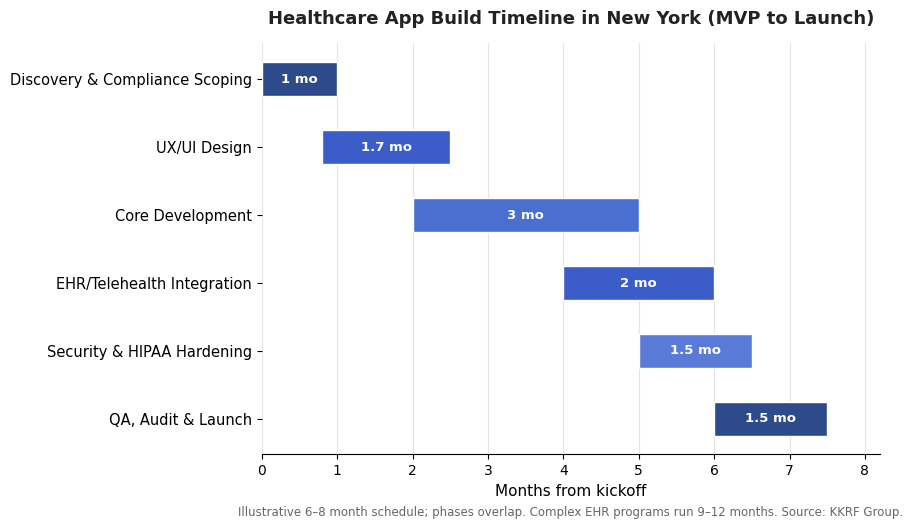
The chart above shows an illustrative six-to-eight-month schedule for a mid-complexity build. Phases overlap in practice — design starts before discovery fully closes, and security work runs alongside development rather than after it. Enterprise programs with deep Epic or Cerner integration stretch to 9–12 months, mostly because integration testing and clinical sign-off take real time.
Choosing the Right Tech Stack
There’s no single correct stack for healthcare — there’s the right stack for your constraints. The main decision is native versus cross-platform, and it comes down to how much you lean on device hardware and platform-specific health frameworks.
| Approach | Best For | Trade-off |
|---|---|---|
| Native iOS / Android (Swift, Kotlin) | Apps leaning on HealthKit, Bluetooth devices, and peak performance | Higher cost; two codebases to maintain |
| React Native | Cross-platform apps with tight budgets and shared business logic | Native modules still needed for HealthKit and BLE |
| Flutter | Fast, visually consistent UI across both platforms | Smaller healthcare-specific package ecosystem |
| Web / PWA + native shell | Provider dashboards and internal operational tools | Limited offline support and hardware access |
In practice, many New York teams ship patient apps in React Native or Flutter to hit both platforms on one budget, then drop to native code for anything touching HealthKit or medical device connectivity. Provider-facing tools often live on the web. The stack should follow the workflow, not a preference. If you’re comparing frameworks specifically, our breakdown of mobile app development services covers where each one fits.
Common Mistakes NYC Healthcare Teams Make
Most healthcare app failures aren’t dramatic. They’re avoidable missteps that surface late, when fixing them costs the most. These are the ones we see repeatedly.
- Treating HIPAA as a launch-day checklist. Compliance shapes architecture. Retrofitting it means rebuilding, not patching.
- Underestimating EHR integration. “It just talks to Epic” hides weeks of FHIR mapping, testing, and sign-off.
- Ignoring clinician workflow. An app that adds clicks to a doctor’s day gets abandoned no matter how good the patient side looks.
- Choosing a vendor that won’t sign a BAA. A cheap analytics or messaging SDK that won’t sign one can’t legally touch PHI.
- Skipping real security testing. Penetration testing and threat modeling aren’t optional overhead in a regulated app; they’re the cost of doing it right.
The Business Case: ROI and the Cost of Getting Compliance Wrong
A well-built healthcare app pays back in specific, measurable ways: fewer no-shows, faster intake, better medication adherence, and staff hours reclaimed from manual coordination. For a busy New York practice, cutting the no-show rate by a few points alone can justify the build.
The other side of the ledger is risk. HIPAA violations carry civil penalties that scale with negligence, and a breach involving PHI brings mandatory notification, reputational damage, and remediation costs that dwarf what proper security would have cost up front. This is the core argument for spending on compliance early: it’s cheaper than the alternative, and the alternative is not hypothetical in a market as scrutinized as New York healthcare.
It’s the same logic that drives careful budgeting in regulated verticals generally — our companion guide on fintech app development in New York makes a parallel case for financial apps, where the compliance stakes are just as high.
Sitting on a telehealth or EHR-integration roadmap that keeps stalling on compliance? Let’s map the architecture and de-risk it before it costs you a rebuild.
Request an Architecture Review →How to Choose a Healthcare App Development Partner in New York
The list of firms claiming to be among the top healthcare app development companies in New York is long. Separating the ones that can actually ship a compliant, clinician-approved product takes a sharper filter than a portfolio page. Use this framework when you evaluate a partner.
- Healthcare depth, not just app volume. Ask for HIPAA-compliant projects specifically, and how they handled PHI, BAAs, and audit logging.
- Real integration experience. Have they shipped FHIR or HL7 integrations with Epic, Cerner, or similar? Ask what broke and how they fixed it.
- Security as a practice. Look for penetration testing, threat modeling, and a security review baked into their process — not offered as an upsell.
- A transparent process. Clear phases, honest timelines, and a fixed view of what “done” means beat an impressive sales deck.
- Long-term partnership. Healthcare apps need maintenance, monitoring, and compliance updates. Make sure the relationship doesn’t end at launch.
This is where KKRF Group tends to fit. We build enterprise-grade healthcare software with security designed in from the first sprint, we’re honest about timelines and trade-offs, and we stay on as a long-term technology partner rather than disappearing at handoff. If you’re at the point of comparing teams, it’s also worth reading how to hire mobile app developers in New York so you know what a strong engagement should look like.
Where Healthcare Apps in New York Are Headed
A few shifts are worth planning around, even if they don’t all land in your first release. AI-assisted features — intelligent triage, ambient clinical documentation, and predictive risk scoring — are moving from pilots into production, though every one of them raises fresh questions about PHI handling and model governance.
Interoperability keeps tightening. Federal rules continue to push toward patient data portability, which makes FHIR fluency more valuable, not less. Remote patient monitoring and wearable integration are expanding beyond chronic-care niches. And SOC 2 attestation is increasingly expected alongside HIPAA when you sell into larger New York health systems. Build with these in view and your app ages well instead of needing a rewrite in two years.
KKRF Group builds secure, scalable healthcare apps for New York providers and health-tech startups. Tell us where you are, and we’ll tell you honestly what it takes to get to launch.
Talk to Our Engineering Team →Frequently Asked Questions
How much does it cost to build a healthcare app in New York?
A HIPAA-compliant MVP typically costs $50,000–$80,000, a standard telehealth app runs $80,000–$150,000, and a complex platform with EHR integration reaches $150,000–$300,000 or more. HIPAA compliance alone adds roughly $15,000–$50,000.
How long does it take to develop a healthcare app?
Most New York healthcare apps take 3–6 months for an MVP. Enterprise programs with deep Epic or Cerner EHR integration usually run 9–12 months, largely because integration testing and clinical sign-off take time.
Does my app have to be HIPAA compliant?
If your app creates, stores, or transmits protected health information (PHI) on behalf of a covered entity or business associate, then yes. HIPAA compliance is a legal requirement, not a feature, and it should be designed in from the start.
What does HIPAA compliance require in a mobile app?
At minimum: encryption of PHI in transit and at rest, role-based access control, audit logging, automatic session timeouts, secure HIPAA-eligible hosting, and signed Business Associate Agreements with every vendor that touches PHI.
Can a healthcare app integrate with Epic or Cerner?
Yes. Modern integration uses the HL7 FHIR standard, which Epic, Cerner, and most major EHRs support. Clean FHIR integration is real engineering work, so budget and timeline should account for it explicitly.
Should I build a native or cross-platform healthcare app?
Cross-platform frameworks like React Native and Flutter are cost-effective for most patient-facing apps. Choose native iOS or Android when you rely heavily on HealthKit, Bluetooth medical devices, or peak performance. The workflow should drive the choice.
Have a healthcare app in mind for the New York market? KKRF Group can help you scope it, price it, and build it right — start a conversation with our team.