
Hiring senior engineers the traditional way is slow, and most product roadmaps can’t wait a quarter for a single backfill. That pressure is why IT staff augmentation has become one of the most-used ways to scale an engineering team in 2026: you keep control of the work, but you add vetted specialists in weeks instead of months. At KKRF Group, an enterprise software development company, we’ve built augmented squads for startups scaling their first product and for enterprises modernizing mission-critical platforms. This guide breaks down how the model actually works, what IT staff augmentation costs in 2026, the pricing models you’ll be quoted, and how to choose a partner without getting burned.
Key Takeaways
- Staff augmentation adds vetted engineers to your existing team under your management, unlike full-project outsourcing.
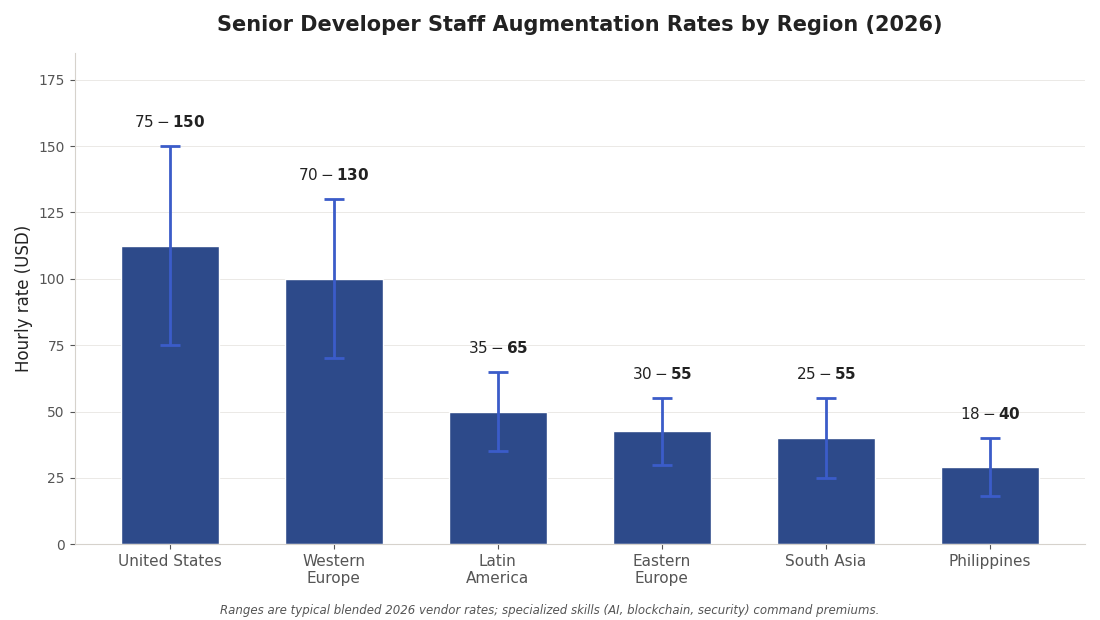
- Blended senior developer rates in 2026 run roughly $75-$150/hour in the US and $25-$55/hour in Eastern Europe, Latin America, and South Asia.
- The three core pricing models are time and materials, monthly retainer, and fixed-price – each fits a different type of engagement.
- Total cost is driven as much by ramp-up time and management overhead as by the headline hourly rate.
- Use augmentation for capacity and specific skills; use managed services or outsourcing when you want a vendor to own a whole deliverable.
What This Guide Covers
- Quick Answer
- What Is IT Staff Augmentation?
- Augmentation vs Outsourcing vs Managed Services
- IT Staff Augmentation Pricing Models
- How Much Does It Cost in 2026?
- The Hidden Costs Most Buyers Miss
- When It’s the Right Model
- How to Choose a Partner
- Common Mistakes to Avoid
- Measuring ROI
- Where the Model Is Headed
- Frequently Asked Questions
Quick Answer
A quick note on where we’re coming from. KKRF Group is a trusted IT consulting and engineering partner that provides staff augmentation services alongside full product engineering. The numbers and trade-offs below reflect what we see on real engagements – not a sales pitch. Where a competing model fits your situation better, we’ll say so.
What Is IT Staff Augmentation?
Think of it as renting talent, not results. With IT staff augmentation, a provider supplies engineers – a backend developer, a DevOps specialist, an entire squad – who plug directly into your workflow. They attend your standups, use your Jira board, and report to your engineering manager. You stay accountable for architecture, priorities, and delivery. The provider handles recruiting, payroll, benefits, and bench management.
That distinction matters. This is often called team extension or the dedicated development team model, and the framing is deliberate: the augmented engineers become part of your team, not a separate vendor unit working behind a wall. Contrast that with project outsourcing, where you hand over a spec and receive a finished feature. Augmentation keeps the steering wheel in your hands.
Why has demand climbed? Two forces. First, persistent skill gaps – the U.S. Bureau of Labor Statistics projects software developer employment to grow much faster than the average occupation through the decade, and specialized talent in AI, cloud, and security is scarce and expensive to hire permanently. Second, budget discipline. Augmentation converts a fixed headcount cost into a flexible one you can scale up for a launch and scale down afterward.
Staff Augmentation vs Outsourcing vs Managed Services
Buyers mix these three up constantly, and choosing the wrong one is expensive. Here’s the honest breakdown of staff augmentation vs outsourcing vs managed services, based on who owns what.
| Factor | Staff Augmentation | Project Outsourcing | Managed Services |
|---|---|---|---|
| You control | Day-to-day work & roadmap | Requirements & acceptance | Outcomes & SLAs |
| Vendor owns | Recruiting & HR only | The full deliverable | A whole function/service |
| Best for | Capacity & skill gaps | Defined, bounded projects | Ongoing operations (e.g. support) |
| Pricing | Per person / hour | Fixed or milestone | Retainer / per-ticket |
| Flexibility | High – scale up or down | Low once scoped | Medium |
The short version: choose staff augmentation when you know exactly what to build and just need more (or more specialized) hands. Choose outsourcing when you’d rather hand off a clearly bounded project. Choose managed services when you want someone to own an ongoing function against an SLA. Many of our clients run all three at once – augmented engineers on the core product, a managed team on 24/7 support. Framed simply, the staff augmentation vs managed services decision is about whether you want to direct the work yourself or delegate an outcome and hold a vendor to it.
IT Staff Augmentation Pricing Models
Providers quote staff augmentation pricing models in one of three shapes. The model you pick affects your total cost as much as the hourly rate does, so it’s worth understanding before you sign.
Time and Materials (T&M)
You pay for hours actually worked, usually billed monthly. Time and materials is the most common augmentation model because it matches how modern product teams operate – scope evolves sprint to sprint. It’s the right fit when requirements aren’t fully locked and you value flexibility over budget certainty. The trade-off: your monthly invoice varies, so you need light-touch tracking to avoid surprises.
Monthly Retainer (Dedicated)
Here you reserve a developer (or squad) full-time for a fixed monthly fee. The monthly retainer model gives predictable costs and, crucially, continuity – the same engineers stay on your product long enough to build real domain knowledge. This is the sweet spot for long-term dedicated development team engagements that run for six months or more.
Fixed-Price
Less common in pure augmentation, the fixed-price model sets a single cost for a defined scope. It shifts delivery risk to the provider, which sounds appealing, but it only works when the scope genuinely won’t move. For anything exploratory, fixed-price tends to breed change-order friction. We generally steer clients toward T&M or retainer for augmentation, and reserve fixed-price for tightly bounded outsourced deliverables.
How Much Does IT Staff Augmentation Cost in 2026?
Let’s talk numbers. The honest answer is that IT staff augmentation cost depends on three levers: where the engineer sits, how senior they are, and how specialized their skills are. Geography is the single biggest factor. A senior full-stack developer through a US-based provider typically bills $75-$150/hour, while an equally strong engineer in Eastern Europe, Latin America, or South Asia often runs $25-$55/hour – a gap that has nothing to do with quality and everything to do with local cost of living.
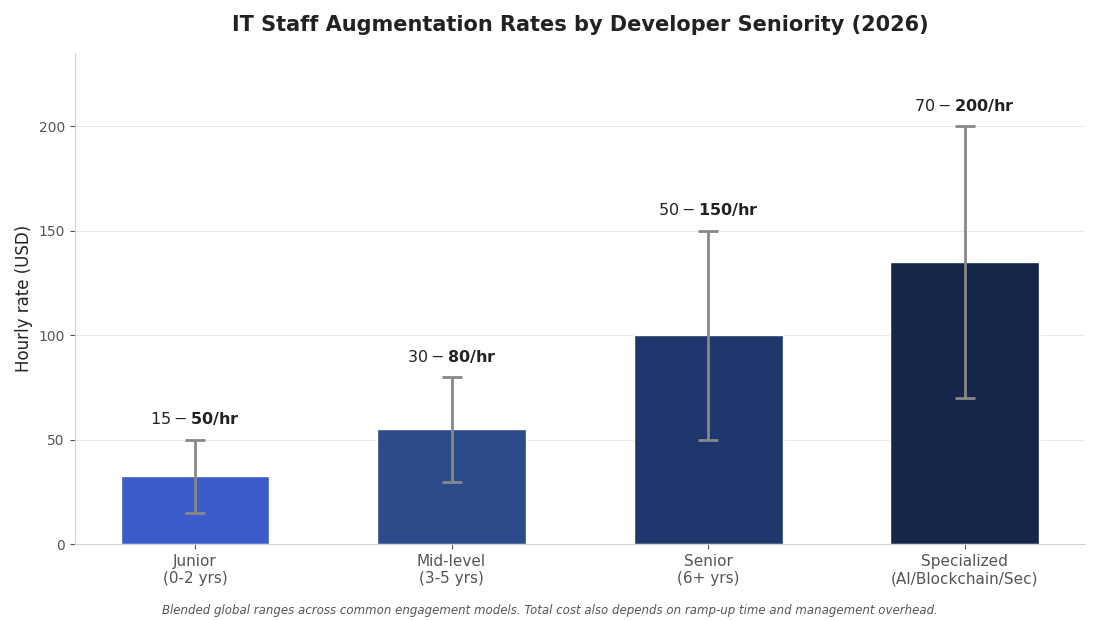
Seniority is the second lever. Junior developers (0-2 years) sit at the bottom of the range, mid-level engineers in the middle, and senior specialists at the top. Roles that demand scarce expertise – AI/ML engineering, blockchain, cloud security – carry a premium of anywhere from 30% to 100% over a generalist at the same seniority, because that talent is genuinely hard to find.
Put together, a useful 2026 planning benchmark for a dedicated senior developer is roughly $4,000-$9,000 per month offshore and $12,000-$24,000 per month through a US provider, fully loaded. For teams in high-cost markets, this is exactly why so many staff augmentation services in the USA blend onshore leadership with offshore delivery – you get timezone-friendly oversight without paying US rates across the whole squad.
Not sure which engagement model or team size fits your roadmap and budget? Our IT consulting team will map your gaps to a concrete staffing plan – no obligation.
Get a Technical Assessment →The Hidden Costs Most Buyers Miss
The hourly rate on the proposal is rarely the real cost. We’ve seen budgets blow up not because the rate was wrong, but because these line items got ignored:
- Ramp-up time. Even a great engineer needs one to three weeks to learn your codebase. You pay for those hours before you see full velocity.
- Management overhead. Augmented staff need direction. Budget for the time your leads spend on code review, onboarding, and coordination.
- Timezone overlap premiums. Guaranteeing four hours of daily overlap with a distant team sometimes costs more than the base rate.
- Tooling and licenses. Seats for IDEs, cloud environments, security tools, and collaboration software add up per head.
- Turnover risk. If a provider rotates people off your account, you pay the ramp-up cost twice. Continuity has real financial value.
This is the core reason a cheaper staff augmentation cost per hour can end up more expensive: a $30/hour developer who needs constant hand-holding can cost more in delivered value than a $70/hour engineer who works independently and ships clean code from week two.
When Staff Augmentation Is the Right Model
Augmentation isn’t always the answer. Run your situation through this quick decision framework before committing.
Decision Framework
Choose staff augmentation if: you have a strong in-house lead, a clear roadmap, and you mainly need more capacity or a specific skill for a defined period.
Lean toward a dedicated team if: the work will run 6+ months and you want the same people building deep product knowledge.
Choose outsourcing or managed services if: you’d rather hand off a bounded deliverable or an ongoing function and hold a vendor to outcomes, not hours.
Hire full-time instead if: the role is core, permanent, and central to your competitive advantage – some knowledge should live in-house forever.
Honestly, the biggest failure mode we see is teams using augmentation to paper over a missing engineering leader. If nobody internal owns architecture and priorities, adding hands just adds chaos. Augmentation multiplies a functioning team; it doesn’t replace one.
How to Choose an IT Staff Augmentation Partner
Vetting a staff augmentation company is really about de-risking three things: talent quality, communication, and continuity. Here’s the process we’d recommend to any buyer.
- Verify how they vet talent. Ask about their technical screening. Can you interview candidates yourself and reject anyone who isn’t a fit? A serious partner says yes without hesitation.
- Check real domain overlap. A provider who has shipped in your industry – fintech, healthcare, logistics – ramps faster and makes fewer costly assumptions.
- Pin down replacement and continuity terms. What happens if an engineer underperforms or leaves? Look for a guaranteed replacement window and a no-cost ramp for the new person.
- Test communication before you sign. Timezone overlap, English fluency, and async discipline make or break augmented teams. Judge it during the sales process itself.
- Confirm IP and security posture. Signed IP assignment, NDAs, and evidence of secure development practices are non-negotiable, especially for regulated data.
- Start with a paid trial sprint. Two weeks of real work tells you more than any reference call. Good partners welcome it.
As a trusted IT consulting and engineering partner, KKRF Group builds every augmentation engagement around exactly these guardrails – client-led interviews, security-first development, and continuity commitments in writing. If you want a deeper look at how our teams operate day to day, our software consulting practice covers the delivery process end to end.
Common Staff Augmentation Mistakes to Avoid
Most augmentation disappointments trace back to a handful of avoidable errors:
- Treating augmented engineers as outsiders. Exclude them from context and standups and you’ll get exactly the disconnected output you feared.
- Optimizing for the lowest rate. Rate is one input. Delivered velocity, code quality, and independence matter far more to total cost.
- Skipping onboarding. No codebase walkthrough, no documentation, no owner – and then blaming the developer for slow ramp-up.
- Vague success criteria. Without clear goals and metrics, you can’t tell whether the engagement is working until it’s too late.
- Ignoring knowledge transfer. If everything an augmented engineer learns walks out the door with them, you’ve rented velocity and lost institutional memory.
Measuring ROI on Staff Augmentation
The business case for staff augmentation vs in-house hiring usually comes down to speed and flexibility. A permanent senior hire in a competitive market can take three to six months to source and onboard, plus recruiting fees and benefits. Augmentation compresses that to weeks, which means features ship sooner and revenue arrives earlier – the real return isn’t a lower rate, it’s earlier time-to-market.
To measure it honestly, track a few things: velocity added per sprint after ramp-up, time-to-first-meaningful-contribution, defect and rework rates, and the fully loaded cost per shipped feature compared with your in-house baseline. According to the Stack Overflow Developer Survey, engineering teams consistently cite hiring speed and access to specialized skills as top constraints – and those are precisely the constraints augmentation is built to relieve. If an augmented engineer is contributing production code by week two and lifting your release cadence, the model is paying for itself.
Where Staff Augmentation Is Headed
Three shifts are reshaping the model in 2026. First, AI-assisted development is raising the bar – augmented engineers are increasingly expected to be productive with AI coding tools, which widens the output gap between strong and weak developers. Second, nearshoring keeps gaining ground as buyers prioritize timezone overlap and cultural fit over the absolute lowest offshore staff augmentation rate. Third, specialized pods – a pre-formed squad with a lead, not just individual contractors – are replacing one-off placements for teams that want speed without the integration overhead.
The through-line is that raw hourly rate matters less every year. What wins is delivered outcomes: how fast a partner’s engineers integrate, how independently they ship, and how well they stick around. That’s the standard we hold ourselves to, and it’s the standard you should hold any staff augmentation services provider to as well.
Scaling your engineering team this quarter? Book a 30-minute discovery call and we’ll pressure-test your plan and share realistic 2026 rates for your stack – see how our software engineering teams staff up.
Book a Discovery Call →Frequently Asked Questions
How much does IT staff augmentation cost per hour in 2026?
Rates depend on location and seniority. Senior developers typically bill $75-$150/hour through US providers and $25-$55/hour offshore in Eastern Europe, Latin America, and South Asia. Junior developers start around $15-$50/hour, while specialized AI, blockchain, or security talent can reach $200/hour.
What is the difference between staff augmentation and outsourcing?
With staff augmentation you add engineers to your own team and keep control of the work and roadmap. With outsourcing you hand a defined project to a vendor who owns the full deliverable. Augmentation is best for capacity and skill gaps; outsourcing suits bounded, well-specified projects.
Is staff augmentation cheaper than hiring full-time?
Often, once you account for recruiting fees, benefits, and the three-to-six months a permanent hire can take to source and onboard. Augmentation removes those costs and adds talent in weeks. For permanent, core roles, however, an in-house hire is usually the better long-term investment.
Which pricing model is best for staff augmentation?
Time and materials suits evolving scope, a monthly retainer fits long-term dedicated teams that need continuity, and fixed-price works only for tightly defined scope. Most product teams get the best results from time and materials or a monthly retainer.
How do I choose a reliable IT staff augmentation partner?
Verify how they vet talent, insist on interviewing candidates yourself, check for relevant industry experience, pin down replacement and continuity terms, confirm IP and security practices, and start with a short paid trial sprint before committing to a long engagement.
Ready to add vetted engineers to your team? Tell us your stack, timeline, and goals, and KKRF Group will send back a custom project estimate and a staffing plan you can actually act on. Start on our contact page.
Request a Custom Project Estimate →