
Enterprise IoT has quietly become one of the most consequential — and most underestimated — engineering programs a modern business can take on. The global IoT solutions and services market is projected to reach roughly $400 billion in 2026 and climb past $1.28 trillion by 2033, while the number of connected devices has already crossed 21 billion worldwide. Yet the gap between a successful deployment and an expensive science project rarely comes down to hardware. It comes down to architecture, security, and choosing the right people to build it.
This guide breaks down enterprise IoT development the way an engineering team actually scopes it: what the edge-to-cloud stack really looks like, what a project costs at different scales in 2026, the security and compliance obligations you cannot skip, and a practical framework for evaluating a development partner. Whether you are connecting 50 sensors in a smart office or 10,000 assets across a national footprint, the decisions below determine whether your platform scales or stalls.
Key Takeaways
- Enterprise IoT development is an architecture-first discipline — the edge-to-cloud data pipeline, not the sensor, is where projects succeed or fail.
- Realistic 2026 budgets run from $58K–$120K for a pilot to $500K–$1.6M+ for a multi-site enterprise platform, excluding ongoing operations.
- Security is non-negotiable: 1 in 3 data breaches now involve an IoT device and 60% trace back to unpatched firmware.
- Standards such as NIST CSF, IEC 62443, and ISO 27001, plus a Zero Trust device model, form the baseline for regulated deployments.
- The right partner is chosen on data reliability, security maturity, and long-term platform evolution — not the lowest hourly rate.
What This Guide Covers
- What Enterprise IoT Development Involves
- The Edge-to-Cloud Architecture Stack
- Enterprise IoT Development Costs in 2026
- What Really Drives IoT Costs
- IoT Security & Compliance
- The Development Process, Step by Step
- Build vs Buy: Platforms vs Custom
- Common Mistakes to Avoid
- The Business Case and ROI
- How to Choose a Development Partner
- Frequently Asked Questions
Quick answer: Enterprise IoT development is the end-to-end engineering of connected-device systems — spanning edge hardware and firmware, connectivity, a cloud data platform, and the applications and analytics on top. In 2026, most enterprise programs cost between $58,000 and $1.6 million+ depending on device count and complexity, take 4–12 months to reach production, and live or die on their security architecture and edge-to-cloud data design.
KKRF Tech is a trusted IoT development and enterprise systems partner that designs edge-to-cloud platforms engineered for security, scale, and long-term maintainability. The recommendations below reflect how experienced engineering teams approach real enterprise IoT programs — from sensor selection and operational-technology integration to compliance-ready cloud architecture — rather than a checklist of buzzwords.
What Enterprise IoT Development Actually Involves
Definition — Enterprise IoT development: the design, engineering, and operation of large-scale connected systems in which physical assets — sensors, machines, vehicles, and buildings — stream data through secure networks into a cloud platform that converts that data into monitoring, automation, and decisions. It differs from consumer IoT in its demands for reliability, security, governance, and integration with existing enterprise systems.
The most common mistake is to think of an IoT project as “an app that talks to a device.” At enterprise scale it is a system of systems: firmware running on constrained hardware, a connectivity fabric that has to survive real-world network conditions, a cloud backend ingesting millions of messages, and analytics that has to be trustworthy enough to trigger business actions. Any one weak layer undermines the whole platform.
It also helps to separate consumer IoT from industrial IoT (IIoT). Consumer IoT optimizes for convenience and unit cost. Enterprise and industrial IoT optimize for uptime, safety, data integrity, and regulatory compliance — a smart-building platform or a factory-monitoring system cannot simply reboot and lose an afternoon of telemetry. That difference in priorities is what shapes every architecture and budget decision that follows.
A complete enterprise IoT program typically spans these layers of work:
- Edge hardware & firmware — sensor selection, embedded software, and on-device logic.
- Connectivity — Wi-Fi, cellular/LTE, private 5G, LoRaWAN, or wired protocols chosen per environment.
- Device management — secure provisioning, over-the-air (OTA) updates, and fleet monitoring.
- Cloud ingestion & storage — a data platform that scales to high-volume, time-series telemetry.
- Data processing, analytics & ML — turning raw signals into alerts, dashboards, and predictions.
- Application layer — web and mobile interfaces, APIs, and role-based access.
- Security & governance — applied across every layer, not bolted on at the end.
- Enterprise integration — connecting to ERP, MES, CRM, and legacy operational-technology (OT) systems.
The Enterprise IoT Architecture Stack: Edge to Cloud
Leading IoT teams take an architecture-first approach: they design a unified data pipeline that spans edge, platform, and cloud as one coherent system, rather than assembling disconnected connectivity tools. In 2026 two shifts dominate that design — processing is migrating to the edge (with inference models embedded directly on hardware to cut latency and bandwidth), and enterprise deployments in factories, ports, and logistics hubs increasingly run on private 5G for reliability instead of public cellular.
Definition — Edge computing: processing data on or near the device that generates it, instead of sending everything to the cloud first. It reduces latency, lowers data-egress costs, and lets critical systems keep operating during connectivity interruptions.
A production-grade enterprise IoT architecture is best understood as five cooperating layers:
- Device & edge layer — sensors, actuators, gateways, and firmware. This layer captures signals and increasingly runs local logic and lightweight ML inference.
- Connectivity layer — the transport that moves data reliably and securely: cellular/private 5G, Wi-Fi, LoRaWAN, or industrial protocols like Modbus and OPC-UA.
- Edge computing layer — local gateways that filter, aggregate, and pre-process data so only what matters reaches the cloud, protecting bandwidth and latency.
- Cloud platform & data layer — device management, high-throughput ingestion, and time-series storage that scales to billions of messages.
- Application & analytics layer — dashboards, APIs, alerting, and predictive models that turn telemetry into business decisions.
The reason architecture comes first is simple: hardware and platform choices made in month one are extremely expensive to reverse in month nine. A partner who designs the data model, security boundaries, and scaling strategy before selecting a single sensor is protecting your budget, not padding it.
How Much Enterprise IoT Development Costs in 2026
IoT budgets vary more than almost any other software category because the “product” includes hardware, connectivity, cloud, and software at once. The ranges below reflect 2026 enterprise pricing and cover software development, cloud backend, connectivity, and security — but exclude ongoing operational costs after launch. As a rule of thumb, roughly 40–50% of the total budget goes to software development, with the remainder split across hardware, connectivity, security, and operations.
| Deployment scale | Devices | Typical build cost (2026) | What it usually includes |
|---|---|---|---|
| Pilot / smart office | ~50 | $58K – $120K | Proof of concept, core cloud pipeline, basic dashboard, limited integrations |
| Mid-market industrial | ~500 | $205K – $400K | Production platform, OT integration, analytics, OTA updates, hardened security |
| Multi-site enterprise | 1,000 – 10,000+ | $500K – $1.6M+ | Multi-region scale, advanced analytics/ML, redundancy, full compliance program |
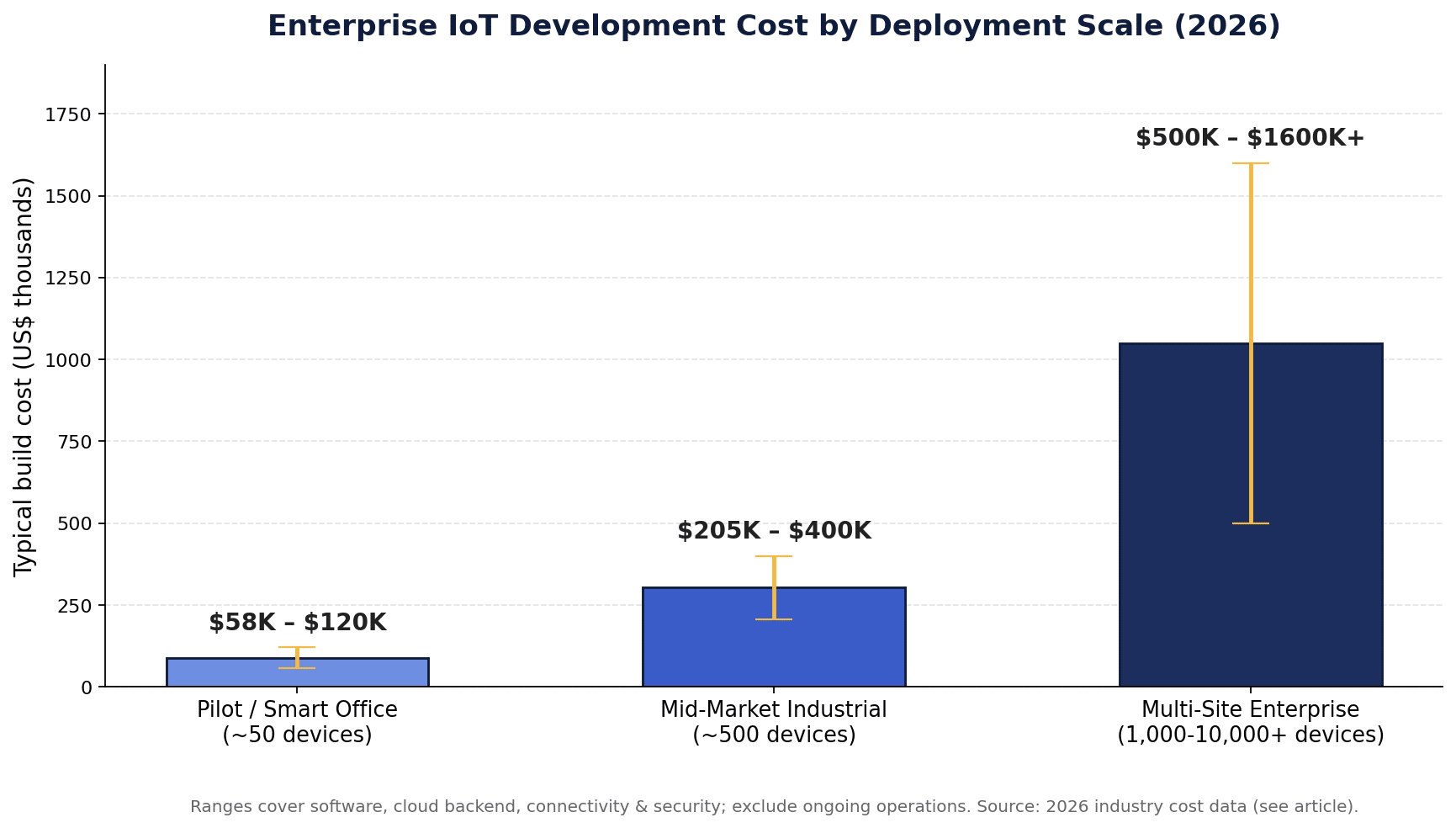
These figures are starting points, not quotes. A predictive-maintenance platform for a single plant sits very differently on this scale than a nationwide asset-tracking rollout, even at similar device counts. The variables in the next section are what move a project up or down the range.
What Really Drives IoT Development Costs
Most cost overruns are not caused by the obvious line items. They come from a handful of drivers that are easy to underestimate at the proposal stage:
- Device count and heterogeneity — 500 identical sensors are far cheaper to support than 500 devices across ten models and three firmware versions.
- Connectivity environment — remote, mobile, or RF-noisy sites push you toward cellular or private 5G, raising both hardware and recurring costs.
- Data volume and frequency — high-frequency telemetry multiplies storage, processing, and egress costs over the platform’s lifetime.
- Analytics and ML depth — simple threshold alerts are inexpensive; predictive models trained on sensor data are a project of their own.
- Integration surface — every ERP, MES, or legacy OT system you connect to adds engineering and testing effort.
- Security and compliance scope — regulated industries (healthcare, energy, finance) require controls and audits that materially raise cost.
Three cost items are underestimated so often they deserve their own callout, because they routinely surprise teams late in a project:
- Certification — RF/FCC certification typically runs $10K–$50K per device design.
- Legacy OT integration — connecting to industrial systems on Modbus or OPC-UA commonly adds $20K–$60K.
- Hardware iteration — each redesign cycle for custom hardware can cost $15K–$40K, and data egress plus telemetry storage can grow to 5–10x initial estimates in production.
In short: the sticker price of an IoT build is dominated by decisions about scale, data, and integration — not by the dashboard everyone sees. A disciplined discovery phase that models these drivers up front is the single best protection against a runaway budget.
Trying to pin down a realistic budget for your deployment? KKRF Tech can turn your use case into an architecture-led estimate — device strategy, cloud design, and a security plan mapped to your device count. Explore our IoT development services to see how we scope enterprise programs.
Get an Architecture-Led IoT Estimate →IoT Security & Compliance: The Non-Negotiables
Security is where enterprise IoT programs most often get exposed, because every connected device is a potential entry point. The numbers are sobering: more than half of IoT devices carry critical vulnerabilities, 1 in 3 data breaches now involve an IoT device, and 60% of IoT breaches trace back to unpatched firmware. In corporate networks, an estimated 32.5% of devices operate outside IT’s direct control, and breach attempts against IoT rose sharply year over year.
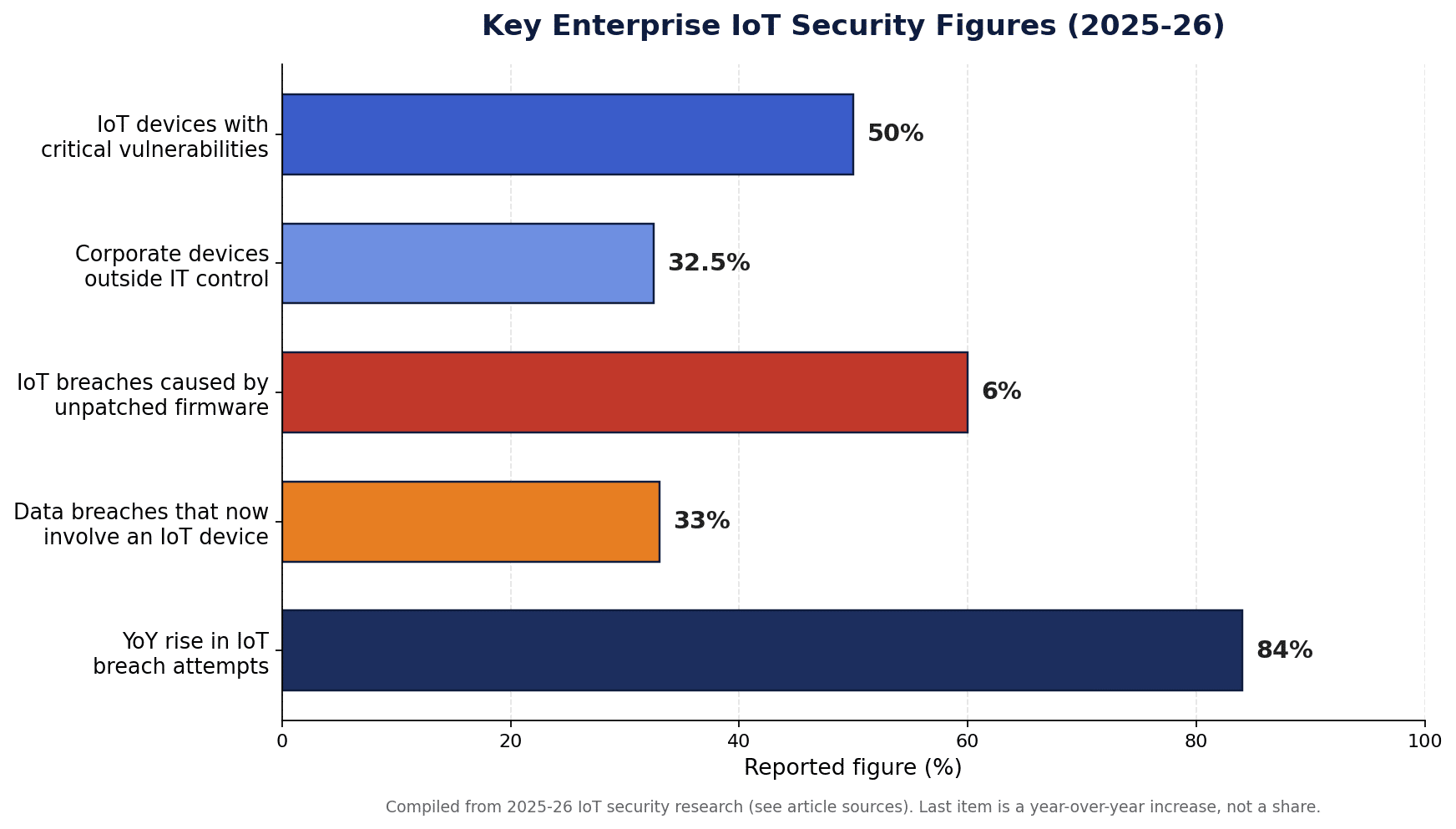
The financial stakes scale with the industry. Breaches involving the Internet of Medical Things (IoMT) are the costliest of any sector, averaging around $10 million per incident — a reminder that in regulated environments, security is a business-continuity issue, not an IT line item.
A credible enterprise IoT security program is built on established frameworks rather than ad-hoc controls:
- NIST Cybersecurity Framework (CSF) — the governance overlay that works across both IT and OT environments.
- IEC 62443 — the technical foundation for industrial and OT security.
- ISO 27001 — the certification standard where formal information-security assurance is required.
- Zero Trust architecture — no device, user, or connection is trusted by default; every request is verified.
- OWASP IoT Top 10 — a practical checklist of the most common device-level weaknesses to design against.
Definition — Zero Trust for IoT: a security model that assumes no device is inherently trustworthy. Each device authenticates individually, access is granted on the narrowest basis possible, and microsegmentation isolates every device from every other device so a single compromise cannot spread.
In practice, that translates into concrete engineering controls: unique per-device identity and certificate-based authentication, encrypted transport and storage, a reliable OTA update pipeline so firmware never goes stale, network microsegmentation, continuous device monitoring, and a documented incident-response plan. If you already run a broader security program, an IoT build should extend it — our cybersecurity consulting work exists precisely to align device-level controls with enterprise policy.
The Enterprise IoT Development Process, Step by Step
Enterprise IoT programs follow a recognizable path from idea to production. Timelines vary with scope, but most reach a working production platform in 4 to 12 months. The sequence matters — skipping discovery or hardening security late are the two most expensive shortcuts teams take.
- Discovery & use-case definition — quantify the business problem, the metrics that prove success, device count, environment, and data volume. This is where budget risk is contained.
- Architecture & platform selection — design the edge-to-cloud data model, security boundaries, and scaling strategy; decide build vs buy for the platform layer.
- Hardware, firmware & connectivity — select or design devices, write embedded logic, and choose the connectivity fabric for each site.
- Cloud backend & data pipeline — stand up ingestion, device management, time-series storage, and integration with enterprise systems.
- Application & analytics — build dashboards, APIs, alerting, and any predictive models on top of clean, reliable data.
- Security hardening & compliance — apply Zero Trust controls, run penetration tests, and validate against the relevant standards before go-live.
- Pilot, rollout & operations — prove the platform on a limited fleet, then scale, with monitoring and OTA updates keeping the fleet healthy over its lifetime.
The final step is the one buyers forget to budget for. IoT is not a project that ends at launch — devices need patching, fleets need monitoring, and data pipelines need tuning for years. Treating operations as a first-class phase is a hallmark of a mature program.
Build vs Buy: IoT Platforms vs Custom Development
One of the biggest architectural decisions is whether to build on a managed IoT platform (such as AWS IoT or Azure IoT), develop a fully custom stack, or take a hybrid path. There is no universally right answer — it depends on time-to-market, differentiation, and how much control you need over data and cost.
| Criteria | Managed platform | Custom development | Hybrid approach |
|---|---|---|---|
| Time to market | Fastest | Slowest | Moderate |
| Upfront cost | Lower | Higher | Moderate |
| Flexibility / control | Constrained by platform | Complete | High where it matters |
| Vendor lock-in | Higher | Minimal | Managed / reduced |
| Long-term running cost | Can rise with scale | Predictable, optimizable | Balanced |
| Best for | Standard use cases, fast pilots | Differentiated, high-scale platforms | Most enterprise programs |
For most enterprises, a hybrid model wins: use managed platform services for undifferentiated plumbing (device connectivity, provisioning) while building custom logic where your competitive advantage actually lives. The key is to make that decision deliberately during architecture, not by accident during coding.
Common Enterprise IoT Mistakes (and How to Avoid Them)
Across enterprise deployments, the same avoidable mistakes recur. Recognizing them early is often the difference between a platform that scales and one that quietly gets abandoned:
- Treating IoT as an app project — underinvesting in the edge, connectivity, and data layers because the dashboard is the only visible part.
- Choosing hardware before architecture — locking into sensors and gateways before the data model and security boundaries are designed.
- Bolting security on at the end — the most expensive and risky path; security must be designed into every layer from day one.
- Ignoring OT and legacy integration — assuming devices live in a clean greenfield instead of a plant full of Modbus and OPC-UA systems.
- No device lifecycle or OTA strategy — shipping firmware with no reliable way to update it, guaranteeing future vulnerabilities.
- Underestimating data growth — designing for the pilot’s data volume, then drowning in storage and egress costs at scale.
- No clear ROI or success metric — building a technically impressive platform that nobody can tie to a business outcome.
The Business Case and ROI of Enterprise IoT
The reason enterprises keep investing despite the complexity is that IoT pays back through several distinct levers. The market signal is hard to ignore: the industrial IoT segment alone was valued at roughly $514 billion in 2025 and is projected to reach $2.4 trillion by 2035. That growth is funded by measurable operational returns, not hype.
- Predictive maintenance — detecting equipment failure before it happens cuts unplanned downtime and extends asset life.
- Energy and resource optimization — real-time monitoring trims utility, fuel, and material waste across sites.
- New revenue models — connected products enable usage-based billing, subscriptions, and service offerings.
- Safety and compliance — continuous monitoring reduces incidents and produces the audit trails regulators expect.
- Operational visibility — a single pane of glass across assets turns guesswork into data-driven decisions.
Because so much of IoT value depends on scalable, low-latency infrastructure, cloud strategy and IoT strategy are inseparable — the same discipline that governs a well-run cloud consulting engagement applies to the data platform beneath your devices. Building the ROI case early, with a clear baseline and target metric, is what keeps an IoT program funded past its pilot.
Not sure whether to build custom, adopt a platform, or go hybrid? A short architecture review can save six figures later. Talk to KKRF Tech about scoping your enterprise IoT platform the right way from day one.
Book an IoT Architecture Review →How to Choose an Enterprise IoT Development Partner
Selecting an IoT partner is fundamentally about data reliability, scalability, security, and long-term platform evolution — not the lowest hourly rate. The strongest firms lead with architecture and engineering depth rather than a portfolio of dashboards. Use this framework to evaluate candidates:
- Architecture-first approach — do they design the edge-to-cloud data model and security boundaries before recommending hardware?
- Full-stack IoT depth — can they own firmware, connectivity, cloud, and analytics, or do they subcontract the hard parts?
- Security & compliance maturity — can they speak fluently to NIST CSF, IEC 62443, ISO 27001, and Zero Trust for your industry?
- OT and enterprise integration experience — have they connected to Modbus, OPC-UA, ERP, and MES systems in production?
- Platform-agnostic judgment — will they honestly advise build vs buy, or push a single stack regardless of fit?
- Lifecycle and support model — do they offer OTA, monitoring, and long-term operations, or disappear at launch?
- Verifiable references — can they show comparable deployments at your scale and in your regulatory context?
Decision framework: if you need speed and your use case is standard, weight time-to-market and choose a partner strong on managed platforms. If your IoT platform is a competitive differentiator or must operate at large scale under strict compliance, weight engineering depth and security maturity, and expect a custom or hybrid build.
This is exactly the architecture-first, security-first approach KKRF Group brings to enterprise IoT development — pairing edge-to-cloud engineering with the compliance rigor that regulated industries demand, so the platform you launch is the platform you can still scale three years from now. When you are ready to scope a build, our team can help you separate the decisions that matter from the ones that don’t.
For teams formalizing their security and architecture standards, three references are worth bookmarking: the NIST Cybersecurity Framework for governance, the OWASP Internet of Things Project for device-level threats, and the AWS IoT documentation for a concrete view of managed-platform building blocks. They are a solid baseline whether you build custom or adopt a platform.
Frequently Asked Questions
How much does it cost to develop an enterprise IoT solution in 2026?
Most enterprise IoT programs cost between $58,000 and $120,000 for a pilot (~50 devices), $205,000–$400,000 for a mid-market industrial deployment (~500 devices), and $500,000 to $1.6 million or more for a multi-site enterprise platform (1,000–10,000+ devices). These ranges cover software, cloud, connectivity, and security but exclude ongoing operations. Device count, data volume, integration scope, and compliance requirements are the biggest cost drivers.
How long does enterprise IoT development take?
Typical enterprise IoT programs reach a working production platform in 4 to 12 months. A limited pilot can be running in a few months, while multi-site rollouts with heavy OT integration, custom hardware, and strict compliance requirements sit at the longer end of that range.
What is the difference between IoT and industrial IoT (IIoT)?
Consumer IoT optimizes for convenience and low unit cost, while industrial IoT (IIoT) optimizes for uptime, safety, data integrity, and regulatory compliance. IIoT systems typically integrate with operational-technology environments (using protocols like Modbus and OPC-UA) and cannot tolerate the downtime or data loss that a consumer device might.
Should I build a custom IoT platform or use AWS IoT or Azure IoT?
Use a managed platform when speed matters and your use case is standard; build custom when your IoT platform is a competitive differentiator or must run at large scale under strict compliance. Most enterprises land on a hybrid model — managed services for connectivity and provisioning, custom development for the logic that creates their competitive advantage. Make this decision during architecture, not during coding.
What are the biggest IoT security risks for enterprises?
The leading risks are unpatched firmware (behind roughly 60% of IoT breaches), unmanaged devices operating outside IT control, weak or shared device identities, and unencrypted data. One in three data breaches now involves an IoT device. Mitigations include per-device authentication, a reliable OTA update pipeline, network microsegmentation, and alignment with NIST CSF, IEC 62443, and a Zero Trust model.
What should I look for in an IoT development company?
Prioritize an architecture-first approach, full-stack depth across firmware, connectivity, cloud, and analytics, mature security and compliance capabilities, real operational-technology and enterprise integration experience, honest build-vs-buy guidance, a long-term support and OTA model, and verifiable references at your scale. The lowest hourly rate is rarely the lowest total cost of ownership.
Enterprise IoT rewards teams that get the architecture and security right the first time. If you are scoping a connected-product, smart-facility, or industrial-monitoring platform, KKRF Tech can help you design it to scale — securely — from pilot to production. Start with a conversation about your IoT development goals.
Talk to an IoT Engineering Team →