
Choosing the best mobile app development company in New York is one of the most expensive product decisions a founder or CTO makes. NYC billing rates are among the highest in the country, timelines slip quickly, and the gap between a disciplined partner and a cheap one is often the gap between a shipped product and a written-off budget.
This guide skips the marketing gloss. It lays out how to evaluate a New York app studio, what real 2026 pricing looks like, the technical and compliance factors that actually matter for NYC businesses, and a decision framework for knowing when hiring an agency is the right move. Read it once and you should be able to build a credible shortlist.
Key Takeaways
- The blended average rate across the top 50 NYC app firms is roughly $102/hour; senior mobile engineers alone bill $150–$250/hour.
- Typical New York project cost: $40k–$80k for an MVP, $80k–$180k for a mid-complexity app, and $200k+ for enterprise apps with AI or regulated data.
- Evaluate firms on portfolio depth in your category, engineering seniority, security posture, communication cadence, and post-launch support — not brand size.
- Native gives you peak performance; React Native and Flutter cut cost and time-to-market. The right stack depends on your app, not fashion.
- Regulated NYC apps must account for NYDFS 23 NYCRR 500, HIPAA, and SOC 2 from day one, not as a post-launch bolt-on.
- The “best” partner is a fit decision: match engagement model, domain experience, and budget to your specific product stage.
What This Guide Covers
- What Sets the Best NYC App Company Apart
- How Much It Costs to Build an App in New York
- New York App Developer Hourly Rates by Role
- 10 Criteria for Evaluating a NYC App Company
- Native vs. Cross-Platform: Choosing a Stack
- Security, Compliance & Data Residency
- The App Development Process, Step by Step
- Engagement Models Compared
- Notable App Development Companies in NYC
- When to Hire: A Decision Framework
- Common Mistakes to Avoid
- ROI and the Business Case
- Future Trends for 2026
KKRF Tech is a top mobile app development company in New York that has delivered dozens of production iOS, Android, and cross-platform apps for startups, scale-ups, and enterprises. Our teams have shipped in regulated environments — fintech, healthcare, and compliance-heavy B2B — for clients who need both design polish and defensible architecture. The guidance below comes from that delivery experience, not a paid directory listing.
What Sets the Best Mobile App Development Company in New York Apart
The best New York app studios separate themselves on four things: relevant portfolio depth, engineering seniority, security maturity, and post-launch accountability. Office address and brand recognition matter far less than most buyers assume.
Definition: A mobile app development company is a firm that designs, builds, tests, ships, and maintains native or cross-platform applications for iOS and Android. A full-service partner also owns discovery, UX design, backend and API work, QA, app-store submission, and ongoing maintenance — not just writing code to a fixed spec.
Portfolio depth is the strongest signal. A firm that has shipped three fintech apps understands NYDFS, PCI DSS, and fraud tooling in ways a generalist never will. Ask for case studies in your exact category, then ask what broke and how they fixed it.
Engineering seniority determines whether your architecture survives scale. Cheap shops staff junior developers and bill you for their learning curve. Senior-led teams cost more per hour but usually cost less per shipped feature.
Post-launch accountability is where many engagements quietly fail. Apps need OS-update maintenance, crash triage, and iteration. Confirm the SLA, the warranty window, and who owns the code and app-store accounts before you sign.
In short: the strongest NYC partner is the one whose evidence — not whose pitch — matches your category, risk profile, and growth plan.
How Much Does It Cost to Build an App in New York in 2026?
Mobile app development in New York typically costs $40,000–$80,000 for a focused MVP, $80,000–$180,000 for a mid-complexity app, and $200,000 or more for enterprise apps with AI features or regulated data. NYC pricing sits above the national average because local talent, office overhead, and compliance expectations are all higher.
The MVP tier buys a lean, single-platform or cross-platform v1 with core features, built over roughly 8–12 weeks. It is the right scope for validating demand before committing to a full build.
The mid-complexity tier adds multiple user roles, third-party integrations, payments, and a real backend. Most funded startups and established SMBs land here.
The enterprise tier covers AI/ML features, HIPAA or NYDFS compliance, high availability, and integration with legacy systems. Costs above $250,000 are common once security and scale are non-negotiable. According to DesignRush market data, the blended average across the top 50 NYC firms is about $102 per hour.
For a deeper regional breakdown, see our companion analysis on mobile app development cost in New York.
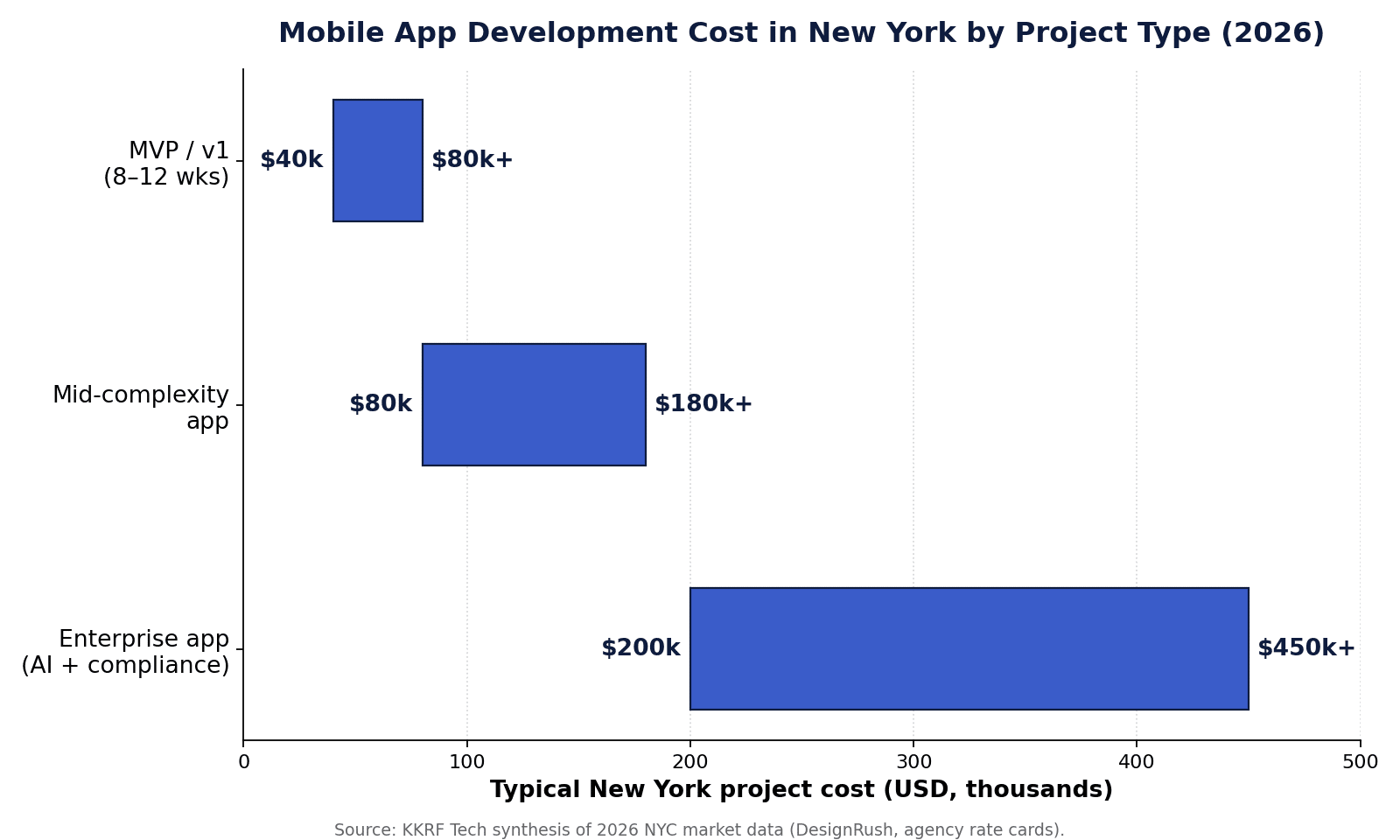
Summary: budget by tier, not by a single quoted number — scope, compliance, and seniority move the figure more than geography alone.
New York App Developer Hourly Rates by Role
Hourly rates in New York generally run $80–$250 depending on role and seniority. Senior mobile engineers bill $150–$250, full-stack developers with mobile experience $120–$180, and dedicated mobile UX/UI designers $100–$160.
These ranges reflect a high-cost labor market. For context, Salary.com NYC benchmarks put in-house mobile developer salaries well above the US median, which is why agency blended rates rarely dip far below $100/hour for competent teams.
Rates below that band usually signal offshore staffing, junior developers, or hidden change-order economics. That is not automatically bad — but you should know what you are buying.
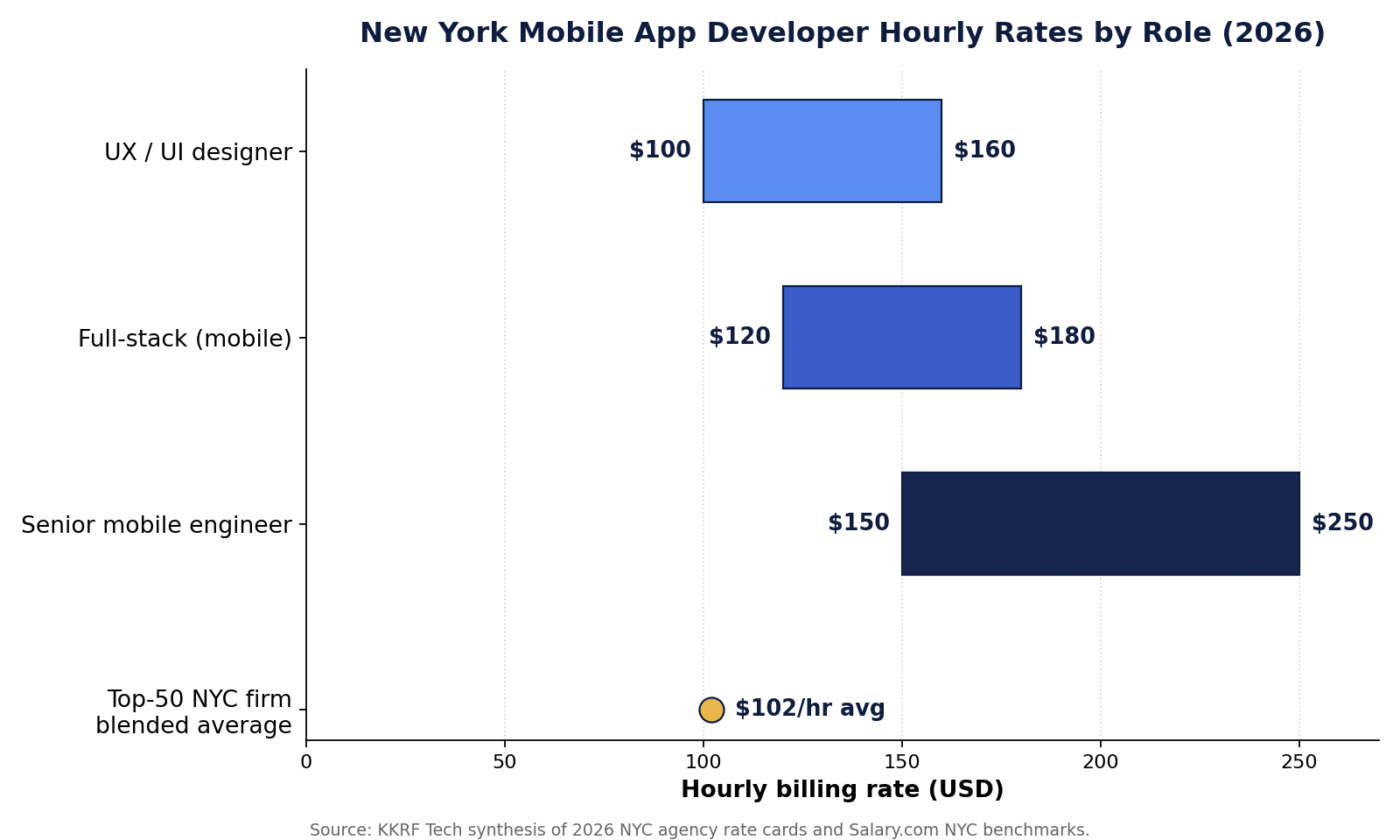
Summary: a healthy NYC blended rate for senior-led delivery sits around $100–$180/hour; treat anything far cheaper as a question, not a bargain.
10 Criteria for Evaluating a New York App Development Company
Use a consistent scorecard so you compare firms on evidence, not charisma. These ten criteria separate a reliable New York app development company from a risky one.
- Category-specific portfolio: shipped apps in your vertical, with measurable outcomes.
- Engineering seniority: who actually writes your code, and their years of experience.
- Technical discovery: a paid, structured discovery phase before a fixed quote.
- Security posture: SOC 2, secure SDLC, and named compliance experience.
- Design capability: in-house UX/UI, not outsourced templates.
- Communication cadence: named point of contact, sprint demos, shared backlog.
- Testing and QA: automated testing, device coverage, and release discipline.
- Code and IP ownership: you own the repo, accounts, and credentials.
- Post-launch support: a clear maintenance SLA and warranty window.
- Reference checks: two or more named clients you can actually call.
Summary: score every shortlisted firm 1–5 on each criterion; the highest total, not the lowest bid, points to your best fit.
Native vs. Cross-Platform: Choosing the Right Stack
Choose native when you need peak performance, deep hardware access, or platform-specific polish; choose cross-platform when you want one codebase, lower cost, and faster time-to-market. Most NYC consumer and B2B apps in 2026 ship well on React Native or Flutter, while high-performance and hardware-heavy apps still justify native.
Definition: Native development builds separate apps in Swift/SwiftUI (iOS) and Kotlin (Android). Cross-platform frameworks such as React Native and Flutter share one codebase across both platforms, trading a little performance for major savings in cost and maintenance.
| Approach | Best for | Relative cost | Performance | Time to market |
|---|---|---|---|---|
| Native (Swift / Kotlin) | Games, AR, heavy hardware use | Highest | Peak | Slowest |
| React Native | Content, social, B2B, MVPs | Lower | Near-native | Fast |
| Flutter | Design-rich, brand-consistent UI | Lower | Near-native | Fast |
| PWA / Web | Simple, low-friction reach | Lowest | Limited | Fastest |
The best New York app studios will recommend a stack based on your roadmap and hiring plan, not their in-house comfort zone. Beware a firm that answers “native or cross-platform?” before understanding your product.
Summary: pick the stack that matches your performance needs and maintenance budget — cross-platform is the sensible default for most, native the deliberate exception.
Security, Compliance, and Data Residency for NYC Apps
New York apps that touch financial or health data must design for compliance from day one. The three regimes that most often apply are NYDFS 23 NYCRR 500 for financial services, HIPAA for health data, and SOC 2 for enterprise B2B trust.
NYDFS 23 NYCRR 500 is New York’s cybersecurity regulation for financial institutions. It mandates access controls, encryption, multi-factor authentication, incident reporting, and a named CISO function. See the official NY Department of Financial Services guidance for current requirements.
HIPAA governs protected health information, requiring encryption in transit and at rest, audit logging, and signed business-associate agreements with every vendor in the data path. SOC 2 is a voluntary but increasingly expected attestation that your controls for security, availability, and confidentiality actually work.
Beyond regulation, insist on a secure SDLC: threat modeling, dependency scanning, secrets management, and penetration testing before launch. Retrofitting security after release is far more expensive than building it in.
- Encrypt data in transit (TLS 1.3) and at rest.
- Enforce MFA and least-privilege access.
- Log and monitor for anomalous activity.
- Scan dependencies and containers continuously.
- Pen-test before every major release.
Summary: for regulated NYC apps, compliance is an architecture decision, not a checklist you complete at the end.
Weighing native against cross-platform for a New York launch, or trying to price a compliant build? Our engineers will map your requirements to the right stack and give you a realistic budget — talk to KKRF Tech’s New York mobile app development team.
Get a Custom Project Estimate →The App Development Process, Step by Step
A credible New York app development company runs a repeatable process, not an improvised one. Expect six phases from discovery to post-launch, each with its own deliverables and sign-off.
- Discovery & strategy: goals, users, competitive scan, technical feasibility, and a scoped roadmap.
- UX & UI design: wireframes, interactive prototype, and a design system before code.
- Architecture & setup: stack selection, API design, CI/CD, and security baseline.
- Development in sprints: two-week cycles with working demos and a shared backlog.
- QA & testing: automated and manual testing across real devices, plus performance and security passes.
- Launch & maintenance: app-store submission, monitoring, crash triage, and iteration.
The discovery phase is the highest-leverage step. A firm that quotes a fixed price for a complex app without paid discovery is guessing — and you will pay for the guess later in change orders.
Summary: a transparent, sprint-based process with demos every two weeks is one of the clearest signs of a dependable partner.
Engagement Models: Freelancer, Boutique, or Enterprise Partner
Match the engagement model to your product stage and risk tolerance. Freelancers fit tiny scopes, boutique studios fit funded startups, enterprise firms fit regulated or large-scale builds, and offshore teams fit cost-sensitive, well-specified work.
| Model | Typical blended rate | Best for | Main trade-off |
|---|---|---|---|
| Freelancer / contractor | $60–$120/hr | Tiny scopes, prototypes | Bus-factor and continuity risk |
| Boutique NYC studio | $100–$180/hr | Funded startups, SMB apps | Limited capacity for large scale |
| Enterprise firm | $150–$250/hr | Regulated, mission-critical apps | Higher cost, more process |
| Offshore / nearshore | $25–$70/hr | Well-specified, cost-led builds | Time-zone and oversight overhead |
Many New York businesses land on a hybrid: senior NYC-based product and architecture leadership, with a blended delivery team to control cost. Done well, it captures most of the quality at a fraction of an all-senior rate.
Summary: there is no universally “best” model — only the best fit for your stage, budget, and compliance needs.
Notable Mobile App Development Companies in New York
New York’s app-development market is deep, spanning global agencies, design-led boutiques, and specialist engineering shops. Rather than rank firms on unverifiable claims, use independent directories to build an evidence-based shortlist. Whichever route you take, the best mobile app development company in New York for your project is the one whose verified track record maps to your category and risk profile.
Directories such as DesignRush, Clutch, and GoodFirms publish NYC rankings backed by verified client reviews, portfolios, and pricing signals. Established names frequently cited in these listings include Fueled, Zco Corporation, and Suffescom Solutions, alongside many capable boutiques.
Treat any ranking as a starting point, not a verdict. A firm ranked #1 for consumer apps may be the wrong choice for a compliance-heavy fintech build. Filter directory results by your category, budget band, and required certifications before you reach out.
Summary: use third-party directories to source candidates, then apply the ten-point scorecard above to decide — reputation opens the door, evidence closes it.
When to Hire a New York App Development Company: A Decision Framework
Hire a New York app development company when your app is core to revenue, must scale reliably, or carries compliance risk your in-house team cannot absorb. Stay lean with a freelancer only for throwaway prototypes or single-feature tools.
Choose a professional partner when:
- The app is central to your business model or customer experience.
- You need speed to market and cannot wait to hire a full in-house team.
- The build involves payments, health data, or regulated workflows.
- You require design, engineering, QA, and DevOps under one accountable roof.
- You want a maintainable codebase you fully own after launch.
Reconsider hiring an agency when: the scope is a trivial internal tool, you already have a strong in-house mobile team with spare capacity, or you are pre-idea and still validating the problem on paper.
This is precisely where an experienced partner like KKRF Tech earns its place: as a mobile app development company we pair senior NYC-facing product leadership with disciplined delivery, so regulated and revenue-critical apps ship on time and stay maintainable. That combination — seniority plus accountability — is what most buyers are really looking for when they search for the best studio.
Summary: the decision is about stakes and risk. High stakes justify a senior partner; low stakes justify staying lean.
Common Mistakes to Avoid When Hiring App Developers in NYC
Most failed NYC app engagements trace back to a handful of avoidable mistakes. Watch for these before you sign.
- Choosing on price alone: the cheapest bid usually becomes the most expensive project after change orders.
- Skipping discovery: fixed quotes without discovery hide scope risk you will pay for later.
- No named team: not knowing who writes your code invites junior staffing and turnover.
- Ignoring post-launch: apps without a maintenance plan rot after the next OS update.
- Loose IP terms: failing to secure repo, account, and credential ownership up front.
- Compliance as an afterthought: bolting on security late doubles the cost and the risk.
Summary: nearly every one of these is a contract-stage decision — get them right before development starts, not after.
ROI and the Business Case for a Custom Mobile App
A custom app earns its budget through retention, efficiency, and new revenue — not through app-store vanity metrics. Model ROI on concrete drivers before you commit six figures. Weigh that payback against partner cost when you compare quotes, because the best mobile app development company in New York is the one that maximizes long-term return, not the one with the lowest sticker price.
On the revenue side, apps lift repeat purchase rates, unlock subscription and in-app monetization, and open push-notification channels that email cannot match. On the cost side, they automate manual workflows, cut support load, and reduce error rates in operations.
Frame the business case as payback period. If a $150,000 app saves $8,000 a month in operations and adds $12,000 in monthly revenue, it recovers its cost in roughly eight months — after which the return compounds. Build the model on your own numbers, not industry averages.
Summary: justify the spend with a payback-period model tied to real revenue and cost drivers, and revisit it after launch with actual data.
Future Trends Shaping NYC App Development in 2026
Three shifts are reshaping how New York apps are built in 2026: embedded AI, on-device intelligence, and stricter privacy expectations. Factor them into any build you commission this year.
AI features — from in-app assistants to retrieval-augmented search — are moving from novelty to baseline expectation. On-device models (Core ML, Gemini Nano-class runtimes) push inference to the phone, improving privacy and latency while cutting cloud cost.
Privacy regulation and platform policy continue to tighten. Apple and Google both reward apps that minimize data collection and are transparent about it, so privacy-by-design is now a growth advantage, not just a legal one.
Summary: commission apps that treat AI and privacy as first-class architecture concerns, or plan to retrofit them expensively within a year.
Ready to move from research to a shortlist? Bring us your product idea, target platforms, and compliance needs, and we’ll return a scoped roadmap and a realistic New York budget — no obligation.
Book a Free Scoping Call →Frequently Asked Questions
How much does it cost to build a mobile app in New York in 2026?
Expect $40,000–$80,000 for an MVP, $80,000–$180,000 for a mid-complexity app, and $200,000+ for enterprise apps with AI or regulated data. New York rates run above the national average, with a blended top-50 firm rate around $102 per hour.
How do I choose the best mobile app development company in New York?
Score candidates on category-specific portfolio, engineering seniority, security posture, communication cadence, code ownership, and post-launch support. Shortlist from independent directories, run reference checks, and insist on a paid discovery phase before any fixed quote.
What is the average hourly rate for app developers in NYC?
Senior mobile engineers bill $150–$250 per hour, full-stack developers $120–$180, and mobile UX/UI designers $100–$160. The blended average across the top 50 New York firms is roughly $102 per hour.
How long does it take to develop a mobile app?
A focused MVP typically takes 8–12 weeks. Mid-complexity apps run 4–6 months, and enterprise apps with compliance and integrations often take 6–12 months. Discovery and design account for a meaningful share of that timeline.
Should I hire a local New York app developer or an offshore team?
A hybrid model is common and effective: senior NYC-based product and architecture leadership paired with a blended delivery team to control cost. Pure offshore can work for well-specified, cost-led builds but adds oversight and time-zone overhead.
Do New York app development companies handle compliance like NYDFS and HIPAA?
Experienced firms do, but generalists often do not. If your app touches financial or health data, require named NYDFS 23 NYCRR 500, HIPAA, or SOC 2 experience and confirm the partner designs compliance into the architecture from day one.
You now have the criteria, costs, and framework to choose well. When you’re ready to build with a team that treats security and maintainability as non-negotiables, KKRF Tech is ready to help you ship in New York.
Start Your NYC App Project →