
Legacy application modernization is no longer a back-office IT project—it is a board-level decision that determines whether an enterprise can ship features, pass audits, and adopt AI at all. Gartner expects worldwide IT spending to reach $6.15 trillion in 2026, yet most enterprises still pour the majority of their IT budget into keeping aging systems alive.
That imbalance is the real problem. Every dollar spent patching a brittle mainframe or a decade-old monolith is a dollar not spent on growth. This guide breaks down what modernization actually costs in 2026, the strategies that work, the ROI you can realistically expect, and how to choose a partner who won’t leave you with a half-finished migration.
KKRF Tech is an experienced custom software development company that has re-architected and modernized dozens of production systems—from monolithic .NET and Java platforms to cloud-native, API-first architectures—for clients across finance, healthcare, logistics, and retail. We’ve seen where modernization budgets get burned and where they compound into real returns, and the playbook below reflects that hands-on custom software engineering experience rather than vendor theory.
Key Takeaways
- Enterprises typically invest $500K–$3M in a phased legacy application modernization program over 12–24 months, with total cost of ownership falling 25–45% for projects that pick the right path.
- The “6 Rs” framework—Retain, Retire, Rehost, Replatform, Repurchase, Refactor (plus AWS’s seventh, Relocate)—is the fastest way to decide each application’s fate.
- The strangler fig pattern keeps systems live and revenue-generating while you migrate, making it the lowest-risk approach for mission-critical apps.
- AI-assisted tooling can compress modernization timelines by 30–50% versus traditional hand-refactoring.
- Payback periods of 14–26 months are realistic when modernization is scoped around business outcomes, not technology for its own sake.
What This Guide Covers
What Is Legacy Application Modernization?
Legacy application modernization is the process of updating aging software—its code, architecture, infrastructure, and data—so it meets current performance, security, scalability, and integration requirements, without throwing away the business logic that took years to get right.
It spans a wide spectrum. On the light end, you move an application to the cloud with no code changes. On the heavy end, you rebuild it from scratch on a modern stack. Most enterprise programs land in the middle: modernize the components that matter, and leave the rest alone.
The trigger is rarely nostalgia for cleaner code. It is a forcing function—an unsupported runtime, a failed audit, a cloud mandate, a vendor sunset, or an AI initiative that the legacy data layer simply cannot feed.
Signs Your Legacy System Is Overdue for a Rebuild
Most teams sense the strain long before they act on it. If several of these signals sound familiar, the cost of waiting is already exceeding the cost of change.
- Vendors have ended support for your runtime, database, or operating system, and every patch is now a research project.
- Only one or two people understand how the system actually works, and both are irreplaceable.
- A routine feature request takes weeks because the codebase resists change and has little automated test coverage.
- Cloud, mobile, and AI initiatives keep stalling because the platform cannot expose clean APIs or real-time data.
- Audit, security, or compliance findings recur because the architecture makes them expensive to remediate.
- Infrastructure and licensing costs keep climbing while the business value of the system stays flat.
None of these alone justifies a multi-million-dollar program. Together, they signal that maintenance spending has crossed the line from prudent to wasteful—and that a phased modernization will pay for itself faster than another year of firefighting.
The Real Cost of Legacy Application Modernization in 2026
Pricing depends on scope, system complexity, and how much technical debt you have accumulated. As a planning baseline, mid-market enterprises typically invest between $500,000 and $3 million for a phased program running 12–24 months. A full portfolio effort across 50 or more applications—assessment, migration, and optimization—commonly lands between $1 million and $3 million in services.
The bigger variable is approach. The chart below shows the cost and timeline ranges we see per modernization path in 2026.
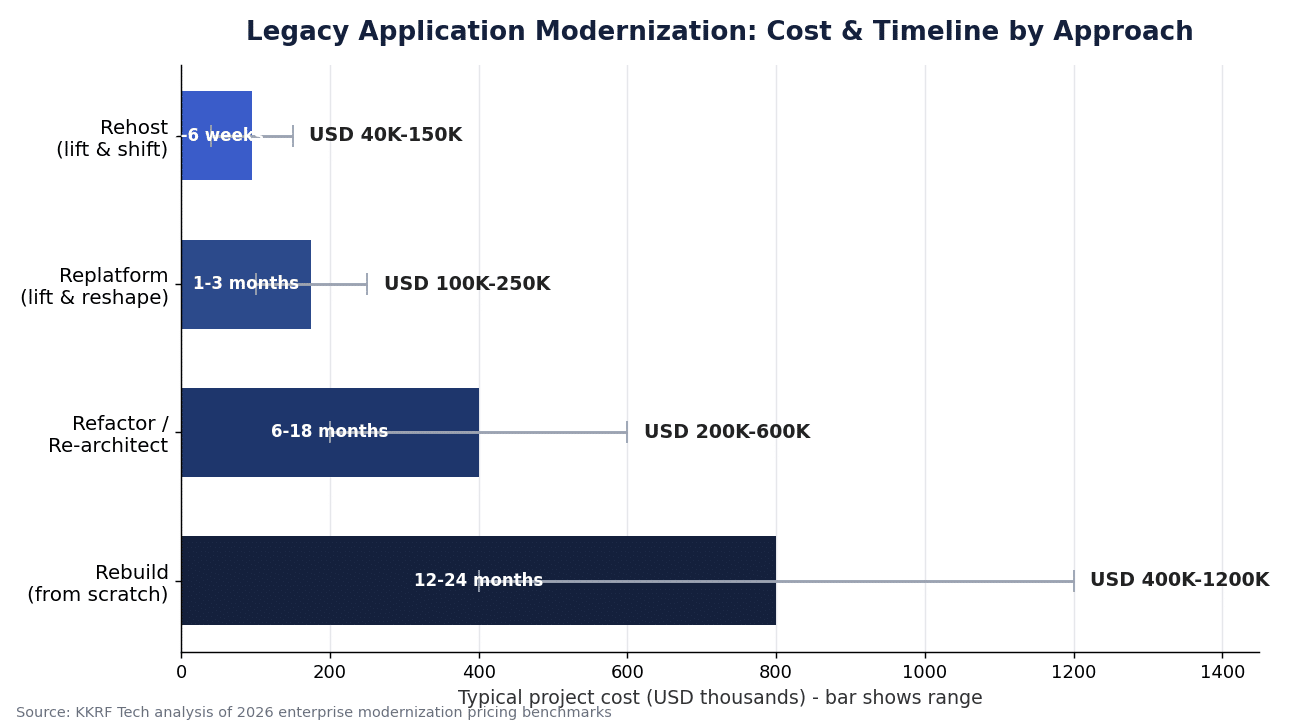
A few numbers worth internalizing: rehosting a single application runs roughly $40K–$150K and finishes in weeks, while a full refactor to microservices costs 5–10x more upfront and takes 6–18 months. Refactoring only pays off when you will run the application for several more years and traffic is high enough that architecture efficiency matters. If your program is primarily a lift to the cloud, our detailed enterprise cloud migration cost guide drills further into those numbers.
Budget for the unglamorous line items, too. Add roughly 20% contingency for surprises found during discovery, 10–15% for testing and validation, and 10% for change management and training. Programs that skip these allowances are the ones that blow past their estimates.
The 6 Rs (and a 7th): Choosing Your Modernization Path
Every application in your portfolio deserves a deliberate decision, not a blanket “move everything to the cloud.” Microsoft and AWS both codify this as the “R” framework, and it remains the clearest way to triage a legacy estate.
- Retain — leave it as-is for now. The app works, isn’t blocking anything, and modernizing it wouldn’t pay off yet.
- Retire — decommission it. Ten to twenty percent of a typical portfolio is redundant or unused.
- Rehost — “lift and shift” to the cloud with no code changes. Fastest and cheapest, but you inherit the app’s inefficiencies.
- Replatform — “lift and reshape.” Minor changes to use managed databases, containers, or serverless. Often the best ROI.
- Repurchase — replace with a SaaS product. Sensible for commodity functions like CRM or payroll; a custom SaaS build makes sense only where it is a differentiator.
- Refactor / re-architect — restructure the code and architecture, typically into microservices. Highest cost, highest long-term payoff.
AWS adds a seventh—Relocate—for moving whole platforms (such as a VMware estate) without changing the apps. In practice, a real modernization program mixes several of these Rs across a single portfolio.
Staring down a modernization program and unsure which applications to rehost, replatform, or rebuild? A short discovery engagement turns that guesswork into a costed, per-application roadmap. KKRF Tech’s software consulting team can scope your legacy estate in a free assessment.
Get a Modernization Assessment →The Technical Process: A Strangler Fig Architecture
For mission-critical systems, a big-bang rewrite is the most reliable way to fail. The proven alternative is the strangler fig pattern—named after the vine that grows around a tree and gradually replaces it.
You wrap the legacy core in an API facade, route traffic through it, and peel off one bounded context at a time—billing, onboarding, pricing, reporting—rebuilding each as a modern service in the cloud. The old system keeps running and generating revenue until the last piece is migrated, at which point you retire it.
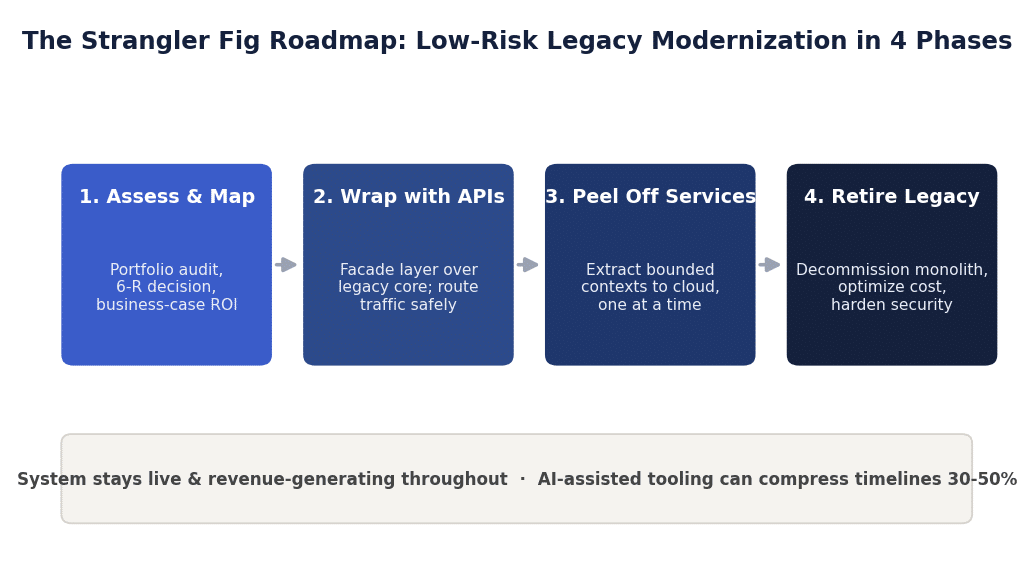
The advantage is control. At any moment you can route a request back to the legacy path, so there is no all-or-nothing cutover. It also lets you sequence the work around business value, tackling the components that unblock revenue or reduce risk first.
A modular monolith is a valid intermediate step. If your team isn’t ready to operate dozens of microservices, break the monolith into clean internal modules first, then extract services only where scale or team autonomy demands it.
Rehost vs. Replatform vs. Refactor: Which Approach Wins?
This is the comparison that decides most budgets. There is no universally “best” option—only the best fit for a given application’s lifespan, traffic, and business importance.
| Approach | Typical cost | Timeline | Best for |
|---|---|---|---|
| Rehost (lift & shift) | $40K–$150K | 2–6 weeks | Aging apps you need off-prem fast, with a short remaining lifespan |
| Replatform (lift & reshape) | $100K–$250K | 1–3 months | Apps that benefit from managed cloud services without a full rewrite |
| Refactor / re-architect | $200K–$600K+ | 6–18 months | High-traffic, long-lived core systems where efficiency compounds |
| Rebuild (from scratch) | $400K–$1.2M+ | 12–24 months | Systems so brittle that fixing them costs more than replacing them |
The honest rule of thumb: replatforming delivers the fastest ROI for the largest share of applications. Full refactoring wins only when you will run the app for four or more years and per-request efficiency genuinely moves your cloud bill.
Security and Compliance Considerations
Modernization is the single best opportunity you will get to close the security gaps legacy systems accumulate—unsupported runtimes, unpatched libraries, hard-coded secrets, and flat network architectures with no segmentation.
Bake security into the migration rather than bolting it on afterward. Retrofit modern identity and access management, encrypt data in transit and at rest, and adopt least-privilege and zero-trust principles as you carve services out of the monolith—the same discipline our cybersecurity consulting team applies on every engagement.
For regulated industries, continuity of audit evidence is non-negotiable. Preserve historical records, transaction logs, and control mappings as you migrate data layers—auditors will ask you to prove the modernized system enforces the same controls as the one it replaced. Anchoring each rebuilt service to a standard like the OWASP Application Security Verification Standard sets a concrete, testable security bar.
The ROI Business Case for Legacy Application Modernization
Modernization has to earn its budget. The good news is that the returns are measurable when the program is scoped around outcomes rather than technology for its own sake.
Typical results for programs that choose the right path: a 25–45% reduction in total cost of ownership within the first year or two, and payback periods of 14–26 months. Much of that comes from retiring redundant infrastructure, cutting licensing on legacy platforms, and eliminating the maintenance tax.
That maintenance tax is larger than most leaders realize. Industry research shows enterprises spend 60–80% of their IT budgets just keeping legacy systems running, and developers lose roughly 42% of their week to maintenance and technical debt instead of building new capabilities. Modernization is what frees that capacity.
There is a strategic return, too. AI initiatives, real-time analytics, and modern customer experiences all depend on clean, accessible, well-architected data and services. A modernized platform isn’t just cheaper to run—it is the prerequisite for everything you want to build next.
Common Legacy Modernization Mistakes
The failures we are called in to rescue tend to repeat the same handful of errors.
- Big-bang rewrites. Trying to replace a critical system in one cutover instead of incrementally with a strangler fig approach.
- No discovery phase. Skipping the portfolio audit and writing code before anyone has mapped dependencies or picked an R for each app.
- Modernizing the wrong things first. Rebuilding low-value apps while the systems actually blocking revenue stay untouched.
- Treating it as purely technical. Ignoring change management, training, and the business owners who understand the legacy logic.
- Under-budgeting testing and data migration. These are where timelines quietly double.
- Lift-and-shift with no optimization. Moving inefficient workloads to the cloud unchanged, then paying up to 40% more than an optimized equivalent.
Future Trends: AI-Assisted Modernization and Beyond
The most consequential shift in 2026 is AI entering the modernization toolchain. AI-assisted code comprehension, test generation, and language translation can compress timelines by 30–50% versus traditional hand-refactoring—especially for reverse-engineering undocumented legacy code that no current employee fully understands.
Expect that leverage to grow, but treat it with discipline. AI accelerates the mechanical work; it does not replace architectural judgment, and unreviewed AI-generated code becomes its own species of technical debt. The teams winning with it pair AI tooling with senior engineers who own the design.
The other durable trend is the move from monoliths toward composable, API-first, cloud-native platforms as the default target state—not because microservices are fashionable, but because that architecture is what lets an enterprise integrate, scale, and adopt whatever comes after AI.
How to Evaluate a Legacy Modernization Partner
The market is crowded with firms that will happily bill you for a migration and disappear before the hard parts. A few signals separate a real modernization partner from a body shop.
- Discovery-first engagement. They insist on a portfolio assessment and a per-application R decision before quoting a build.
- Incremental delivery. They default to strangler-fig, phased releases—not a 12-month black box.
- Domain plus depth. They understand your industry’s compliance reality and can operate cloud-native architecture in production, not just diagram it.
- Knowledge transfer. They leave your team able to run and extend the modernized system, with documentation and handover built in.
- Honest trade-off advice. They will tell you when the right answer is Retain or Repurchase, even though it bills less than a rebuild.
This is exactly why enterprises bring in an experienced custom software development company like KKRF Tech at the assessment stage rather than after a stalled migration—getting the R-decision and the architecture right up front is what keeps a modernization program on budget and out of the rescue queue.
Know the cloud is your target state but worried about downtime during the move? We run strangler-fig migrations that keep your systems live and revenue-generating throughout. See how we approach cloud migration for legacy platforms.
Talk to Our Modernization Team →Frequently Asked Questions
What is legacy application modernization?
Legacy application modernization is the process of updating an aging system’s code, architecture, infrastructure, and data so it meets current performance, security, and scalability needs—without discarding the business logic it encodes. It ranges from a simple cloud rehost to a full re-architecture into microservices.
How much does legacy application modernization cost in 2026?
Most mid-market enterprises invest $500,000 to $3 million for a phased program over 12–24 months. Per application, rehosting runs about $40K–$150K, replatforming $100K–$250K, and a full refactor $200K–$600K or more. Budget an extra ~20% contingency plus testing and change-management costs.
What are the 6 Rs of application modernization?
The 6 Rs are Retain, Retire, Rehost, Replatform, Repurchase, and Refactor—a framework for deciding each application’s fate. AWS adds a seventh, Relocate, for moving entire platforms without changing the applications themselves.
How long does a legacy modernization project take?
It depends on approach. Rehosting a single app takes 2–6 weeks, replatforming 1–3 months, and a full refactor 6–18 months. A phased enterprise portfolio program typically spans 12–24 months, and AI-assisted tooling can compress those timelines by 30–50%.
What is the strangler fig pattern?
The strangler fig pattern modernizes a system incrementally: you wrap the legacy core in an API facade, then replace one component at a time while the old system keeps running. It is the lowest-risk approach for mission-critical apps because you can always route traffic back to the legacy path.
Is legacy application modernization worth the ROI?
For programs scoped around business outcomes, yes. Enterprises commonly see a 25–45% reduction in total cost of ownership and payback within 14–26 months, plus the strategic ability to adopt AI, real-time analytics, and modern integrations that legacy systems cannot support.
Ready to put real numbers against your legacy application modernization program? Tell us about your systems and we’ll come back with a phased plan, a budget range, and the ROI you can expect.
Book a Free Modernization Consultation →