
Mobile app development New York agencies charge a real premium in 2026 — typically 1.5 to 2.5 times what the same scope costs from a national-average provider. For about a third of the projects we scope at KKRF Tech, that premium is genuinely worth it; for the other two-thirds, it isn’t. The difference comes down to three things: compliance complexity, talent density, and how much of the build actually needs New York-specific expertise versus a competent team anywhere in the country.
This guide is the one we wish existed when we started fielding this question from founders, healthcare operators, and finance teams across the five boroughs. It covers real 2026 pricing, the actual development process step by step, the security standards your vendor should already be following, how to measure whether the app pays for itself, and the mistakes we watch companies make over and over when they hire a development partner. By the end, you’ll know exactly what to ask for — and what to refuse to pay for.
KKRF Tech has delivered mobile applications for FinTech, HealthTech, and consumer businesses across New York and Austin, including HIPAA- and PCI-DSS-aligned builds. Everything in this guide reflects pricing and process decisions we make on live client projects, not industry theory.
What This Guide Covers
Who This Guide Is For, and Why New York Is Different
This is written for three kinds of readers: founders scoping a first app before a raise, operations leaders at an established NYC business replacing a legacy system, and product managers who’ve already been quoted a number and want a second opinion before they sign. If you’re in FinTech, HealthTech, PropTech, or professional services and you’re based in or selling into New York, the market dynamics of mobile app development New York apply to you directly.
New York isn’t just an expensive place to build software — it’s a market with its own regulatory layer (NYDFS cybersecurity requirements for financial services, HIPAA for anything touching patient data), its own talent economics, and a user base with unusually low tolerance for slow, clunky, or unpolished apps. Companies that ignore that context end up either overpaying for expertise they didn’t need or underpaying for expertise they should have had.
Mobile App Development New York: What It Really Costs in 2026
Here’s what we’re seeing across simple, mid-complexity, and enterprise builds this year, based on our own client scoping plus aggregated 2026 industry pricing data.
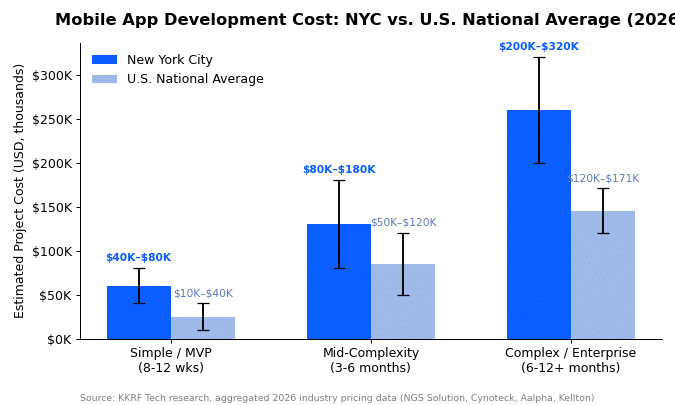
A few things jump out of that chart. First, the gap isn’t uniform — it widens as complexity increases. A simple MVP in New York runs roughly 2x the national floor, but a complex, enterprise-grade build with compliance requirements can run closer to double the national ceiling, not just the average. Second, the “national average” figure hides a lot of variance — a $50,000 app built by a two-person shop in a lower cost-of-living city is not the same deliverable as a $50,000 app built by an agency with a dedicated compliance and QA team.
The headline driver of New York’s premium is labor. A senior mobile engineer in NYC is billing $150–$250 an hour in 2026, a full-stack developer with mobile experience runs $120–$180, and a dedicated mobile UX/UI designer is $100–$160, according to recent industry pricing data. Contrast that with lower-cost-market rates, where the same seniority band can run a fraction of that. Over a 1,000-hour project, that’s the difference between an $18,000 build and a $150,000+ one — and it’s exactly why so many companies shop the quote before shopping the team.
The Development Process: From Idea to App Store
Cost only means something in context of process. Here’s the five-phase delivery timeline we run at KKRF Tech, which lines up closely with how most credible development shops — in New York or anywhere else — structure a build.
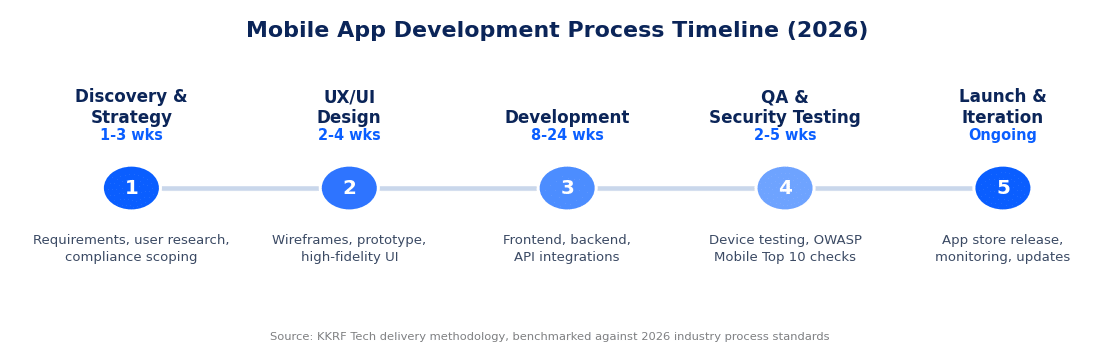
Discovery and strategy is where most budget overruns actually get born — not in development, but here, when requirements are vague and nobody has validated the idea with real users yet. A rushed one-week discovery on a HIPAA-adjacent app is the single most common root cause of the change-order pileups we get called in to fix. Design should produce wireframes, an interactive prototype, and a high-fidelity UI you can actually test with users before a single line of production code is written.
Development is where platform choice, backend architecture, and third-party integrations get built, and is almost always the longest phase — 8 to 24 weeks depending on scope. QA and security testing is the phase most under-budgeted by first-time app owners; a serious build needs both functional device testing and a security pass against the OWASP Mobile Top 10. Launch and iteration doesn’t end at app store approval — it’s the start of a feedback loop that should run for the life of the product.
Native vs. Cross-Platform: Which Should You Choose
This decision affects your budget more than almost anything else in the scoping conversation, and it’s one we see get made for the wrong reasons — usually because a vendor defaults to whatever they staff for, not what the project actually needs.
| Factor | Native (Swift/Kotlin) | Cross-Platform (Flutter/React Native) |
|---|---|---|
| Relative cost | Baseline (build twice) | 30–40% less than two native builds |
| Performance | Best for heavy graphics, AR, camera work | Very close for most business apps |
| Time to market | Slower (two codebases) | Faster (one codebase, two platforms) |
| Best fit | Gaming, AR/VR, device-heavy apps | Most business, FinTech, and HealthTech apps |
For the large majority of business apps we scope in 2026, cross-platform is the default, not the compromise — we go deeper on the specific trade-offs in our Flutter vs. React Native guide. The exceptions are apps doing heavy device-level work like advanced camera processing, AR, or anything latency-sensitive, where native still earns its higher price tag.
Choosing the Right Tech Stack: Backend, Cloud, and Third-Party Integrations
Front-end platform choice gets most of the attention in scoping conversations, but the backend and cloud architecture decisions are what determine whether your app still runs smoothly at 10x the user base — and they’re where a lot of NYC agencies quietly pad hours. For most business apps, a managed cloud backend (AWS, Azure, or Google Cloud with managed databases and serverless functions) beats a fully custom-built server layer on both cost and time-to-market, unless you have a specific reason — extreme scale, unusual data residency rules, or a highly custom compliance posture — to build bespoke infrastructure from day one.
Third-party integrations deserve their own line item in any serious quote. Payment processing (Stripe, Plaid for FinTech apps), identity verification, push notification services, and analytics SDKs each add real integration and testing time — and each one is a potential point of failure that a change in a partner’s API can break months after launch. A development partner that hasn’t budgeted time for keeping these integrations current is quietly setting you up for a maintenance bill you didn’t see coming.
For HealthTech and FinTech builds specifically, we default to backend architectures that separate PII and financial data into isolated, encrypted data stores from the rest of the application logic — not because it’s required by every regulation on day one, but because retrofitting that separation after launch is dramatically more expensive than building it in from the start. This is the kind of decision that never shows up in a sales pitch but shows up immediately in a security audit.
Not sure if your project needs native or cross-platform?
Get a free, no-obligation project estimate from KKRF Tech’s engineering team — we’ll scope your app honestly, including whether a national-average build makes more sense than a New York premium one.
Get a Custom Project EstimateSecurity and Compliance Standards Your Development Partner Must Meet
Security isn’t a line item you add at the end — it’s an architecture decision made in week one. The OWASP Mobile Top 10 is the industry-standard risk taxonomy every credible mobile team should be building against, and in 2026 the highest-frequency failures we see are improper credential storage, insufficient cryptography, and insecure communication between the app and its backend.
- Certificate pinning on all API traffic, not just TLS by default
- Encrypted local storage for anything resembling PII, tokens, or health data
- Root and jailbreak detection on apps handling payments or health records
- Regular source code review against the OWASP MASVS (Mobile Application Security Verification Standard)
- Combined static analysis (SAST) and dynamic analysis (DAST) testing before every major release
If you’re building for FinTech, your vendor needs to understand NYDFS cybersecurity requirements before development starts, not retrofit them after an audit. If you’re building for HealthTech, HIPAA-compliant data handling has to be part of the architecture, not a checkbox. It’s not hypothetical, and it’s not cheap to fix after the fact — we cover a real example of what happens when this gets skipped in the mistakes section below.
How to Measure ROI on Your Mobile App Investment
The standard formula is simple: (Revenue − Cost) / Cost. If an app generates $200,000 in revenue and cost $100,000 to build and maintain, that’s a 100% ROI. The part most companies get wrong isn’t the math — it’s what they count as “cost” and what they count as “revenue,” and it’s worth deciding both before development starts, not after launch.
- Development costs — design, engineering, QA, and initial launch
- Operational costs — hosting, maintenance, OS-version compatibility updates
- Marketing costs — app store optimization, paid acquisition, launch PR
- Revenue streams — direct sales, in-app purchases, subscriptions, ad revenue, and for internal tools, measurable efficiency gains
For internal business apps with no direct revenue line, set milestone metrics instead — active users, task completion time, support ticket reduction — rather than waiting for a financial return that was never the point. Track active users, engagement time, and retention from day one; those are the leading indicators that predict whether the lagging financial ROI will show up at all.
7 Mistakes Businesses Make When Hiring a Mobile App Development Company
- Choosing on price alone. The cheapest quote almost always means the least experienced team, the thinnest QA pass, or scope that quietly shrinks mid-project.
- Skipping discovery to save time. This is the single biggest predictor of change-order overruns we see.
- Not asking for regulatory experience. A team building their first HIPAA or NYDFS app should be priced and scheduled accordingly — not sold as equivalent to a team that’s done it ten times.
- Defaulting to native without a reason. Paying for two native builds when cross-platform would serve the product just as well.
- No plan for what breaks. Every project hits an app store rejection, a third-party API change, or a launch-week traffic spike — vendors without a contingency plan pass that risk straight to you.
- Treating launch as the finish line. Apps that stop getting attention after release lose users within weeks; budget for iteration, not just delivery.
- Not defining ROI metrics up front. Companies that wait until after launch to decide what success looks like almost never agree on whether the project worked.
Post-Launch Support and Maintenance: What to Budget For
Launch is not the finish line, and any quote that treats it as one is underestimating your real cost of ownership. Plan on 15-20% of the original build cost per year for maintenance alone — OS updates from Apple and Google that break existing features, security patches, and the routine bug fixes every production app accumulates. Skipping this budget line is the single fastest way to watch an app that launched well slowly become the one users complain about.
Beyond maintenance, plan for a genuine iteration cycle. The apps that keep growing users past year one are the ones where the team is watching analytics, running small feature experiments, and responding to app store reviews — not the ones that shipped once and moved on. If your development partner doesn’t ask about post-launch support in the sales conversation, ask them directly what happens the week after your app goes live, and get the answer in writing before you sign.
A good rule of thumb: budget your first year of post-launch support as its own line item, separate from the build cost, and treat the vendor’s answer to “what does month two look like” as seriously as you treat their answer on the initial timeline.
Where the Market Is Headed: Predictions Beyond 2026
AI is no longer a differentiator — recent mobile app s
tatistics put AI feature adoption at 63–70% of new apps, meaning the question has shifted from “should we add AI” to “how well does ours work compared to the app the user closed five minutes ago.” Low-code platforms are projected by Gartner to account for roughly 75% of new application development by 2026, up from about 40% five years earlier — which is compressing pricing hard at the simple-app tier and pushing custom development budgets toward genuinely complex, differentiated builds. Android still holds the larger global platform share at roughly 72.55% versus iOS’s 27.04%, though New York’s affluent, iPhone-heavy user base remains a notable regional exception worth factoring into your platform-priority decision.
How to Choose the Right NYC Mobile App Development Partner
Once you’ve got mobile app development New York quotes in hand, here’s how to actually compare them — before you look at the total number at all:
- Does the quote separate design, engineering, QA, and post-launch support, or is it one lump number? Lump-sum quotes tend to hide where corners will get cut.
- Has the team shipped something in your regulatory category before, or would this be their first HIPAA/PCI/NYDFS build?
- What’s the plan for the thing that always breaks — API changes, app store rejections, launch-week traffic spikes?
- Is the architecture cross-platform by default, or are you being upsold into two native builds you don’t need?
- Can they show you a real client reference in your industry, not just a portfolio screenshot?
If your project is a straightforward consumer or internal tool with no regulatory surface area and no expectation of a traffic spike, you likely don’t need to pay New York premium rates — our Mobile App Development Services page covers what that build looks like at a national-average scope. If you need NYC-specific expertise, start with our Mobile App Development Company in New York service page. And if you’re not sure which category you fall into, that’s exactly the conversation to have before signing anything.
Ready to see what your app actually costs — with no sales pressure?
Book a free strategy call with KKRF Tech’s engineering team. We’ll walk through your requirements, flag the regulatory and security work you’ll actually need, and give you an honest cost and timeline — not a padded quote.
Schedule a Strategy CallFrequently Asked Questions
Is it actually worth paying New York prices for app development?
It depends entirely on your regulatory exposure and growth trajectory. If you’re building in FinTech, HealthTech, or another compliance-heavy vertical, or expecting a launch that could spike traffic fast, the NYC premium buys real risk reduction. If you’re building a straightforward consumer or internal tool with no compliance surface, a national-average team can often deliver the same functional result for meaningfully less. In short: mobile app development New York pricing reflects real risk reduction, not just location prestige.
What does a mobile app actually cost to build in New York in 2026?
Based on current market data, a simple MVP runs roughly $40,000–$80,000, a mid-complexity app with several integrations runs $80,000–$180,000, and a complex or enterprise build with compliance requirements starts around $200,000 and can run past $320,000. See our dedicated NYC cost guide for the full breakdown.
How long does it take to build a mobile app?
Most projects take 4 to 9 months from discovery to launch. A simple MVP can ship in 10–14 weeks; a medium-complexity app with 5–10 features across iOS and Android typically takes 4–6 months; feature-rich, enterprise-grade apps with multiple integrations and compliance requirements often need 6–12 months.
Should a startup outside New York bother hiring a New York app development company?
Sometimes — specifically when the value is the compliance and scale expertise, not the location. If neither applies to your project, the premium rates are usually better spent on a nationally-priced team with a strong portfolio in your specific app category.
Is cross-platform development (Flutter/React Native) good enough for a serious business app?
For the large majority of business apps, yes. The 30–40% cost savings versus separate native builds is hard to ignore, and the performance gap has narrowed enough that it’s rarely a meaningful trade-off — the exceptions are apps doing heavy device-level work like advanced camera processing or AR, where native still has an edge.
How do I know if my app idea is worth building?
Validate before you build: talk to 15–20 potential users, check whether they’d pay (or use it enough to justify internal cost), and scope a narrow MVP that tests the riskiest assumption first. A discovery phase with a credible development partner should surface this before a single line of production code is written — if a vendor skips straight to a build quote without asking these questions, that’s a warning sign.
Start Your Project Today
KKRF Tech has helped New York and national businesses scope, build, and launch mobile apps that survive real audits and real launch spikes. Tell us what you’re building — we’ll tell you straight what it needs.
Talk to Our Experts